 Sector Insights
Listen to this Recap
10:42
Storage, AI and Supply Chains Drive a Mixed Market — Utilities, Materials and Tech Outperform as Rate and Policy Headwinds Pressure Real Estate and Industrials
Podcast • Loading audio...
Share this article
Spread the word on social media
Key Takeaways
- •Storage and grid upgrades are lifting utilities, energy and materials in a correlated move (e.g., 400 MW / 1,600 MWh battery online; HVDC link supplying ~20% of NYC power).
- •Mortgage rates near 6.8% and credit‑flow models are pressuring real estate and mortgage‑sensitive financials.
- •AI funding and Prime Day demand support pockets of tech, but security and safety incidents add headline risk.
- •China trade curbs and regulatory enforcement are re‑shaping industrial and healthcare risk profiles; policy calendars matter.
- •Crypto shows stabilization cues (BTC large‑holder selling at 19‑month lows) but remains sensitive to upcoming policy hearings.
Executive summary
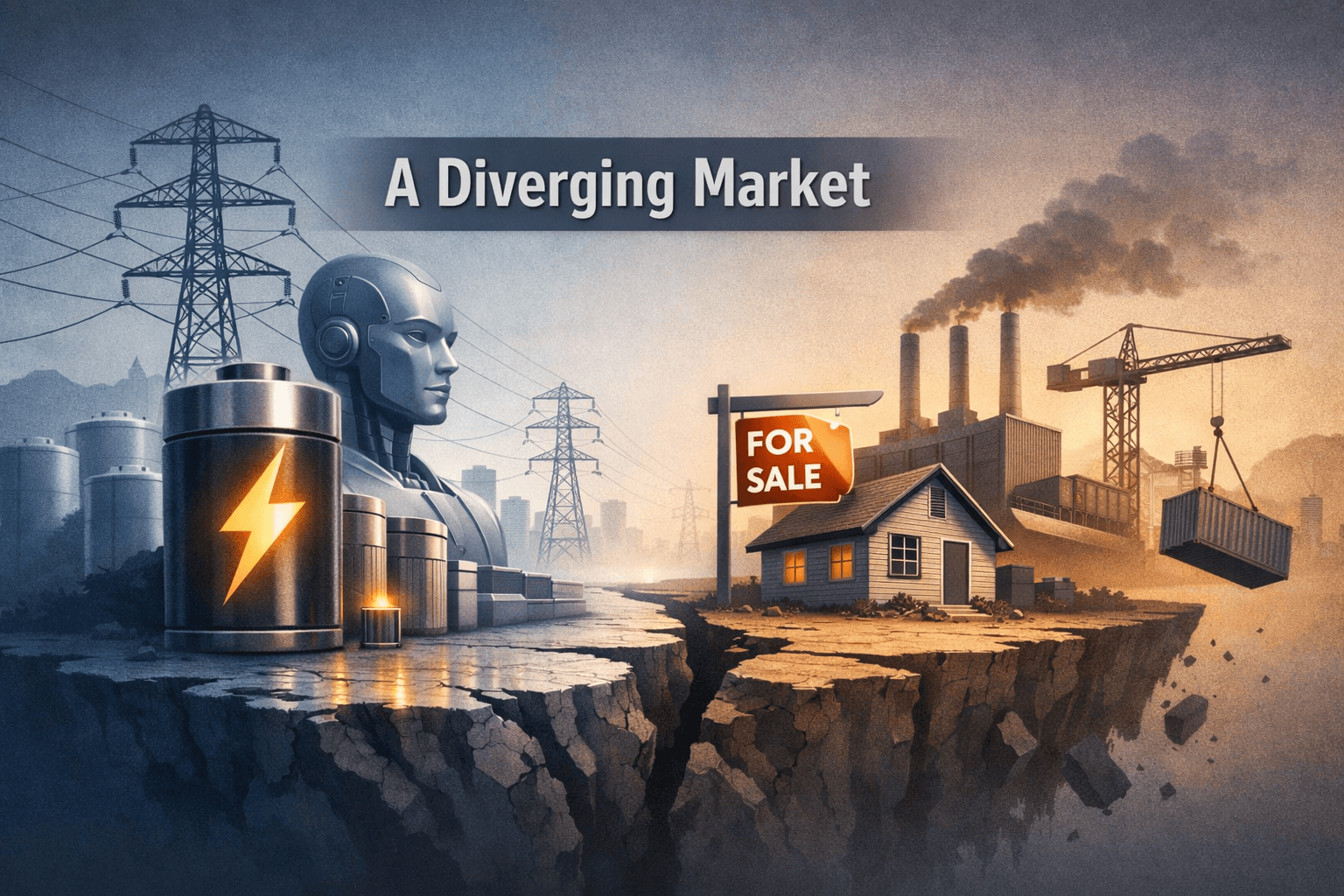
Today’s market tape read like a sector map of structural transition: winners clustered where capital, policy and technology intersect, and laggards reflected exposure to interest‑rate sensitivity and geopolitical frictions. Utilities and energy storage grabbed headlines with a set of large projects and product rollouts — a 400 MW/1,600 MWh battery project coming online and record first‑quarter storage installs cited by analysts — while a new high‑voltage DC link is now supplying roughly 20% of New York City’s power needs. Materials rallied around a Western rare‑earth consolidation move (Energy Fuels’ tie‑up with Germany’s Vacuumschmelze) and fresh anode and low‑carbon steel plans. Tech found an upside thread — Menlo’s $3 billion AI fund, heavy Prime Day sales and ecommerce automation initiatives — even as security incidents and an auto safety headline introduced caution.
Conversely, real estate and certain industrials were on the defensive. Mortgage rates pushed toward 6.8%, amplifying refinancing and acquisition cost pressure and feeding models that show lenders and mortgage credit flow changing course. Manufacturing and defense‑supply momentum was checked after China announced trade curbs on 56 U.S. defense and aerospace firms; that dovetailed with labor and tariff headwinds flagged in apparel and export‑sensitive supply chains. Healthcare and communications produced mixed signals: clinical and AI advances competed with enforcement and content‑demand dynamics, while a $3.6 billion C‑band bill for SES and smartphone shipment softness tempered media fortunes.
Taken together, the tape suggests market participants are differentiating on three axes today: (1) exposure to energy transition and electrification (storage, rare earths, grid links), (2) sensitivity to rates and credit costs (real estate, mortgage finance), and (3) short‑term demand elasticity tied to retail and advertising cycles (communications, consumer). Bitcoin and parts of crypto showed green shoots — BTC selling by holders is at a 19‑month low and regulators set a CLARITY Act hearing for July 17 — but the sector remains driven by policy cadence.
Investment disclaimer: This article provides market analysis and data for informational purposes only. It is not personal investment advice and does not recommend buying, selling or holding any security.
Sector groupings: outperformers, underperformers, stable
Below we group the 24 sector briefs received today into three performance buckets, based on the market implications in each summary:
Outperformers (momentum and positive structural drivers)
- Utilities — Storage boom, community microgrids and a new HVDC link delivering ~20% of NYC power were the day’s big utilities stories. Analysts highlight policy clarity and corporate demand as tailwinds.
- Materials — Rare‑earth industrial consolidation (Energy Fuels’ deal with Vacuumschmelze), low‑carbon steel plans, graphite anode projects and recycling advances gave materials a directional lift.
- Technology — Large new AI funding (Menlo’s $3B AI fund), ecommerce strength tied to Prime Day, and corporate AI payrolls/initiatives provided positive catalysts despite security and safety headwinds.
- Energy — Production increases from Alaska and Angola, elevated tanker rates amid Persian Gulf flows and record European power prices signaled near‑term strength in commodity and infrastructure–linked names.
Underperformers (rate or policy pressure, or regulatory headwinds)
- Real estate — Mortgage rates near 6.8% and modeling that points to credit reflows away from some guaranteed pools created immediate financing and valuation pressure for parts of the real‑estate complex.
- Industrials — China’s trade curbs on U.S. defense and aerospace suppliers, tougher tariff rules and apparel labor pressures tightened the industrial snapshot.
- Communications & Media — A mixed content environment (Netflix and branded experiences offset by phone shipment softness) and a $3.6 billion C‑band bill for SES created a choppy day for the sector.
- Healthcare — Innovation headlines (AI diagnostic advances, new disease subtypes) were offset by enforcement risk and a Pfizer clinical setback; policy and DOJ activity add uncertainty.
Stable / Mixed (idiosyncratic catalysts but muted net directional bias)
- Crypto — A mixed day: on‑chain signals (BTC holder selling at 19‑month low) and market structure gains (Ripple preliminary EU licensing, Congress scheduling a CLARITY Act hearing) offset residual volatility.
- Consumer & Retail — Automation, AI and promotional activity (Nestlé’s $330M automated hub; DoorDash’s conversational shopping assistant) are longer‑term positives, but short‑term promotional intensity and consumer stress indicators keep the read cautious.
- Finance — Volatility featured, but select regional banks and fintech winners emerged. Municipal fund commentary and AI positioning (AMD analysis) framed a nuanced day rather than a wholesale directional move.
- Cannabis — Regulation and policy dominated headlines — livestreaming of a DEA hearing, state record sealing, and uplist filings — producing event‑driven moves without a clear broader market direction.
Note: These buckets are derived from thematic read‑throughs of the sector briefs rather than intraday price prints. They reflect relative momentum and catalyst alignment, not specific percentage changes.
Cross‑sector themes and correlations to watch
- Electrification and storage that cut across utilities, materials and energy
A consistent thread was the linkage between new storage deployments and demand for materials and services. The 400 MW / 1,600 MWh facility and record Q1 storage installs cited by utilities analysts directly lift demand prospects for battery‑grade materials, grid‑scale inverters and installation services. Materials headlines — rare‑earth deals and graphite/anode planning — are part of that same stack. In short, storage and grid projects are simultaneous demand drivers for utilities, energy and materials companies, increasing correlation among those sectors.
- Policy and geopolitics are re‑rating supply chains
China’s trade curbs on defense and aerospace firms, U.S. moves to block a Fed CBDC through 2030, and shifts in cannabis regulation all underscore that policy risk is actively reshaping capital allocation. Industrial supply chains with China exposure and materials firms seeking Western supply‑chain sovereignty (rare earths) are moving in opposite directions: reshoring and strategic minerals deals support materials, while trade restrictions pressure industrials.
- Interest rates remain a punctuating factor for credit‑sensitive sectors
Mortgage rates near 6.8% are not an isolated statistic; they feed through to transaction volumes, cap rates, mortgage REIT spreads and lender loan‑loss assumptions. The real‑estate summaries showing institutional deal activity alongside rising rates underscore the bifurcation: big investors with capital are still active, but costlier financing is changing buyer mixes and pushing credit to different pools.
- AI and automation create intra‑sector winners and losers
AI flows into tech, consumer retail and finance show up as selective positives: Menlo’s $3B AI fund, conversational shopping rollouts by DoorDash and bank AI commentary (AMD analysis) are structural positives. But AI also raises regulatory, security and labor questions that manifest in a more nuanced pricing of risk — the Klue breach and a fatal Tesla crash illustrate how AI or software adoption can accompany headline risk.
- Energy flows and maritime/shipping dynamics connect energy producers and logistics plays
Exploding tanker rates amid Hormuz flows, rising LNG and offshore supply cues, plus record European power prices, show how geopolitical friction and physical logistics are impacting commodity and transport costs. Energy producers that can ramp or shift flows (Alaska, Angola) benefit, while insurers, shippers and equipment suppliers see correlated volatility.
Significant moves and context
Utilities / Storage: 400 MW / 1,600 MWh project online — This is material for the utilities complex. A facility of that scale meaningfully increases regional capacity to absorb variable renewables and provides ancillary services revenue potential (frequency response, capacity markets). Analysts point to policy clarity and corporate offtake commitments as critical to realizing the mine of long‑duration storage contracts expected in 2026–28.
Grid infrastructure: HVDC link delivering ~20% of NYC power — High‑voltage DC links change the economics of urban power supply, enabling distant renewable injection and reducing congestion. For municipal utilities and grid operators, this reduces day‑ahead price spikes and supports reliability; for developers, it increases arbitrage opportunities between generation hubs and load centers.
Materials: Energy Fuels — Vacuumschmelze tie‑up — The cooperation between a U.S. rare‑earth producer (Energy Fuels, ticker UUUU) and a European magnet maker helps close a technology and processing gap that has hindered Western rare‑earth supply chains. Given concerns about concentrated processing capacity in East Asia, this will be read as de‑risking for defense and EV supply chains.
Technology: Menlo $3B AI fund, Prime Day strength — Menlo’s large AI fund and Amazon‑led consumer demand pulses (Prime Day reported strength across categories) show capital and demand pulling in parallel. For public tech names, the implication is durable enterprise and consumption budgets for AI services; for smaller vendors it means a larger addressable market but also a fast‑consolidating vendor landscape.
Finance / Credit: Mortgage rates ~6.8% and modelled shifts in mortgage credit — The climb in mortgage rates is a blunt instrument: it increases monthly servicing costs and reduces buying power, while driving spreads and LLPAs higher. Modelers warning that credit could migrate away from some guaranteed pools suggest potential margin pressure for mortgage originators and refinancers, and valuation implications for mortgage REITs and certain bank balance sheets.
Industrials / Trade: China curbs on 56 U.S. defense and aerospace firms — This is a direct trade‑policy shock for firms with China sales or inputs. Stocks with significant defense export exposure or China‑based OEM dependencies face both demand erosion and supplier‑chain complexity. Longer term, it strengthens the case for allies to accelerate domestic or trusted supply alternatives.
Crypto: BTC holder selling at a 19‑month low; CLARITY Act hearing July 17 — On‑chain and policy signals are simultaneously constructive and cautionary. Lower net selling among large BTC holders has historically correlated with price bottoms; at the same time, a macro policy framework (the CLARITY Act hearing) sets a timetable for market structure adjustments that will materially affect institutional participation.
Healthcare: AI diagnostic wins vs. Pfizer clinical setback and DOJ enforcement — The sector remains bifurcated: clinical innovation and new IPOs (a $400M IPO cited) provide headline upside, but regulatory and legal risk (DOJ fraud enforcement) and trial failures (Pfizer) create headline volatility that can swamp underlying fundamentals in the near term.
Actionable insights for investors (informational, non‑personalized)
Tilt research and due diligence toward policy‑exposed names: Where headlines cited policy shifts (rare earths, CBDC, trade curbs, cannabis regulation), valuation and long‑term cash‑flow assumptions are most likely to change. Data suggests re‑pricing can be rapid once policy clarity arrives, so tracking legislative timetables (e.g., the July 17 CLARITY Act hearing) and licensing milestones (Ripple’s preliminary EU licensing) matters.
Stress‑test rate sensitivity in real‑estate and mortgage‑credit models: With mortgage rates near ~6.8%, investable pools that assume low funding costs or stable refinancing cycles should be re‑examined. Models that incorporate higher cap‑rates, longer sales windows and increased LLPAs will produce materially different valuations for REITs and mortgage originators.
Follow the storage‑materials supply chain as a combined theme: The simultaneous rise in storage project rollouts and materials deals (anode plans, rare‑earth partnerships) increases the correlation across utilities, materials and certain energy names. For portfolios seeking exposure to electrification, consider the entire value chain — from raw materials to system integrators — when assessing cyclical risk and policy timing.
Prepare for cluster risk in industrials exposed to China: The trade curbs on defense and aerospace illustrate how sector‑specific geopolitics can create cluster risk. Investors with exposure to multi‑national supply chains should assess alternative sourcing timelines and the potential near‑term hit to backlog and revenue recognition.
Monitor corporate AI adoption and security events for second‑order effects: Tech’s AI fund flows and Prime Day demand are positives, but incidents like the Klue breach and the Tesla safety headline show that security and governance issues can produce outsized short‑term volatility. For equity owners, tracking governance disclosures and security budgets will help differentiate long‑term winners.
Use event calendars to bracket headline risk: Several events carry outsized informational content in the coming weeks — the CLARITY Act hearing (July 17), any regulatory decisions on DEA rescheduling hearings, and municipal/macro data that influence rate expectations. Calendars matter for positioning around sectors sensitive to those outcomes (crypto, cannabis, real estate, healthcare).
Notable tickers and data points cited today
- Energy Fuels (UUUU): Western rare‑earth deal noted as a structural development for the sector.
- Netflix (NFLX): Content momentum continued to be a driver in media headlines.
- Tesla (TSLA): A fatal crash added to safety and regulatory headlines affecting the broader auto/tech conversation.
- DoorDash (DASH): Rolled out a conversational shopping assistant, an example of AI in retail.
- Pfizer (PFE): Clinical setback discussed in healthcare briefs.
- AMD (AMD): Mentioned in finance sector analysis of AI positioning.
- SES: A $3.6 billion C‑band bill for SES was highlighted in communications coverage.
- Bitcoin (BTC): Holder selling hit a 19‑month low; crypto policy hearings scheduled.
- Other data points: 400 MW / 1,600 MWh battery project online; 1 GWh iron‑air storage deal in Europe; Nestlé $330M automated hub; Menlo $3B AI fund; mortgage rates near 6.8%.
(These tickers and figures are referenced where they appeared in sector briefs and in public headlines today; they are presented for informational context.)
Risks and caveats
Headlines can create short‑term dispersion: Many of today’s sector moves are event‑driven. That means day‑to‑day returns may not reflect durable changes in fundamentals. For example, uplist filings (Glass House), festival content boosts (media) or single project commissionings (a battery facility) can produce outsized short‑term reaction without immediate earnings impact.
Policy is a double‑edged sword: While many stories highlight policy enabling investment (rare‑earth financing, storage incentives), other moves (trade curbs, DOJ enforcement, CBDC prohibition) introduce asymmetric risks. Investors should monitor the policy pipeline and not treat regulatory changes as one‑off events.
Correlation can rise quickly within thematic stacks: Electrification and AI themes tie together multiple sectors; when sentiment turns positive, correlations increase — which can both help and hurt diversified portfolios.
Forward‑looking perspective
Over the next several weeks, market direction will likely hinge on a narrow set of catalysts rather than broad macro surprises. Watch for: (1) policy and legislative timetables — CLARITY Act hearings, DEA rescheduling developments and trade‑policy announcements — which can abruptly change sector outlooks; (2) additional storage project announcements and battery supply contracts that confirm a multi‑year roll‑out and lift vendor order books; (3) real‑estate and mortgage data that either eases or cements rate‑sensitive pressure on transaction volumes; and (4) earnings and guidance from tech incumbents that will reveal whether AI investment is translating into durable revenue growth.
Today’s tape suggests we are in a market that continues to reward structural winners — those tied to electrification, reshoring of critical minerals and AI adoption — while penalizing entities with high rate sensitivity or China‑centric supply chains. That does not mean broad sector rotation is complete; rather, it implies investors should be selective, focus on catalysts and monitor policy developments closely.
Sentiment rating: neutral — The mix of durable structural positives (storage, rare earths, AI funding) and near‑term headwinds (rates, trade curbs, enforcement) produces a balanced risk/reward environment. Momentum exists in pockets, but macro and policy shocks could reassert volatility.
Key takeaways
- Storage and grid projects are creating correlated upside across utilities, energy and materials — the 400 MW / 1,600 MWh project and HVDC link are emblematic of that nexus.
- Rising mortgage rates (~6.8%) and credit modeling shifts are pressuring real‑estate and mortgage‑sensitive sectors, prompting reassessment of valuations and credit risk.
- Tech retains pockets of strength (AI investment, Prime Day demand) but security incidents and product risks can quickly temper sentiment.
- Geopolitical and regulatory headlines (China trade curbs, DOJ enforcement, cannabis policy) continue to create idiosyncratic risk; tracking policy calendars is essential.
- Crypto shows tentative signs of stabilization (BTC large‑holder selling at 19‑month lows) but remains highly policy‑dependent with scheduled hearings in July.
Investment disclaimer (repeat): This article is for informational purposes only. It does not constitute personalized investment advice or a recommendation to buy, sell, or hold any security.
Top and bottom sectors (market read‑through)
Top sectors: Utilities, Materials, Technology
Bottom sectors: Real Estate, Industrials, Communications
— End —
Sources
+ 14 more sources
Use these insights — enter this week's contest.
Free practice contests — earn Alpha CoinsExplore More Content
Disclaimer: StockAlpha.ai content is for informational and educational purposes only. It is not personalized investment advice. Sentiment ratings and market analysis reflect data-driven observations, not buy, sell, or hold recommendations. Always consult a qualified financial advisor before making investment decisions. Past performance does not guarantee future results.