 Sector Insights
Listen to this Recap
11:51
AI & Energy Drive Today's Market Mosaic — Bitcoin, Oil and WWDC Lead Cross‑Sector Moves
Podcast • Loading audio...
Share this article
Spread the word on social media
Key Takeaways
- •AI and infrastructure spending (Apple WWDC, Amazon‑Corning, LG Uplus $3.26B) are re‑accelerating demand across tech, cloud and comms hardware.
- •Geopolitical strikes between Israel and Iran lifted oil roughly 5%, reintroducing short‑term supply risk into energy and transport costs.
- •Bitcoin held near $63,000 despite approximately $1.7B in spot‑ETF outflows — market structure and derivatives product launches are changing crypto liquidity dynamics.
- •Renewables and critical minerals saw meaningful project and funding headlines (TOYO $357M HJT plant; ABTC $115M DOE grant), but execution and permitting remain binary risks.
- •Real estate and utilities face policy and affordability headwinds, while finance is balancing deal‑flow uncertainty and regulatory noise.
Executive summary
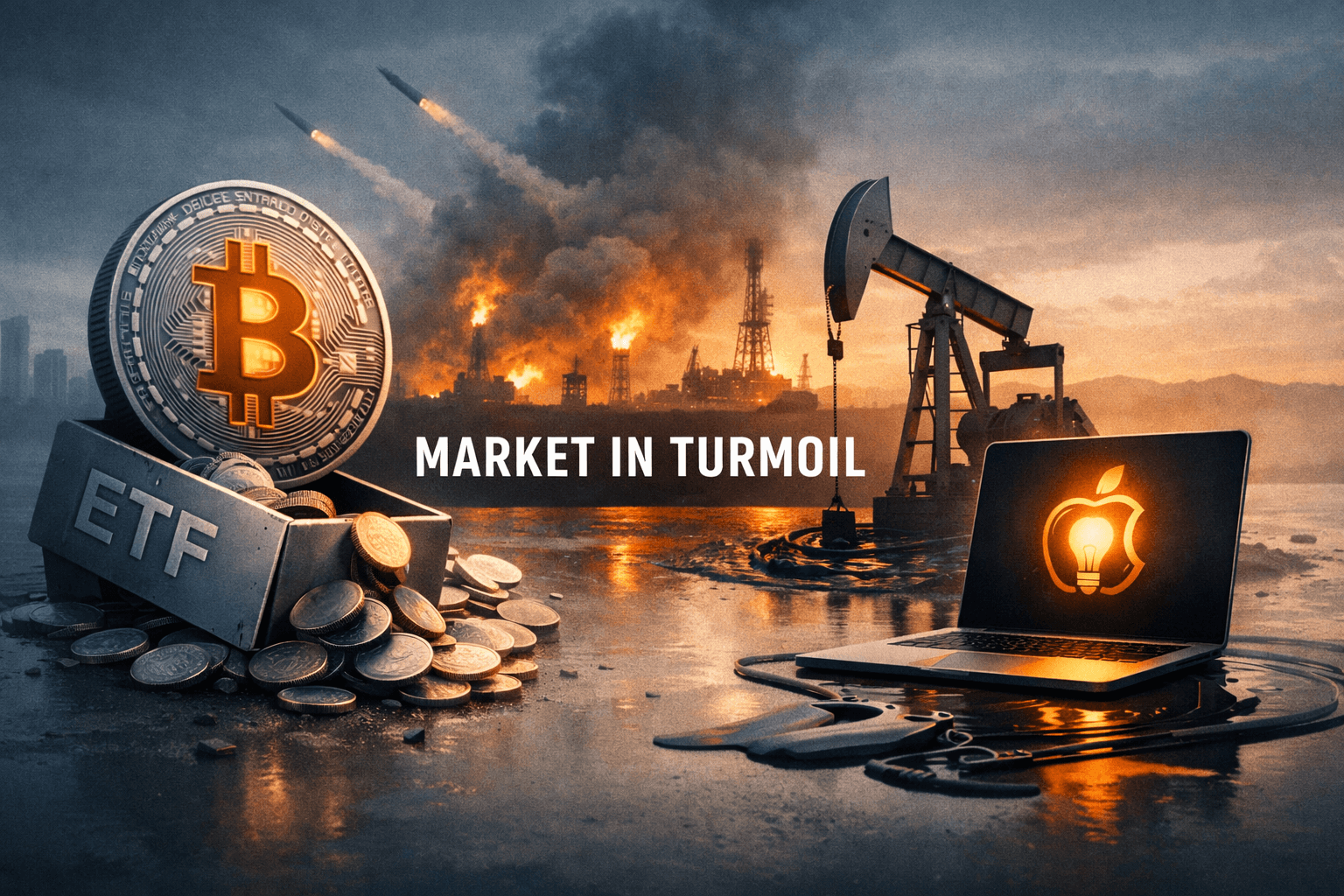
Markets opened and closed on a patchwork of sector‑specific catalysts on June 8. Technology headlines out of Apple’s WWDC and semiconductor supply‑chain news reinforced AI and device upgrade narratives, while large corporate deals in communications underscored continued digital infrastructure investment. Energy markets were driven by geopolitics — overnight strikes between Israel and Iran sent oil up about 5% — even as renewables and storage projects continued to advance. Cryptocurrency showed resilience: Bitcoin traded near $63,000 despite spot‑ETF flows of roughly $1.7 billion out of the category in the latest week.
Across sectors, the common threads were (1) a drift toward AI and infrastructure spending, (2) supply‑shock sensitivities in energy and commodities, and (3) an ongoing regulatory and policy overlay — from state cannabis bills to UK tech rules — that is compressing short‑term certainty. The net market posture is mixed: pockets of momentum coexist with meaningful event and policy risks, leaving investors to weigh selective opportunities against heightened volatility.
Grouping by performance: outperformers, underperformers, stable
Note: sector summaries provided were not accompanied by uniform intraday performance data. The groupings below reflect the balance of headlines, deal flow and momentum on June 8 rather than absolute index returns.
Outperformers
- Technology — Apple’s WWDC announcements (Siri AI, new Foundation Models, Core AI frameworks) and continuing compute‑infrastructure demand (Nvidia‑led interest, device refresh narratives) tilted the sector positive. Hardware and cloud stacks remain central to AI investment themes.
- Energy — Geopolitical strikes raised near‑term oil risk, lifting crude roughly 5% and increasing focus on jet‑fuel and LNG supply tightness. Simultaneous investment in renewables (notably a new HJT solar plant in Houston) broadened market interest across the energy complex.
- Cryptocurrency — Bitcoin’s price resilience near $63,000 and institutional activity (research notes, strategic reserve proposals) lent the crypto complex momentum despite significant ETF outflows.
Underperformers / More challenged sectors
- Real estate — Structural demand issues persisted: first‑time buyers remain constrained while more complex products (reverse mortgages marketed to affluent retirees) raised affordability and demographic questions. Leasing wins were offset by stalled inventory in core markets.
- Utilities — Mixed operational news (solar, EV charging wins) competed with persistent regulatory and wildfire risks. Capacity planning pressures and state‑level policy shifts kept the sector rangebound and cautionary for investors.
- Finance — A mixed signal day: deal uncertainty, regulatory guidance changes and uneven macro commentary kept financials under a cloud of uncertainty. Headlines out of Europe (deal drama in Italy) and banks’ shifting guidance added to the noise.
Stable / Mixed sectors
- Communications & Media, Consumer & Retail, Materials & Mining, Healthcare, Industrial, Cannabis — each saw meaningful company or policy headlines (large fiber and data‑center deals, AI in retail, lithium and copper drill results, biotech trial updates, industrial AI productivity initiatives, state cannabis policy moves) but no single unifying directional push across the whole sector.
Cross‑sector themes and correlations
AI as a multi‑sector demand engine: Apple’s WWDC and related device‑and‑software disclosures reinvigorated AI spending narratives that feed into semiconductors, cloud services, communications infrastructure and even industrial automation. Corning/AMZN fiber deals and LG Uplus’s $3.26 billion AI data‑center plans show AI investment cascading across infrastructure layers.
Geopolitics-driven commodity correlation: The Israel‑Iran strikes propagated directly into energy (oil up ~5%) and indirectly into related commodity and transport sectors (jet fuel risk, coal repricing, and worries about supply chains). Energy moves are spilling into broader inflation expectations for materials and transportation companies.
Crypto–traditional finance decoupling: Bitcoin trading near $63k alongside $1.7B in spot‑ETF outflows highlights a bifurcation: price action is increasingly driven by on‑chain flows, OTC accumulation and custodial activity rather than simple ETF demand. New CME volatility products and institutional commentary are reshaping how crypto correlates with risk assets.
Policy as price driver: State‑level cannabis and hemp rulemaking, UK tech regulatory movements and U.S. DOE grants for critical minerals (ABTC and a reclaimed $115 million award) underscore the growing impact of policy calendars on share prices in niche but high‑growth segments.
Renewables and traditional energy interplay: While renewables projects and battery/storage developments continue to attract capital (TOYO’s $357 million HJT plant in Houston), near‑term supply risks in oil and gas are re‑emphasizing the energy transition’s two‑speed reality.
The most significant moves — what happened and why it matters
Below are the day’s largest, cross‑sector moves with context and implications.
- Oil and broader energy: ~5% intraday oil jump after Israel‑Iran strikes
- What happened: Overnight strikes between Israel and Iran triggered a near‑term supply‑risk repricing that pushed crude about 5% higher. Markets immediately flagged jet‑fuel and regional logistics as tightness drivers.
- Why it matters: The move reintroduces the classic geopolitical risk premium into a market already watching demand variables (summer travel season) and incremental LNG/LNG supply shifts. Higher oil can rapidly compress margins for energy‑intensive sectors (airlines, heavy manufacturing) and complicate central‑bank inflation monitoring.
- Bitcoin resilience despite ETF outflows
- What happened: Bitcoin held near $63,000 even as spot Bitcoin ETFs saw roughly $1.7 billion in weekly outflows. Institutional momentum stories — including proposals for a Strategic Bitcoin Reserve and new CME volatility products — supported price stability.
- Why it matters: The divergence between ETF flows and price strength suggests a more fragmented market structure: on‑chain accumulation, OTC investors and private strategic reserve proposals are increasingly important. Risk managers should monitor liquidity metrics and new derivatives product adoption, which could change volatility patterns.
- Apple WWDC and the AI hardware/software nexus
- What happened: Apple’s WWDC announcements — expanded Siri AI across devices, new Foundation Models and Core AI frameworks — sparked renewed optimism about device refresh cycles and developer monetization.
- Why it matters: WWDC is often the catalyst for hardware refresh outlooks and developer monetization outlooks. Apple’s push reinforces demand for semiconductors (NVDA, AMD), cloud services and app‑monetization channels. It also sharpens geopolitically driven vendor considerations (Pentagon’s Chinese‑firm list) for supply‑chain and procurement risk.
- Communications infrastructure deals: Amazon + Corning, LG Uplus $3.26B data‑center plans
- What happened: Amazon and Corning inked a multi‑billion fiber deal, and LG Uplus targeted about $3.26 billion for AI data‑center buildout. Those are large, multi‑year commitments to connectivity and compute.
- Why it matters: Large fiber and data‑center commitments signal that capex cycles for digital infrastructure are still very much alive and potentially back‑loaded into the next few years as AI workloads scale. That benefits network equipment, fiber producers and data‑center REITs, while pressuring legacy content monetization models where incumbents cannot monetize infrastructure ownership.
- Renewables and critical minerals: TOYO HJT plant, ABTC DOE grant, copper/lithium drill results
- What happened: TOYO announced a $357 million HJT (heterojunction) solar plant in Houston; ABTC reclaimed a $115 million DOE grant for a Tonopah lithium refinery; miners reported high‑grade copper hits and Orla Mining restarted operations at Camino Rojo.
- Why it matters: Funding and project execution in lithium and next‑gen solar point to the continued industrialization of the energy transition. DOE grants and public capital can de‑risk early‑stage projects, but execution and permitting remain binary risks for valuations. Commodities news also ties back to energy security concerns highlighted by the oil move.
- M&A and corporate finance: Ingredion $3.6B buyout and deal drama in finance
- What happened: Ingredion’s announced buyout (~$3.6 billion) is among the larger consumer‑sector transactions; separate headlines around deal uncertainty in Italy and mixed bank guidance complicated financial market tone.
- Why it matters: M&A continues to be selective and strategic, often reflecting consolidation in slower growth consumer categories. Financial sector headlines remind markets that deal execution and regulatory scrutiny remain potential flashpoints for bank earnings and credit spreads.
- Real‑estate bifurcation: leasing wins vs. affordability stress
- What happened: Leasing wins in NYC and a $138 million Midtown recapitalization were offset by ongoing weakness in first‑time buyer demand and the growing marketing of reverse mortgages to affluent retirees.
- Why it matters: The sector shows bifurcated fundamentals: core commercial assets with high occupancy can outperform while widespread housing affordability pressures keep the residential market fragile. Demographic and rate dynamics will continue to determine regional outcomes.
Actionable insights for investors (for informational purposes only)
Focus on catalysts, not headlines: With tech and energy themes driven by specific catalysts (WWDC, data‑center spending, geopolitical events), identify the near‑term news calendar that will move sectors — product launches, infrastructure contracts, OPEC+ statements, and macro data releases.
Monitor liquidity and derivatives flows in crypto: Bitcoin’s price holding near $63k despite $1.7B ETF outflows suggests liquidity is migrating to other venues and products (OTC, custody desks, new CME products). Analysts note that volatility could increase if derivatives markets re‑price quickly.
Watch policy and grant timelines for critical minerals: DOE grants and state policy moves materially affect miner valuations. ABTC’s reclaimed $115 million DOE grant and other project permits are binary outcomes that can change project economics quickly.
Treat energy as a two‑speed story: Near‑term oil shocks from geopolitics can coexist with structural renewable investment. Investors should track short‑term supply risk (Middle East developments, shipping constraints) alongside project‑level execution (HJT factories, battery plant builds).
Be selective in real estate: Leasing and recapitalization activity in prime office and logistics assets can outperform, while broader residential affordability issues argue for caution in exposure that is sensitive to mortgage rates and first‑time‑buyer demand.
Prepare for sector rotation risk around AI hardware: WWDC and other AI triggers can produce rotation into semiconductors, cloud services and networking hardware. Positioning should consider the potential for headline‑driven reversals if execution or guidance disappoints.
Maintain risk management: Across volatile energy and crypto markets, position sizing and stop rules matter. Analysts note that shock events can produce outsized intraday moves and widen bid‑ask spreads in thinly traded names.
Sector‑by‑sector watchlist (near‑term events and indicators)
- Technology: Apple follow‑through commentary, Nvidia product and guide updates, WWDC developer adoption metrics, and Computex supply‑chain signals.
- Energy: Iran‑Israel developments, weekly inventory reports, LNG supply announcements, and project execution updates for renewable builds (TOYO HJT plant progress).
- Crypto: Spot‑ETF flows, CME volatility product uptake, custody inflows, and regulatory timelines.
- Communications & Media: Large infrastructure contract announcements (Corning/AMZN) and content monetization metrics for streaming platforms.
- Materials & Mining: DOE grant outcomes, drill intercept follow‑ups, and copper/lithium price momentum.
- Real Estate: Leasing velocity in major metros, mortgage rate movements, and REIT earnings commentary.
- Utilities: Wildfire season forecasts, state regulatory decisions, and distributed solar build rates (Mexico at 5.165 GW of distributed solar flagged today).
- Finance: Bank earnings cadence, credit‑spread developments, and regulatory guidance from European and U.S. authorities.
- Consumer & Retail: M&A outcomes (Ingredion $3.6B buyout), loyalty and AI adoption metrics, and retailer international expansion updates.
- Healthcare/Biotech: Clinical trial readouts and policy debates over drug pricing and access.
- Cannabis: State policy timelines (California drive‑thru dispensary bill, Illinois hemp rules) and corporate listing events (Trulieve preparing for a NYSE listing on June 10).
What analysts are watching next (market‑consensus signals)
- Whether AI spending announcements translate into tangible capex acceleration across semiconductors and data‑center developers.
- If geopolitical flareups persist and push oil and related commodity prices into a sustained risk premium.
- How crypto custody adoption and new derivatives products affect realized volatility and ETF arbitrage flows.
- Execution milestones and permitting outcomes for renewable projects and critical minerals facilities that underpin the transition supply chain.
Risk factors and what could change the narrative
- A de‑escalation in the Middle East could quickly reverse the recent oil premium, compressing energy sector returns.
- Disappointing earnings or guidance from major AI‑supplier companies (semis, cloud vendors) would blunt the tech momentum sparked by WWDC.
- Policy or regulatory surprises — from UK tech rules to U.S. state cannabis and hemp regulations — can create rapid valuation gaps in affected sectors.
- Swift changes in macro liquidity or rate expectations (not central to today’s headlines but always relevant) could re‑weight the relative attractiveness of growth vs. value sectors.
Conclusion — forward‑looking perspective
June 8’s tape offered a compact lesson in modern market complexity: AI and digital infrastructure stories are lifting pockets of the market even as old‑fashioned geopolitical shocks continue to dictate near‑term risk premia in energy and related commodities. Cryptocurrency’s resilience despite ETF outflows highlights evolving market structure, while policy and execution risk remain critical for capital allocation decisions in renewables, critical minerals and regulated sectors.
For the coming days, markets are likely to be steered by a mix of event‑driven headlines (product launches, geopolitical developments, ETF flows) and granular execution news (project permits, earnings guidance, grant decisions). Analysts note that this environment rewards clear catalyst identification, active monitoring of liquidity in less liquid corners (crypto, smaller miners), and disciplined risk management. The broad picture is neither uniformly bullish nor bearish: it is a market of differentiated opportunities where cross‑sector linkages — AI demand, energy security, and regulatory outcomes — will determine winners and losers.
Investment disclaimer: This analysis is for informational purposes only. It does not constitute a recommendation to buy, sell, or hold any security, nor is it personalized investment advice. Analysts’ language in this piece (e.g., “analysts note”, “data suggests”, “momentum indicates”) reflects market observations rather than specific investment instructions.
Sources
+ 14 more sources
Use these insights — enter this week's contest.
Free practice contests — earn Alpha CoinsExplore More Content
Disclaimer: StockAlpha.ai content is for informational and educational purposes only. It is not personalized investment advice. Sentiment ratings and market analysis reflect data-driven observations, not buy, sell, or hold recommendations. Always consult a qualified financial advisor before making investment decisions. Past performance does not guarantee future results.