 Sector Insights
Listen to this Recap
8:41
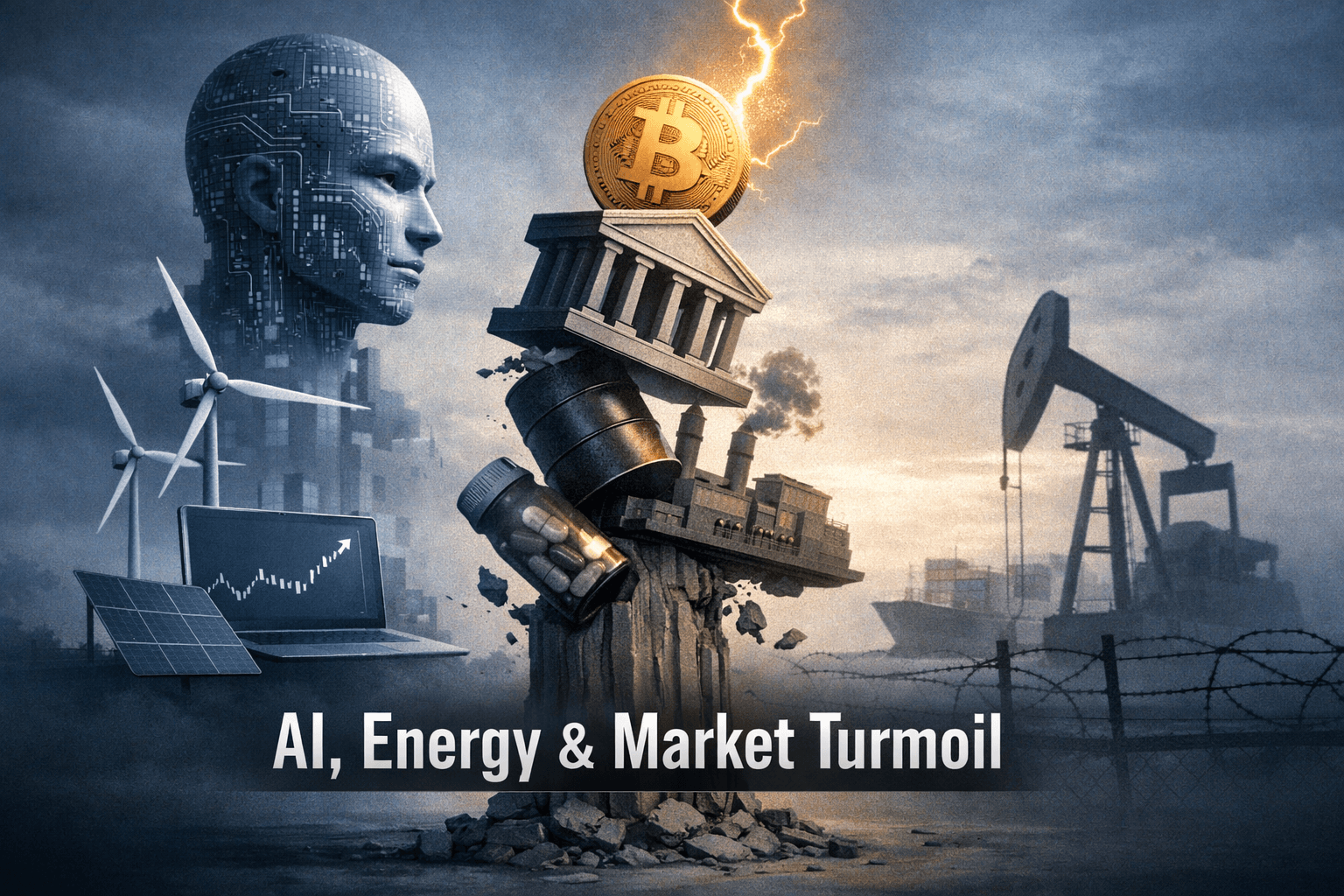
AI, Energy Stress and Crypto Volatility: Tech Drives the Rally While Policy and Supply Risks Bite Other Sectors
Podcast • Loading audio...
Share this article
Spread the word on social media
Key Takeaways
- •Tech/AI momentum dominated headlines — Alphabet’s $80B buildout and Microsoft’s Build 2026 drove cross‑sector capex implications for semiconductors, memory and materials.
- •Renewables and storage reached structural milestones (battery storage >100 GW) even as energy risk rose from Strait of Hormuz tensions and LNG demand dynamics.
- •Crypto showed structural adoption signs (CME 24/7, MoneyGram stablecoin) but remained flow‑sensitive after bitcoin dipped below $70,000 amid ETF redemptions and Mt. Gox transfers.
- •Policy and tariff developments (including a proposed 25% USTR tariff on certain Brazil imports) continue to be major near‑term volatility drivers for industrials and materials.
- •Finance faces headline risk from regional bank M&A and regulatory flags, emphasizing the importance of monitoring capital, asset‑quality and governance updates.
Executive summary
Markets opened the month with a clear split: technology continued to outsize headlines and sentiment — driven by Microsoft (MSFT) and large-cap AI capital commitments — while energy and utilities showed a bifurcated picture as renewables milestones clashed with geopolitical supply risks. Crypto markets were again a source of volatility, with bitcoin slipping below $70,000 amid ETF flows and Mt. Gox transfers, and finance names saw fresh headline risk from regional bank M&A and regulatory scrutiny. Across materials, energy and industrials, supply-chain and policy drivers (tariffs, critical‑mineral deals, shipping routes) established the near‑term narrative.
Several specific datapoints anchored the day: Alphabet outlined an $80 billion AI buildout, Microsoft dominated Build 2026 with new models and a Mayo Clinic partnership, battery storage capacity passed the 100 GW mark, and a $435 million longevity financing closed in healthcare. On the risk side, a proposed 25% USTR tariff on certain imports from Brazil and Strait of Hormuz supply concerns kept energy-risk premia elevated. Crypto structural changes — CME Group (CME) launching 24/7 products, MoneyGram (MGI) testing a stablecoin, and Mt. Gox transfers — interacted with ETF redemptions to produce downward pressure on bitcoin.
This recap groups sectors by relative performance and draws connections across headlines to give investors a framework for interpreting cross‑market signals and potential positioning considerations.
Grouping by performance: outperformers, underperformers, and stable sectors
Note: sector performance labels below synthesize news flow and market impact from June 2. They reflect relative momentum, headline pressure and fundamental catalysts reported across the day rather than strict intraday returns.
Outperformers
- Technology: Microsoft (MSFT), Alphabet (GOOGL), Intel (INTC) and chip-supply chain names drew momentum as AI-capex and chip capacity pledges dominated headlines. Alphabet’s $80 billion AI push and Microsoft’s product announcements at Build gave the sector directional lift.
- Utilities / Renewables: Renewables and storage made structural progress; battery storage capacity passed the 100 GW milestone and new hybrid projects (e.g., Iberdrola’s wind-hydro commissioning) signaled durable demand for grid upgrades.
- Materials & Mining: Critical‑mineral deals, fresh copper drilling results and consolidation in specialty mining created a constructive tone for commodity‑linked names that underpin electrification and semiconductors.
Underperformers
- Cryptocurrency: Slumping volumes, ETF redemptions and headline events (Mt. Gox transfers, bitcoin falling through the $70k mark) increased downside pressure and elevated short‑term volatility.
- Finance & Banking: Regional bank M&A, FDIC flags on underperforming lenders and CEO turnover in select banks fed caution around credit and governance risk in the sector.
- Industrials: Tariff proposals (including a suggested 25% USTR levy on certain imports from Brazil) and supply‑chain policy headlines introduced uncertainty for capital goods and export‑exposed equipment makers.
Stable / Mixed
- Energy: Mixed — renewables and EV charging M&A attracted positive attention while oil risk remained elevated because of Strait of Hormuz tensions and supply concerns. LNG demand from India and strike risks in Australia added nuance.
- Consumer & Retail: Momentum in discount and apparel retail was offset by mixed results across categories; Amazon (AMZN) and select brands pushed AI initiatives that could improve supply chain and loyalty economics.
- Healthcare & Real Estate: Both sectors had meaningful headlines — from a $435M longevity financing in healthcare and laboratory therapy advances to big real‑estate groundbreakings and financing rounds — but these were largely idiosyncratic and did not move broad indices uniformly.
Cross‑sector themes and correlations
AI and capex are cross‑cutting: tech’s headline AI investments reverberated beyond FAANG-style names. Alphabet’s $80 billion buildout and Microsoft’s product and healthcare tie‑ups signal a capex cycle concentrated in cloud, data centers and specialized silicon. That flow benefits semiconductors (chipmakers, memory suppliers), materials (specialty silicon, copper for data center buildouts) and industrials (construction and equipment for data centers). The correlation is visible: tech momentum tends to lift semiconductor capital‑equipment and select materials stocks.
Energy transition meets energy security: renewables and storage hit structural milestones (battery storage >100 GW) and projects such as hybrid wind‑hydro increase grid flexibility, but traditional energy risk remains. Strait‑of‑Hormuz supply worries and spot LNG buying (notably India) tightened near‑term risk premia for oil and gas. The result is a coexistence of long‑run structural investment into clean energy while cyclical fossil-fuel prices remain sensitive to geopolitical events.
Policy and regulation are the dominant short‑term mover across multiple sectors: tariffs (industrial supply chains), state cannabis rules (Minnesota, Kentucky, New Jersey), banking oversight (FDIC flags), healthcare AI standards, and China’s tech policy adjustments all show that regulatory decisions are a powerful near‑term source of volatility. Investors are increasingly pricing policy risk into valuations rather than only macro variables.
Crypto is evolving structurally but remains flow‑sensitive: institutional infrastructure additions — CME’s 24/7 launch and MoneyGram’s stablecoin work — are structural positives for adoption, yet the market is still susceptible to ETF flows, transfers from historical creditors like Mt. Gox, and liquidity squeezes. That creates a high‑convexity environment where technology adoption gains are offset by acute flow volatility.
Supply‑chain geography matters more: announced tariffs on Brazilian imports and potential constraints on Taiwan‑linked parts for industrials emphasize the sensitivity of manufacturing and equipment businesses to geopolitical re‑routing. Materials and mining stories (critical minerals, copper drilling) reflect re‑shoring and diversification of supply chains.
Significant moves of the day — what happened, why it matters
Microsoft (MSFT) and Alphabet (GOOGL): AI capex and product cadence
- What happened: Microsoft dominated Build 2026 with new models, developer tools and a high‑profile Mayo Clinic partnership; Alphabet disclosed plans for an $80 billion AI buildout.
- Why it matters: Large, coordinated capital commitments from hyperscalers lift demand for cloud infrastructure, advanced nodes, memory and the power/cooling and construction capacity to house new data centers. The knock‑on effects include increased wafer demand (benefitting chip equipment suppliers), stronger memory pricing dynamics over time (positive for memory producers) and incremental demand for copper and specialty materials.
Battery storage and renewables (utilities): structural momentum
- What happened: Battery storage passed the 100 GW threshold and projects combining wind and hydro went operational (Iberdrola highlighted among operators).
- Why it matters: Storage crossing 100 GW is a validation point: grid operators can integrate higher shares of intermittent renewables, which reduces curtailment risk and supports electrification trends (EV charging, industrial electrification). Utilities and independent power producers that can deploy hybrid assets and storage may see improving capacity‑factor economics and new revenue streams (capacity, ancillary services).
Crypto — Bitcoin (BTC), CME and MoneyGram
- What happened: Bitcoin slipped below $70,000 amid ETF redemptions and Mt. Gox transfers; at the same time CME launched 24/7 trading and MoneyGram advanced a stablecoin pilot.
- Why it matters: Structural adoption (CME’s expanded product suite, MoneyGram’s stablecoin testing) reduces some friction for institutional use, but large redemptions and legacy claim transfers can overwhelm liquidity, producing sharp price moves. The net is continued volatility with growing market infrastructure that may reduce trading frictions over time but does not eliminate acute flow risk.
Energy — Strait of Hormuz, LNG demand and renewables M&A
- What happened: The market priced in elevated supply risk after flare‑ups around the Strait of Hormuz, while India’s LNG buying and strike threats in Australia added regional tightening. Concurrently, M&A in drilling and EV‑charging updates provided sector‑specific catalysts.
- Why it matters: Oil markets can reprice quickly on shipping route disruptions, which feeds into inflation expectations and central‑bank considerations. At the same time, stronger LNG demand supports natural‑gas prices and underpins investment in liquefaction and shipping capacity.
Finance & Banking — regional M&A and regulatory flags
- What happened: Regional bank consolidation continued via M&A headlines and at least one lender was flagged by the FDIC for underperformance; there was also a notable CEO turnover in a regional bank.
- Why it matters: Bank M&A tends to re‑rate regional names unevenly — acquirers may be viewed as strategic consolidators while targets can face sharp share‑price moves. FDIC flags increase scrutiny on asset quality and capital buffers, possibly leading to more conservative lending and margin compression in the near term.
Industrials & tariffs
- What happened: Proposals for tariffs, including a suggested 25% USTR tariff on certain imports from Brazil, punctuated the day.
- Why it matters: Tariffs increase input costs for firms reliant on affected components or raw materials, undermine planning visibility for supply chains and can slow capital spending on equipment that competes on price. Firms with localized supply chains or pricing power will fare better than those with global cost exposure.
Healthcare — funding and policy
- What happened: A $435 million longevity financing closed and lab-backed therapy advances were reported alongside new AI responsibility standards.
- Why it matters: Capital continues to flow into biotech and longevity plays, but these companies also face higher regulatory scrutiny as AI is introduced in clinical and operational workflows. Policy will likely shape commercialization pathways and reimbursement discussions.
Cannabis — state policy moves
- What happened: Kentucky expanded medical access, Minnesota rewrote canopy/supply rules, and New Jersey courts broadened worker protections.
- Why it matters: State‑by‑state policy shifts create patchwork regulatory regimes that change licensing economics and supply‑chain dynamics; firms with diversified state footprints or nimble distribution models can capitalize on regulatory openings, while single‑market operators face concentrated execution risk.
Materials & Mining — critical minerals and operational disruptions
- What happened: New supply deals for critical minerals were announced, fresh copper drilling results arrived and an Orla Mining blockade temporarily halted operations.
- Why it matters: Securing critical‑mineral supply is a priority for EV and semiconductor supply chains; disruptions like blockades have immediate price and project‑timing effects, particularly for projects already near production.
Actionable insights for investors (informational; not advice)
- Track AI capex beneficiaries beyond headline names
- Why: Alphabet’s and Microsoft’s commitments suggest multi‑year demand for cloud infrastructure, data‑center construction, semiconductors and memory. Watch suppliers to cloud hyperscalers (chipmakers, memory producers, equipment firms) as potential indirect beneficiaries of AI capex.
- Signals to monitor: incremental data‑center announcements, wafer capacity utilization rates, and memory demand/price guidance from manufacturers.
- Position for bifurcated energy exposure
- Why: Renewable projects and storage deployments are structural positives, but oil and LNG remain susceptible to geopolitical shocks. Investors looking for exposure to the energy transition should separate pure clean‑technology plays (storage, grid software) from cyclical fossil‑fuel names that remain volatile.
- Signals to monitor: project commissioning schedules, storage capacity growth, LNG charter rates, and developments near chokepoints such as the Strait of Hormuz.
- Treat crypto as a flow‑sensitive asset with structural tailwinds
- Why: Institutional infrastructure (CME 24/7, stablecoins) improves access and liquidity over time, but short‑term pricing is dominated by ETF flows and large transfers. Risk management and time horizon are critical.
- Signals to monitor: ETF inflow/outflow data, major wallet transfers (Mt. Gox and similar), and derivatives‑clearing liquidity measures.
- Factor policy risk into industrial and international supply‑chain exposure
- Why: Proposed tariffs and export‑control chatter can quickly change cost structures and capital budgets in industrials. Companies with diversified supplier bases or those relocating capacity domestically will be less vulnerable.
- Signals to monitor: tariff announcements, import statistics for affected product categories and corporate guidance on sourcing strategies.
- Watch rolling regulatory and state policy updates for patchwork sectors
- Why: Cannabis, healthcare (AI rules) and banking are being reshaped by state and federal regulation. Earnings and valuation sensitivity will depend on how fast policy changes filter into revenue and cost structures.
- Signals to monitor: state‑level legislative calendars, federal rule‑making timelines, and regulators’ enforcement statements.
The most important single cross‑market linkage to watch
AI investment flows into data centers and advanced semiconductors are likely to be the dominant multi‑year transmission mechanism across tech, materials and industrial equipment. If hyperscaler commitments translate into sustained procurement (servers, GPUs, memory, power and cooling systems), expect a durable cyclical upswing in capital spending that benefits select suppliers and materials. Conversely, if macro or policy shocks (tariffs, higher rates) slow corporate capex, that transmission will weaken quickly.
Risks and asymmetries
- Policy shocks remain the largest near‑term risk — the potential for new tariffs, bank supervisory actions or restrictive state cannabis laws can create rapid repricings.
- Geopolitical disruptions in shipping lanes or energy production can produce outsized price moves in oil and LNG that feed through to inflation expectations and rates.
- Crypto markets retain high convexity: positive structural adoption signals can be overwhelmed by large redemptions or concentrated transfers.
- Execution risk for large capital projects (data centers, renewables, critical‑minerals mines) is real — permitting, labor and supply chains can delay expected benefits.
Conclusion and forward view
June 2 underscored a bifurcated market: technology-driven narratives (AI capex, cloud expansion) are powering a growth story that ripples into semiconductors, materials and industrial equipment, while energy and commodities are navigating a dual path of structural transition and cyclical geopolitics. Finance and crypto remain sensitive to liquidity and policy headlines. For investors, the coming weeks will likely be defined by the pace at which AI commitments convert into procurement and the evolution of policy risk around tariffs, banking oversight and state regulatory changes.
Expect volatility to remain elevated in sectors where headline risk and flows dominate (crypto, regional banks, energy spot markets). In parallel, structural stories — renewables deployment, critical‑mineral sourcing, and cloud infrastructure expansion — will continue to attract capital and reshape sector compositions over the medium term.
Investment Disclaimer
This analysis is provided for informational purposes only. It is not a recommendation to buy, sell or hold any security, nor is it personalized investment advice. Analysts note that market conditions can change quickly; readers should perform their own due diligence and consult a licensed financial professional before making investment decisions.
Key data points cited in this report
- Alphabet disclosed plans for an $80 billion AI buildout.
- Microsoft (MSFT) dominated Build 2026 with new models, developer tools and a Mayo Clinic partnership.
- Battery storage capacity passed the 100 GW milestone.
- A $435 million longevity financing closed in healthcare.
- Bitcoin slid below $70,000 amid ETF redemptions and Mt. Gox transfers; CME launched 24/7 trading and MoneyGram (MGI) advanced a stablecoin pilot.
- Proposed USTR tariff suggestion: 25% on certain imports from Brazil raised policy risk for industrials.
- Notable corporates mentioned in day’s headlines: MSFT, GOOGL, AMZN, META, INTC, DE (Deere), FDX (FedEx), MGI (MoneyGram), CME (CME Group), Iberdrola.
For regular sector recaps and alerts, StockAlpha.ai will continue to monitor policy developments, earnings, capex announcements and flows that could alter these narratives.
Sources
+ 14 more sources
Use these insights — enter this week's contest.
Free practice contests — earn Alpha CoinsExplore More Content
Disclaimer: StockAlpha.ai content is for informational and educational purposes only. It is not personalized investment advice. Sentiment ratings and market analysis reflect data-driven observations, not buy, sell, or hold recommendations. Always consult a qualified financial advisor before making investment decisions. Past performance does not guarantee future results.