 Sector Insights
Listen to this Recap
10:18
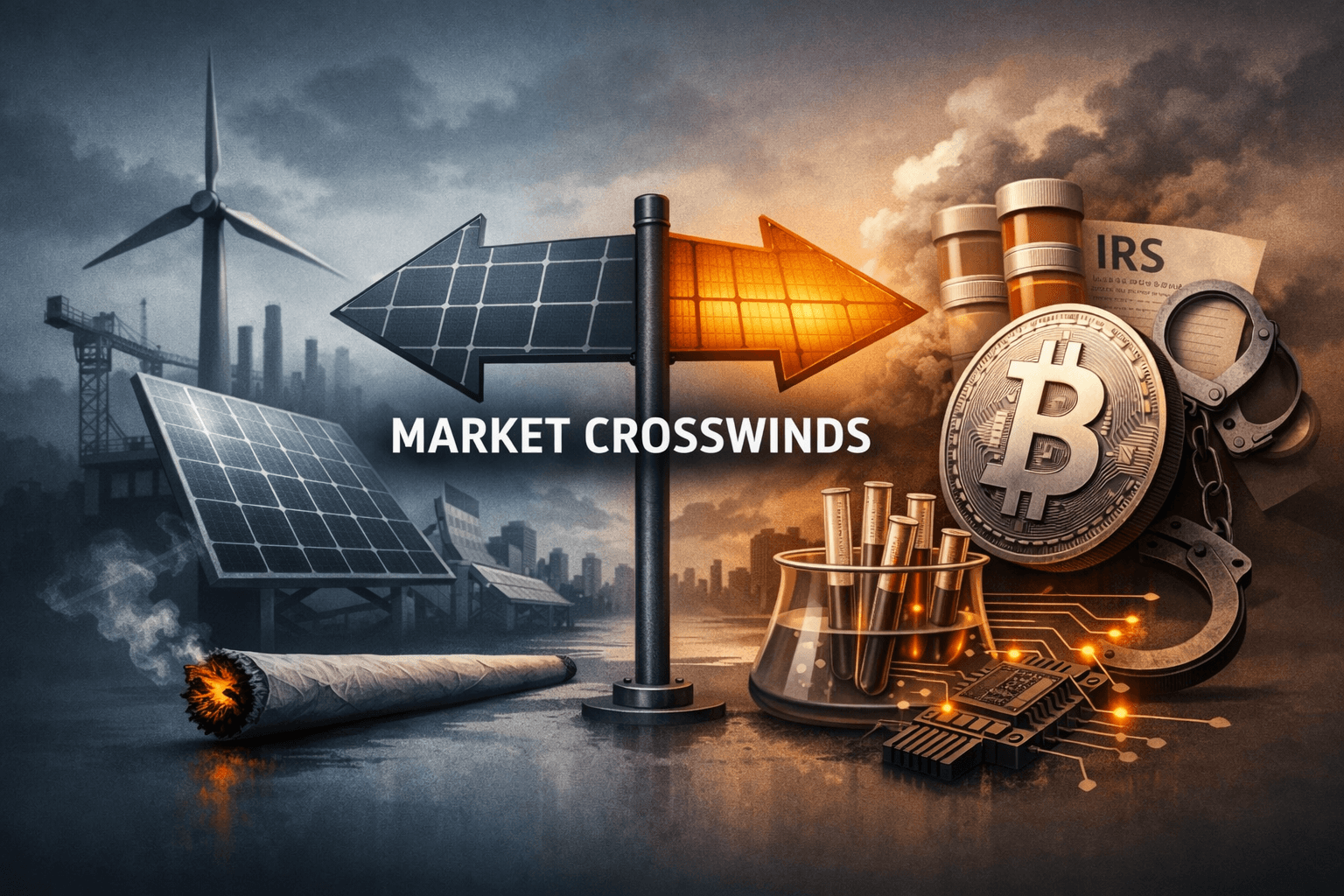
Solar, Rescheduling and Regulation: Cross‑Market Catalysts Drive Divergent Sector Moves on May 28
Podcast • Loading audio...
Share this article
Spread the word on social media
Key Takeaways
- •Renewables and energy security headlines (JinkoSolar 20 GW, large BESS financing) drove strength across energy, utilities and materials.
- •Federal rescheduling momentum for cannabis has shifted the focus to IRS and ATF guidance — administrative details will be immediate catalysts.
- •Crypto faced liquidity pressure: $528M Bitcoin ETF outflow and ETH under $2,000 highlight short‑term volatility and investor rotation risk.
- •AI remains a cross‑sector demand driver, but funding and governance headlines (Anthropic valuation, activist board moves) create funding/liquidity risks.
- •Watch near‑term policy and financing updates — DEA/IRS guidance, ETF flows, interconnection rules, and clinical readouts — for the next directional cues.
Executive summary
Markets on May 28 moved on a mix of policy, capital‑allocation and macro‑geopolitical headlines that produced a bifurcated day: pockets of clear positive momentum in energy, utilities and real estate were matched by weakness and caution in crypto and parts of healthcare and communications. Renewable manufacturing announcements — highlighted by JinkoSolar’s 20 GW booking — and several large project and financing deals (DigitalBridge’s $1.05 billion ArcLight purchase, a $450 million financing for a Texas BESS) underpinned gains across the clean‑energy complex and fed demand for materials and industrial capacity. At the same time, federal rescheduling momentum for cannabis prompted tax and regulatory follow‑through conversations, while crypto flows showed material outflows ($528 million from a Bitcoin ETF) and ETH traded below $2,000, creating a drag on risk appetite.
Across the tape, three cross‑cutting themes stood out: (1) policy and regulatory developments continuing to reprice entire sub‑sectors (cannabis, crypto, communications); (2) AI and tech spending as a pervasive demand driver across technology, finance and healthcare; and (3) renewables and energy security — from solar module bookings to near‑term oil support after geopolitical incidents — shaping capital flows into materials, utilities and real estate.
This recap groups sectors by performance, explains the why behind the moves, highlights the day’s biggest stories, and lays out the actionable things investors and analysts should watch next. An important reminder: this is market analysis and not investment advice.
Grouping by performance
Outperformers
- Energy: Renewables + geopolitics
- Utilities: M&A, storage and interconnection reform momentum
- Real estate: Big sales, conversions and tech‑driven leasing wins
Stable / Mixed
- Technology: AI product launches and governance news balanced by funding concerns
- Materials & Mining: Selective operational wins alongside supply risks
- Consumer & Retail: New launches and tariff refunds but margin vigilance
- Industrial & Manufacturing: Capacity expansions and accidents offsetting each other
- Finance: AI funding enthusiasm tempered by regulatory friction and consumer‑finance litigation
Underperformers / Cautionary
- Cryptocurrency: ETF outflows, ETH < $2,000 and market cap swings
- Healthcare: Promising clinical data offset by public‑health risks and pricing pressures
- Communications & Media: Content deals competed with regulatory and security headwinds
Cross‑sector themes and correlations
- Policy and regulatory clarity is a primary market mover
- Cannabis rescheduling at the federal level and related administrative steps (IRS tax guidance, ATF form changes) are creating immediate re‑rating opportunities for firms exposed to legalization. Legal and tax frameworks are moving from “uncertain” to “transition,” which typically compresses risk premia and increases M&A and capital‑raising activity once guidance is published.
- Communications saw regulation resurface with an FCC dispute involving a major broadcaster, reinforcing that content/media licensing and distribution arrangements remain exposed to policy risk.
- Finance is simultaneously digesting a CFPB lawsuit and elevated scrutiny of AI funding structures — regulatory outcomes could materially affect banks, fintechs and underwriting activity.
- Renewables and energy security are driving capital allocation across multiple sectors
- JinkoSolar’s 20 GW booking and announcements around BIPV and storage indicate stronger-than-expected demand and push more capex into solar manufacturing (materials, conveyors, polysilicon) and logistics (industrial). Utilities are responding with project financing and grid planning, illustrated by a $450 million BESS financing and interconnection reform chatter.
- Geopolitical strikes near the Strait of Hormuz provided episodic oil support, which along with a large LNG supply deal, tightened near‑term energy fundamentals and benefited traditional energy names and energy infrastructure (Freeport-McMoRan (FCX) received a bullish analyst note, per sector commentary).
- AI is a horizontal growth and valuation theme — but liquidity and governance are risks
- Tech headlines were led by AI product expansions (YouTube, device makers) and activist governance moves in high‑profile boards. At the same time, financing headlines — Anthropic’s near‑$1 trillion private valuation talk, for example — raise questions about liquidity cycles and potential valuation excess in AI infrastructure suppliers and chipmakers. Finance sector notes flagged “AI liquidity risks.”
- Healthcare and consumer are also feeling AI’s effects: Teladoc (TDOC) expanding into Walmart’s digital health platform signals distribution gains, while healthcare tech shows potential to lower unit costs but introduces execution risk and regulatory oversight.
- Capital recycling and large asset sales reshape sector valuations
- Real‑estate moves — SL Green’s partial tower stake sale (49%) and other big transaction activity — show institutional capital redeploying into higher‑growth real assets (data centers, multifamily conversions) and pressuring lower‑growth office portfolios to accelerate repurposing or monetization.
Sector highlights and the reasons behind the moves
Energy (Outperformer)
- What moved markets: Renewables led the tape with manufacturing and project momentum — JinkoSolar booked 20 GW, and multiple BIPV and storage trends were cited — while geopolitical friction near Hormuz and an LNG supply deal supported traditional energy. Fast‑charging network plans and EV upgrades added incremental demand themes.
- Why it matters: The combination of near‑term supply support (geopolitical) and structural demand (EVs, storage, rooftop and building‑integrated solar) creates a multi‑horizon investment case for energy and energy‑adjacent names. Materials, industrial manufacturers and utilities are the immediate transmission channels for this capital.
- Data points: JinkoSolar — 20 GW booked; major LNG deal announced; strikes near Hormuz; fast‑charging network investment plans discussed.
Utilities (Outperformer)
- What moved markets: M&A and project financing headlines dominated: DigitalBridge’s $1.05 billion ArcLight purchase and $450 million financing for a Texas BESS were among the largest items. Interconnection reforms and new monitoring tech were also cited.
- Why it matters: Utilities are the operators of the new clean‑energy stack; financing availability, interconnection reforms and large asset deals reduce execution risk for large projects and can accelerate returns on capital for storage and grid modernization.
- Data points: DigitalBridge $1.05B ArcLight deal; $450M BESS financing; new campus solar and interconnection policy chatter.
Real Estate (Outperformer)
- What moved markets: Large transactions (SL Green selling a 49% stake in a Midtown tower JV), office‑to‑residential conversion moves by JBG SMITH, and AI‑driven leasing highlighted the sector.
- Why it matters: Capital redeployment toward higher‑rowth property types (data centers, residential conversions) and the monetization of legacy office assets indicate an active repricing cycle in commercial real estate. Repositioning and selective value creation are now visible levers.
- Data points: 49% stake sold by SL Green; JBG SMITH office conversion announcements; Digital mortgage demand increases.
Materials & Mining (Stable/Mixed)
- What moved markets: A mix of permit wins, recycling contracts, and strategic deals (Energy Fuels’ ASM move; PureCycle ISO nod) pointed to selective momentum, while supply risks and commodity cycles kept sentiment guarded.
- Why it matters: Materials provide the upstream inputs for renewable projects (copper, rare earths, polysilicon) and are therefore sensitive to both cyclical commodity factors and long‑run green demand. Permits and government approvals de‑risk projects, often creating meaningful re‑ratings.
- Data points: Multiple permits and approvals reported across recycling and critical‑minerals projects.
Technology (Stable/Mixed)
- What moved markets: AI product rollouts (YouTube and device makers) and funding/governance headlines (activist board news) drove headlines. The sector also saw an activist governance move that could affect chip and software suppliers.
- Why it matters: AI remains the dominant secular driver of enterprise IT spending and consumer device upgrades, but capital concerns (where valuations and funding come from) and governance battles can sap momentum.
- Data points: Multiple high‑profile AI product launches; activist board developments reported.
Finance & Banking (Stable/Mixed)
- What moved markets: Regulatory stories — notably a CFPB lawsuit — and AI funding headlines (Anthropic near‑$1 trillion private valuation) were the key items. Freeport (FCX) received a bullish analyst note tied to energy/commodity cycles.
- Why it matters: Banks and finance firms must balance potentially higher returns from AI‑driven fintech services with escalating regulatory scrutiny that can raise compliance costs and capital requirements. The CFPB action is a reminder that consumer finance remains a policy front.
- Data points: Anthropic near‑$1 trillion valuation cited; CFPB lawsuit headlines; analyst bullishness on FCX.
Cryptocurrency (Underperformer)
- What moved markets: Outflows and price weakness: a reported $528 million outflow from a Bitcoin ETF and Ethereum trading under $2,000 combined with a reported $80 billion market‑cap decline in crypto created a risk‑off tone. Corporate activity included a $408 million Samsung bid for Dunamu and a regulatory reversal for Gemini.
- Why it matters: ETF outflows and ETH below $2,000 signal waning risk appetite in the short term and increase the probability of greater volatility. Regulatory clarity (positive or negative) remains the principal swing factor for valuations.
- Data points: $528M Bitcoin ETF outflow; ETH < $2,000; $408M Samsung bid for Dunamu; an $80B market‑cap drop referenced.
Healthcare (Underperformer / Mixed)
- What moved markets: Positive clinical signals — GSK reporting a hepatitis B therapy producing a “functional cure” in roughly 1‑in‑5 patients (about 20%) — were offset by public‑health and safety stories (implant infections) and broader pricing/insurance discussions.
- Why it matters: Breakthrough clinical outcomes can be value‑creating for specific therapeutics and biotechs, but broader insurer, pricing and public‑health risks keep index‑level healthcare sentiment muted.
- Data points: GSK reported ~20% functional‑cure rate in an experimental hepatitis B therapy; stem‑cell heart patch progress noted.
Consumer & Retail (Stable)
- What moved markets: Walmart (WMT) opening to premium DTC brands, Dick’s Sporting Goods (DKS) posting good results, Warby Parker (WRBY) product news, and tariff refund flows were among the day’s items.
- Why it matters: Retailers that can integrate DTC brands and control margins via supply‑chain or price adjustments stand to benefit from elevated consumer selectivity. Tariff refunds reduce near‑term cost pressure.
- Data points: DKS results referenced; WMT partnership moves; WRBY new launches.
Communications & Media (Underperformer / Mixed)
- What moved markets: Content wins — festival premieres, scripted deals and sports‑agency consolidation — were counterbalanced by regulatory friction (FCC dispute with ABC) and telecom workforce cuts at Vodafone.
- Why it matters: Content remains expensive to produce and distribute. Regulatory actions that influence carriage and licensing can have immediate revenue implications for broadcasters and streaming partners.
- Data points: FCC dispute with ABC; major festival premieres and scripted deals cited.
Industrial & Manufacturing (Stable/Mixed)
- What moved markets: Logistics deals, a big IPO target, rail reporting rules, rare‑earth and magnet JV activity, and factory restarts after accidents (including a fatal mill implosion) were reported.
- Why it matters: Industrial capacity and supply‑chain resiliency are key to meeting the capex surges in renewables and EVs. Safety incidents and restarts introduce stop/start production risk that can temporarily tighten specialty materials.
- Data points: Blue Origin $600M plant expansion; new rail reporting rules; rare‑earth JV news.
Cannabis (Outperformer)
- What moved markets: Federal rescheduling momentum sent lawmakers to press the IRS for tax guidance, the ATF adjusted forms and unions and advocacy groups pushed for pardons and inclusion in hearings. NORML pushing to participate in DEA rescheduling hearings adds a public‑policy catalyst.
- Why it matters: Federal rescheduling materially alters compliance costs, taxation (Section 280E effects), banking access and M&A dynamics. Moving from Schedule I toward a lower schedule or decriminalization reduces legal risk and can unlock clearer capital pathways.
- Data points: Regulatory steps noted — DEA rescheduling process, IRS guidance requests, ATF form changes; UFCW public calls for pardons.
Most significant moves with context
JinkoSolar’s 20 GW bookings: This is evidence that module demand remains robust even amid price volatility. For materials suppliers and polysilicon producers, higher forward bookings can support margins and justify incremental capacity.
DigitalBridge’s $1.05B ArcLight deal and $450M Texas BESS financing: Large institutional capital being deployed into energy infrastructure suggests yield‑seeking investors view clean‑energy assets as core infrastructure, aiding long‑duration project finance markets.
Cannabis federal rescheduling process surging to the fore: Policymakers are moving fast enough that tax and banking guidance is now the near‑term focus. Administrative steps that follow rescheduling could materially change cash flow dynamics for operators and shift valuations.
Crypto outflows and ETH under $2,000: The reported $528 million outflow from a Bitcoin ETF and weakness in major tokens are a reminder that regulatory headlines and liquidity rotations can produce swift repricing in digital assets.
GSK’s hepatitis B news (~20% functional cure): While early, this outcome is the kind of clinical upside event that can meaningfully revalue small biotech players and affect larger pharma strategic positioning around infectious‑disease R&D.
SL Green’s 49% stake sale and JBG SMITH conversions: Large, visible transactions in commercial real estate underscore the sector’s active repricing and the trend toward alternative real‑asset allocations (data centers, residential conversions).
Actionable insights and watchlist for investors (informational only)
Monitor DEA/IRS guidance and court filings on cannabis rescheduling. The timing and content of tax guidance (Section 280E treatment and state reconciliation rules) will be a near‑term re‑rating catalyst for listed cannabis names.
Track Bitcoin ETF flows daily. Large outflows (e.g., the $528 million event reported) and ETH price thresholds (like $2,000) are useful technical and sentiment cues for crypto exposure and cross‑asset risk appetite.
Watch interconnection policy and BESS financing pipelines. Utilities and project developers will tell the story of how quickly storage can be deployed; announced financings ($450M for a Texas BESS) and M&A moves reduce execution risk for project owners.
Keep an eye on AI funding cycles and governance events. Big private valuations (Anthropic near $1 trillion in sector notes) and activist board actions can presage a funding pause or a re‑rating in hardware and software suppliers.
Check energy geopolitics and freight/shipping lanes. Incidents near Hormuz and LNG deals are immediate drivers of oil and gas prices, which affect energy infrastructure, materials and shipping costs.
Follow clinical readouts and regulatory moves in healthcare. Promising early efficacy (GSK hepatitis B ~20% functional cure) can create idiosyncratic winners, but broader sector exposure remains tied to reimbursement and safety narratives.
For real estate allocations, evaluate balance‑sheet flexibility and asset repositioning plans. Sellers of office stakes and firms doing office‑to‑residential conversions (JBG SMITH) are examples of tactical asset‑class rotation; prospective investors should model cash flows under alternative use cases.
Risk considerations
- Policy risk is elevated: regulatory outcomes in cannabis, crypto, communications and consumer finance can produce abrupt changes to cash flow assumptions.
- Liquidity and valuation risk in venture‑backed AI and crypto assets could transmit volatility to public markets, especially smaller cap tech and fintech stocks.
- Execution risk remains in industrial and materials projects: restarts after accidents and permitting timelines can alter supply projections and margin assumptions.
Conclusion and forward outlook
May 28 was a microcosm of the current market landscape: policy and capital flows are re‑shaping long‑duration sectors (energy, utilities, real estate, cannabis) even as liquidity and regulatory headlines cap parts of the risk appetite spectrum (crypto, healthcare, communications). The immediate weeks ahead are likely to be driven by a handful of clear catalysts: DEA/IRS follow‑up on cannabis rescheduling, daily crypto ETF flows and token price levels, AI funding and governance headlines, BESS and solar project finance announcements, and material clinical readouts.
For market participants, the message is twofold. First, identify whether exposure is to structural, policy‑driven re‑rating (renewables, utilities, cannabis) or to liquidity‑sensitive, event‑driven assets (crypto, certain tech IPOs, early‑stage biotech). Second, use the coming cadence of regulatory guidance and financing updates as checkpoints to reassess risk premia rather than as binary trade triggers.
Investment disclaimer: This analysis is for informational purposes only. It does not constitute a recommendation to buy, sell or hold any security, nor is it personalized investment advice. Analysts note themes and data points above to help frame market discussions; individual investors should consider their own circumstances and consult a licensed professional before making investment decisions.
Appendices: notable datapoints from May 28 reporting
- JinkoSolar booked 20 GW of solar capacity.
- DigitalBridge completed a $1.05 billion ArcLight acquisition.
- A Texas BESS closed $450 million in financing.
- Reported Bitcoin ETF outflow: $528 million.
- Ethereum CAD/spot traded below $2,000 at one point on May 28 reporting.
- Reported $408 million bid by Samsung for Dunamu (crypto exchange parent).
- GSK reported an experimental hepatitis B therapy produced a functional cure in approximately 1‑in‑5 patients (~20%).
- SL Green sold a 49% stake in a Midtown tower joint venture.
- Blue Origin announced a $600 million plant expansion.
- Anthropic was discussed in sector notes with valuation chatter near $1 trillion.
Sources
+ 13 more sources
Use these insights — enter this week's contest.
Free practice contests — earn Alpha CoinsExplore More Content
Disclaimer: StockAlpha.ai content is for informational and educational purposes only. It is not personalized investment advice. Sentiment ratings and market analysis reflect data-driven observations, not buy, sell, or hold recommendations. Always consult a qualified financial advisor before making investment decisions. Past performance does not guarantee future results.