 Sector Insights
Listen to this Recap
12:10
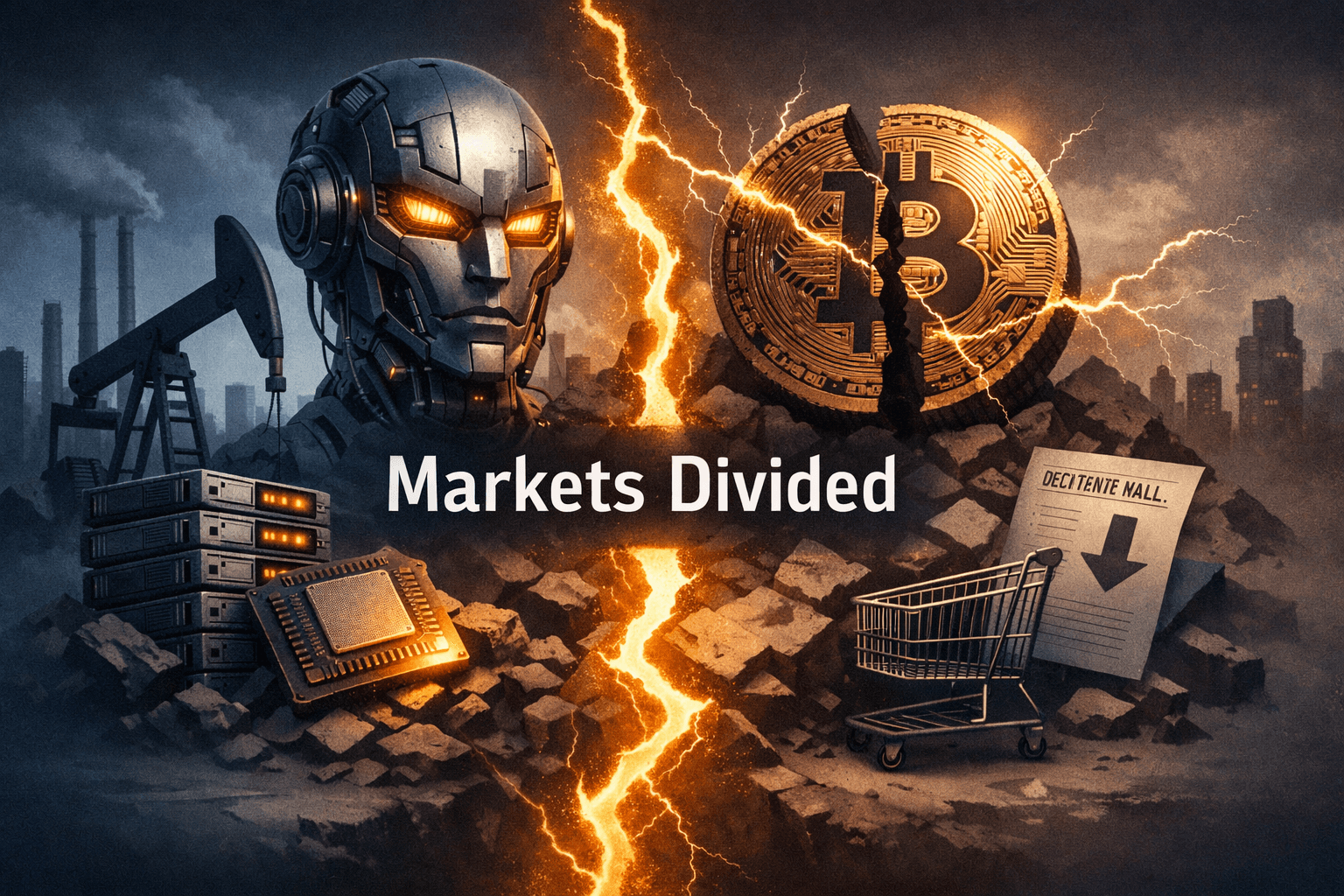
AI Money and Energy Mega-Deals Drive Divergence: Tech, Energy and Industrials Lead While Crypto, Utilities and Consumer Feel Pressure
Podcast • Loading audio...
Share this article
Spread the word on social media
Key Takeaways
- •AI funding and large private-credit packages (Broadcom ~ $35B, an AI IPO ~20x demand) concentrated investor interest in Technology and related industrial supply chains.
- •Energy saw sizable M&A and capacity announcements (reported $58B oil merger; new 4 GW solar factory), but geopolitical risks around shipping lanes kept volatility elevated.
- •Industrials benefitted from large capex and reshoring commitments (Lilly ~$4.5B; ~$20B India-linked U.S. investments), supporting machinery, automation and materials demand.
- •Crypto, Utilities and Consumer names were more sensitive to regulatory headlines, operational hiccups, and trade-down consumer behavior, producing mixed flows and higher near-term risk.
- •Near-term catalysts to monitor: SEC rule-making on crypto, major tech earnings and investor days, Fed liquidity signals, and execution indicators from utilities and consumer installers.
Executive summary
Markets closed the week with a clear bifurcation: heavy capital flows and deal activity concentrated in Technology, Energy and Industrials contrasted with muted, headline-driven action in Crypto, Utilities and Consumer names. Key transactions and headlines — Broadcom’s pursuit of roughly $35 billion in private credit, an oversubscribed AI IPO (demand reported at roughly 20x), a $58 billion oil-sector merger, and Roche’s $750 million purchase of PathAI — set the tape and illustrated where corporate risk appetite and investor attention currently sit.
Other notable data points that framed the day: Citi’s investor day messaging on turnaround plans, Lilly’s roughly $4.5 billion commitment to Indiana manufacturing capacity, $20 billion of India-linked U.S. investments in industrial projects, a $500 million Park Avenue real-estate sale and a top online savings rate posting a 4.21% APY. At the same time, operational stumbles — from Sunrun’s sales miss to platform glitches in crypto trading and higher console prices compressing gaming hardware demand — kept volatility front of mind.
Taken together, the tape suggests a market where capital is selectively moving toward companies and sectors tied to AI, large-scale manufacturing and energy scale-ups, while sectors sensitive to regulation, short-term consumption patterns, and execution risk are trading more cautiously.
Grouping sectors by performance
Below we group the 24 sectors provided into outperformers, underperformers and stable/mixed performers based on the day’s news flow, deal sizes and cross-sector linkages.
Outperformers
- Technology: Heavy AI capital flows dominated headlines. Broadcom’s move to arrange roughly $35 billion in private credit and the reported 20x subscription for an AI chipmaker’s IPO underscored strong institutional demand for AI exposure. Earnings and supply-chain stories were mixed, but overall momentum favored chipmakers, AI infrastructure names and AI-adjacent software.
- Energy: A wave of M&A and capacity announcements (including a reported $58 billion oil merger and a new 4 GW solar factory) put energy leaders in focus. Geopolitical friction around the Strait of Hormuz and U.S.-Iran tensions added risk-premium support for commodity prices and for names exposed to upstream cash flows.
- Industrials & Manufacturing: Large-scale investments — roughly $20 billion of India-linked U.S. projects and a $4.5 billion manufacturing commitment from Lilly — alongside automation and robotics deployments suggested a capex-led beat for industrial activity.
Why these outperformed: large, concrete capital commitments and M&A create immediate cash-flow and demand narratives; AI financing in particular concentrated investor attention and liquidity in tech-related equities and financing vehicles.
Underperformers
- Cryptocurrency: Regulatory scrutiny and platform outages created a fractured tape. Headlines ranged from stablecoin questions for major platforms to AWS-linked outages disrupting trading — volatility spiked around tokens such as ZEC even as BTC faced technical disruptions.
- Utilities: Mixed news left the sector vulnerable. Renewable deployment and policy wins were offset by specific operational headwinds (notably sales misses at residential installer Sunrun) and procurement concerns — a classic earnings/operational sensitivity story.
- Consumer & Retail: The sector showed evidence of pressure from trade-down behavior in groceries, higher costs passed through to consumers in areas like gaming hardware, and activist-driven corporate changes that created near-term uncertainty for names in apparel, toys and food retail.
Why these lagged: regulatory noise, execution risk and signs of consumer retrenchment reduced risk appetite; those sectors are more sensitive to near-term cash-flow and operational surprises.
Stable / Mixed performers
- Finance & Banking: A neutral day — Citi presented turnaround plans, there were isolated earnings transcripts ($QNST, $OWLT, $HIMX referenced) and product-competitive dynamics (4.21% APY on a top savings product) but no systemic move across the sector.
- Healthcare: Active in M&A and health‑IT modernization, highlighted by Roche’s $750 million PathAI deal, yet FDA leadership uncertainty and isolated public-health scares (a hantavirus incident on a cruise ship) restrained a full directional move.
- Real Estate: Deal flow was healthy — a $500 million Park Avenue acquisition and increased office/hotel transaction activity — but affordability pressures and zoning risks keep the sector balanced between opportunistic buyers and liquidity-constrained sellers.
- Materials & Mining, Communications & Media, Cannabis, Crypto (some cross-listed headlines), and others landed in the mixed bucket; strong project and M&A announcements in materials and continued catalog/studio settlements in communications gave pockets of strength amid broader uncertainty.
Cross‑sector themes and correlations
Several cross-cutting themes connected the disparate sector headlines and help explain why capital moved where it did today.
- Flood of capital into AI and related infrastructure
- Evidence: Broadcom’s roughly $35 billion private-credit push and an AI chipmaker’s IPO seeing ~20x demand.
- Cross-sector impact: Tech capital has a multiplier effect — chipmakers, cloud providers, data-center industrials and materials suppliers (for advanced semiconductors) benefited. Industrials saw read-throughs via increased automation and robotics demand, while real estate pockets (data-center REITs) received a positive signal.
- Renewables and energy scale-up vs. geopolitical energy risk
- Evidence: A 4 GW solar factory announcement and large oil-sector consolidation ($58B merger). At the same time, shipping disruptions near the Strait of Hormuz and U.S.-Iran clashes raised short-term oil and LNG risk.
- Cross-sector impact: Energy names with upstream exposure rallied on consolidation and risk premiums, while utilities and industrials tied to grid and EV infrastructure saw follow-through demand. However, the geopolitically driven energy premium can feed through to consumer goods via higher fuel costs.
- Capex and reshoring momentum
- Evidence: $20 billion India-linked U.S. investments and Lilly’s $4.5 billion plant commitment.
- Cross-sector impact: Industrial and materials companies stand to benefit from higher sustained capital spending; machinery, automation, and logistics ecosystems also see demand, connecting to manufacturing supply chains.
- Regulatory and operational fragility in crypto and health-tech
- Evidence: Crypto faced regulatory scrutiny over stablecoins and platform glitches; healthcare confronted FDA leadership uncertainty and an isolated infectious-disease scare.
- Cross‑sector impact: Volatility and flow reversals were notable. Regulatory headlines can quickly reallocate risk capital away from the most headline-sensitive sectors, crowding into perceived safe-haven or deal-driven names.
- Consumer rebalancing and margin pressure
- Evidence: Trade-down trends in grocery, higher console prices affecting gaming hardware demand, Mattel under activist pressure.
- Cross-sector impact: Retailers and consumer discretionary companies with exposure to discretionary spend showed weaker investor conviction; at the same time, communication platforms and logistics innovation (same‑day delivery pilots) are being viewed as defensive operating levers.
Notable movers and why they mattered
Below are the most significant single-day moves and why they should matter to market watchers.
Broadcom (AVGO) — arranging roughly $35 billion in private credit
- Why it matters: Such a large private-credit package reflects both the scale of financing demanded by large-cap technology companies and continued institutional appetite to underwrite tech-related leverage outside public markets. That financing can facilitate M&A, share buybacks or capital returns and contributes to overall liquidity in tech.
AI chipmaker IPO with ~20x demand
- Why it matters: Oversubscription on this scale signals strong institutional appetite for AI hardware exposure, translating into higher valuations for semiconductor and data-center infrastructure names and putting pressure on incumbents to accelerate AI road maps.
$58 billion oil merger (name-level consolidation)
- Why it matters: Large consolidation in oil suggests strategic repositioning for scale and reserves. For markets, it tightens supply-side dynamics, can lift upstream cash flow expectations and affects midstream and service providers through contract renegotiation and capex plans.
Roche’s $750 million acquisition of PathAI (RHHBY / ROG)
- Why it matters: The deal consolidates diagnostics and AI-driven pathology capabilities within a major pharma/diagnostics player, underscoring the sector’s pivot towards precision diagnostics and software-enabled care pathways.
Sunrun (RUN) — reported sales drop and procurement concerns
- Why it matters: Operational misses in the residential solar-installation channel reverberate across utilities, installers and financing partners. Given the sector’s sensitivity to policy incentives and supply chains, these execution issues can slow near-term adoption narratives despite longer-term policy tailwinds.
Citi (C) — investor day; turnaround messaging
- Why it matters: Bank strategy updates — around cost control, capital deployment, and risk mitigation — can reshape investor expectations for returns and capital allocation in finance. Citi’s messaging influenced bank peers’ comps and risk-appetite measures.
Lilly — ~$4.5 billion investment in Indiana plants
- Why it matters: Direct evidence of pharma reshoring and capacity expansion; manufacturing investments support stable cash flows and show confidence in long-term demand for medicines.
$20 billion of India-linked U.S. investments
- Why it matters: These deals reflect a reshaping of global supply chains and investments aimed at diversification away from single-country reliance; benefits accrue to industrials, materials, logistics and regional real-estate.
Olin (OLN) — strike resolution and resumption of operations
- Why it matters: Resolution of labor disruptions reduces immediate supply constraints at chemical and materials suppliers; this can normalize downstream manufacturing and cost structures.
Crypto (BTC, ZEC) — mixed price action and platform glitches
- Why it matters: Short-term liquidity and trust issues after outages and regulatory signaling can amplify volatility; ZEC’s move (privacy-token-specific) underlines fragmented sector-level flows.
What the moves imply for portfolio positioning (informational only)
Analysts and strategists parsing today’s tape note several practical considerations that investors — institutional and retail — may monitor. These are not recommendations to buy or sell any security, but signals to inform further due diligence.
- Watch catalysts and timing
- Events to monitor include upcoming regulatory decisions (SEC guidance on crypto and stablecoins), corporate investor days/earnings from major Tech and Energy players, and policy events tied to renewables incentives. Data suggests markets are rewarding companies with visible, near-term catalysts.
- Prioritize balance-sheet and execution clarity
- Today’s winners were often companies or sectors with immediate capital commitments or clear scale benefits (AI infrastructure, energy consolidation). Given execution sensitivity evident in utilities and parts of consumer retail, names with demonstrable margin control and cash liquidity are likely to face less downside on operational shocks.
- Consider supply-chain exposure mapping
- Reshoring and industrial investment flows mean companies with direct exposure to new U.S. manufacturing demand (machinery, packaging, logistics) may see incremental orders. Conversely, solar installers and some consumer-facing supply chains remain vulnerable to component constraints and procurement issues.
- Monitor cross-market liquidity shifts
- Private-credit and large financing packages (e.g., Broadcom’s $35 billion) suggest part of capital markets is shifting toward secured, negotiated financing structures. This dynamic can influence public market liquidity and relative valuations across the cost-of-capital spectrum.
- Treat headline-sensitive sectors with an eye to regulatory risk
- Crypto and certain health-tech names showed how fast sentiment can swing on regulatory or operational headlines; investors tracking these spaces should watch rule-making calendars and enforcement actions closely.
Key tickers and data points highlighted today
- Broadcom: arranging roughly $35 billion in private credit (AVGO)
- AI IPO: reported ~20x institutional demand (company unnamed in sector briefs)
- Roche / PathAI: ~ $750 million acquisition (RHHBY / ROG)
- Oil merger: reported ~$58 billion deal (sector-level)
- Sunrun: reported sales drop and procurement concerns (RUN)
- Lilly: ~$4.5 billion for Indiana plants
- $20 billion: India-linked U.S. industrial investments
- Park Avenue acquisition: ~$500 million real-estate deal
- Crypto: BTC platform glitches and ZEC volatility (BTC, ZEC)
- Savings APY: 4.21% on a top online savings product
- Public-company transcript references: $QNST, $OWLT, $HIMX (earnings/transcripts hit tape)
Note: tickers are mentioned to provide context from the day’s coverage and are not investment endorsements.
Actionable research ideas and screens (for informational use)
Below are research prompts and screening ideas investors and analysts may use to pursue deeper investigation. These are neutral, informational suggestions to help focus further due diligence:
- AI-Exposure Composite: screen for companies with >20% revenue exposure to AI hardware, AI services, or cloud AI contracts. Filter for Net Debt / EBITDA < 3 to limit balance-sheet risk.
- Energy Consolidation/Scale Screen: identify integrated oil & gas names with proven reserve additions or recent M&A announcements; layer in leverage metrics and expected synergy capture timelines.
- Capex Beneficiaries: screen industrial suppliers, automation vendors and semiconductor equipment makers that count top-20 cloud/AI customers among their client lists.
- Regulatory Event Risk Bucket: list crypto exchanges, stablecoin issuers, and health-tech firms with imminent rule-making or enforcement dates; measure daily volume/volatility vs. 30‑day average.
- Execution Risk at Installers: for residential solar installers, track sequential sales and procurement indicators; cross-reference local permitting backlogs and state incentive changes.
Risks and counterarguments
- Valuation and crowding: heavy demand for AI exposure risks creating crowded positions. If macro liquidity tightens or sentiment shifts, these positions can see sharp repricing even without earnings misses.
- Policy and geopolitics: energy-related rallies driven by geopolitical tension are inherently fragile and can reverse quickly if diplomatic developments lower risk premiums.
- Execution vs. narrative: several consumer and utility names showed that a compelling long-term story (renewables, electrification) can be derailed by short-term operational problems that are not yet priced in by the market.
- Regulatory shocks: crypto and health-tech are vulnerable to outsized moves on regulatory announcements; the potential for abrupt trading halts or enforcement actions remains higher in these spaces than in more regulated sectors.
Conclusion and forward-looking perspective
Today’s tape reinforced a two-speed market: sectors backed by concrete capital commitments (AI, energy consolidation, industrial capex) outperformed, while headline-sensitive pockets (crypto, parts of utilities, consumer-facing discretionary names) exhibited sharper intra-day swings and greater downside risk. Momentum currently favors large-scale, tangible investments and consolidation narratives — but that momentum coexists with near-term macro and policy risks that could prompt quick reversals.
Key near-term catalysts to monitor: broader-market liquidity and Fed policy signals, SEC rulemaking and enforcement actions affecting crypto and stablecoins, quarterly earnings and investor-day disclosures for large tech and bank names, and geopolitical developments affecting energy shipping lanes. Market participants will also watch whether private-market financing — exemplified by large private-credit packages — continues to substitute for public-market activity, which has implications for public-equity liquidity and sector leadership.
Analysts note that while the headline counts favor a cautious tilt in some consumer and regulated pockets, the underlying capital deployment into AI and manufacturing may provide durable support for select sub-industries. Data suggests investors and analysts will be parsing execution signals over the next several earnings cycles to separate sustainable outperformance from short-term flows.
Investment disclaimer This article is for informational purposes only. It does not constitute investment advice and does not recommend buying, selling, or holding any security. Readers should conduct their own research or consult a licensed investment professional before making investment decisions. Language such as "analysts note," "data suggests," and "momentum indicates" is used to describe market conditions and commentary, not to prescribe specific actions.
Sources
+ 14 more sources
Use these insights — enter this week's contest.
Free practice contests — earn Alpha CoinsExplore More Content
Disclaimer: StockAlpha.ai content is for informational and educational purposes only. It is not personalized investment advice. Sentiment ratings and market analysis reflect data-driven observations, not buy, sell, or hold recommendations. Always consult a qualified financial advisor before making investment decisions. Past performance does not guarantee future results.