 Sector Insights
Listen to this Recap
10:36
AI, Energy Routes and Crypto Surge: Markets Digest Divergent Sector Signals on May 6
Podcast • Loading audio...
Share this article
Spread the word on social media
Key Takeaways
- •AI and data-center spending is a multi-sector tailwind benefitting tech, communications, industrials and real-estate exposure to compute infrastructure.
- •Geopolitical routing changes (Strait of Hormuz closure) and corporate supply shocks (P&G $150M hit) are producing near-term volatility in energy, materials and consumer staples.
- •Regulatory and legal risks — from cannabis rescheduling litigation to fintech data-breach suits and stablecoin debates — are amplifying idiosyncratic sector volatility.
- •Utilities and renewables momentum is supported by large project rollouts and private capital interest, while crypto’s institutional activity is driving a meaningful short-term rally.
- •Investors should prioritize scenario analysis and operational risk monitoring as cross-sector shocks are likely to drive dispersion over the coming weeks.
Executive summary
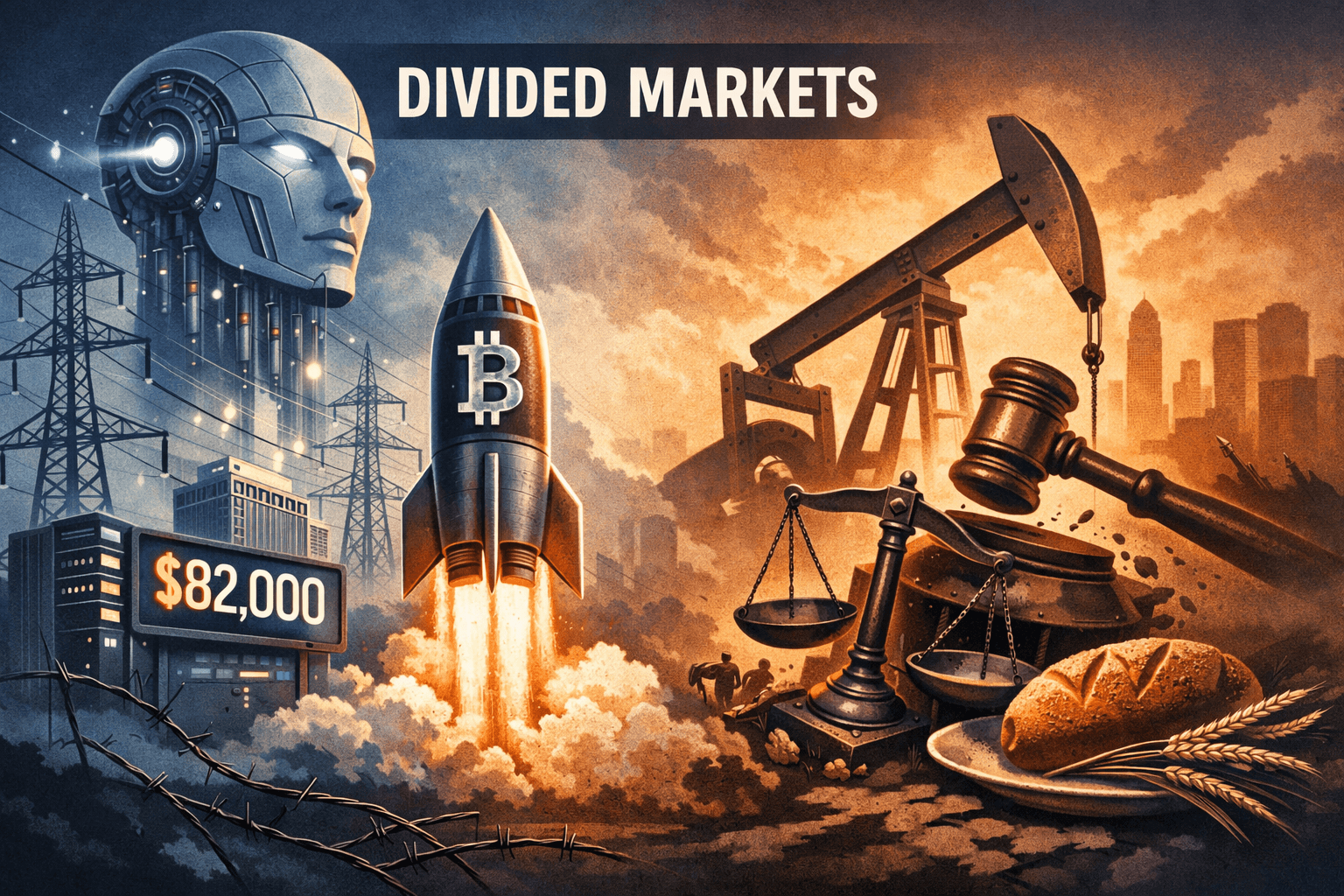
Markets woke to a day of divergent sector stories on May 6: an institutional-driven rally in cryptocurrency (Bitcoin nudging toward $82,000) and renewed AI- and infrastructure-led momentum in technology and utilities sat alongside stress in energy markets driven by Middle East routing shifts and an uptick in regulatory and legal risks across cannabis, crypto and banking. Large strategic moves — Bayer’s $2.45 billion deal for Perfuse, ADNOC’s AED 200 billion awards, and Warner Bros. Discovery’s (WBD) March-quarter loss tied to a breakup fee — punctuated a day in which geopolitics, corporate strategy and rapid technological change all left clear footprints.
Taken together, the cross-section of headlines suggests a market balancing two dominant forces: acceleration in digitization and grid/renewables investment that supports select sectors (tech, utilities, industrials) versus macro and regulatory shocks that amplify volatility in energy, finance and regulated consumer areas (cannabis, healthcare). Analysts note this dichotomy is shaping idiosyncratic stock moves more than broad market-wide trends today.
Important investor note: this article provides analysis and data for informational purposes only. It does not recommend buying, selling or holding any specific security, nor does it offer personalized investment advice.
How sectors grouped today: outperformers, underperformers, and stable
Outperformers (momentum and constructive headlines)
- Cryptocurrency: Bitcoin climbed toward $82,000 on institutional pilots, stablecoin optimism and large fundraises — a clear short-term leadership signal for crypto-related infrastructure and financial products.
- Technology: Strong startup funding, Nvidia-linked infrastructure deals and AI-driven product announcements kept tech flows active (NVDA featured prominently in infrastructure moves; AAPL surfaced with Apple TV content activity).
- Utilities: Grid-scale launches, solar+storage wins and nuclear gains at TVA coupled with private-interest in regulated assets signaled constructive momentum for utilities and energy transition infrastructure.
Underperformers (regulatory, geopolitical or safety headwinds)
- Cannabis: Regulatory pushback in Florida and Louisiana, plus a new lawsuit seeking to roll back federal rescheduling and class-action suits against multistate operators (MSOs) created a risk-off tone.
- Energy: Geopolitical rerouting tied to an announced nine‑week closure of the Strait of Hormuz and volatility in oil forward curves created supply-route and price uncertainty despite big project awards (ADNOC’s AED 200 billion in new contracts) and Fujairah route implications.
- Finance: Food inflation datapoints, a high-profile fintech data-breach lawsuit (Chime) and disputes over stablecoin yields kept regulatory and credit worries front-and-center.
Stable / Mixed (balanced positives and negatives)
- Healthcare: Big-ticket M&A (Bayer up to $2.45B for Perfuse) and AI/payer modernization signals sat next to GLP-1 cost pressure and policy uncertainty; net neutral in headline tone.
- Consumer & Retail: Product innovation and tech integrations were offset by restructuring and mixed same-store results; the sector showed pockets of strength and weakness.
- Materials & Industrial: Recycling and DRI project progress and robotics/automation demand were counterbalanced by industrial accidents, safety concerns and supply-chain constraints; messaging was constructive but cautious.
- Real Estate: Active deal flow, strong leasing in selective submarkets and adaptive reuse momentum contrasted with rent stagnation and localized demand variability.
- Communications & Media: Content market activity and telecom AI plans coexisted with large, headline-making losses at legacy studios (WBD) — mixed but strategically active.
Sector snapshots with context and drivers
Cryptocurrency
- What happened: Bitcoin pushed toward $82,000 amid reports of institutional pilots, bullish forecasts and stablecoin optimism. Exchanges and banks rolled out new products and infrastructure funding continued.
- Why it moved: Data suggests increasing institutional onboarding and productization of crypto (custody, ETFs and treasury services) is translating into renewed price momentum. Legal risks and security (hacks, quantum threats) remain as asymmetric downside risks.
- Key names/metrics: BTC ~ $82,000; exchanges and custody providers featured in headlines.
Technology
- What happened: A mixed trading day overall, but the subsectors tied to AI, data centers and cloud infrastructure had visible tailwinds. Nvidia (NVDA) continued to shape infrastructure deals; Apple (AAPL) showed streaming content momentum for Apple TV.
- Why it moved: AI demand continues to underpin hardware and software spending; potential data-center transactions (a reported possible $30 billion sale) and fresh startup funding buoyed investor interest. Governance and clean-energy concerns at major AI firms added risk to some names.
- Key names/metrics: NVDA, AAPL; data-center deal chatter ~ $30B.
Utilities
- What happened: Renewables, storage and grid projects advanced with EDAM's western launch and rising nuclear share at TVA. Private capital interest surfaced in Cleco and TXU's EV charging program.
- Why it moved: Policy clarity (ITC guidance on safe-harbor), grant/contract flows and continued utility-scale procurement are underpinning earnings visibility for regulated and contracted projects. Private-buyout chatter points to valuation disconnects between regulated cash flow and broader equity market multiples.
- Key names/metrics: Cleco (M&A interest), TXU (EV program), EDAM launch.
Energy
- What happened: The market digested a reported nine-week closure of the Strait of Hormuz, forcing rerouting toward Fujairah, while ADNOC announced AED 200 billion in new awards. Oil prices were volatile amid U.S.-Iran negotiation reports.
- Why it moved: Physical-route disruptions raise freight and insurance costs and complicate refining feedstock logistics; at the same time, long-cycle project awards (ADNOC) reflect continued capital flow into upstream and midstream capacity. Short-term price direction remains driven by geopolitical headlines and supply reallocation.
- Key names/metrics: ADNOC AED 200B; Fujairah logistics re-routing; oil futures volatility.
Finance
- What happened: Food inflation readings and a prominent Chime data-breach lawsuit grabbed headlines, while debates over stablecoin yields and regulator-bank friction continued.
- Why it moved: Higher food inflation can pressure consumer credit quality and margins for low-fee deposit providers. Data-breach litigation raises reputational and remediation cost questions for fintechs; regulatory scrutiny around stablecoin returns is creating uncertainty for deposit-replacement products.
- Key names/metrics: Chime lawsuit; stablecoin regulatory debates.
Healthcare
- What happened: Bayer agreed to buy Perfuse for up to $2.45 billion; Medicare and payer modernization news, interoperability and GLP-1 pricing pressure were also in focus.
- Why it moved: Large strategic M&A shows incumbents are buying targeted capabilities (Perfuse’s assets) to defend pipelines and expand biologics/oncology offerings. Payer modernization and interoperability can reduce cost and friction but heighten pricing scrutiny.
- Key names/metrics: Bayer up to $2.45B for Perfuse; GLP‑1 pricing debates.
Materials & Mining
- What happened: Recycling and DRI (direct reduced iron) progress drove headlines; uranium permitting and Namibian license deals signaled mineral-security positioning even as industrial accidents and a deadly mine blast spotlighted safety and geopolitical risks.
- Why it moved: Policy focus on critical minerals and recycling tailwinds support long-term demand for certain materials, but safety incidents can catalyze near-term supply shocks and regulatory tightening.
- Key names/metrics: $5M loan for recycled plastics; Namibian licence deals; uranium permitting.
Real Estate
- What happened: A flurry of transactions — from Dick’s (DKS) House of Sport entry in California to a $110 million hotel refinancing — and pockets of strong office and adaptive reuse leasing were reported.
- Why it moved: Localized demand pockets (student housing, adaptive reuse) underpin transaction activity despite national rent stagnation. Lenders appear willing to refinance select assets with strong cash flow or repositioning potential.
- Key names/metrics: Dick’s (DKS); $110M hotel refinance.
Consumer & Retail
- What happened: AI product pushes (Wayfair), brand expansions (Superfeet), and labor stories (REI) produced a mixed picture; impairments and restructuring at some retailers introduced countervailing pressure.
- Why it moved: Retailers investing in AI and supply-chain efficiencies may preserve margins, but cyclical consumption and wage pressures continue to affect results unevenly across subsegments.
- Key names/metrics: Wayfair AI initiatives; REI labor unrest.
Communications & Media
- What happened: Warner Bros. Discovery (WBD) posted a large March-quarter loss tied to a breakup fee while studios and streaming displayed content-strength; Cannes market activity drove pre-sales and telecoms unveiled AI plans.
- Why it moved: Legacy media companies remain exposed to heavy restructuring and one-time costs, while streaming and content monetization show resilience. Telecoms are retooling around AI and infrastructure partnerships.
- Key names/metrics: WBD loss; Cannes content-market dynamics.
Industrial & Manufacturing
- What happened: P&G (PG) warned of a $150 million hit tied to supply disruptions from the Iran war; automation, drone makers and AI-related industrial product demand saw positive headlines.
- Why it moved: Supply-chain disruptions increase input costs and margin risk for consumer staples; conversely, industrial automation and AI investments aim to raise efficiency and reduce labor dependence.
- Key names/metrics: P&G $150M hit; growth in robotics/automation demand.
Cross-sector themes and correlations
- AI and data center demand is a multi-sector growth engine
- Technology, communications, industrials and real estate (data-center real estate) are jointly benefitting from AI-related capex. Reported Nvidia-backed infrastructure deals and chatter of a potential $30 billion data-center transaction underscore that compute and real-estate are increasingly correlated.
- Geopolitics is reasserting a cross-asset influence
- Energy routing changes (Strait of Hormuz closure, Fujairah refocus), P&G’s Iran-related supply hit and mining safety/geopolitical license moves show that geopolitical events are cascading into supply-chain, commodity and corporate margin volatility.
- Regulatory and legal risk is a shared constraint
- Cannabis rescheduling litigation, a Chime data‑breach suit, stablecoin yield disputes and healthcare drug‑pricing scrutiny demonstrate that legal/regulatory developments are a persistent, cross-sector source of event risk.
- Infrastructure and private capital are chasing yield and stability
- ADNOC awards, Cleco private-buyout interest and strong utilities project wins reflect private/public capital flowing into long-duration, low-beta assets even as public equities adjust to differing multiples.
- Safety and ESG operational risks are market-moving
- Mining accidents and industrial explosions have both humanitarian and supply implications. ESG- and risk-focused investors are increasingly pricing operational safety as an earnings and valuation factor.
The most significant moves — deeper context
Bitcoin approaching $82,000: The renewed institutional push (ETF and custody pilots, stablecoin infrastructure) is translating into price leadership for crypto. Market mechanics — concentrated ownership, leverage and fund flows — mean that tail events (regulatory enforcement or large-scale hacks) remain high-impact risks despite the positive narrative.
ADNOC AED 200 billion awards: This level of awards signals sustained upstream and midstream capital deployment in the Middle East. For global oil markets, it suggests continued investment in capacity, although near-term routing disruptions will shape where and how product moves to market.
Warner Bros. Discovery’s large loss: WBD’s reported March-quarter loss tied to a breakup fee is a reminder that content-heavy legacy studios carry restructuring and one-off risks even as streaming and licensing show underlying strength. Media consolidation and content pre-sales (Cannes) are reshaping revenue models.
Bayer’s Perfuse acquisition ($2.45B deal): Big-pharma deal activity signals a trend of incumbents buying innovation rather than relying solely on internal R&D. This can accelerate pipeline growth but also concentrate integration risk and near-term cash outflows.
P&G’s $150M Iran-impact hit: Consumer staples’ exposure to geopolitical supply chains is tangible. Even large, diversified firms like PG face identifiable one-off costs stemming from regional conflicts, which can pressure margins in the near term.
Actionable insights for investors (analysis, not recommendations)
Reassess exposure to geopolitically sensitive supply chains: Data suggests that energy routing changes and regional conflicts translate quickly into logistics and input-cost disruptions. Analysts note that portfolios with concentrated exposure to Gulf shipping routes, refinery feedstocks or single-source suppliers should re-evaluate contingency plans and scenario analyses.
Monitor AI-capex and data-center supply chains: Tech hardware, semiconductor names (NVDA) and data-center REITs are increasingly correlated. Track indicators such as server orders, hyperscaler capex guidance and reported data-center M&A to gauge near-term demand momentum.
Price regulatory risk into high‑beta sectors: Cannabis, fintech (stablecoins) and certain healthcare subsegments face headline-driven volatility. Scenario planning around court outcomes, state ballot measures and regulator actions can help stress-test allocations.
Consider duration and private-capital dynamics: ADNOC’s large awards and private interest in regulated utilities (Cleco) indicate a bifurcation between public-equity multiples and private transactions valuing steady cash flows. For longer-term allocation, investors may want to model returns on a total‑capital basis, accounting for potential buyouts and repricing events.
Watch for safety and ESG operational shocks: Mining accidents and industrial incidents can rapidly impair supply and earnings. Analysts increasingly incorporate operational risk indicators (safety audits, inspection results) into valuation models for materials and industrial holdings.
Keep liquidity and contingency plans for crypto exposure: Crypto markets remain prone to rapid directional moves driven by flows and product launches. Institutions note the importance of custody, counterparty risk assessment and scenario planning for extreme volatility.
Sector-specific watchlist for the next 48–72 hours
- Crypto: Exchange/product rollouts, ETF/institutional custody pilot updates and any major security incidents.
- Energy: Further developments on Strait of Hormuz routing, ADNOC project milestones and U.S.-Iran diplomatic reporting that could shift oil volatility.
- Technology: NVDA guidance and data-center M&A signals; any governance/clean-energy disclosures from major AI players.
- Utilities: Regulatory guidance (ITC safe-harbor), EDAM rollout developments and private M&A headlines involving regulated assets.
- Finance: Legal developments around the Chime suit and stablecoin regulatory guidance.
- Cannabis & Legal: Court filings related to federal rescheduling and MSO class-action progress.
Conclusion — forward-looking perspective
May 6 underscored a bifurcated market where structural growth drivers (AI, grid modernization, recycling and data-center expansion) coexist with acute, headline-driven shocks (geopolitics, regulatory litigation, industrial accidents). That combination is producing idiosyncratic sector leadership — crypto and AI-linked tech names led upward momentum — while traditional cyclical sectors and regulated, litigation-prone areas lagged.
Looking ahead, the balance between these forces will likely hinge on three key dynamics: 1) the pace and composition of AI and data-center capital expenditure (which can lift a broad swath of tech, industrial and real-estate-related equities); 2) geopolitical stability in key transit corridors and supplier regions (which drives energy, materials and consumer-staple inputs); and 3) the regulatory/legal calendar across cannabis, fintech and healthcare (which can produce outsized valuations swings for affected companies).
In the near term, market participants should expect continued dispersion: days when risk-on flows (as we saw in crypto and parts of tech) dominate, and days when defensive positioning dominates amid headline shocks. Analysts underscore that staying disciplined on risk management, monitoring cross-sector correlations and maintaining a clear view of liquidity and counterparty exposure will be critical as markets navigate this hybrid environment of structural growth and episodic risk.
Investment disclaimer: This piece is for informational purposes only. It does not constitute investment advice or a recommendation to buy, sell, or hold any security. Readers should consult a qualified financial advisor for personalized guidance.
Sources
+ 14 more sources
Use these insights — enter this week's contest.
Free practice contests — earn Alpha CoinsExplore More Content
Disclaimer: StockAlpha.ai content is for informational and educational purposes only. It is not personalized investment advice. Sentiment ratings and market analysis reflect data-driven observations, not buy, sell, or hold recommendations. Always consult a qualified financial advisor before making investment decisions. Past performance does not guarantee future results.