 Sector Insights
Listen to this Recap
9:46
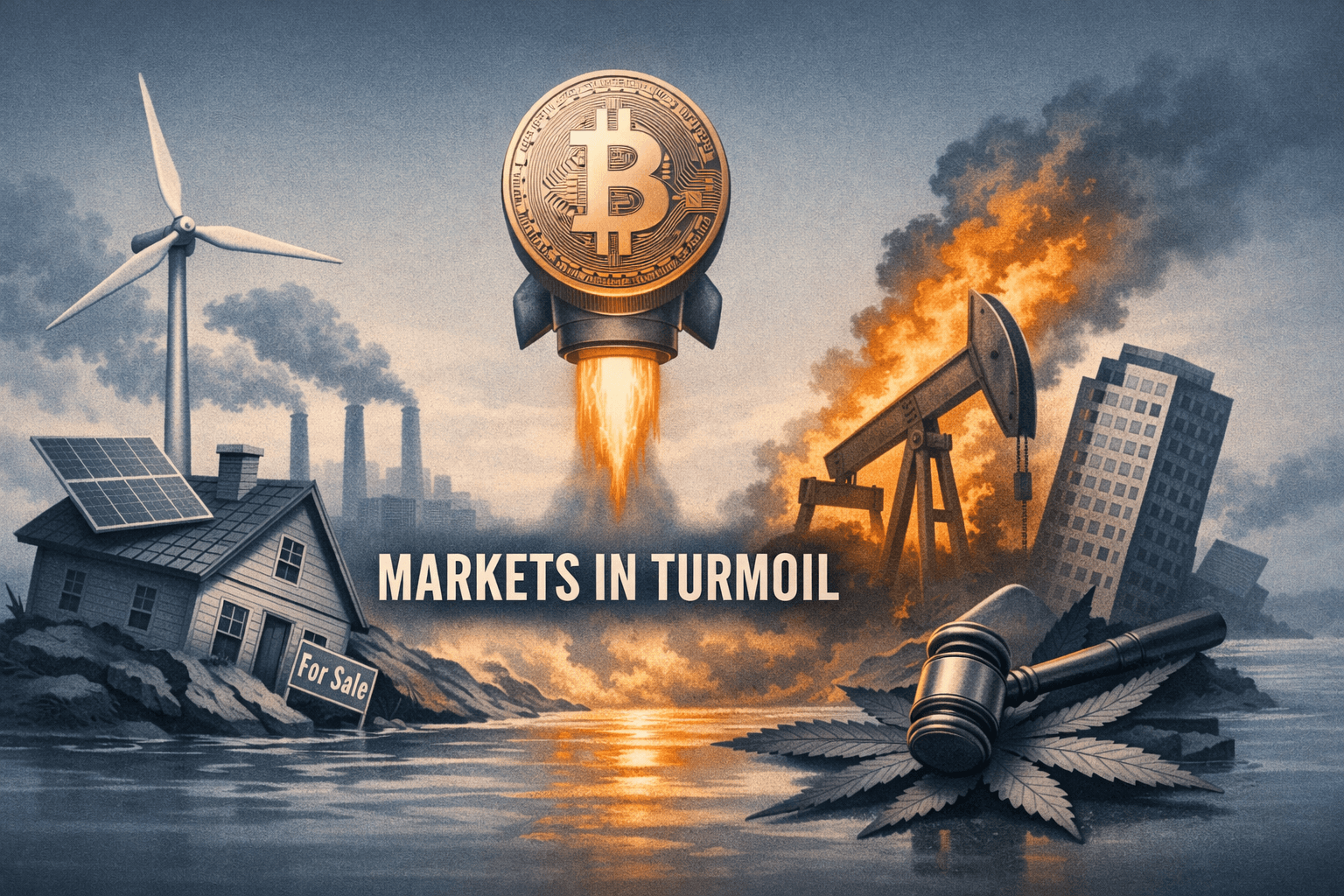
Crosswinds and Breakouts: Bitcoin Hits $80k as Oil Spikes, Renewables Win Amid Policy Headaches — A May 4 Sector Recap
Podcast • Loading audio...
Share this article
Spread the word on social media
Key Takeaways
- •Bitcoin’s move above $80,000 and oil’s spike to ~$114 were the day’s dominant cross-asset drivers, affecting energy, finance and risk-sensitive sectors.
- •Renewables and grid-technology wins (DOE funding, pumped-storage orders) offset some energy-policy headwinds, creating a bifurcated energy/utility landscape.
- •Cannabis and parts of real estate were headline-sensitive: litigation and regulatory scrutiny compressed near-term upside.
- •AI adoption continues to lift parts of tech, but export controls and proposed U.S. AI oversight introduced meaningful operational and compliance risks.
- •Corporate actions (GameStop’s $56B bid for eBay; Amazon’s logistics push) are reshaping competitive dynamics in retail and communications.
Executive summary
Markets arrived at May 4 with a mix of powerful single-asset moves and broad-sector rotations. The two clearest intraday headlines were a renewed crypto advance — Bitcoin briefly cresting $80,000 — and an oil-price spike that pushed benchmarks to about $114 a barrel amid Middle East tensions. Those cross-asset moves rippled across financials, energy and risk-sensitive cyclical names.
At the same time, structural themes continued to drive individual sectors: renewable project wins, grid-technology orders and DOE funding lifted utilities and some industrial names; box-office strength and streaming headlines buoyed communications and media; and AI-related developments presented a split tape for technology, with adoption news at odds with fresh oversight proposals. Meanwhile, several sectors — notably cannabis and parts of real estate — were weighed by legal and regulatory developments that may compress upside until clarity arrives.
This note groups sector performance, connects the thematic threads, highlights the day's biggest moves with context, and closes with investor-oriented signals and a forward-looking view. Data and quotes below are drawn from the day’s coverage and market action; the analysis is intended for informational purposes only.
Performance grouping: outperformers, underperformers, stable
Outperformers
- Crypto: Bitcoin broke above $79,500 and spiked to the $80,000 level intraday (roughly +0.6% from $79,500). Momentum around a Clarity Act compromise in Washington and stronger ETF flows powered the move. DeFi headlines still raised idiosyncratic risks.
- Communications & Media: Box-office surprises and strong content news — plus positive streaming metrics for major platforms — helped the sector outpace peers. Disney (DIS) and Netflix (NFLX) headlines helped lift mood across media names.
- Utilities (select renewables & grid tech): Federal funding, a pumped-storage order tied to GE Vernova and Dominion’s offshore progress pushed select utilities and grid-tech suppliers higher as investors rotated into infrastructure and reliability plays.
Underperformers
- Cannabis: Two countervailing forces — renewed federal rescheduling chatter and New York openings versus legal pushes over hemp THC and state THC caps — left the sector volatile and sentiment fragile. Lawsuits and court challenges added downside risk.
- Real estate: Regulatory scrutiny of home equity investments, housing-policy debates and mixed consumer sentiment dented the sector’s near-term outlook. Financing flows remained active, but policy risk compressed some names.
- Healthcare (certain subsectors): The sector delivered mixed clinical wins but was hit by regulatory and legal items — fines for certain weight-loss ad practices and rising bankruptcies among smaller providers — generating uneven returns.
Relatively stable / mixed performers
- Technology: A split tape — strong app adoption (image-AI growth) and large fundraises on one hand; U.S. AI oversight plans and security incidents on the other — left the sector rangebound overall.
- Energy: Oil’s surge to ~$114 was a tailwind for many upstream names, but policy moves that paused or froze 165 U.S. wind projects and shifting EV demand indicators produced a bifurcated profile across fossil- and clean-energy subgroups.
- Industrial & Materials: Deal activity, automotive capex and early Industry 4.0 adoption supported select industrial and materials names, though results were heterogeneous across miners and recyclers.
Cross-sector themes and correlations
Geopolitics drives cross-asset volatility: Oil at ~$114 — driven by renewed Middle East disruptions — was the clearest reminder that geopolitical shocks remain the primary cross-sector correlation. Higher oil lifts energy producers, raises input costs for transport-heavy sectors (consumer discretionary, industrials, materials) and can pressure margins for logistics-intensive retailers. Finance names also face credit and market-risk implications as energy-driven inflation and volatility feed through.
Renewables and grid resilience as structural offset: DOE funding for hydropower, a GE Vernova pumped-storage order and Dominion’s offshore progress illustrate the policy-and-capex tailwinds underpinning parts of utilities, industrials and materials. That flow of capital is supporting project developers, equipment suppliers and grid-software firms even as some policy decisions (e.g., temporary freezes on wind projects) create near-term churn.
Crypto’s institutionalization continues to move pockets of alpha: Bitcoin’s push above $80k was supported by a legislative compromise on crypto clarity and continued spot-Bitcoin ETF inflows. That rallies not just crypto coins but also ancillary equities — miners, exchanges and custody providers — and lifts risk-on appetite in small-cap technology names. However, DeFi hacks and legal disputes (Aave court fight, frozen ETH disputes) illustrate concentrated tail risk.
AI’s double-edged sword for technology and more: App adoption for image-AI and a large crypto fundraise pushed sentiment for certain tech subsectors, but proposed U.S. AI oversight measures and bipartisan safety calls created regulatory overhang. Nvidia’s comment that China accelerator share has fallen to zero — a direct consequence of export-control regimes — underscores how geopolitics and policy are reshaping supply chains for chips and hardware.
Corporate actions and M&A reverberate across consumer and communications: GameStop’s surprise $56 billion bid for eBay (GME’s headline and EBAY as target) and Amazon (AMZN) opening its logistics network shifted attention to industry consolidation, distribution advantages and the strategic value of platform control. Such deals raise valuation questions across retailers and logistics providers.
Legal & regulatory risk compressing speculative pockets: Cannabis and certain health-adjacent businesses saw legal pressures intensify (THC legal risk, lawsuits, fines for weight-loss ads). For sectors where licensing, state rules or consumer protections are decisive, headline risk can dominate fundamentals until legal clarity emerges.
Most significant moves — the what, why and context
- Bitcoin: breakout above $80,000
What: Bitcoin moved from roughly $79,500 to $80,000 intraday, a modest but psychologically notable break past the $80k mark. Why: A combination of legislative momentum — lawmakers advancing a Clarity Act compromise — and continued spot-Bitcoin ETF inflows supported demand. Institutional licensing progress and a more constructive regulatory tone also reduced a key overhang. Context and ripple effects: The move boosted crypto-related equities and renewed appetite for risk assets. That helped mid-cap tech and fintech names that are correlated with digital-asset activity. But DeFi security incidents and ongoing litigation (Aave court fight, frozen ETH disputes) kept volatility elevated and limited a broader risk-on surge.
- Oil: surge to about $114 per barrel
What: WTI crude pushed toward $114 amid Middle East attacks and supply concerns. Why: Geopolitical flare-ups in a region that still represents a sizable share of seaborne crude sparked risk premia and near-term supply fears. LNG tightness headlines and delayed supply also contributed. Context and ripple effects: Energy producers and service names outperformed; higher fuel costs raised cost pressures in transport-intensive sectors (consumer discretionary, industrials). Defense-related industrials saw speculative interest. For policymakers and central bankers, sustained oil strength adds to inflation risk considerations.
- Renewables and grid wins: DOE funding, GE Vernova pumped-storage order, Dominion offshore progress
What: Multiple funding and contract announcements — from DOE hydropower funding to a pumped-storage order tied to GE Vernova — supported select utilities and suppliers. Why: Policy and capital allocation toward grid reliability and renewables continue despite headline policy hiccups in wind permitting. Project finance and federal grants mitigate risk for long-duration storage and offshore projects. Context and ripple effects: Equipment makers, specialty materials providers and grid-software vendors saw positive flow; utilities with large renewables/ storage pipelines attracted rotation from income-focused accounts seeking growth and regulatory insulation.
- Communications & media tailwinds: box-office and streaming momentum
What: Box-office hits and ramping content production lifted media names; Disney (DIS) and Netflix (NFLX) headlines were notable. Why: Strong theatrical performance coupled with recurring subscriber or engagement metrics reinforced narratives around content monetization and franchise strength. Context and ripple effects: Advertising and distribution partners, cinema chains and content supply industries saw follow-through. Regional box-office strength in India and Korea also emphasized the importance of global distribution slots for major content owners.
- GameStop’s $56B bid for eBay + Amazon logistics opening
What: GameStop’s headline $56 billion proposal for eBay and Amazon’s move to open its logistics network were large corporate strategy stories. Why: The bid underscores activist or strategic consolidation aimed at platform control; Amazon’s logistics initiative further institutionalizes the company’s fulfillment moat. Context and ripple effects: Retail logistics providers, third-party sellers, and marketplace-native businesses may face renewed margin and competition pressures. The M&A chatter boosted speculative activity across small-cap retail and e-commerce names.
- Tech regulation and export-control dynamics: Nvidia and AI oversight
What: Nvidia (NVDA) noted that its China accelerator share has fallen to zero while U.S. policymakers proposed new AI oversight targets. Why: Export controls and geopolitical tensions are reshaping the hardware market; lawmakers are responding to the pace of AI commercialization with new oversight ideas. Context and ripple effects: Hardware suppliers with reputational or geopolitical exposure face increased business-model risk; software and cloud providers may see demand reallocated domestically as multinational customers manage compliance.
- Cannabis legal headwinds
What: A mixture of federal rescheduling chatter, New York retail openings and lawsuits over hemp THC and state caps produced a volatile day. Why: While rescheduling can be seen as long-term positive, litigation and state-level THC caps create near-term uncertainty around inventory, labeling and licensing. Context and ripple effects: Operators with multi-state footprints and diversified product sets weathered the day better than single-state or heavily hemp-exposed names. Investors remain focused on legal clarity and state-level regulation outcomes.
Actionable insights and signals for investors (informational only)
- Watch cross-asset triggers carefully
- Why it matters: Oil and Bitcoin remain potent cross-sector influencers. A sustained move in either can change risk premia quickly across equities and fixed income.
- Signal to monitor: Geopolitical headlines, shipping/Strait-of-Hormuz developments, and the pace of spot-Bitcoin ETF inflows. Momentum in ETF flows often precedes broader equity re-rating for correlated names.
- Separate renewables winners from policy-exposed losers
- Why it matters: The clean-energy theme is intact but uneven. Federal funding and large-scale orders (storage, offshore wind where permitted) are catalyzing capex and supplier order books, while permitting and local policy can stall individual projects.
- Signal to monitor: Contract awards, DOE funding announcements, permitting news and project cancellations or freezes (the day’s note of ~165 frozen wind projects is a salient example). Those specifics matter far more than headline sector narratives.
- Treat crypto rallies as event-driven with persistent tail risk
- Why it matters: Rapid regulatory or legal developments (Clarity Act-style compromises versus DeFi litigation) can flip flows in and out of the asset class quickly.
- Signal to monitor: ETF flows, major court decisions (Aave, frozen ETH disputes), and legislative timelines. Correlated equity baskets (miners, exchanges, custody providers) can amplify gains and losses.
- Factor AI oversight into T1/T2 adoption timelines
- Why it matters: Adoption of AI by apps and cloud providers continues apace, but regulatory proposals introduce implementation and compliance costs that vary by vendor scale and cloud-dependency.
- Signal to monitor: Policy progress on AI oversight, export-control declarations affecting hardware suppliers (NVDA’s China note is a case in point), and enterprise adoption metrics such as bookings and ARR growth for software providers.
- For cyclical exposure, track commodity pass-through and logistics costs
- Why it matters: Oil moves and logistics changes (Amazon opening its network) change margin dynamics for retailers and industrials.
- Signal to monitor: Freight indices, diesel/jet-fuel spreads, and company-level gross-margin commentary in near-term updates.
- Legal and regulatory timelines matter more than headlines for fragile sectors
- Why it matters: Cannabis and certain consumer-health subsegments are valuation-sensitive to legislative and court outcomes. Headlines can trigger large re-pricings independent of cash-flow trajectories.
- Signal to monitor: Court dockets, state-level rule deadlines, and enforcement actions (fines, licensing revocations). Small changes in legal outcomes can disproportionately affect market valuations.
Notable stock/ticker mentions and data points from the day
- Bitcoin (BTC): moved from $79,500 to briefly $80,000 (+0.6% intraday from the cited pivot).
- GameStop (GME): headline $56 billion proposal to acquire eBay (EBAY as the target).
- Nvidia (NVDA): reported its China accelerator share has fallen to zero amid export controls.
- Enphase (ENPH): cited for AI-enabled power-management advances in home energy systems.
- GE-related orders: GE Vernova tied to a pumped-storage order supporting grid resilience; Dominion Energy (D) noted offshore progress.
- Oil (WTI): climbed toward $114 on Middle East-related supply concerns.
Note: This is a summary of the day’s news flow and market implications. The above tickers and price references are included for context; they are not recommendations.
Risks and what could change the story tomorrow
- Geopolitical escalation or de-escalation: Any meaningful change in Middle East tensions could reverse the oil move and reprice risk assets.
- Legislative outcomes: If Congressional negotiation on crypto clarity stalls or accelerates, Bitcoin and related equities could see outsized moves.
- Permitting and regulatory decisions: Government action on wind projects or new energy-policy enforcement could cause sharp re-rating in parts of the utilities and renewables supply chain.
- Corporate surprise actions: Large M&A developments (e.g., a bid succeeding or being withdrawn) or earnings that diverge materially from expectations in retail and media could rapidly change sector correlations.
- AI policy and export-control shifts: Additional export restrictions or new oversight rules could alter supply chains for semiconductors and hardware, with second-order effects for cloud and software providers.
Conclusion — forward-looking perspective
May 4 reinforced a market landscape defined by a handful of high-impact cross-asset moves layered atop structural secular trends. Bitcoin’s move above $80,000 and crude’s surge toward $114 are the immediate storylines that propagated through energy, finance and risk-sensitive cyclicals. At the same time, the continued policy and capital tilt toward renewables, storage and grid modernization provides a durable growth corridor for utilities, industrial suppliers and materials vendors tied to clean-energy buildout.
Investors should expect ongoing dispersion: sectors tied to explicit policy or legal outcomes (cannabis, certain parts of healthcare and real estate) will likely remain headline-driven and episodically volatile, while pockets of technology and industrials anchored to AI adoption and infrastructure spending may produce steadier multi-quarter narratives. Crypto’s institutionalization has increased its market contagion, but idiosyncratic risks remain acute.
In the near term, the market’s direction will hinge on geopolitical developments, the trajectory of ETF flows and legislative progress on key regulatory items. Those external drivers will determine whether today’s rotations consolidate into broader sector trends or reverse as liquidity seeks different pockets of opportunity.
Investment disclaimer: This article is for informational purposes only. It does not constitute a recommendation to buy, sell or hold any security, nor is it personalized investment advice. Analysts note these are market observations and signals; individual investors should consult a licensed financial professional about their specific circumstances before making investment decisions.
Sources
+ 14 more sources
Use these insights — enter this week's contest.
Free practice contests — earn Alpha CoinsExplore More Content
Disclaimer: StockAlpha.ai content is for informational and educational purposes only. It is not personalized investment advice. Sentiment ratings and market analysis reflect data-driven observations, not buy, sell, or hold recommendations. Always consult a qualified financial advisor before making investment decisions. Past performance does not guarantee future results.