 Sector Insights
Listen to this Recap
11:54
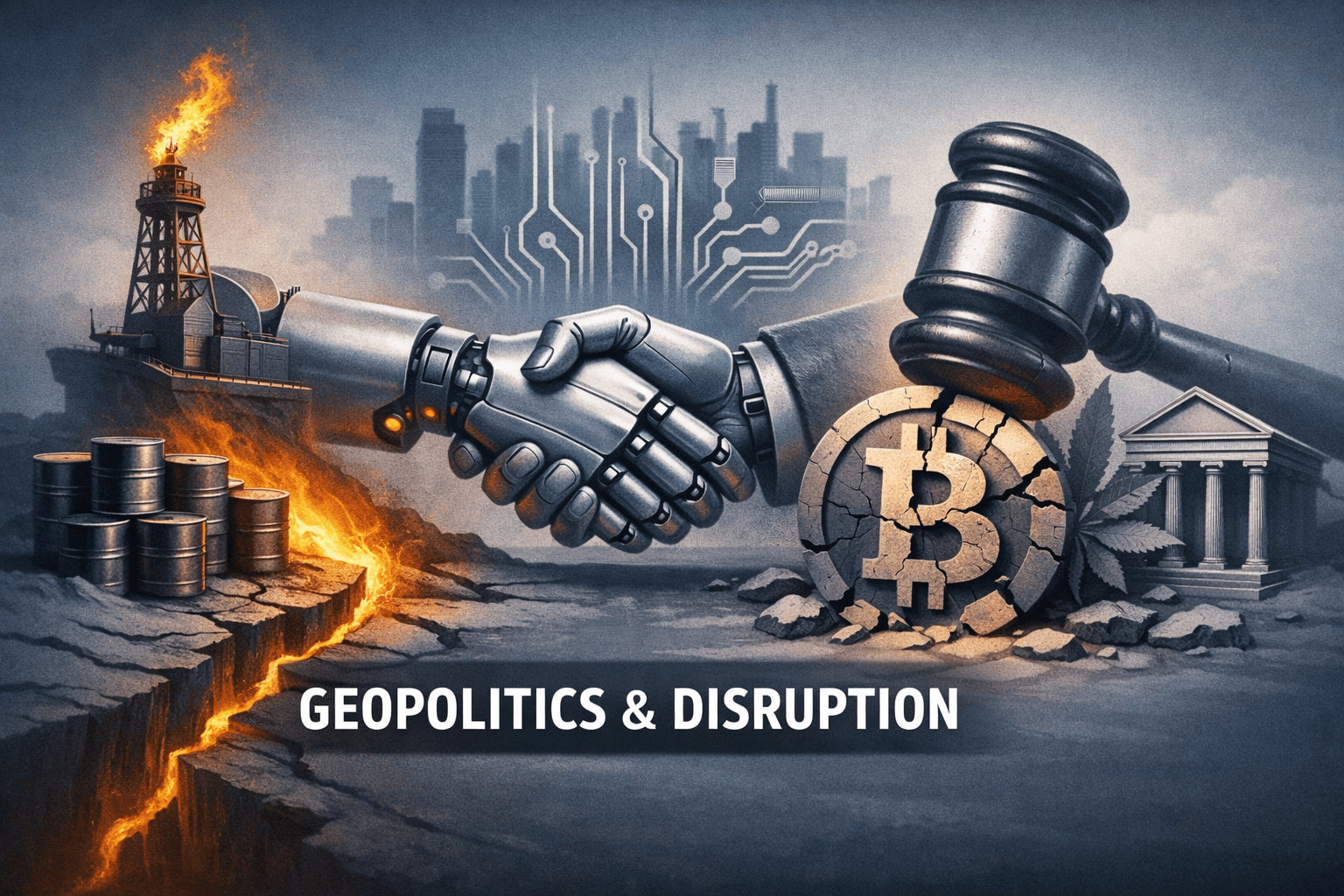
Oil Surges, AI Deals and Regulatory Shockwaves: Markets Pivot on Geopolitics and Policy — Apr 24 Recap
Podcast • Loading audio...
Share this article
Spread the word on social media
Key Takeaways
- •Energy led markets as Brent approached $106/bbl and U.S. crude crossed $100, re‑pricing supply risk and lifting energy and service names.
- •Big AI transactions — Alphabet’s ~$40B Anthropic pact and Cohere‑Aleph with $600M backing — are accelerating platform consolidation and downstream demand for data centers and infrastructure.
- •Regulatory and enforcement headlines (a $344M USDT freeze tied to Iran; hemp THC debates; banking scrutiny) produced outsized volatility in crypto, cannabis and parts of finance.
- •Materials, industrials and miners gained on green transition investments (Fortescue ~$680M, recycling and project awards), tying them to both energy and tech capex cycles.
- •Near‑term strategy should focus on policy‑dependency, exposure to oil price scenarios, AI consolidation winners and stress‑testing liquidity for enforcement events.
Executive summary
Markets opened and closed Tuesday under two competing forces: a geo‑political shock to energy supply that pushed crude above $100 a barrel (Brent topping about $106) and a fresh wave of large, strategic AI and industrial deals that are re‑shaping technology and manufacturing supply chains. Those bullish impulses collided with heightened regulatory pressure — most visibly in crypto (a $344 million USDT freeze tied to Iran, new sanctions and enforcement chatter) and cannabis (federal hemp THC control debates and state‑level reversals) — and with political scrutiny circling financials.
The result was a mixed tape: clear outperformers in energy, parts of technology and materials; pressured pockets in crypto, cannabis and certain financial subsectors; and a broad middle of more defensible sectors — healthcare, real estate and utilities — that posted muted reactions as investors parsed fundamental signals against policy risk. Earnings, large corporate deals and policy notes provided near‑term catalysts; they also underscored an emerging market narrative in which geopolitics and regulation are re‑pricing risk faster than macro data is changing.
Key numbers and headlines from Apr 24 you should know:
- Brent crude traded above $106/bbl, U.S. crude crossed $100/bbl during the session. Energy names rallied on supply‑risk repricing.
- Google/Alphabet announced a $40 billion strategic pact tied to Anthropic, intensifying AI platform consolidation.
- Cohere agreed to merge with Germany's Aleph Alpha with a planned $600 million commitment from Schwarz Group, signaling cross‑border AI industrialization.
- Crypto enforcement headlines included a $344 million USDT token freeze linked to Iran and fresh sanctions activity; spot Bitcoin ETF flows remain in the background.
- Materials and mining saw capital flow into green energy and critical minerals; Fortescue committed roughly $680 million to battery and minerals initiatives.
- Industrial sector moves included a Skydio buildout (reported at $3.5 billion) and a $2.5 billion supplier takeover, underscoring manufacturing expansion and consolidation.
- Healthcare mixed: a landmark gene‑therapy approval competed with execution pressures at large pharmas (notably a rough week for $LLY).
This note groups sector outcomes, draws cross‑sector themes, highlights the day’s most consequential moves, and outlines actionable, non‑prescriptive insights investors can use when re‑setting portfolio exposures.
Grouping by performance: outperformers, underperformers, stable
Outperformers
- Energy: Driven by a supply shock and geopolitical escalation in the Middle East, oil benchmarks jumped (U.S. crude > $100/bbl, Brent ~ $106). Upstream producers, refiners and energy services rallied on widening risk premia and near‑term tightening in shipping and insurance costs. Data from Baker Hughes showing stronger LNG demand compounded optimism in energy services and midstream names.
- Technology: Large strategic deals — notably Alphabet’s $40 billion Anthropic pact, Cohere‑Aleph merger with $600 million backing, and ComfyUI’s reported $500 million valuation — fueled M&A and investment optimism in AI platforms and foundational models. Infrastructure names and chipmakers with AI exposure showed strength, especially those tied to cloud, data‑center buildouts and inference hardware.
- Materials & Mining: Money flowed to critical minerals, battery recycling and green energy projects. Fortescue’s $680 million commitment and several project awards and partnerships pushed miner and recycler sentiment higher.
- Industrials: Big factory builds, automation and defense/aircraft supplier activity — a Skydio $3.5 billion buildout and a $2.5 billion supplier takeover — drove industrial capex and M&A optimism.
Underperformers
- Crypto: Enforcement headlines — a $344 million USDT freeze associated with Iran, sanctions news and a quantum cryptography alert — created headwinds despite ongoing ETF flows into spot Bitcoin products. Regulatory risk dominated headlines and pressured sentiment.
- Cannabis: A mixed policy landscape (federal hemp THC debates, Virginia rejecting a sales amendment, Texas delays) plus uneven Canadian retail data left the space directionless and sensitive to policy timelines.
- Finance & Banking: Political scrutiny, spiking headlines around dropped or reopened inquiries, and uneven earnings commentary created volatility. Banks faced mixed reactions as analysts parsed deposit trends and energy‑related loan exposure.
Stable / Mixed
- Healthcare: Scientific advances (a landmark gene‑therapy approval and faster FDA review pathway for psychedelics) offset commercial and execution risks at large pharmas and system strains (ED boarding, climate‑linked health risks). Neutral overall.
- Real Estate: Major lease deals, mortgage market commentary and signs of CRE resilience suggested a potential trough in mortgage activity even as investors watch financing conditions closely.
- Utilities: Nuclear approvals, storage pilots and grid upgrades produced a steady flow of project news; defensive demand remained intact.
- Consumer & Communications: Mixed retail execution, leadership changes and festival/box office noise in media kept these groups near the flatline.
Cross‑sector themes and correlations
Geopolitics is an amplifier: Energy, shipping, insurance and commodity markets moved together as Iran‑related headlines and Hormuz tensions pushed Brent toward $106. The energy price move correlated with risk repricing in finance (loan exposures, margin pressure for energy counterparties) and with swaps/derivatives pricing that affects real‑estate and corporate borrowing costs.
Regulation is a structural risk factor again: Crypto and cannabis were the clearest examples, but financial and communications sectors also felt regulatory spillovers (DOJ posture, antitrust scrutiny, media content regulation). Enforcement headlines — token freezes, sanctions, federal THC control debates — are rapidly re‑setting valuations in sectors where policy drives revenue and access.
AI consolidation drives breadth in tech and materials demand: The $40 billion Alphabet‑Anthropic pact and Cohere‑Aleph cross‑border deal demonstrate platform concentration and sovereign interests in model ownership. This ripples into materials (demand for high‑performance chips and cooling), data centers (real‑estate demand), utilities (grid stress from electrified compute) and industrials (automation for data center hardware). The correlation between tech M&A and industrial capex was visible in the Skydio and supplier deals.
Energy transition remains capital‑intensive and materials‑heavy: Fortescue’s $680 million commitment and multiple mining project awards underscore that battery and critical minerals markets are capitalizing quickly. That ties materials, industrials and energy together: higher oil prices can complicate miners’ cost bases while increasing incentives to accelerate domestic recycling and localization of supply chains.
Policy timing shapes near‑term volatility: Several catalysts have explicit calendars — hemp THC rulemaking in Washington, federal rescheduling/implementation logistics for medical cannabis, key sanctions timelines, and impending earnings and M&A close dates. Markets are pricing moves ahead of these events, so volatility is likely to concentrate around policy readouts.
What moved the tape: the most significant developments (and why they matter)
Alphabet’s $40B Anthropic pact
- What happened: Alphabet disclosed a roughly $40 billion strategic commitment tied to Anthropic (details center on cloud, compute commitments and model commercialization).
- Why it matters: This is a scale play on foundational models. It accelerates platform consolidation, gives Alphabet a stronger moat against cloud competitors, and raises the bar on compute capacity demand. Expect upward pressure on data‑center real‑estate and power demand (utility and industrial linkages) and renewed investor focus on AI revenue pathways for enterprise software and chip vendors.
Brent and WTI surge on geopolitical tensions
- What happened: Brent approached $106/bbl and U.S. crude rose above $100/bbl on Iran‑linked escalation and shipping risk in the Strait of Hormuz.
- Why it matters: A sustained oil price rally increases cash flows for E&P producers and energy services but feeds through to higher input costs across materials and manufacturing and can accelerate inflation expectations. Banks with energy‑sector exposure will be watched for credit risk and earnings sensitivity; refiners and midstream names may benefit in the near term.
$344M USDT freeze and crypto enforcement pressure
- What happened: Authorities reported a $344 million freeze of USDT tokens linked to Iran, while other enforcement and sanctions stories circulated.
- Why it matters: This highlights that on‑chain asset enforcement is maturing and that stablecoins and exchanges remain vectors for geopolitical actions. Short‑term volatility is likely to persist; longer term, enforcement clarity is a pre‑condition for institutional crypto adoption and for fresh regulation.
Cohere‑Aleph and Schwarz Group backing; ComfyUI valuation
- What happened: Cohere agreed to merge with Aleph Alpha with ~$600 million backing from Schwarz Group; ComfyUI secured a reported $500 million valuation.
- Why it matters: These moves show both U.S. and European players scaling and cross‑border capital flowing into model developers. They also suggest the market is rewarding open‑stack tooling and sovereign AI strategies, which will inform policy debates and procurement strategies in the EU and beyond.
Fortescue’s $680M commitment and materials momentum
- What happened: Fortescue committed roughly $680 million to battery or critical minerals initiatives; other miners reported project awards and partnerships.
- Why it matters: Materials and recycling are clearing bottlenecks for the energy transition. These commitments reduce medium‑term supply risk for battery makers while signaling more capex for miners and recycling firms — a positive demand correlation for industrial equipment suppliers and smelting/logistics providers.
Industrial capex and consolidation: Skydio and supplier takeover
- What happened: A reported $3.5 billion Skydio buildout and a $2.5 billion supplier takeover reflect accelerated spending on automation, robotics and defense/comms hardware.
- Why it matters: These moves increase demand for high‑precision manufacturing and for the software/AI that runs autonomous hardware. They also underscore M&A as a pathway for scale and technology access in industrials.
Cannabis policy flux: rescheduling and hemp THC debates
- What happened: Federal rescheduling to Schedule III discussions and White House backing for medical cannabis were counterbalanced by hemp THC control debates in Washington and state pushback (Virginia rejecting a sales amendment).
- Why it matters: Policy ambiguity is a dominant value driver for cannabis. Rescheduling alone is insufficient to normalize tax treatment, banking access and interstate commerce. Investors need to watch implementing guidance and tax rulings; equity reactions will be volatile around policy milestones.
Healthcare: gene‑therapy approvals vs commercial pressures
- What happened: A landmark U.S. gene‑therapy approval and faster FDA review pathways for psychedelics were juxtaposed against commercial execution issues and safety/quality scrutiny. Notably, $LLY had a rough week.
- Why it matters: Scientific advances are meaningful longer‑term value drivers, but commercial execution, pricing, payer adoption and safety data continue to create short‑term dispersion in healthcare stocks.
Actionable insights (for informational purposes only)
- Re‑weight your policy‑risk overlays
- What the data suggests: Regulatory headlines are driving outsized moves in crypto, cannabis and segments of financials. Where exposures are policy‑sensitive, consider shorter duration and scenario planning around enforcement outcomes and rulemaking timelines.
- How to use it: Tag positions by policy‑dependency (high/medium/low); prioritize monitoring of calendared rulemakings (hemp THC rule, rescheduling implementation dates, sanctions and enforcement hearings).
- Reassess energy cyclicals and inflation linkages
- What the data suggests: Oil > $100/Bbl and Brent ~ $106 is materially shifting near‑term cash flows. Gains in E&P and energy services may be offset by cost inflation in manufacturing, transportation and raw materials.
- How to use it: Track forward curves and refined product spreads, monitor shipping/insurance disruptions, and re‑test sensitivity of high‑beta cyclicals to sustained oil scenarios.
- Monitor AI consolidation and connected demand chains
- What the data suggests: Platform deals (Alphabet‑Anthropic, Cohere‑Aleph) signal higher capital intensity for compute, power and data‑center capacity; vendors that provide chips, cooling, and specialized infrastructure stand to benefit indirectly.
- How to use it: Watch enterprise software providers for new revenue pathways tied to generative AI, and watch suppliers of compute infrastructure for capex cycles.
- Keep a watch on materials and recycling for transition exposure
- What the data suggests: Fortescue’s commitments and project awards show capital flowing into miners and recyclers — a multi‑year theme as EVs and storage scale. But higher energy costs can compress margins for miners.
- How to use it: Evaluate exposure to critical minerals, recycling capacity expansions and jurisdictional risk; track further offtake agreements and government incentives.
- Stress‑test crypto allocations for enforcement events
- What the data suggests: On‑chain freezes and sanctions demonstrate that crypto assets are subject to non‑market shocks that can rapidly impair liquidity and access. ETF inflows matter, but enforcement remains an asymmetric risk.
- How to use it: Ensure operational readiness for custody, know counterparties, and model recovery/liquidity scenarios around major enforcement actions.
- Treat healthcare as a bifurcated opportunity set
- What the data suggests: Breakthrough approvals are fueling long‑term optimism, but commercial execution and payer acceptance are the dominant short‑term drivers. Volatility will remain around trial readouts and approval details.
- How to use it: Separate platform/innovation exposure from late‑stage commercial exposures and monitor payer reimbursement signals closely.
Risk signals and watchlist (near term)
- Hemp THC/medical cannabis rule‑making dates and implementation guidance from Treasury/IRS on tax treatment.
- U.S./Iran geopolitical developments and shipping disruptions; forward oil curve steepness.
- DOJ and regulatory enforcement calendars impacting crypto and banks; any new sanctions targeting on‑chain flows.
- Earnings and guidance from large banks and energy services firms; Baker Hughes LNG demand commentary is a key input.
- AI competition and regulatory scrutiny (antitrust, data usage rules) — especially near large platform integration closes (Alphabet‑Anthropic).
- Spot Bitcoin ETF flows and custody incidents that could amplify volatility.
- Materials project financing and offtake announcements that indicate supply growth or bottleneck relief.
Conclusion and forward look
Apr 24 was a reminder that markets no longer move on macro data alone. Geopolitics and policy enforcement — and the responses to both — are acting as accelerants that can rapidly re‑price entire sectors. Energy's strong session (Brent ~ $106, U.S. crude > $100) and sweeping AI deal activity (Alphabet‑Anthropic at ~$40 billion, Cohere‑Aleph with $600 million support) give the market clear structural narratives: near‑term tightness in oil markets and deepening platform concentration in AI. Against those positives, regulatory and enforcement shocks in crypto and cannabis, and political scrutiny for financials, have reintroduced meaningful tail risks.
For the next several weeks, expect volatility around policy readouts, M&A closings, and earnings calls. Investors and allocators will be busy re‑testing assumptions about inflation pass‑through from higher energy, the cadence of AI monetization for tech vendors, and the timeline for regulatory clarity in crypto and cannabis.
Data suggests active risk management — not passivity — is warranted: tag positions by policy sensitivity, stress‑test earnings assumptions against higher energy prices, and watch cross‑market linkages (AI → data center demand → utilities/real‑estate; energy → materials cost pressure → industrial margins). Our read of today is neutral: there are clear pockets of strength and structural opportunity, but they sit alongside concentrated policy risks that can produce fast, asymmetric moves.
Investment disclaimer: This analysis is for informational purposes only. It does not constitute personalized investment advice or a recommendation to buy, sell or hold any security. Analysts note market conditions are evolving quickly; readers should consult their own advisors and consider their risk tolerance before acting.
Sources
+ 13 more sources
Use these insights — enter this week's contest.
Free practice contests — earn Alpha CoinsExplore More Content
Disclaimer: StockAlpha.ai content is for informational and educational purposes only. It is not personalized investment advice. Sentiment ratings and market analysis reflect data-driven observations, not buy, sell, or hold recommendations. Always consult a qualified financial advisor before making investment decisions. Past performance does not guarantee future results.