 Sector Insights
Listen to this Recap
12:01
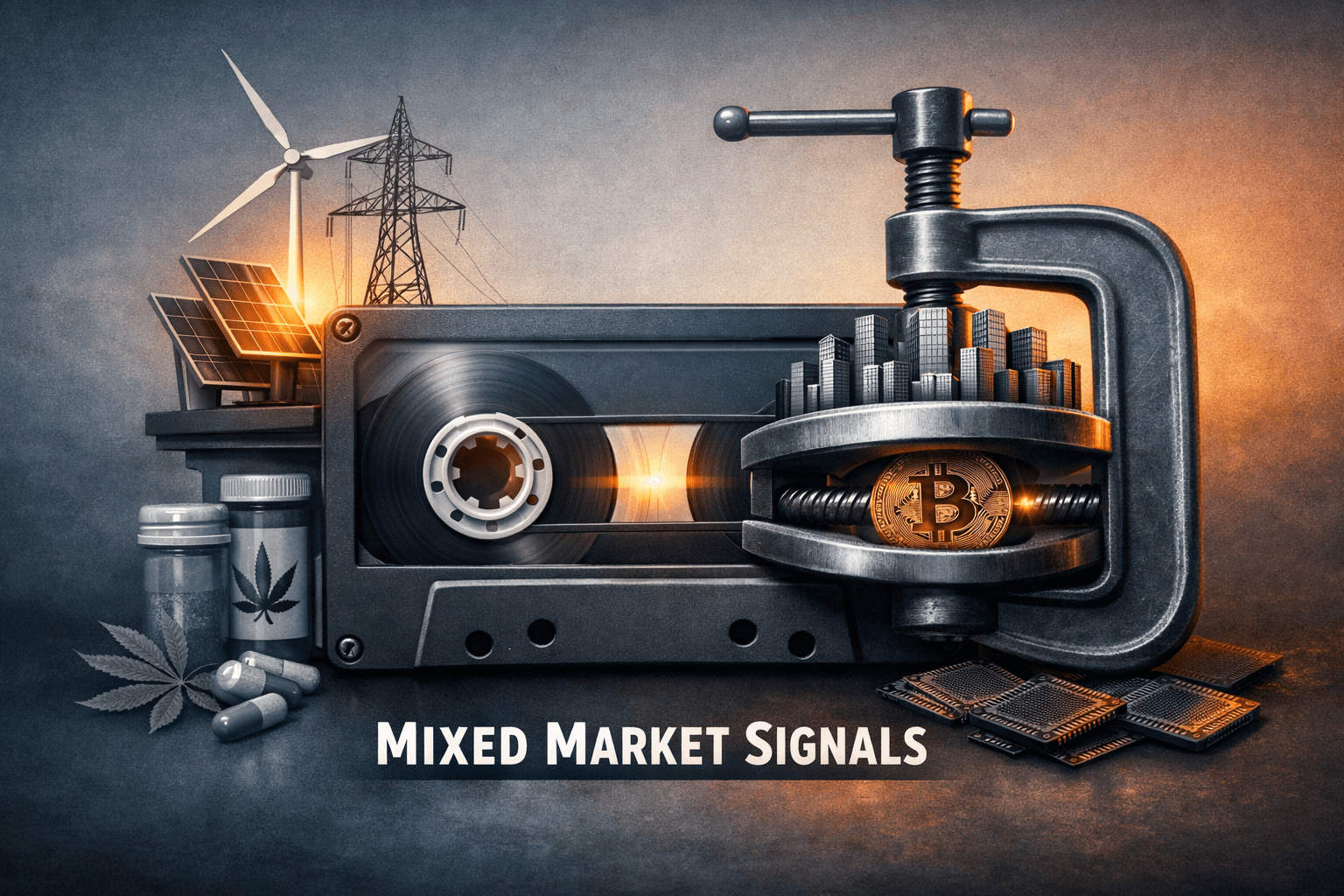
Policy Shocks and Tech Capex Drive a Mixed Tape — Utilities and Renewables Shine, Real Estate and Crypto Feel the Squeeze
Podcast • Loading audio...
Share this article
Spread the word on social media
Key Takeaways
- •Renewables and utilities were among the strongest themes today — GE Vernova’s 100 GW backlog and a 40% Rystad index rebound underline multi‑year demand.
- •Federal rescheduling of cannabis to Schedule III is a major policy catalyst that could reconfigure banking, research and commercialization pathways over months.
- •Tech capital expenditure (TSMC Arizona, SpaceX GPU intent) supports industrial suppliers, but near‑term margin and labor headlines (Meta 10% cuts) create mixed signals.
- •Real estate and credit‑sensitive finance names showed strain from tighter lending conditions and rising no‑ratio loans; monitor refinancing metrics and loan performance.
- •Crypto flows are improving (ETF flows positive for the year) but operational risk remains high after a $292M exploit — custody and security remain central to institutional adoption.
Executive summary
Markets closed a day dominated less by macro prints and more by discrete policy and industry headlines that re‑rated pockets of the market. Two clear storylines emerged: energy and utilities capitalizing on renewables momentum (backed by a 100 GW turbine backlog at GE Vernova and a 40% year rebound in the Rystad Green Energy Index) while technology and industrials continued to show long‑lead capital spending that underpins mid‑cycle growth. At the same time, policy and regulatory moves — most notably the federal rescheduling of cannabis to Schedule III and a Strait of Hormuz disruption after Iran seized vessels — created concentrated volatility and sector rotations.
The day’s flow left a split market: clear outperformers tied to energy transition and policy liberalization contrasted with pressure in credit‑sensitive real estate and risk assets such as crypto following a $292 million protocol exploit. Overall market sentiment is mixed — momentum in green energy and capex is real, but financing strain, geopolitical risk and idiosyncratic security failures keep headline risk elevated.
Important disclaimer: This article is for informational purposes only. It does not constitute a recommendation to buy, sell, or hold any security, nor is it individualized investment advice. Analysts note and data suggest trends; readers should consult a licensed advisor before acting.
Grouping sectors by performance
Outperformers (upside drivers today)
- Utilities: Renewables and grid equipment demand accelerated after GE Vernova reported a 100 GW turbine backlog and local battery/storage programs gained traction. New permitting wins and a restored federal project pathway were cited as near‑term catalysts.
- Energy (select): Renewables and solar tech names outperformed as the Rystad Green Energy Index showed a 40% year rebound and new generation forecasting tech reduced long‑term uncertainty. Separately, oil‑market sensitivity to Strait of Hormuz disruptions created episodic strength for traditional energy assets.
- Cannabis: Federal rescheduling to Schedule III dominated headlines and prompted state‑level administrative moves, immediate policy responses and a re‑pricing of regulatory risk—an event that market structure historically treats as a multi‑day sector catalyst.
Stable / Mixed performers (rangebound or offsetting forces)
- Technology: Capex and strategic anchor deals (TSMC starting Arizona packaging construction targeting 2029, SpaceX flagging GPU manufacturing in an S‑1) supported hardware and semiconductor suppliers even as Meta announced a 10% headcount reduction that weighed on software/media sentiment.
- Industrials & Materials: New contracts, recycling wins and drilling permits provided support, but aluminium supply worries and rising logistics costs limited upside.
- Consumer & Retail / Communications & Media: AI product launches and content tie‑ups sustained momentum for selected names (Macy’s, Ulta; streaming/content M&A progress), but mixed consumer signals and margin pressure tempered broad leadership.
Underperformers / pressured sectors (downside drivers today)
- Real Estate: Financing strain and rising no‑ratio loans combined with falling potential rental yields produced uneven sentiment. Deal volumes and loan‑officer appeals to policymakers highlighted credit sensitivity heading into funding cycles.
- Crypto: Despite a positive flip in ETF flows for the year, product launches and institutional interest were offset by a $292 million exploit and intermittent protocol freezes, keeping risk‑on flows cautious.
- Finance & Banking (select): The tape was bifurcated — bullish takes on tickers like $OZK and yield ideas around $CSWC met PNC’s announcement of 777 job cuts and sector‑specific regulatory/meme‑stock pressures.
Cross‑sector themes and correlations
- Energy transition as a market anchor
- Renewables and storage propelled both Utilities and parts of Energy and Materials today. The GE Vernova 100 GW backlog is concrete evidence of multi‑year demand; combined with Rystad’s 40% year rebound in green energy, it suggests supply‑chain and project pipeline growth that will touch turbine makers, transmission equipment suppliers and metals recyclers.
- Correlation: utilities equipment demand lifts industrials and materials (steel, copper, specialty alloys) while policy shifts and permitting processes remain a gating factor.
- Policy and regulatory shocks move whole ecosystems
- The federal rescheduling of cannabis to Schedule III is not just a legal reclassification: it alters banking access, tax treatment and research pathways. That classification shift connects finance (payment rails, banking coverage), healthcare (research, clinical trials) and consumer retail (distribution channels).
- Likewise, the Strait of Hormuz stoppage after Iran seized vessels had an immediate risk‑premium effect across crude markets, which then ripples into energy producers, shipping insurers and logistics providers.
- Capital spending and industrialization vs. near‑term margins
- TSMC’s Arizona packaging plant (targeted open by 2029) and SpaceX flagging GPU manufacturing in its S‑1 underscore a multi‑year capex cycle in chips and compute hardware. That supports industrial equipment and specialty materials even as companies manage near‑term wage, logistics and automation tradeoffs.
- Correlation: technology capex supports industrials/transportation (lift in $UPS exposure for logistics demand) but also creates cyclical sensitivity in suppliers' margins when shipping costs and regulatory friction rise.
- Technology and AI are cross‑cutting but concentrated risk remains
- AI and agentic commerce pilots at Macy’s and Ulta and telcos rolling AI+5G tools pushed Communications, Consumer and Technology tapes higher for specific names. However, Meta’s 10% workforce cut and protocol/legal risks highlight concentration of execution risk: scaling AI requires both capital and clear regulatory/legal pathways.
- Credit & financing stress dents real estate and selective finance names
- Rising no‑ratio financing and falling potential rental yields strained real estate deal economics. Finance sector narratives split between yield opportunity ideas (10% yield pitch for $CSWC) and cost‑cutting/restructuring (PNC 777 job cuts), indicating idiosyncratic selection is critical.
The day’s most significant moves — what happened and why it matters
Cannabis rescheduling to Schedule III
- What happened: The federal government reclassified cannabis to Schedule III. That move was the day’s most consequential policy shock, prompting immediate industry and state responses.
- Why it matters: Schedule III status materially relaxes federal restrictions compared with Schedule I: it can ease banking access, reduce perceived criminality, open research and development pathways, and change tax and accounting treatment. Analysts note the potential for faster institutional capital flows, improved insurance coverage and acceleration of M&A and consolidation, though operational and state‑level rules will dictate the pace of commercial normalization.
GE Vernova 100 GW turbine backlog and Rystad green energy rebound (+40% year)
- What happened: GE Vernova reported a 100 GW turbine backlog; Rystad’s Green Energy Index showed a 40% year rebound.
- Why it matters: These data points underscore a durable demand wave for renewables equipment. A 100 GW backlog implies multi‑year production scheduling, supply‑chain layering (blade, tower, transformer) and predictable aftermarket/service revenue. The Rystad index suggests capital flow and sentiment rotation into green energy, which supports valuations for utilities and select industrial suppliers.
Regeneron FDA approval and AbbVie manufacturing commit ($1.4B)
- What happened: Regeneron secured an FDA approval for a hearing‑loss gene therapy; AbbVie committed $1.4 billion to U.S. manufacturing capacity.
- Why it matters: Clinical approvals and manufacturing commitments are rare binary catalysts that alter growth outlooks for biotech/healthcare clusters. Gene therapy approval has downstream effects on CDMOs, specialty reagents, and rare‑disease insurers. AbbVie’s $1.4B commitment is illustrative of pharma onshoring trends and regulatory emphasis on domestic capacity.
Tech capex headlines: TSMC Arizona project and SpaceX GPU manufacturing intention
- What happened: TSMC began construction on an Arizona packaging site with a 2029 target; SpaceX signaled GPU manufacturing in its S‑1.
- Why it matters: TSMC’s multi‑billion‑dollar capex creates a long tail of demand for advanced packaging suppliers and test/assembly services in the U.S., reinforcing a secular shift toward onshore semiconductors. SpaceX’s GPU manufacturing intent signals verticalization in cloud/compute supply chains and a potential new competitor set for specialized GPU makers and contract manufacturers.
Meta layoffs (10% cut) vs. AI product commercialization
- What happened: Meta announced a 10% workforce reduction; concurrently, retailers and telcos rolled out AI tools and product integrations.
- Why it matters: Meta’s cuts are a reminder that reallocation of tech labor toward AI and efficiency is maturing. For markets, layoffs can depress discretionary ad spend while freeing capital for AI R&D; the net effect is sector and company specific. The contrast between cuts and new customer‑facing AI deployments highlights the uneven path from research spending to monetization.
Crypto exploit and ETF flows
- What happened: A $292 million protocol exploit and intermittent protocol freezes occurred even as ETF flows turned positive for the year and $700 million funds sought institutional backing.
- Why it matters: The juxtaposition shows crypto’s twin reality: institutional product flow is steadying, but operational risks and protocol security remain acute. Exploits compress risk appetite and can delay institutional onboarding even when ETF flows are improving.
Real estate financing strain and loan market crack
- What happened: Rising no‑ratio financing, falling potential rental yields and heightened borrower outreach to policymakers highlighted stress on transaction financing.
- Why it matters: Credit conditions are a primary channel for real estate value. Higher financing costs and tighter underwriting margins directly compress cap rates and transaction volumes. Analysts note that persistent loan market strain will accentuate bifurcation between trophy assets (lower cap rate expansion) and secondary markets (higher yield repricing).
Actionable insights for investors (informational)
Watchlist: near‑term catalysts to monitor
- Implementation timeline for cannabis Schedule III: track banking guidance, state regulatory rollouts and FDA/DEA follow‑ups. Data suggests the market will reprioritize names with liquidity access and U.S. consumer retail footprints.
- Renewables project permits and interconnection queues: GE Vernova’s backlog is meaningful only if permitting and grid interconnection scale. Monitor federal permitting decisions and FERC/interconnection metrics.
- Semiconductor construction milestones: TSMC’s Arizona build and SpaceX signals point to multi‑year supplier revenue streams; watch capacity‑on‑line targets through 2027–2029 for revenue inflection points.
- Real estate lending standards and No‑Ratio loan volumes: loan originations and delinquencies will give early warning on CRE stress; pay attention to regional bank exposures and policy responses.
- Crypto security incidents and custody rules: protocol exploits materially slow institutional traction. Regulatory clarity on custody and stablecoin rules will determine the pace of ETF adoption.
Portfolio posture considerations (broad, non‑personal)
- Positioning for the energy transition: data indicates durable demand in turbine manufacturing, storage and grid upgrades. Analysts note that a multi‑year backlog favors names with service and aftermarket exposure; investors may want to track service revenue growth as a hedge to hardware cyclicality.
- Capital‑intensive tech suppliers benefit from multi‑year capex commitments: those exposed to advanced packaging, testing and specialty materials may see multi‑year revenue visibility, although margins can be volatile during capacity ramp phases.
- Credit sensitivity remains a differentiator in real estate exposure: tighter financing and rising no‑ratio loans make balance sheet strength and refinancing access critical metrics for REITs and developer names.
- Event risk and idiosyncratic security failures remain high in crypto: despite positive ETF flows, exploit frequency keeps volatility elevated. Custody and protocol security metrics are increasingly material inputs to risk assessment.
Signals to avoid over‑reaching on
- Treat single‑day policy moves as starting points, not endpoints. For example, cannabis rescheduling is meaningful but requires months of implementing rules, banking integration and political pushback. Analysts caution against extrapolating immediate price action into structural market dominance.
- Beware conflating capex announcements with near‑term profit growth. Large semiconductor and renewables projects underpin multi‑year revenue funnels, but margins and timing depend on supply chains and production efficiencies.
Sector‑specific notes to monitor into earnings and policy windows
Utilities & Energy
- Track GE Vernova backlog conversion rates, interconnection queues and state permitting updates. Storage deployments and microreactor timelines are catalysts that could show up in utility capex guidance.
Technology & Semiconductors
- Watch TSMC construction milestones, test/assembly equipment orders and SpaceX supply‑chain disclosures as indicators of future revenues for hardware suppliers.
Healthcare & Biotech
- Monitor uptake and commercialization timelines for Regeneron’s gene therapy and AbbVie’s manufacturing capacity build. Clinical follow‑ups and reimbursement guidance will be key earnings season inputs.
Real Estate & Finance
- Follow loan performance metrics, regional bank exposure reports and changes in loan‑to‑value and debt servicing assumptions. PNC’s job cuts and bank rebrands underscore ongoing cost efficiency drives in the sector.
Crypto
- Track protocol security incidents, custody provider audits, and regulator statements on ETF flows and stablecoin rules. Positive ETF flows are encouraging but not definitive proof of institutional stability.
Consumer, Retail & Communications
- Adoption ramps for AI agentic commerce at Macy’s, Ulta and telco AI+5G launches will be a two‑quarter story. Early product metrics (conversion lifts, repeat usage) will determine durable revenue upside.
Cannabis
- Enter a monitoring phase: watch bank announcements on service restorations, DEA/FDA implementing guidance and any state‑level ballot or legislative activity that accelerates commercial activity.
Conclusion and forward view
Today’s tape reinforced a core market dynamic: secular themes (energy transition, chip onshoring, AI) are drawing patient capital and creating durable demand for a defined set of industrial and technology suppliers, even as event risk and financing frictions create idiosyncratic drawdowns in other pockets (real estate, crypto). The cannabis rescheduling event is a rare policy catalyst that can rewire cross‑sector flows over quarters; investors should treat it as a structural story with implementation risk.
Near term, expect the market to parse two forces: (1) continuing reallocation into renewables and tech capex beneficiaries as data (backlogs, construction starts) arrives, and (2) episodic volatility from geopolitical incidents (Strait of Hormuz), security failures (crypto exploits) and credit‑market repricings that re‑test risk premia. Earnings season will be the crucible where capex narratives meet margin realities; watch guidance for capex cadence, service revenue growth and financing cost disclosures.
Sentiment snapshot: neutral. Momentum and data favor renewables and certain tech suppliers, but cross‑cutting policy and security risks keep conviction tempered. Analysts note that active selection and close attention to financing and implementation metrics will likely outperform broad index tracking in the coming quarters.
Appendix — quick-reference highlights (select datapoints)
- GE Vernova: 100 GW turbine backlog (company disclosure)
- Rystad Green Energy Index: +40% year rebound (Rystad report)
- Regeneron (REGN): FDA approval for a hearing‑loss gene therapy (regulatory disclosure)
- AbbVie (ABBV): $1.4 billion commitment to U.S. manufacturing (company disclosure)
- Meta (META): announced a 10% reduction in headcount (company disclosure)
- TSMC: Arizona chip packaging plant construction started; targeted opening by 2029 (company disclosure)
- Crypto exploit: $292 million protocol exploit reported (industry sources)
- PNC: 777 job cuts announced (company disclosure)
Important reminder: This article is informational only. It does not constitute investment advice or a recommendation regarding any security or sector. Analysts’ language above reflects observed data and common market interpretations rather than prescriptive guidance.
Sources
+ 14 more sources
Use these insights — enter this week's contest.
Free practice contests — earn Alpha CoinsExplore More Content
Disclaimer: StockAlpha.ai content is for informational and educational purposes only. It is not personalized investment advice. Sentiment ratings and market analysis reflect data-driven observations, not buy, sell, or hold recommendations. Always consult a qualified financial advisor before making investment decisions. Past performance does not guarantee future results.