 Sector Insights
Listen to this Recap
10:49
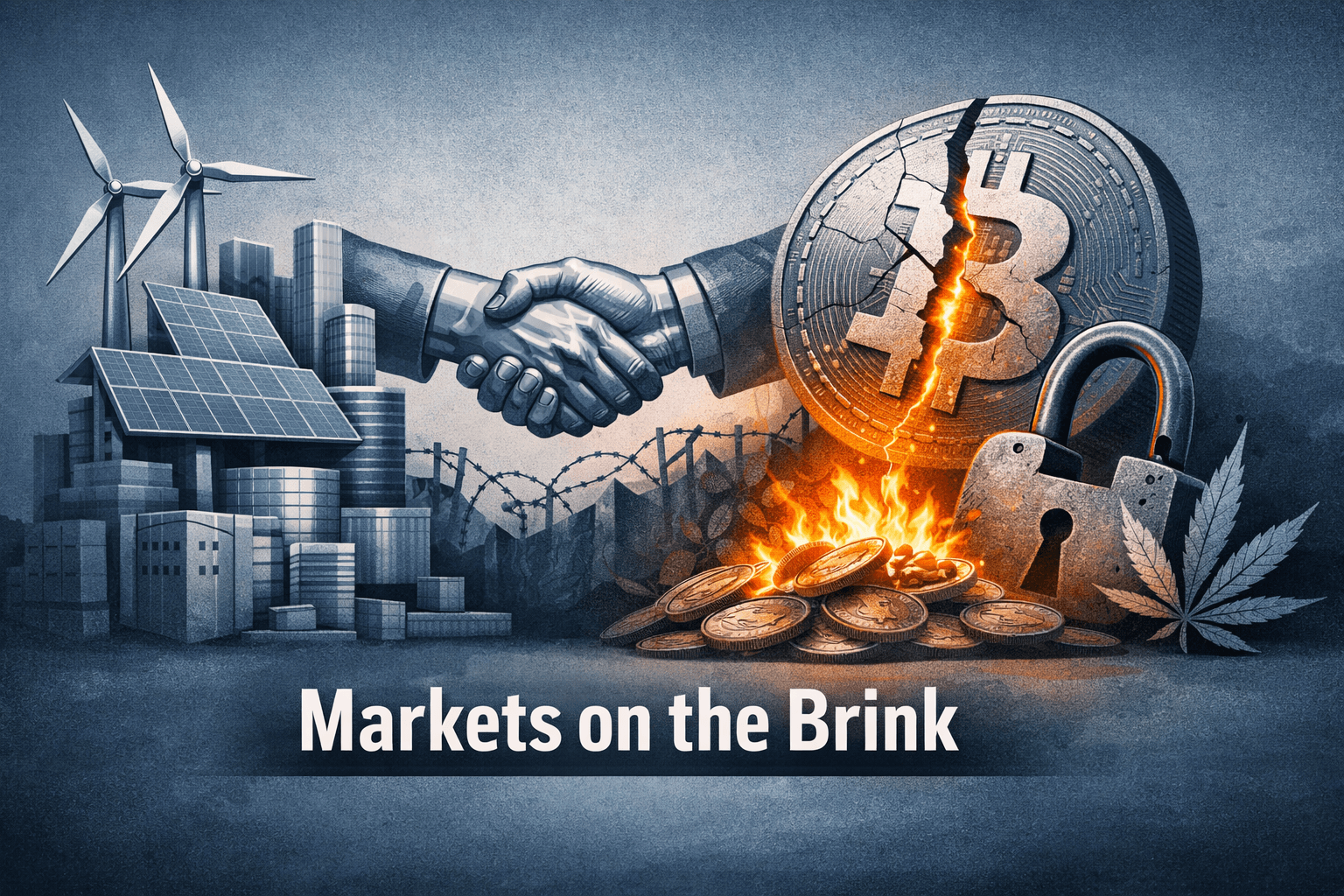
Deal Flow, Renewables and Security Shocks: Markets Digest M&A, Policy and a $292M Crypto Exploit
Podcast • Loading audio...
Share this article
Spread the word on social media
Key Takeaways
- •Policy and permit calendars are primary catalysts: state and federal decisions can create rapid re-ratings in cannabis, materials and psychedelics.
- •M&A and order-book strength fueled outperformance in materials, industrials and utilities, but integration, permitting and financing are immediate risk checks.
- •Security events in crypto (a $292M KelpDAO exploit) materially increase counterparty and operational risk, elevating demand for custody, audits and insurance.
- •Energy transition continues to link utilities, materials and industrials — but permitting and capital intensity remain key frictions.
- •Real estate benefits from heavy deal flow and public funding yet faces margin pressure from rising insurance and OpEx costs.
Executive summary
Today’s tape was defined less by a single market direction than by the pull of large, idiosyncratic stories across sectors. Deal activity and funding — from USA Rare Earth’s headline-making $2.8 billion acquisition to a series of industrial buyouts — provided a pro-cyclical backdrop for materials, industrials and parts of the utilities complex. Renewable buildouts and storage deployments reinforced that same pro-investment tone in utilities.
At the same time, security and policy friction capped risk appetite: the crypto world reeled from a $292 million KelpDAO exploit that forced emergency freezes on Arbitrum, while state-level pushback and a federal court pause in Rhode Island put cannabis names on edge. Real estate faced a tug-of-war between heavy deal flow (including a $216 million FHA healthcare loan and a $4.7 billion DOT funding boost) and rising operating costs and insurance pressures that pressure margins.
Cross-cutting themes — policy and regulation, energy-transition economics, M&A-driven re-rating, and security/operational risk — dominated sector headlines. The day’s moves were less a broad market rally and more a rotation: capital chasing tangible asset and infrastructure deals while shunning high-tail-risk areas until regulatory clarity and security controls improve.
Grouping sectors by performance
Below is a qualitative grouping based on the day’s headlines and implied market reaction.
Outperformers
- Utilities — Renewables and storage gains: multiple reports highlighted new solar projects, perovskite partnerships and storage deployments. The push toward distributed resources and microgrids suggested incremental revenue visibility against a backdrop of rising electrification demand. Utilities looks favored for steady cash flow exposure to the energy transition.
- Materials & Mining — Strategic M&A and project moves: USA Rare Earth’s $2.8 billion Serra Verde acquisition, Centrus Energy’s Ohio uranium expansion and other consolidation themes are lifting sentiment. Metals and specialty materials with clear offtake or government support drew attention.
- Industrials & Manufacturing — Deal-driven demand and capacity expansion: Brady’s ~$1.4 billion acquisition, Cleveland‑Cliffs’ elevated order book and domestic steel investment drove constructive stories for industrials tied to near-term demand and reshoring dynamics.
Underperformers
- Crypto — Security shock and regulatory overhang: a $292 million KelpDAO exploit, active laundering and emergency freezes on Arbitrum were headline negative, amplifying regulatory scrutiny and counterparty risk concerns across the ecosystem.
- Cannabis — Policy friction despite pockets of progress: mixed policy signals (Virginia roadblocks, a federal court pause in Rhode Island) contrasted with other state-level tailwinds, creating a volatile environment for cannabis equities and ETFs like $MSOS and key names such as $TLRY.
- Real Estate — Margin pressure amid product innovation: heavy deal flow (including a $216 million FHA healthcare loan and new public funding) is being offset by rising property insurance and operational input costs, raising near-term profitability questions for REITs and developers.
Stable / Mixed
- Technology — AI momentum overshadowed by regulation and geopolitics: fundraising, product launches and infrastructure upgrades were balanced against EU cloud policy risks and an evolving regulatory framework.
- Healthcare — Research upside and trial setbacks: scientific progress (CAR‑T work, startup funding) coexists with clinical trial failures, and large payers like UnitedHealth reported earnings strength that did not entirely resolve sector-level uncertainty.
- Energy — Mixed signals: renewable capacity growth and geothermal optimism were balanced against geopolitical tensions and commodity volatility, leaving net directionality mixed.
- Consumer, Communications, Finance, Materials (second tranche), and others displayed mixed tapes driven by idiosyncratic M&A, expansion and policy items rather than sector-wide flows.
Cross‑sector themes and correlations
- Policy and permitting is the common multiplier
- Evidence: Cannabis policy decisions in multiple states (Virginia, Rhode Island) and federal-level activity on psychedelics influenced the cannabis complex; materials M&A (rare earths, uranium) next faces permitting and financing risk; EU cloud policy is an overhang for tech.
- Implication: Regulatory and permitting outcomes are acting as binary catalysts that can rapidly re-rate assets in cannabis, materials and technology. Investors and analysts should treat policy calendars as core fundamental inputs.
- Energy transition is linking utilities, materials and industrials
- Evidence: Renewables and storage headlines in utilities; USA Rare Earth’s big acquisition tied to the battery and high-tech supply chain; domestic steel investment and factory upgrades in industrials.
- Correlation: Demand for critical minerals and domestic manufacturing capacity is likely to remain positively correlated with utility-scale storage and electrification projects. A common risk is permitting and capital intensity.
- M&A and large transactions are reshaping sector narratives
- Evidence: USA Rare Earth ($2.8bn), Brady (~$1.4bn), a $216M FHA healthcare loan and $4.7B DOT funding injection highlight heavy transaction flow.
- Implication: Where deals provide scale or offtake, they can compress risk premia quickly; however, financing terms and integration risk remain immediate watch points.
- Security and operational risk are re‑pricings for growth assets
- Evidence: The $292M KelpDAO exploit and subsequent emergency freezes underscore fragility in crypto rails; similarly, cybersecurity and infrastructure reliability are recurring constraints in tech and industrials.
- Implication: Operational controls, custody arrangements and insurance/insuranceability of novel assets are becoming valuation differentiators.
- Consumer automation and AI lift cross-sector capex
- Evidence: Home Depot’s same-day plans, Target’s baby-area expansion, Home Depot’s automation investments, and $HD acquiring Simpl Automation; $LULU expanding e-commerce to Mexico and brick‑and‑mortar optimization.
- Correlation: Retailers using AI and automation will increase demand for industrial robotics, logistics upgrades, and edge compute, playing into industrials, tech and materials chains.
Most significant moves and context
- USA Rare Earth acquisition — $2.8 billion
- Why it matters: The size of the deal signals continued consolidation in critical mineral supply chains as nations and companies seek domestic sources for technologies ranging from EVs to defense systems. A successful integration could shorten time-to-market for rare-earth processing capacity, but financing and permitting remain key risks.
- KelpDAO exploit — $292 million; Arbitrum emergency freezes
- Why it matters: This was the day’s most acute risk event. A multi‑hundred‑million dollar exploit that forces chain-level freezes heightens counterparty and operational risk across decentralized finance. Market participants will likely demand stronger custody proofs, insurance and clearer regulatory guardrails before redeploying capital into higher-risk crypto products.
- Brady’s ~$1.4 billion purchase and Cleveland‑Cliffs’ order strength
- Why it matters: M&A activity and robust order books indicate pockets of durable industrial demand. For cyclical and capital‑goods companies, visible backlog supports forward revenue and margin projections, which can justify higher multiples even against macro uncertainty.
- Utilities: solar, perovskite R&D and storage deployment headlines
- Why it matters: Continued momentum in solar manufacturing, perovskite partnerships and microgrid deployment underlines a shift toward diversified supply chains and a faster pace of capacity additions. This supports long-term demand for grid modernization, storage and associated materials.
- Real estate funding and cost pressures — $216M FHA loan; $4.7B DOT boost; $14 trillion housing wealth discussion
- Why it matters: Significant funding flows into healthcare real estate and infrastructure are positive for deal activity and liquidity, but rising property insurance and OpEx inflation threaten near-term cash yields. The debate over unlocking $14 trillion in housing wealth via reverse mortgages highlights product innovation where policy, consumer protection and balance‑sheet risk intersect.
- Why it matters: Large retailers are leaning into automation and regional expansion to safeguard margins and capture convenience-driven spending. Execution here can change the composition of cost structures and capex cycles for retail-oriented supply chains.
- Tech policy and EU cloud strategy
- Why it matters: Moves in the EU to diversify cloud sourcing away from large U.S. vendors remain a strategic overhang for major cloud providers, potentially shifting enterprise demand and pricing dynamics in the medium term.
Actionable insights for investors (informational only)
Treat policy calendars as catalysts
- Track state ballots, court schedules and federal agency guidance for cannabis, materials permitting and psychedelics. Policy events can produce binary outcomes that materially alter valuations within hours or days.
Re-assess operational risk in crypto exposure
- The KelpDAO exploit reinforces that custody, code audits and on-chain monitoring are central to risk controls. For holders or industry watchers, prioritize counterparties that disclose proof-of-reserves, have insurer arrangements or use established custodians.
Use M&A and order-book signals to identify durable demand
- Sizable deals (e.g., USA Rare Earth, Brady) plus elevated order books for industrials like Cleveland‑Cliffs can be read as leading indicators of capex and commodity demand. Monitor financing terms and regulatory approvals as the next check points.
Monitor cost inputs for income-oriented sectors
- Real estate and certain utilities may face margin compression from rising insurance, labor and materials costs. For income strategies, pay attention to payout coverage, leverage and tenant/occupancy trends.
Watch cross-sector supply-chain linkages
- Energy transition demand for critical minerals ties materials, industrials and utilities together. Delays in permitting or shipping can cause correlated squeezes; conversely, policy support or offtake agreements can be accelerants.
Keep an eye on EU regulation for tech exposure
- Potential shifts in cloud sourcing economics and compliance costs could weigh on margins for large vendors; follow EU rulemaking and major enterprise procurement announcements.
Prioritize liquidity and downside protection in high-volatility areas
- Sectors with policy or security binary events (crypto, cannabis, certain parts of tech) may reward strategies that emphasize liquidity, position sizing and hedging.
Notable tickers and reference points mentioned today
- ETFs and cannabis: $MSOS, cannabis names including $TLRY referenced as barometers for policy-driven volatility.
- Retail and consumer names: Home Depot ($HD) — same-day and automation strategy; Lululemon ($LULU) — Mexico e‑commerce expansion.
- Energy/auto: Tesla ($TSLA) flagged as an earnings and industry event to watch amid EV and storage linkages.
- Payer/healthcare: UnitedHealth (market reference $UNH) reported a strong earnings beat that supplied firm-level clarity amid wider clinical and policy noise.
- Crypto exchanges and platforms: Coinbase (publicly traded reference $COIN) is part of the broader ecosystem dynamics though not tied to the day’s exploit directly.
- Corporate transactions and financing: USA Rare Earth ($2.8bn), Brady ($1.4bn), $216M FHA loan and $4.7B DOT boost were all material deal-size data points.
Risk factors and what to watch next
- Near-term: regulatory and court timetables for cannabis and psychedelics; immediate fallout measures from the crypto exploit (on-chain tracing, recovery efforts, asset freezes); any new security or audit disclosures from exchanges or DAOs.
- Medium-term: financing and permitting for large materials projects (rare earths, uranium), which will determine whether today’s M&A translates into near-term capacity additions.
- Macro overlays: interest rates and credit conditions remain a background risk for real estate and leveraged M&A; inflation in construction and insurance costs can erode returns on new projects.
- Geopolitics: oil and commodity price swings driven by ceasefire or escalation risks can reprice energy and materials exposure quickly.
Sector-by-sector quick scan (highlights)
Utilities: Renewables and storage headlines continue to support constructive narratives. Watch for project-level cost signals (pumped storage, perovskite manufacturing economics) and interconnection timelines.
Materials & Mining: Consolidation (USA Rare Earth $2.8bn), uranium expansion and recycling initiatives suggest a two-track story: near-term permitting and financing risk vs. long-term strategic demand for critical inputs.
Industrials: M&A and order-book strength point to pockets of durable demand, but watch tariffs, AI chip shortages and trade frictions that could constrain certain supply chains.
Crypto: Security event was the day’s largest negative shock. Expect increased regulatory scrutiny, potential enforcement actions, and a short-term liquidity pullback in derivatives and prediction markets.
Consumer & Retail: Automation and geographic expansion are the dominant themes. While growth plays persist, selective bankruptcies (e.g., QVC filing mentioned in briefings) underscore the divergence between digitally-native winners and legacy retailers.
Energy: Renewables surge (record global solar capacity — 605 GW in 2025) sits against continued oil export strength and geopolitical volatility. Mixed exposures may require active management.
Healthcare: Earnings and scientific progress were offset by trial setbacks and policy fights over federal health data; large payer strength coexists with micro-level risk in biopharma pipelines.
Technology: AI, fundraising and product upgrades bolster innovation narratives, but EU cloud policy and data sovereignty issues add strategic overhangs for large vendors.
Finance: Earnings dispersion and consumer-spending caveats suggest a selective environment; IRMAA and retiree-cost dynamics are additional local pressures.
Real Estate: Heavy funding and deal flow are counterbalanced by higher OpEx and insurance costs; product innovation (reverse mortgages unlocking ~$14 trillion in housing wealth) is a long-term thematic with significant policy sensitivity.
Communications & Media: Talent moves, M&A and telco-specific headwinds (bad debt, RAN strategy) create a mixed picture; content success does not fully immunize legacy revenues from distribution and ad-tech shifts.
Investment disclaimer
This report is for informational purposes only and does not constitute investment advice. It does not recommend buying, selling, or holding any specific security or give personalized investment advice. Analysts note risks and catalysts; data and sentiment reflect market reporting and do not constitute a trading instruction.
Conclusion & forward-looking perspective
Today reinforced a bifurcated market structure: capital chasing tangible deals and infrastructure-linked growth (materials, utilities, industrials) while risk assets with binary or operational vulnerabilities (crypto, cannabis, parts of real estate) traded under a discount. The immediate calendar — state and federal policy decisions, pending regulatory actions in crypto, M&A approval timelines and earnings from major consumer and tech names — will determine whether current rotations persist.
In the medium term, energy-transition dynamics and supply-chain reconfiguration look set to be durable, providing multi-year demand for materials, storage and industrial capacity. However, the velocity of that transition will be dictated by permitting, financing and geopolitical stability. Security failures and regulatory scrutiny, as exemplified by today’s crypto exploit, are reminders that operational resilience and regulatory clarity are becoming key valuation inputs.
For market participants, the next phase will likely be about parsing deal credibility and regulatory milestones rather than chasing headline-driven momentum. Tracking specific catalysts (court rulings, permitting decisions, deal close dates and recovery plans in the crypto episode) will be critical to understanding which narratives are durable and which are transient.
Key takeaways below summarize the most actionable informational points from today’s cross‑sector tape.
Sources
+ 13 more sources
Use these insights — enter this week's contest.
Free practice contests — earn Alpha CoinsExplore More Content
Disclaimer: StockAlpha.ai content is for informational and educational purposes only. It is not personalized investment advice. Sentiment ratings and market analysis reflect data-driven observations, not buy, sell, or hold recommendations. Always consult a qualified financial advisor before making investment decisions. Past performance does not guarantee future results.