 Sector Insights
Listen to this Recap
8:50
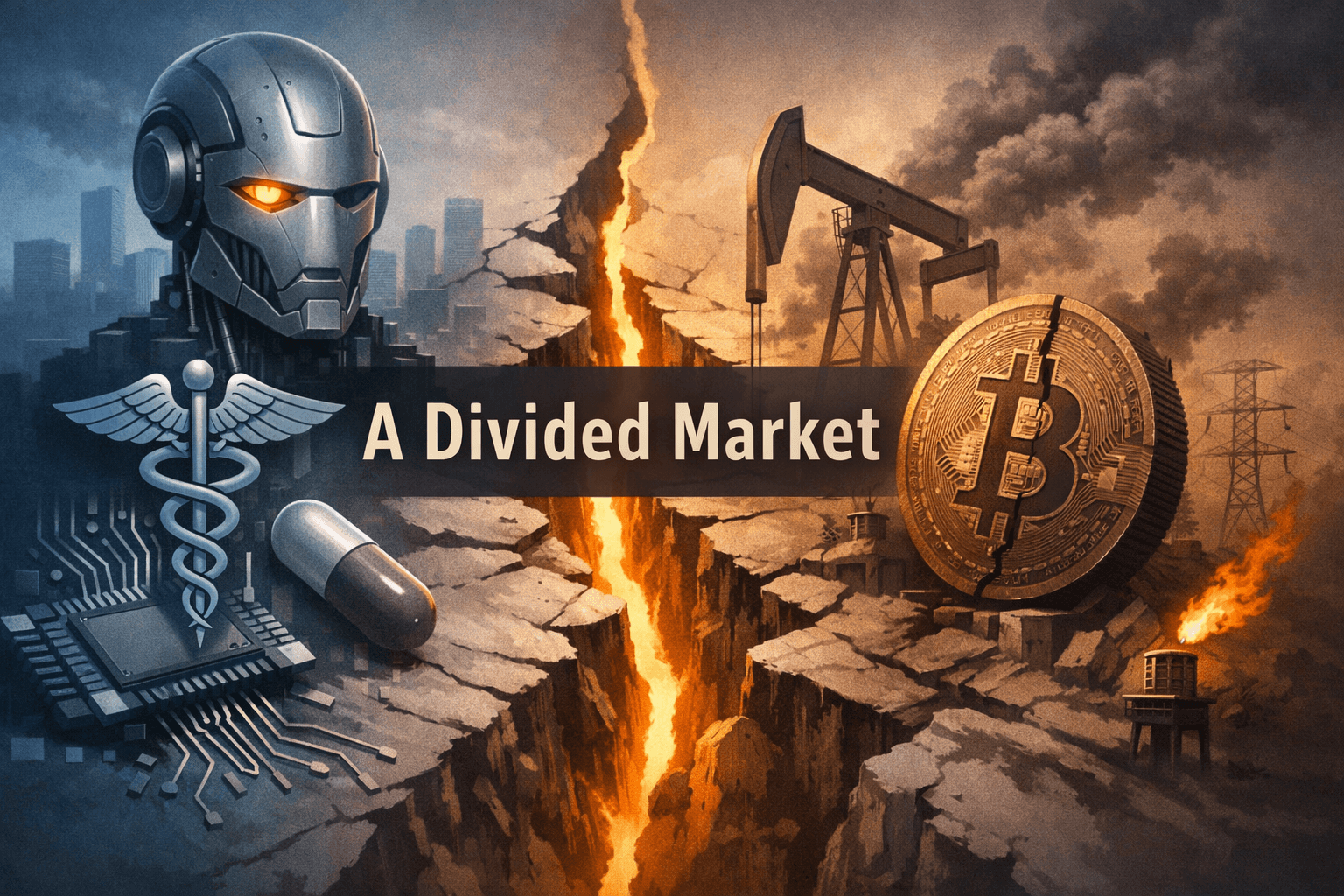
AI, M&A and Geopolitics Drive a Patchwork Market: Tech and Health Lead as Crypto and Energy Face Headwinds
Podcast • Loading audio...
Share this article
Spread the word on social media
Key Takeaways
- •AI hardware and healthcare M&A/clinical wins drove positive momentum across technology and health names.
- •Geopolitical shocks in shipping and oil lifted energy-market volatility and tightened the macro risk backdrop.
- •Crypto showed bifurcation: spot BTC resilience (~$76,500) versus protocol-level security and liquidity stresses.
- •Regulatory calendars (antitrust, stablecoins, drug-pricing and cannabis) remain top cross-sector catalysts.
Executive summary
Markets opened the week with a clear split: technology and healthcare headlines supplied upward momentum, while geopolitics, DeFi shocks and commodity volatility produced pockets of weakness. AI infrastructure and product updates — led by a hardware step-up from SK hynix and continuing Nvidia-linked demand — combined with M&A and clinical wins in healthcare to set a positive tone for growth-oriented sectors. At the same time, an oil-price reaction to shipping disruptions in the Strait of Hormuz, renewed questions about grid security for utilities, and a major DeFi exploit left more speculative and cyclical areas under pressure.
Specific data points that shaped the tape: Bitcoin held above $76,500 amid mixed flows and custody shifts; a NYU-linked study on gut microbiome prediction of melanoma relapse reported up to 94% accuracy; SK hynix began mass production of a 192GB LPDDR5X module pitched at Nvidia-class AI servers; and several large corporate deals surfaced — notably a $17 billion real-estate takeover and a $120 million gold-stream financing. Those events reinforced two dominant market narratives: incumbent winners from AI and healthcare innovation are attracting capital and attention, while macro and policy risks are elevating dispersion across sectors.
This recap groups sectors by relative performance themes (outperformers, underperformers, stable), identifies cross-sector correlations, highlights the day’s most consequential moves, and offers actionable, non-personalized insights investors can monitor in the coming days.
Sector groupings by performance
Note: sector-level performance data was not available in the summaries provided. Groupings below reflect directional cues and thematic strength from headlines and announced activity.
Outperformers (positive momentum and clear catalysts)
- Technology: AI hardware and product momentum, antitrust scrutiny that could reshape competitive dynamics.
- Healthcare: M&A activity, strong clinical readouts and diagnostic advances.
- Consumer & Retail: Expansion and efficiency initiatives, loyalty/payments integration and a major M&A transaction.
Stable / Mixed (news-driven but balanced risks and opportunities)
- Real Estate: Heavy transaction volume and fresh financing — a busy tape with offsetting risks from tighter commercial lending spreads.
- Materials & Mining: Project financing, recycling and capacity builds alongside geopolitics-driven raw-material uncertainty.
- Industrial & Manufacturing: AI and data adoption are promising but execution still uneven; supply-chain tech gains balance slower capex in some pockets.
- Communications & Media: Strong content and live-entertainment momentum offset satellite competition and distribution questions.
- Finance & Banking: AI adoption and stablecoin/regulatory items competed with macro and geopolitical risk.
Underperformers / Risk-On Reductions
- Cryptocurrency: Spot-BTC support contrasted with a major DeFi exploit, liquidity stress in protocols such as Aave, and custody shifts at large managers.
- Energy: Near-term oil volatility after shipping disruptions and heating geopolitical risk offset longer-term renewables progress.
- Utilities: Renewables and grid planning advances are positive, but cybersecurity concerns, EV fleet hesitancy and fossil-fuel policy swings elevated risk.
Cross-sector themes and correlations
- AI as a multi-sector growth engine
- Technology headlines were pervasive: SK hynix’s start of mass production for a 192GB LPDDR5X module specifically designed for Nvidia-class systems signals continued upstream strength in AI compute demand. That hardware news rippled into industrials (smart-manufacturing and data tools), finance (banking AI pilots), and utilities (grid-optimization software and load forecasting).
- Correlation note: When AI hardware cycles accelerate, semiconductor suppliers, cloud providers and enterprise software vendors typically see tighter correlations in returns and order activity. Analysts observe that today’s chip supply cues tend to precede visible enterprise deployments by several quarters.
- Deal-making and consolidation in healthcare and consumer
- Healthcare’s M&A and clinical readouts (including Lilly’s Kelonia transaction and promising CAR-T prevention data) reinforce sector rotation into defensive growth with event-driven upside.
- Consumer saw a $17 billion deal and operational efficiency announcements (e.g., Hershey’s $100 million inventory reduction). Deal flow in consumer and healthcare suggests capital is still chasing scale and margin defensibility.
- Geopolitics and commodity-linked risk
- The reported Strait of Hormuz closure and resulting oil reaction — combined with Eni’s gas find and China’s coal-to-gas restarts — created two-way pressure for energy and materials. Markets are parsing short-term supply shocks against longer-term decarbonization investments (solar, storage, electric vehicles).
- Correlation note: Energy volatility often translates into wider market volatility and raises short-term inflation concerns, which can pressure rate-sensitive sectors such as real estate and utilities.
- Crypto’s bifurcation: institutional flows vs. DeFi fragility
- Bitcoin’s price resilience (staying above $76,500) reflected ongoing ETF and corporate-level demand, but ecosystem-level risks — a major DeFi exploit, stress at Aave and BIS stablecoin warnings — heightened regulatory and liquidity concerns.
- This creates a split between spot-market strength and protocol-level risk premia, which investors are pricing separately.
- Regulation and policy as top-tier market risk
- Antitrust action (a major California filing against Amazon), cannabis and psychedelics policy shifts, and stablecoin warnings show that regulatory calendars are a cross-sector risk. Policy moves can instantly re-rate business models (e.g., platform fees for media, market access for cannabis, custody rules for crypto). Expect higher dispersion around regulatory-sensitive names.
Notable moves and why they matter
SK hynix begins mass production of 192GB LPDDR5X modules (AI hardware)
- What happened: SK hynix started mass producing a 192GB LPDDR5X memory module intended for Nvidia-class systems.
- Why it matters: Memory density and bandwidth are critical constraints for training and inference workloads. Higher-capacity LPDDR5X takes aim at server and edge compute configurations that reduce the number of discrete components or nodes required for large models. For suppliers and infrastructure providers, this can accelerate upgrades and spare-parts demand.
Healthcare M&A and clinical wins (Lilly Kelonia buyout, CAR-T prevention data)
- What happened: Pharmas and biotech announced deal activity and positive clinical data, including an acquisition tied to Lilly and CAR-T prevention readouts.
- Why it matters: Clinical validation and strategic bolt-on acquisitions shorten time-to-market and reduce pipeline risk; that re-rates parts of the healthcare sector where growth and pricing power are clearer. Regulatory scrutiny on pricing persists, but near-term cash-flow inflections attract investor attention.
Bitcoin steady above $76,500 while DeFi shows signs of stress
- What happened: BTC held north of $76,500, supported by spot ETF inflows and broad institutional interest; concurrently, a large DeFi exploit and liquidity stress at Aave created headline risk.
- Why it matters: The split highlights that liquid, ETF-driven demand can stabilize the on-chain market cap while protocol-level security and design risks remain acute. For crypto exposure, participants are increasingly differentiating between spot-backed instruments and native DeFi protocols.
Energy volatility after Strait of Hormuz disruption
- What happened: Shipping disruptions around the Strait of Hormuz contributed to higher oil prices and elevated short-term market uncertainty.
- Why it matters: Oil and shipping shocks can translate into headline inflation risks, influence central-bank sentiment and affect energy-sector capital allocation. Energy companies with leveraged balance sheets or narrow margins can face quick swings in earnings expectations.
Real-estate deal activity and financing flows
- What happened: A $17 billion takeover and renewed construction loan activity were notable on the real-estate beat, even as CRE lending spreads tightened in parts of the market.
- Why it matters: Large transactions signal buyer confidence in select asset classes (core logistics, high-quality residential, or desirable office conversions). But lingering CRE lending costs and underwriting shifts mean outcomes will be highly differentiated across property types and metros.
Materials & Mining: project finance and recycling gains
- What happened: A $120 million gold stream, three-mine land deals, and expanded recycling/automation partnerships were reported.
- Why it matters: Incremental capacity and recycling can relieve raw-material tightness over time, but near-term prices are still vulnerable to geopolitical swings and demand cycles (notably EV supply chains).
Utilities and grid risks meet renewables progress
- What happened: Perovskite panel demo lines and uncertainty-modeling extensions were positive, but cybersecurity concerns and a $2 billion gas-plant proposal in Hawaii underscored mixed signals.
- Why it matters: The transition mix (renewables + backup thermal) adds complexity to investment cases. Grid modernization and resilience remain capital-intensive and politically sensitive, which can delay returns.
Industrial focus on data without action — and pockets of AI-driven productivity
- What happened: Manufacturers report more data availability but struggle to translate it into operational improvement; parcel-shipping AI pilots and fulfillment-network adaptability offer efficiency upside.
- Why it matters: Industrial demand will likely bifurcate: firms that convert data into process change will capture margin gains; those that do not will face cost pressure from higher input prices and trade frictions.
Cannabis and psychedelics policy momentum
- What happened: State-level legalization pushes, expanded research licensing, and White House moves to fast-track psychedelics research kept regulatory reopenings in focus.
- Why it matters: Policy shifts create multi-year structural demand opportunities for research, retail and ancillary service providers, but regulatory fragmentation (e.g., New Jersey tightening hemp rules) increases execution risk.
Actionable insights for investors (informational only)
- Track AI hardware supply indicators for semiconductor/compute timing
- Why: SK hynix’s 192GB LPDDR5X news is an upstream indicator for future enterprise order books. Watch memory and foundry utilization, OEM server bookings, and cloud provider capex commentary. Data suggests hardware supply improvements tend to precede visible enterprise spending by one to three quarters.
- Separate spot crypto exposure from protocol risk
- Why: Bitcoin’s price stability contrasts with DeFi protocol fragility. If your exposure is informational, monitor ETF flows, custody announcements (e.g., Grayscale custody shifts), options expiries, and protocol audits. Analysts note that on-chain security events can create episodic drawdowns in non-custodial instruments even when spot demand is steady.
- Monitor geopolitical chokepoints and commodity reaction functions
- Why: Shipping disruptions and events around the Strait of Hormuz have outsized effects on oil and shipping costs. Investors focused on rate-sensitive sectors (real estate, utilities) should watch near-term inflation and central-bank commentary.
- Watch regulatory calendars across tech, finance and healthcare
- Why: Antitrust filings (Big Tech), stablecoin pronouncements and drug/pricing policy shifts can re-rate companies quickly. Policy events are high-impact catalysts; prepare for headline-driven moves.
- Use event windows to differentiate real-estate and materials opportunities
- Why: Large transactions ($17 billion takeover, $120 million streams) show selective liquidity. Investors should focus on asset-level fundamentals, tenant quality and localized lending spreads rather than broad-sector claims.
- Treat industrial and utilities AI projects as a two-speed market
- Why: Implementation is the bottleneck. Firms that publish concrete ROI metrics for pilots (reduced cycle times, fewer outages) are more likely to scale investment. Data quality and change-management capacity matter as much as technology selection.
Risk watch — key near-term items to monitor
- Geopolitical: Shipping routes and Middle East developments that affect crude and insurance costs.
- Macro: Inflation and central-bank commentary following commodity moves; rate-path uncertainty affects real-estate and financials.
- Regulatory: Antitrust suits, stablecoin regulation and drug-pricing actions can be sudden and sector-wide.
- Crypto security: Protocol audits, exploit activity and ETF flows will shape volatility across crypto instruments.
- Supply chains: Memory and semiconductor capacity, power-grid resilience and EV fleet scaling could create sectoral winners and losers.
Conclusion and forward-looking perspective
Today’s tape underscored a bifurcated market: secular-growth narratives — AI hardware, healthcare innovation and consumer consolidation — continue to attract headlines and capital, while cyclical and risk-sensitive areas such as energy, utilities and crypto reflect shorter-term volatility and policy uncertainty. The most investable themes in the near term appear to be tied to AI infrastructure rollouts and event-driven healthcare outcomes, but both live inside broader macro and regulatory contexts that can change quickly.
Over the next several weeks, pay attention to hardware-supply signals (inventory and booking data), major regulatory milestones (antitrust and stablecoin rule-making), and macro responses to energy shocks. Those items are likely to determine whether today’s cross-sector dispersion narrows into a clearer market leadership trend or persists as a rotation-driven environment with rapid sectoral switches.
Investment disclaimer: This article is for informational purposes only. It does not constitute investment advice, a recommendation to buy or sell securities, or personalized financial guidance. Analysts note trends and data points to inform decision-making; market participants should consult their own advisors before acting.
Appendix: Quick reference of notable items mentioned
- Bitcoin: held above $76,500 during the session.
- SK hynix: mass production of 192GB LPDDR5X modules for Nvidia-class systems.
- Healthcare: Lilly’s Kelonia buyout and CAR-T prevention data highlighted deal and clinical momentum.
- Real estate: a $17 billion takeover and renewed construction-loan activity.
- Materials: $120 million gold stream and multi-mine land deals.
- Energy: oil reaction to Strait of Hormuz disruption; Eni gas find; solar and storage tech progress.
- Utilities: perovskite panel demo lines, $2 billion gas-plant proposal in Hawaii, and grid cybersecurity concerns.
- Consumer: Hershey $100 million inventory reduction; Lululemon expansion; a $17 billion consumer-sector deal.
- Crypto: DeFi exploit, Aave liquidity stress, BIS stablecoin warnings and Grayscale custody shifts.
Sources
+ 14 more sources
Use these insights — enter this week's contest.
Free practice contests — earn Alpha CoinsExplore More Content
Disclaimer: StockAlpha.ai content is for informational and educational purposes only. It is not personalized investment advice. Sentiment ratings and market analysis reflect data-driven observations, not buy, sell, or hold recommendations. Always consult a qualified financial advisor before making investment decisions. Past performance does not guarantee future results.