 Sector Insights
Listen to this Recap
14:35
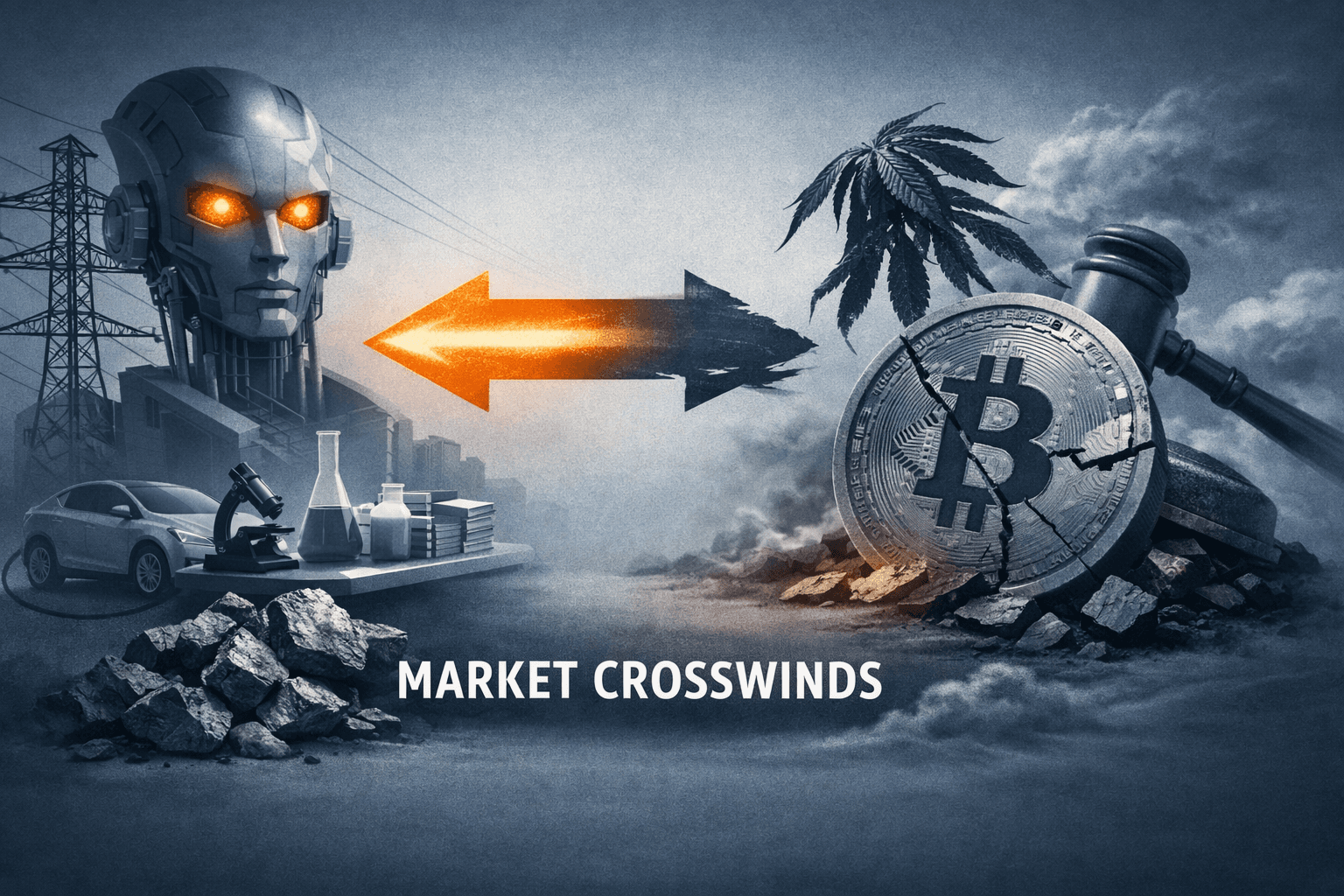
AI, Electrification and Regulation Drive Mixed Market Tape — Tech, Healthcare and Materials Lead; Crypto and Cannabis Face Headwinds
Podcast • Loading audio...
Share this article
Spread the word on social media
Key Takeaways
- •AI and healthcare innovation drove outperformance — tech hiring, new hardware demand and clinical wins underpin a constructive growth narrative.
- •Electrification and critical‑minerals activity supported materials and utilities, with commissioning and policy (e.g., France €10B plan) increasing demand visibility.
- •Regulatory and security shocks kept cannabis and crypto under pressure; court rulings, licensing windows and bridge exploits remain high‑impact risk events.
- •Energy was mixed: geopolitical and trading losses elevated near‑term price risk even as renewables and battery projects provide longer‑term balance.
- •Investors should monitor policy calendars, AI capex announcements, commodity inventories and security events as short‑term catalysts for sector dispersion.
Executive summary
Markets closed the week with a clear bifurcation: growth sectors tied to AI, healthcare innovation and industrial modernization outperformed on fresh, concrete catalysts, while asset classes exposed to regulatory and security shocks — notably cannabis and portions of crypto — underperformed. Technology headlines (AI deployments, hardware and large-scale hiring) combined with healthcare clinical wins to sustain risk appetite, while materials benefitted from dealflow and supply‑chain focus tied to electrification and semiconductors. At the same time, energy showed mixed signals as geopolitical disruptions and a major trading loss lifted near‑term price risk even as renewables and battery projects provided offsetting structural support.
Several cross‑cutting themes dominated the day: AI driving capital allocation across tech, industrials and retail; electrification increasing demand for critical minerals and grid upgrades; and legal/regulatory developments affecting cannabis, crypto and communications. These forces are layering on top of macro inputs — central bank guidance, commodity flows and supply‑chain reports — to produce sector‑level dispersion.
This recap groups sectors by relative performance, explains the drivers, highlights notable moves and draws actionable, non‑prescriptive insights for investors as the market moves toward next week’s calendar and key regulatory deadlines.
Sector winners (outperformers)
- Technology
- Healthcare
- Materials
Why they led
Technology: AI remains the primary market narrative. Multiple data points today reinforced that narrative: OpenAI’s expansion (a 500+ person London hub), Microsoft rolling out new agent capabilities and infrastructure demand for orbital GPUs and new hardware. Corporate software and hardware makers also moved on regulatory and litigation items that clarified near‑term risk (for example, IBM’s DOJ settlement resolved a headline risk). Those headlines supported names tied to AI compute and enterprise deployments; analysts note the constructive signal for semiconductor demand and services spend.
Healthcare: Clinical breakthroughs and strong development news dominated headlines. Coverage included an HIV remission case and late‑stage oncology wins, alongside policy moves around digital care and connected devices. These outcomes tend to produce durable re‑ratings for affected biotechs and medtech companies because they change revenue timelines and reduce binary regulatory risk.
Materials: Deal activity and commissioning of new processing lines cemented a constructive tone. Notable items included a private 5G deal that carried a reported $6.4 billion price tag in one briefing and Neo Performance’s commissioning of an HREE (heavy rare earth element) line. A new critical‑minerals report highlighted supply‑chain fragility; combined with commissioning and M&A, that pushed materials names tied to rare earths, processing and secondary metal markets higher.
Key context and data points
- OpenAI expansion and Microsoft agent work suggest further enterprise AI spend, which flows through chipmakers, cloud providers and enterprise software vendors.
- Neo Performance’s HREE commissioning and Glencore’s stake in secondary aluminum (reported in materials briefings) underscore repositioning toward processing and recycling, not just primary mining. Analysts suggest the trend could help insulate margins from raw ore volatility but increases capital intensity.
Sector laggards (underperformers)
- Cannabis
- Cryptocurrency
- Energy
Why they lagged
Cannabis: The sector saw both relief and renewed pressure in different markets. Court rulings and state pushback gave the hemp market a reprieve in Texas and Nebraska, but separate legal fights in Illinois and Rhode Island, plus a pullback in Michigan March sales, offset that relief. The net is heightened regulatory uncertainty heading into 4/20 promotions and licensing decisions; market participants often respond to that uncertainty with de‑risking flows.
Cryptocurrency: Bitcoin showed resilience intraday — bouncing to about $73,400 — but the broader crypto narrative was mixed and tilted cautious. Two contrasting headlines set the tone: a Hyperbridge exploit that minted 1 billion bridged DOT and layoffs at a major layer‑2 infrastructure firm. Those security and staffing disruptions reintroduced volatility and raised counterparty and protocol‑risk questions that can pressure tokens beyond spot price moves.
Energy: The energy sector was pulled in opposing directions. Geopolitical shocks and a large trading loss in an oil desk amplified short‑term price risk for liquified natural gas and crude, but long‑term project announcements for renewables and battery investments provided offsetting fundamentals. The result was higher realized volatility and selective weakness in companies most exposed to short‑cycle commodity risk.
Key context and data points
- Bitcoin: the intraday bounce to ~$73,400 and the broader support near $70,000 shows persistent institutional appetite, but security exploits like Hyperbridge’s minting of 1B DOT underline ongoing custody and cross‑chain risks.
- Energy: pipeline and shipping disruptions continue to make near‑term flows unpredictable; analysts note that corporate hedging and balance‑sheet strength will be differentiators in the coming quarters.
Relative stable sectors (neutral / mixed)
- Utilities
- Finance
- Consumer & Retail
- Real Estate
- Industrial
- Communications
Why they were mixed
Utilities: Headlines were constructive — France’s €10 billion electrification plan and an EIA forecast for about 17% more solar this summer point to accelerating capex on grids and distributed generation. However, the long lead times of utility projects and regulatory reviews mean near‑term earnings impact is gradual; AI and energy security discussions (battery breakthroughs, grid‑AI applications) are supportive but not immediate return drivers.
Finance: The tape was balanced. Macro and stock‑level optimism converged: analysts issued long‑term price targets for legacy names while dividend and energy exposures created caution. Lending margins and credit quality are being monitored, but no overwhelming directional shift was evident.
Consumer & Retail: AI integrations, logistics upgrades and strong fiscal beats at select distributors (TD SYNNEX topped revenue forecasts in one briefing) supported cyclical goods and retail platform stories. At the same time, shifting consumer behavior and promotional calendars leave company‑specific dispersion high.
Real Estate: Dealflow was brisk, with major financings for industrial and office assets, affordable housing acquisitions and a small uptick in CRE pricing. Yet regulatory and tax worries — plus uneven leasing across property types — kept the sector balanced.
Industrial: Tech‑driven manufacturing narratives — Texas A&M’s $226 million semiconductor center, rising physical‑AI pilots and new TMS capabilities — reinforced the constructive medium‑term outlook. But near‑term margin pressures surfaced from packaging geopolitics and a ~7% FedEx rate increase, which will tighten logistics and input cost dynamics for some operators.
Communications: Heavy activity — regulatory clearances (e.g., Orange’s EU approval), studio casting and network partnerships — suggests fresh catalysts. But the sector’s reaction is stock specific, particularly as telco tax debates and content spend cycles create uneven outcomes for carriers and media companies.
Cross‑sector themes and correlations
AI is the connective tissue. Tech headlines (OpenAI, Microsoft, Amazon Leo product pushes) are not siloed: enterprise AI drives incremental data center demand (materials for semiconductors), software spend (technology and communications platforms), automation in manufacturing (industrial), and new merchandising tools (retail). Analysts point out that AI’s capital intensity shifts capex into cloud, chipset and system integration players while compressing labor intensity in some downstream services.
Electrification raises materials and utilities risk/reward. France’s €10 billion electrification plan, an EIA forecast of ~17% more solar this summer, and commissioning of rare‑earth processing lines all reinforce higher demand for critical minerals, secondary aluminum and grid hardware. That correlation — more renewables and EVs driving mineral demand — is increasing capital allocation to midstream processing and recycling across materials while nudging utilities to accelerate grid modernization projects.
Regulation and litigation are systemic risk multipliers. Cannabis and crypto headlines show how regulatory or legal shocks can quickly compress valuations even amid macro stability. Communications and media also face regulatory scrutiny (spectrum, taxes, content rules) that can alter strategic plans and cost outlooks. Market participants are increasingly pricing in policy risk as a core factor for sector allocation.
Geopolitics and supply chains remain a volatility source for commodities and energy. The energy sector’s mixed performance — elevated near‑term price risk from geopolitical developments vs. the long‑term growth of renewables — highlights differing time horizons. Materials and industrials are similarly split between long‑term capex drivers and short‑term logistical frictions.
Biggest moves and why they mattered
Bitcoin bounce to ~ $73,400: The rebound tested market resilience after earlier profit‑taking; but the Hyperbridge exploit and infrastructure layoffs tempered optimism. Bitcoin’s action continues to matter because of its correlation with risk appetite in equities, particularly small‑caps and crypto‑exposed tech names.
Tech hiring and hardware signals (OpenAI 500+ London hub, Microsoft agent work, orbital GPUs): These moves signal sustained enterprise AI spending and new wave hardware demand, which could lift chipmakers, cloud providers and systems integrators over the next several quarters.
Materials M&A and commissioning (private 5G $6.4B deal, Neo Performance HREE line, Glencore secondary aluminum stake): The combination of deals and capacity additions points to longer‑term structural repositioning — not just extracting rents from commodity cycles, but building midstream and recycling capabilities that address supply‑chain fragility.
Utilities electrification (France €10B plan, EIA 17% more solar): Public policy and supply forecasts moving in the same direction reduce regulatory uncertainty for long‑cycle projects and raise demand visibility for equipment and services providers.
Industrial capex and skills (Texas A&M $226M semiconductor center; FedEx ~7% rate increase): Investment in semiconductor talent and production, paired with higher logistics pricing, is reshaping the industrial cost base. Companies that can automate and optimize logistics could see relative margin resilience.
Cannabis mixed legal outcomes: Local court decisions in Texas and Nebraska gave temporary relief to hemp markets while litigation in Illinois and Rhode Island and declines in Michigan sales show the sector’s continued vulnerability to local regulatory action.
Actionable insights (for informational purposes only)
Reassess exposure to policy‑sensitive sectors. Sectors like cannabis, crypto and parts of communications are sensitive to regulatory events. Data suggests that volatility clusters around legal decisions and licensing windows, so investors may want to monitor court calendars and state regulatory timetables for windows of heightened risk.
Monitor AI capex spillovers. Hardware suppliers, cloud infrastructure providers and industrial automation vendors are receiving incremental demand signals. Analysts note that semiconductor equipment, specialty materials (for chips) and data center suppliers may show early cyclicality advantages from AI deployments.
Watch electrification supply chains. The combination of public electrification plans and increased renewable capacity points to longer‑term demand for critical minerals, recycled metals and grid hardware. Investors tracking thematic exposure should watch commissioning reports, LME inventory data and company disclosures on processing capacity.
Prioritize liquidity and hedging in high‑volatility areas. Crypto and energy traders are being reminded that security exploits and trading losses can increase realized volatility. Those exposures may need closer risk management (position sizing, collateral and derivative overlays) given the potential for rapid downside moves.
Focus on company‑level differentiation in industrials and real estate. FedEx’s ~7% rate increase highlights how pricing changes flow through logistics cost structures. Companies with better logistics tech, pricing power or longer‑dated leases may show more earnings resilience than peers.
Track near‑term catalysts. For cannabis, the 4/20 promotional period and pending court rulings are clear catalysts. For tech and materials, announcements of large cloud contracts, facility commissioning and semiconductor capex plans can shift relative performance quickly.
Notable risk vectors to monitor next week
- Regulatory rulings: hemp/cannabis court decisions, communications/telco tax debates, and ongoing crypto enforcement cases.
- Macroeconomic data and central bank comments that could re‑price risk assets and bond yields, affecting growth multiples across tech and real estate.
- Commodity flow disruptions and LME inventory changes that could widen spreads for aluminum and rare‑earth elements.
- Security events in crypto infrastructure — exploits and cross‑chain bridge integrity are immediate risk drivers for token liquidity and sentiment.
How analysts are framing the tape
Bullish thesis for AI and healthcare: Analysts point to steady, multi‑quarter revenue acceleration in software and cloud segments tied to AI, and to de‑risked pathways for biotechs with positive trial data. This suggests selective upside for names with differentiated IP and scaled commercialization routes.
Caution on policy‑exposed assets: Research desks emphasize that cannabis and crypto remain hostage to regulatory clarity. Until licensing regimes and custodial norms improve, volatility and headline risk may remain elevated.
Structural repositioning in materials: With more deals and capacity builds, analysts say the market is moving beyond cyclical commodity calls to a view that prioritizes processing, recycling and footholds in electrification supply chains.
Conclusion — forward view and positioning implications
The market’s divergence today reflects a broader transition: capital is being reallocated toward durable technology-led productivity gains (AI, automation, semiconductor ramp) and the capital-intensive buildout required for electrification (grid upgrades, rare‑earth processing, recycling). That reallocation is balanced by persistent short‑term risks — regulatory uncertainty in cannabis and communications, security shocks in crypto, and geopolitically driven energy volatility — that keep the overall tone mixed.
Over the coming weeks, watch for: 1) policy and court decisions that could trigger sectorwide re‑rating, 2) further enterprise AI announcements that extend capex visibility, 3) commissioning and inventory data for critical minerals that will clarify supply timelines, and 4) macro prints that could re‑center rate‑sensitive growth valuations.
Investment disclaimer: This analysis is for informational purposes only and is not a recommendation to buy, sell or hold any security. It does not constitute personalized investment advice. Analysts note risks and present data to help inform decision‑making; individual circumstances vary and should be considered before taking action.
Stay tuned to StockAlpha.ai for sector snapshots and rolling coverage as new catalysts and regulatory developments unfold.
Sources
+ 13 more sources
Use these insights — enter this week's contest.
Free practice contests — earn Alpha CoinsExplore More Content
Disclaimer: StockAlpha.ai content is for informational and educational purposes only. It is not personalized investment advice. Sentiment ratings and market analysis reflect data-driven observations, not buy, sell, or hold recommendations. Always consult a qualified financial advisor before making investment decisions. Past performance does not guarantee future results.