 Sector Insights
Listen to this Recap
12:25
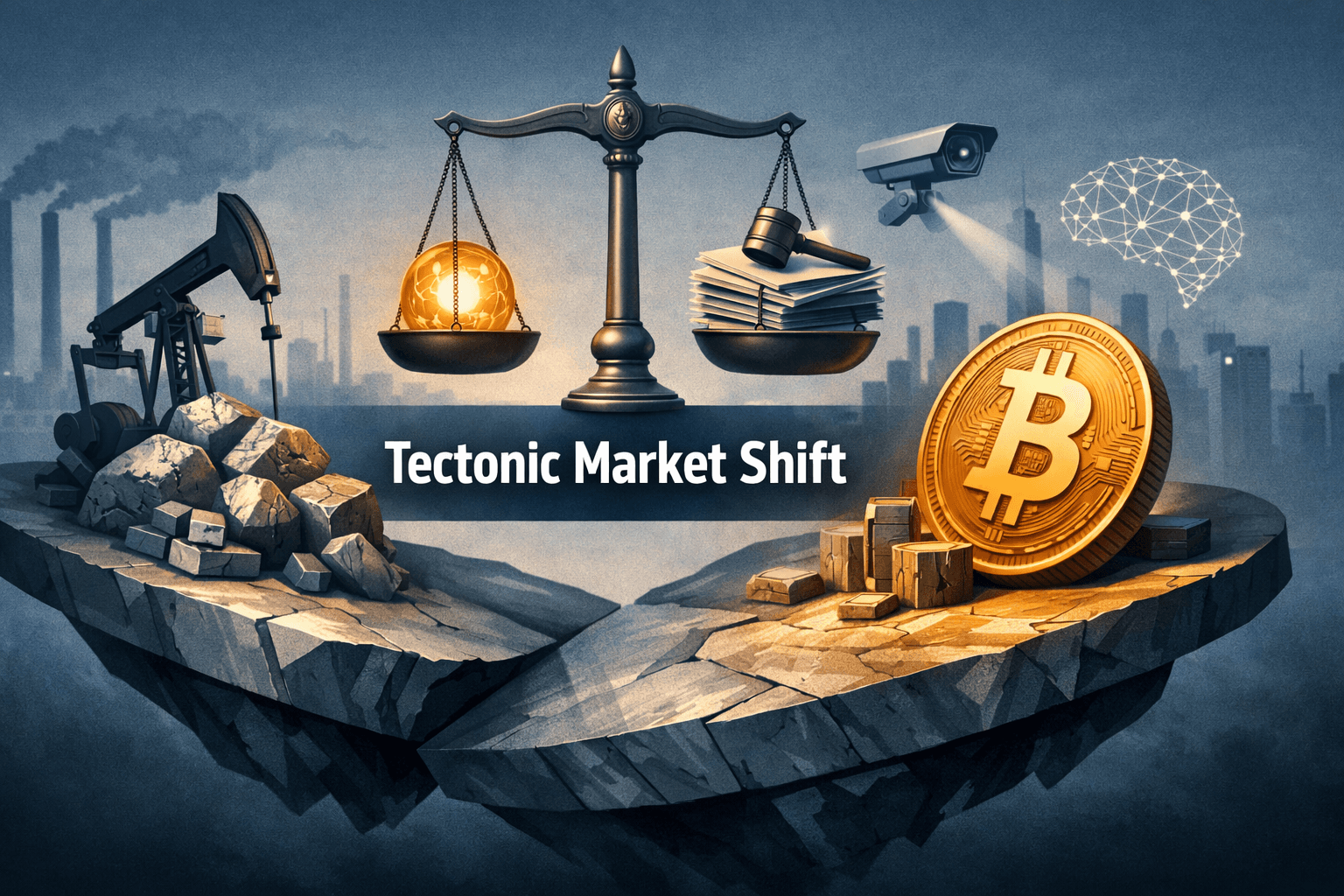
Tectonic Rotation: Energy, Materials and Crypto Lead as Policy, AI and Security Shape Market Direction
Podcast • Loading audio...
Share this article
Spread the word on social media
Key Takeaways
- •Energy and materials led on supply tightness, project financing, and geopolitical risk; monitor physical crude flows and project permits.
- •Spot-Bitcoin ETFs saw a $471M inflow, signaling institutional demand, but a $285M DeFi hack and broader fraud concerns keep operational risk elevated.
- •AI and data-center capex remain cross-sector growth drivers (NVIDIA-related activity), while cybersecurity and controlled rollouts temper near-term upside.
- •Regulatory and legal headlines (Netflix ruling, cannabis policy moves, major media M&A) are creating idiosyncratic volatility and reshaping addressable markets.
- •Real-estate and materials financing is active but often structured via streams/royalties; investors should scrutinize deal economics and financing terms.
Executive summary
Markets opened April 7 with a distinct split: cyclical, commodity- and project-driven sectors showed clear leadership while capital markets and infrastructure-linked groups absorbed regulatory and operational noise. Energy stocks rallied as physical crude tightened to record levels amid Middle East disruptions, materials and mining picked up activity with financing and new drilling, and cryptocurrency saw renewed institutional interest after spot-Bitcoin ETFs collected $471 million — the largest daily inflow since February. At the same time, security incidents (a $285 million DeFi hack and Solana-related concerns), legal rulings (Rome courts on Netflix price hikes) and state-level policy moves (cannabis legalization pushes and hemp-enforcement pauses) complicated the near-term outlook.
Across the 24 sectors we track, three themes dominated: (1) a re-rating of energy and commodity exposure driven by physical tightness and geopolitics, (2) the continuing march of AI and automation into tech, consumer and industrial workflows, and (3) heightened regulatory and security risk that is reshaping capital allocation and investor sentiment.
This recap groups sector performance, explains cross-sector linkages, highlights the most consequential moves and synthesizes actionable insights for investors — all framed by the legal and macro backdrop that will determine whether current momentum sustains.
Grouping by performance
Note: sector-level performance in headlines today was qualitative rather than uniform across every index constituent. The categorizations below reflect the dominant narrative and relative momentum across companies in each sector.
Outperformers
Energy: Physical crude tightened and headline supply risks lifted energy equities and commodity-linked flows. Renewables and EV-linked names also benefited from higher fuel prices that accelerate substitution economics.
Materials & Mining: Project restarts, rare-earth investor events, new drilling programs in Western Australia and financing deals (Macquarie backing Mesabi with $150 million; Versamet adding a 3.52% stream on Eskay Creek gold) supported the sector.
Cryptocurrency: Institutional adoption signals dominated after spot-Bitcoin ETFs posted a $471 million inflow. Despite security headlines, ETF demand and miner positioning created pockets of strength.
Underperformers
Industrial & Manufacturing: Logistics cost pressures, tariff uncertainty and company-level shutdowns (a Walmart fulfillment closure) weighed on near-term fundamentals despite a $1.5 trillion DoD spending proposal that underpins longer-term defense demand.
Utilities: The sector showed a bifurcated picture — storage and nuclear headlines offer upside while coal restarts, generator stress and tariff probes in solar added policy and execution risk.
Communications & Media: Regulatory and legal headlines (a Rome court ruling against Netflix pricing; reputational risks around large M&A such as a $63.5 billion takeover bid for Universal Music) created headline-driven volatility.
Stable / Mixed
Technology: AI-driven capital flows (Nvidia-backed data center funding) and product upgrades balanced against cybersecurity warnings and controlled model rollouts (Anthropic), leaving the sector mixed but structurally positive.
Finance & Real Estate: Banking narratives were mixed — AI tailwinds and margin discussions offset governance scrutiny and a key Bank of America earnings report — while real estate showed healthy deal flow (Carmel Partners' $1.35 billion fund, Welltower's $87.2 million Florida senior-campus purchase, and Empire State Realty Trust (ESRT) moving Midtown assets) amid mortgage-friction debates.
Healthcare & Consumer: Innovation and M&A headlines supported both sectors (Novo Nordisk launching a high-dose obesity product; Henkel agreeing to buy Olaplex), while policy and infectious-disease risk capped exuberance.
Cross-sector themes and correlations
Geopolitics and commodity prices are re-coupling energy, materials and broader markets. Physical crude at record levels and Middle East-related supply disruptions pushed energy equities higher and forced buyers to chase alternatives such as Venezuelan crude. That tightness feeds directly into materials (higher mining and transport costs, but improved resource economics) and indirectly into consumer sectors through higher input prices.
Institutionalization of crypto creates new interplays with finance and energy. Spot-Bitcoin ETF inflows ($471M) signal continued institutional allocation; that raises power demand for miners and ties crypto dynamics to electricity markets — a detail already visible in miner conversations about power contracts. At the same time, fraud and hacks (an $11 billion fraud total in 2025 and a $285 million DeFi exploit today) keep compliance and custody risks top of mind for banks and asset managers.
AI is a cross-cutting growth engine but also a source of differentiation. Nvidia-related data center funding and AI pilots in retail and industrial automation demonstrate how demand for compute drives capex cycles, benefits select chip and data-center names (NVDA and peers), and lifts suppliers across hardware, software and services chains. However, cybersecurity warnings and controlled rollouts (Anthropic) underscore deployment risk and the need for incremental revenue models rather than broad-based immediate margin expansion.
Policy and legal risks create transient winners and losers. Cannabis saw wins in state-level legalization pushes and hemp-enforcement pauses — a favorable commercialization signal — but multi-state operator bankruptcy filings remind investors of the business-model strain. Communications and media saw a bifurcated reaction to regulation: a $63.5 billion takeover bid for Universal Music suggests consolidation upside while local court decisions (Netflix) show revenue-model friction in international markets.
Capital deployment and deal flow are concentrated but selective. Real-estate fundraising (Carmel Partners' $1.35B) and REIT asset trades (Welltower paying $87.2M; ESRT selling Midtown office) indicate active capital recycling. Materials financing and mining streams (Macquarie's $150M, Versamet's 3.52% stream) show project financing is available but often at cost or with royalty-like structures — a sign that equity markets remain cautious and debt or structured deals are growing in importance.
The most significant moves, with context
- Spot Bitcoin ETFs: $471 million inflow (largest daily since February)
Why it matters: ETF flows are an institutionalization story — liquidity, custody services and asset-manager participation are reducing the friction that kept crypto peripheral to many allocators. The inflow signals renewed demand but also concentrates downside risk around ETF redemptions and custody events. Moreover, miner behavior and spot-market liquidity are now increasingly tied to ETF flows, with the power grid implication that miners will seek longer-term, firm power contracts.
- Energy rally on physical tightness and Middle East risks
Why it matters: Physical crude at record levels pushed energy equities higher and revived upstream and midstream narratives. This is not purely an oil-price story: higher fuel costs accelerate policy attention on renewables and electrification, windfalls for resource producers, and stress on transport-intensive manufacturers and retailers. The knock-on effect into consumer price dynamics is an inflationary signal that could influence central-bank calculus over coming weeks.
- Materials financing and project momentum
Why it matters: Multiple financing and deal-flow items (Macquarie's $150 million support for Mesabi; Versamet's 3.52% Eskay Creek stream; new drilling in Western Australia) indicate that capital is available for high-grade projects, particularly those tied to electrification and defense supply chains. That follows broader policy-driven demand for rare-earths and critical minerals — a structural tailwind that shows up in project-level valuations and M&A appetite.
- Security incidents and fraud in crypto
Why it matters: A $285 million DeFi hack and data pointing to $11 billion of fraud in 2025 underline the persistent operational risk in digital-asset infrastructure. These incidents drive regulatory scrutiny, raise compliance costs for institutional participants, and create episodic market dislocations. They temper the bullish ETF flows and keep custody and insurance at the center of conversations for asset managers and banks.
- Media and communications legal fights
Why it matters: A Rome court ruling that Netflix price hikes were illegal — coupled with a $63.5 billion takeover bid for Universal Music — highlights how regulation and consolidation can coexist. Revenue-model changes face local legal systems and consumer-backlash risks, while M&A pressure can create strategic change across content owners and distributors. For global media companies, earnings and subscriber guidance will be watched through the twin lens of local regulation and consolidation possibilities.
- Real-estate deal activity and mortgage friction
Why it matters: High-profile deals — Carmel Partners closing a $1.35 billion fund, Welltower's $87.2 million purchase, and ESRT moving a Midtown office — show investor appetite for income-generating and strategic assets. Simultaneously, mortgage workflow fragmentation and income-verification debates signal potential friction for retail buyers and refinancing markets. The dual dynamic suggests selective opportunities in commercial real estate while residential and mortgage-sensitive sectors remain vulnerable to process and rate volatility.
- Industrial sector dichotomy: defense spending vs. logistics stress
Why it matters: A $1.5 trillion DoD proposal is a structural positive for defense contractors and industrial suppliers, potentially underpinning multi-year revenue visibility for select names. Yet in the near term, rising logistics costs, tariff uncertainty and a Walmart fulfillment closure highlight execution and demand risks in the broader industrial complex. Investors should expect idiosyncratic winners (automation, defense) and losers (logistics-exposed, tariff-sensitive manufacturers).
Actionable insights (for informational purposes)
Reassess exposures to energy and materials with scenario analysis. Data suggests stronger near-term cash flows for producers if physical tightness persists, but investors should stress-test portfolios for both sustained commodity prices and rapid re-pricing if diplomatic developments ease supply constraints.
Treat crypto ETF flows as institutionalization, not immunity from operational risk. ETF inflows ($471M) indicate demand, but the recent $285M DeFi hack and 2025 fraud data argue for careful counterparty and custody due diligence.
Favor companies with defensible tech moats in AI deployments. Nvidia-led data-center funding and AI pilots across retail and industrials are revenue catalysts, but cybersecurity warnings mean that names delivering measurable ROI and robust controls will separate from the pack.
Watch policy and local regulation for content and consumer-facing businesses. Court rulings on pricing (Netflix) and state-level cannabis moves can have outsized short-term effects on subscription growth and addressable markets; scenario planning around legal outcomes will be important for valuation modeling.
Monitor financing terms in materials and real estate. The prevalence of streams, royalties and structured financing (e.g., 3.52% Eskay Creek stream) shows that capital is flowing but often at terms that dilute upside. Investors should examine deal economics closely and differentiate between near-term cash yield and long-term resource optionality.
For utilities and grid-exposed names, focus on transition-readiness and operational flexibility. The interplay between storage demand, coal restarts and generator stress argues for careful assessment of asset mix, regulatory exposure, and transmission constraints.
Digest defense-related industrial exposure with an eye to program timelines. A large DoD proposal supports long-term bookings, but revenue recognition and contract phasing mean near-term earnings drivers can lag headline appropriations.
Notable tickers and data points referenced
- Spot-Bitcoin ETFs: $471 million inflow (largest daily since February) — ETF flows are an important gauge of institutional demand.
- DeFi hack: $285 million — underscores operational and security risk in crypto.
- Fraud in 2025: $11 billion (aggregate figure cited) — sets the regulatory and compliance backdrop.
- Real-estate deals: Carmel Partners closed a $1.35 billion fund; Welltower paid $87.2 million for a Florida senior campus; ESRT (Empire State Realty Trust) agreed to sell a Midtown office.
- Media M&A: a $63.5 billion takeover bid for Universal Music was a headline driver.
- Technology: Nvidia (NVDA)-backed data-center funding featured as an AI-capex catalyst.
- Healthcare / consumer: Novo Nordisk (NVO) launched a high-dose obesity product; Henkel agreed to buy Olaplex.
- Finance: Bank of America (BAC) delivered a pivotal earnings report that investors watched for margin and governance signals.
- Materials financing: Macquarie-backed Mesabi with $150 million support; Versamet added a 3.52% Eskay Creek gold stream.
(These tickers and figures are mentioned for market context and should not be construed as investment recommendations.)
Risks and caveats
Policy and legal outcomes are inherently binary and can rapidly reverse sentiment; examples today include state cannabis legalization pushes and court rulings on subscription pricing.
Security incidents in crypto and cyber threats to enterprise AI deployments create episodic downside that can overwhelm macro narratives.
Commodity prices are sensitive to geopolitical developments; a de-escalation in the Middle East or a rapid supply response could quickly reverse energy and materials gains.
Financing terms for projects are tightening in pockets; equity dilution, streams and royalty deals may compress upside even as projects move forward.
Forward-looking perspective — what to watch next
Oil and physical crude flows: monitor daily physical-price data, tanker flows and sanction enforcement headlines. A persistent tightness will keep energy and commodity-linked equities bid; a rapid resolution to tensions would likely reverse that move.
Crypto custody and regulatory actions: watch statements from the FDIC and SEC, as well as court outcomes related to fraud and DeFi enforcement. Institutional flows can be durable, but regulatory clarity (or lack thereof) will determine the pace.
AI revenue signaling and capex announcements: earnings-season commentary on AI-driven software revenue, data-center bookings and semiconductor supply commitments (NVDA and peers) will set the tone for the tech cycle.
Real-estate mortgage workflows and rate moves: loan-application processing noise and income-verification debates, combined with any moves in mortgage rates, will materially affect residential and REIT performance.
Project financing and mine permits in materials: watch resource approvals, offtake agreements and streaming/royalty packages. Financing that closes at reasonable economics will validate the sector's momentum.
Corporate governance and M&A developments in media & communications: bids like the $63.5 billion Universal Music approach and local legal rulings on pricing will shape investor expectations for free cash-flow and consolidation benefits.
Investment disclaimer (critical)
This report is for informational purposes only. It does not constitute personalized investment advice or a recommendation to buy, sell, or hold any security. Analysts note that the observations above are based on news flow and sector summaries from April 7; readers should conduct their own due diligence and consult a licensed advisor for individualized advice.
Bottom line
April 7’s market narrative was dominated by a rotation into commodity- and project-driven sectors, balanced by the dual forces of AI-driven capital allocation and persistent regulatory and security risks. Energy and materials led on tightening physical markets and deal activity, while crypto saw renewed institutional flows even as fraud and security incidents reminded markets of operational vulnerabilities. Technology and AI remained an undercurrent supporting long-term growth themes, but legal rulings, policy debates and financing structures will determine whether today’s momentum translates into a durable multi-quarter trend.
Investors should monitor real-time commodity flows, ETF and custody developments in crypto, and the cadence of AI-related revenue disclosures; these factors will likely dictate who benefits from — and who is exposed to — the market’s evolving cross-currents over the coming sessions.
Sources
+ 14 more sources
Use these insights — enter this week's contest.
Free practice contests — earn Alpha CoinsExplore More Content
Disclaimer: StockAlpha.ai content is for informational and educational purposes only. It is not personalized investment advice. Sentiment ratings and market analysis reflect data-driven observations, not buy, sell, or hold recommendations. Always consult a qualified financial advisor before making investment decisions. Past performance does not guarantee future results.