 Sector Insights
Share this article
Spread the word on social media
Key Takeaways
- •Energy led the tape as a ~51% one-month WTI surge from Strait of Hormuz disruptions re-priced commodities, shipping and related equities.
- •Real estate showed selective strength — an 85% sellout at a Manhattan condo project and major multifamily financings point to micro-market demand.
- •AI deployments sustained technology momentum, but security incidents and data-center supply constraints present headwinds.
- •Cannabis and crypto were headline-sensitive: legal/campaign-fraud risk weighed on cannabis, while a $280M crypto exploit highlighted custody vulnerabilities.
- •Utility and renewable installations diverged: new manufacturing and grants coexist with a 22% drop in U.S. solar installations in 2025, underscoring execution risk.
Executive summary
Markets opened the month with a clear line of demarcation: sectors tied to commodities and infrastructure reacted strongly to physical supply shocks and project-level deals, while areas exposed to legal, security and policy risk showed caution. A one-month, roughly 51% surge in WTI crude prices — driven by disruptions in the Strait of Hormuz and tighter global seaborne flows — reverberated across energy, transport and parts of financial markets. At the same time, AI rollouts and cloud-product launches kept technology and adjacent communications names in the headlines even as security incidents and data-center supply constraints tempered enthusiasm.
Real estate provided a counterpoint: strong leasing, an 85% sellout at a Manhattan condo project and several large financings signaled continued demand in selected property types. Conversely, cannabis faced fresh legal and political headwinds, utilities grappled with a 22% plunge in U.S. solar installations in 2025 amid infrastructure buildouts, and crypto markets absorbed a $280 million exploit overnight that underscored persistent custody and security vulnerabilities.
Taken together, the tape today favors sectors with direct exposure to physical flows, infrastructure projects and scalable software monetization. Sectors reliant on regulatory clarity, trust in custody and steady consumer spending showed more stress.
Sector performance groups
Below we group the 24 tracked sectors into outperformers, underperformers and stable/mixed performers based on the day’s headlines, macro drivers and deal flow.
Outperformers
- Energy — Driven by crude volatility out of the Middle East and a sharp one-month WTI move (~51%), energy names and commodity-related services saw price-action and volume that suggest renewed risk-on positioning in the short term. Storage, shipping and some integrated players are back in focus. Expect elevated correlation with shipping insurance and freight names in the near term.
- Real estate — Strong leasing deals, an 85% sellout at a Manhattan project (1122 Madison), a $765 million multifamily refinance and reports of record office rent pockets point to select pockets of strength. Investors are parsing micro-markets: luxury Manhattan condos and well-located multifamily units continue to command demand, while broader office recovery remains uneven.
- Technology — AI model rollouts, new product releases (including Cloudflare’s open-source CMS) and persistent enterprise demand for AI tooling kept the sector in demand despite security and supply-chain headwinds. Momentum in AI-related licensing and cloud services continues to prop up large-cap software names and infrastructure suppliers.
Underperformers
- Cannabis — New lawsuits, campaign-fraud allegations and regulatory uncertainty are creating headline risk. Even with New Jersey aligning hemp rules with federal guidance, legal proceedings are weighing on valuations and deal flow.
- Cryptocurrency/blockchain — A $280 million exploit overnight and geopolitical shocks pressured sentiment and liquidity. While large buys (reported Metaplanet purchase of 5,075 BTC) and fresh infrastructure rollouts keep a floor under the market, custody and protocol safety concerns are resurfacing.
- Utilities — The sector showed mixed internal dynamics: a 22% drop in U.S. solar installations in 2025 contrasts with fresh manufacturing announcements, Texas nuclear grants and planned grid programs. Near-term project delays and weather-related preparedness ahead of severe seasons are weighing on investor clarity.
Stable / Mixed performers
- Healthcare — Rapid digital adoption, genomics gains and hospital IT upgrades point to longer-term growth, while strained public-health capacity and access gaps introduce episodic risk and policy uncertainty.
- Consumer & Retail — Same-day delivery moves (FedEx expanding offerings), big payments-tool rollouts (Visa’s AI dispute tools) and brand-level news (Hershey reverting Reese’s recipe, Nike’s turnaround lagging) produced offsetting forces.
- Communications & Media — New content deals (A24 projects) and Cannes-driven creator-economy momentum coexist with structural changes in network supply driven by AI-RAN developments; results will be idiosyncratic across studios, streaming and legacy broadcasters.
- Industrial & Manufacturing — Ongoing manufacturing growth is being counterbalanced by layoffs, price pressures and logistics-cost shifts that create a mixed picture for capital expenditures and margins.
- Materials & Mining — Increased exploration activity in silver, gold and rare earths, and expanded recycling and processing partnerships, suggest selective upside but with commodity-cycle exposure.
- Finance & Banking — Market moves tied to oil and policy (a Medicare Advantage access issue for oncology patients) created pockets of volatility but no broad directional shift.
Cross-sector themes and correlations
Commodity shocks ripple broadly. The crude-price spike shows how a geography-specific supply shock (Strait of Hormuz) can cascade into energy stocks, shipping, insurers and even financials through margin and spread impacts. Where crude rises, diesel and jet-fuel costs pressure industrial margins and transportation pricing, linking energy with industrials and consumer sectors.
AI is a multi-sector growth engine — and a risk amplifier. AI product launches and model rollouts are providing top-line lift in technology and communications, while AI-enabled tools (Visa’s dispute AI, Cloudflare’s CMS) are showing up in payments and content delivery. At the same time, AI increases attack surfaces: crypto and tech security incidents illustrate that faster deployments without hardened controls raise systemic risk.
Infrastructure investment vs. deployment gaps. Utilities and renewables are experiencing a split: new manufacturing and grant-funded projects (e.g., Texas nuclear support) are stacking the pipeline, but installation metrics (solar installations down 22% in 2025) reveal execution bottlenecks — permitting, supply-chain friction and capital constraints. That gap creates differentiated winners and losers among equipment suppliers, EPC contractors and project owners.
Regulatory and legal risk truncates value across small-cap, high-volatility sectors. Cannabis and certain crypto protocols remain highly sensitive to regulatory actions, court rulings and enforcement activity; headlines — not fundamentals — often generate price swings. This is also visible in healthcare access policy debates, where coverage decisions can affect payer and provider revenue streams.
Real asset bifurcation. Within real estate, luxury residential and well-located multifamily continue to attract buyers and lenders, while office and some retail segments remain uneven. This bifurcation emphasizes the need to look at property-level fundamentals rather than sector averages.
The most significant moves, explained
Energy: WTI’s one-month, ~51% surge
Why it mattered: A jump of this magnitude compresses margins and re-prices risk across a swath of sectors. Producers, integrated majors and refiners can see both upside (higher revenue per barrel) and headwinds (feedstock costs, inventory valuation). The move also reshapes transport economics: higher freight and bunker costs feed to shipping and logistics providers.
Why it happened: Disruptions in the Strait of Hormuz and tighter seaborne flows created scarcity in short-term supply, prompting traders to reweight inventories and prompting opportunistic buying from macro funds and physical players.
Crypto: $280 million exploit and Metaplanet buy
Why it mattered: Large protocol exploits undermine confidence in custody arrangements and liquidity on-chain. The loss pressures token prices and raises funding costs for projects that depend on on-chain collateral. Conversely, a reported Metaplanet purchase of 5,075 BTC shows that long-term buyers continue to add to positions, which can provide some price support.
Why it happened: Security gaps in protocol code or in bridging tools remain the dominant vulnerability in crypto markets. At the same time, macro participants with balance-sheet capacity are using dislocation as buying opportunities, creating two-way volatility.
Real estate: 85% sellout at Manhattan condo (1122 Madison); $765M multifamily refinance
Why it mattered: High sellout rates at luxury projects and large financing deals indicate that capital and buyer interest remain in targeted real-estate assets, supporting lenders and select REITs. Large refinancings at attractive spreads help extend maturities and stabilize cash flows for owners.
Why it happened: Tight supply in core urban micro-markets, durable demand from high-net-worth buyers and attractive financing windows for stabilized assets combined to produce deal flow. Multifamily demand remains buoyed by constrained for-sale inventory and favorable urban amenities.
Technology: AI rollouts and Cloudflare open-source CMS
Why it mattered: New product launches drive monetization opportunities for cloud and software players and increase platform stickiness, supporting recurring-revenue models. The open-source CMS release may accelerate third-party development and broaden Cloudflare’s addressable market.
Why it happened: Vendors are moving to capitalize on enterprise AI demand, offering verticalized tools and developer-friendly platforms that speed time to value. But security and data-center supply concerns temper the upgrade cycle.
Cannabis: Legal headwinds and campaign-fraud allegations
Why it mattered: Litigation and political risk depress valuations and increase capital costs. These risks can stall M&A activity and delay expansion into new markets even when regulatory alignment (e.g., New Jersey hemp rules) would otherwise be supportive.
Why it happened: As cannabis markets mature, legal and political frameworks are still settling. Cases tied to campaign finance, licensing and compliance create episodic volatility.
Utilities/renewables: Solar installations down 22% in 2025
Why it mattered: A sharp drop in installations despite manufacturing investments reveals that supply-side growth alone won’t translate into near-term capacity additions. That dynamic affects equipment suppliers, installers and developers’ near-term revenue profiles.
Why it happened: The decline reflects a mix of permitting delays, grid-connection bottlenecks, and, in some geographies, subsidy and policy shifts. At the same time, new manufacturing and grid programs (and nuclear grants in Texas) point to longer-term capacity buildup.
Actionable insights for investors (informational, non-personalized)
Monitor commodity flows and route disruptions closely. With energy prices reacting sharply to geopolitics, watching shipping lanes, insurance rate cards and refinery utilization can provide early signals for energy-related equities and freight-sensitive industrials. Analysts note that storage-duration and geographic flexibility matter more than headline production figures in the short run.
Differentiate within real estate. The 85% sellout and large refinance activity underline the importance of property-level fundamentals. Investors and analysts should focus on rent growth trajectories, lease maturities, tenant quality and local supply pipelines rather than sector aggregates.
Treat AI adoption as both an upside and a governance risk. AI-related product launches will likely support software and cloud revenue growth. But data governance, model risk management and cybersecurity readiness will determine whether AI deployments convert into durable margin expansion. Momentum indicates that vendors with strong security and observability stacks may capture more durable enterprise spending.
Manage crypto exposure around custody and protocol risk. High-dollar exploits ($280M range) and cross-border geopolitical shocks show the continued fragility of some parts of the crypto plumbing. For market participants, on-chain transparency can be a double-edged sword: it enables rapid monitoring but also exposes weak controls. Analysts suggest distinguishing between infrastructural protocols with long-term security roadmaps and high-yield, high-risk primitives.
Watch for policy- and litigation-driven dislocations in regulated sectors. Cannabis and healthcare show that legal and coverage decisions can materially alter revenue paths. Those tracking names in these sectors should model for multiple regulatory outcomes and monitor key court dates and policy announcements.
Focus on execution in renewables. The 22% decline in solar installations indicates that building factories is not the same as getting projects online. Investors should scrutinize developer pipelines, interconnection queues and the health of local EPC partners when assessing renewables exposure.
Anticipate earnings-season nuance. For sectors tied to energy prices (transportation, chemicals, refining) and for tech names with large deferred revenue bases, earnings will likely show divergent impacts from the same macro moves. Watch margins, backlog commentary and FX sensitivity in upcoming reports.
Significant names and tickers in the headlines (contextual only)
- Energy: WTI crude (commodity), integrated majors and energy-services names were in focus as price volatility rose.
- Real estate/property plays: Urban luxury condo projects (1122 Madison) and multifamily borrowers were active in lending markets.
- Technology: Cloudflare (NET) drove headlines with a new open-source CMS; AI leaders and cloud firms remain central to the narrative.
- Consumer & payments: FedEx (FDX) expanded same-day delivery; Visa (V) rolled out AI dispute tools. Hershey (HSY) and Nike (NKE) were mentioned for product and turnaround developments.
- Crypto: Bitcoin (BTC) was a focal point after a large institutional buy (5,075 BTC reported) and a $280M exploit impacted broader sentiment.
- Cannabis: Sector-wide legal headlines affected multiple small-cap names and private operators.
Note: Ticker mentions are for topical context only and not investment recommendations.
Risks and what could change the picture
- Geopolitical escalation in key shipping choke points could push energy and freight costs materially higher, changing inflation and policy expectations.
- A large regulatory shift — for example, meaningful federal action on cannabis, or major healthcare coverage rulings — could instantly re-rate whole subsectors.
- A major technological security breach in a cloud or AI provider would amplify caution across tech and finance, slowing procurement cycles.
- An acceleration in renewables installations driven by streamlined permitting or grid upgrades would narrow the current gap between manufacturing capacity and project delivery, benefiting equipment makers and installers.
Conclusion — looking ahead
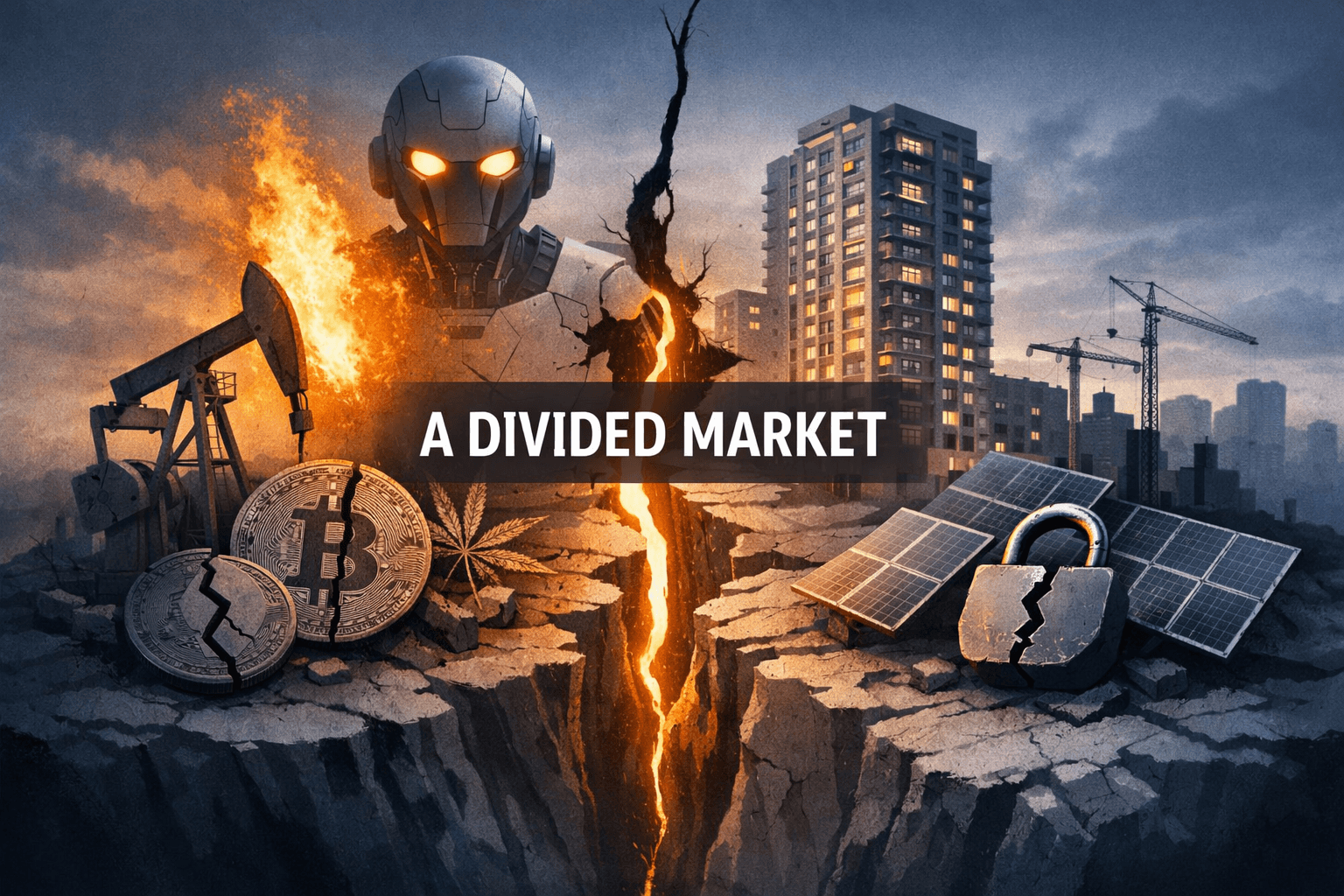
Today’s tape underscores a market divided between tangible, near-term shocks and durable structural trends. The crude-price shock and storage/transport implications will dominate headlines and earnings-season commentary in the short run; at the same time, multi-year themes — AI adoption, urban housing tightness, infrastructure upgrades, and the slow institutionalization of crypto — will continue to shape sector trajectories.
For the next several weeks, watch for: further developments around the Strait of Hormuz and freight-cost indicators; company-level disclosures on AI deployments and security posture ahead of earnings; legal and regulatory milestones in cannabis and healthcare; and data on renewable installations and interconnection queue movement that could signal a pickup in project delivery. These factors will likely determine whether today’s outperformance in energy and real estate proves durable or gives way as broader macro and policy-moving events unfold.
Investment disclaimer: This analysis is provided for informational purposes only. It does not constitute a recommendation to buy, sell, or hold any security, nor is it personalized investment advice. Analysts note that individual investment decisions should account for personal circumstances, risk tolerance and investment horizon.
Sources
+ 3 more sources
Use these insights — enter this week's contest.
Free practice contests — earn Alpha CoinsExplore More Content
Disclaimer: StockAlpha.ai content is for informational and educational purposes only. It is not personalized investment advice. Sentiment ratings and market analysis reflect data-driven observations, not buy, sell, or hold recommendations. Always consult a qualified financial advisor before making investment decisions. Past performance does not guarantee future results.