 Sector Insights
Listen to this Recap
11:03
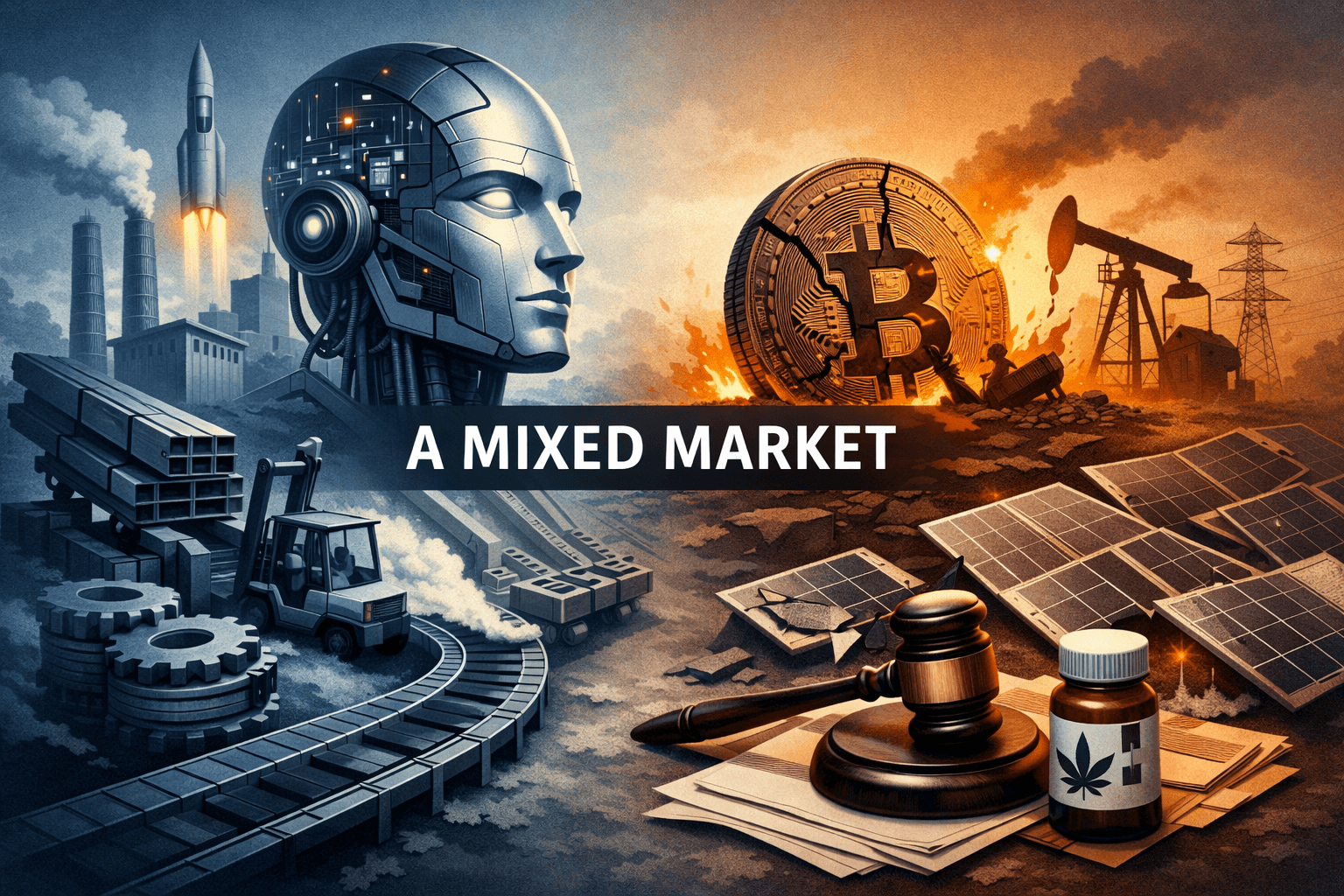
AI and Industrials Drive Breadth While Energy, Crypto and Solar Face Headwinds — A Mixed Market Narrative
Podcast • Loading audio...
Share this article
Spread the word on social media
Key Takeaways
- •AI/cloud and industrial capex headlines (e.g., MSFT’s $5.5B Singapore cloud plan) are driving cross-sector demand for servers, materials and services.
- •Crypto volatility spiked after a $200M+ Solana/Drift exploit, underscoring security and custody risks for institutional flows.
- •Energy faced bifurcated pressures: short-term supply shocks (helium, jet fuel) raised risk premia even as renewables and EV infrastructure continued to attract investment.
- •Solar installs dropped ~22%, creating headwinds for some utilities despite storage (BESS) grants and grid upgrade activity.
- •Regulatory and legal catalysts — from Medicare cannabis litigation to FDA approvals — are producing idiosyncratic opportunity and risk; calendar awareness is crucial.
Executive summary
Today’s market tape read like a study in contrasts. Technology and industrial themes — led by large cloud commitments and renewed capex signals around AI, manufacturing and electrification — provided the clearest upside momentum. Materials and select consumer plays showed constructive M&A and project-driven gains that reinforced a risk-on tone in parts of the cycle.
At the same time, a string of headline risks restrained markets: geopolitical disruptions and supply chokepoints pushed parts of the energy complex higher even as global crude flows showed mixed signals; the cryptocurrency ecosystem was rocked by a $200M+ exploit on a Solana protocol; and solar installs fell sharply, with reports of a 22% decline that pressured utility-scale and distributed-solar narratives. Policy moves — from a federal Medicare reimbursement push for hemp products and a related lawsuit to fresh FDA and Medicare scrutiny in health care — added regulatory uncertainty across several pockets of the market.
Overall, data and headlines suggest a bifurcated market: capital is flowing into AI/cloud computing, manufacturing upgrades and materials tied to electrification, while episodic shocks in energy, crypto and renewables are producing short-term volatility and selective risk-off behavior.
Important note: this article is for informational purposes only. It does not constitute investment advice or a recommendation to buy, sell or hold any security.
Grouping by performance: outperformers, underperformers, stable
Below we group sectors by observed momentum and headline-driven direction today. Performance labels reflect cross-sectional headlines and reported datapoints from the trading day rather than end-of-day index returns.
Outperformers
- Technology: Big-ticket cloud and AI investment news (including Microsoft’s $5.5 billion cloud commitment in Singapore) and fresh open-source AI momentum provided tangible demand signals for capex-related hardware, services and software.
- Industrials & Manufacturing: A third consecutive month of expansion, accelerating freight, AI-driven automation moves and electrification investment headlines supported the sector’s momentum.
- Materials & Mining: Exploration progress, offtake deals, M&A and regulatory wins for resources (including lithium) kept materials in constructive territory.
Underperformers
- Energy: Mixed supply signals — abrupt disruptions raising prices in areas such as helium and jet fuel — and headline-driven volatility left the sector pressured despite pockets of strength in renewables and EV charging infrastructure.
- Cryptocurrency: A $200M+ exploit on Solana’s Drift project and ongoing regulatory scrutiny drove heightened volatility and risk aversion in digital-asset-linked exposures.
- Utilities / Solar-related names: Grid upgrades and storage wins were offset by a reported 22% decline in solar installs, which pulled on sentiment across distributed-generation and installer economics.
Stable / Mixed
- Healthcare: Strong idiosyncratic moves (Eli Lilly’s FDA approval for an oral obesity pill) contrasted with policy headwinds (Medicare Advantage oversight and funding cuts), producing a mixed headline ledger.
- Finance & Banking: A mix of product launches, litigation headlines and institutional crypto exposure news (Franklin Templeton deepening crypto exposure; fintech repositioning from the U.S.) produced a sideways overall picture.
- Consumer & Retail: Large-scale consolidation and tech-led partnerships (including a reported $45 billion Unilever–McCormick tie-up and retail tech moves) created selective winners amid continued demand uncertainty.
- Communications / Media: Momentum in telecoms (private 5G expansion) and steady content deal flow offset regulatory and cultural risks, keeping the sector largely in line with market moves.
- Real Estate: Strong financing activity and large leasing deals (a reported 20,000-sq-ft Midtown lease and a $16 million Brooklyn penthouse listing) signaled active capital markets and selective leasing strength.
- Cannabis: Policy progress (Medicare reimbursement discussions) bumped up legitimacy, but legal actions and state-level bans kept the sector’s outlook uneven.
Cross-sector themes and correlations
- AI / Cloud spending is a cross-market engine
- The $5.5B Singapore cloud commitment by Microsoft and multiple reports of new AI-related hiring and investments in cloud regions suggest a multiyear upgrade cycle. That flows through semiconductors, servers, industrial suppliers and logistics. Data suggests Microsoft’s move has both regional (APAC) and technology demand implications for stocks in the AI hardware and datacenter ecosystem (tickers such as MSFT are often referenced by analysts as lead indicators for cloud capex).
- Industrial modernization and onshoring are lifting materials demand
- Reports of exploration ramps, offtake deals and M&A in mining and materials reflect a durable need for localized supply chains and high-purity inputs. This correlation — between industrial upgrade headlines and materials momentum — argues that materials exposure is picking up in a bottoms-up way rather than via cyclical commodity price spikes alone.
- Energy geopolitics vs. green transition divergence
- Energy headlines were bifurcated: short-term supply shocks (helium shortages affecting chipmakers, jet-fuel pressure in the U.K.) pushed near-term prices and risk premia higher, while renewables and EV charging infrastructure continued to attract investment. The resulting correlation is a market that is both raising cash for short-term energy security and allocating capital to the low-carbon transition.
- Cybersecurity and operational risk are rising cross-asset vulnerabilities
- A major FBI cyber incident paired with the Solana Drift exploit underscores the lesson that technology-driven incidents can have layered market impacts — hitting crypto rails directly, prompting patch activity in software names, and increasing demand for security services.
- Policy and legal headlines continue to drive idiosyncratic volatility
- From Medicare cannabis litigation to healthcare regulatory scrutiny and telecom router rules, regulatory shifts are producing single-stock and sector-level dispersion. That increases the value of active selection and catalyst-aware risk management.
The most significant moves and why they matter
- Solana / Drift exploit (~$200M+)
- What happened: A $200M-plus exploit on Solana’s Drift dominated crypto headlines and flushed liquidity from risk-on digital-asset positions.
- Why it matters: Beyond immediate token price pressure, the exploit highlights persistent security gaps on high-throughput chains and raises counterparty and custody questions for institutional flows (Franklin Templeton’s deeper crypto exposure and Interactive Brokers’ Bitcoin EEA launch are notable contextual developments). The incident underlines correlation risk between on-chain protocols and centralized intermediaries.
- Microsoft’s $5.5B cloud commitment in Singapore
- What happened: Microsoft announced a $5.5 billion total investment to expand cloud infrastructure and AI capabilities in Singapore — a substantial regional capex commitment.
- Why it matters: The deployment is both a demand signal for datacenter equipment and a strategic move for enterprise AI services in APAC. Analysts note such commitments can strengthen demand for server, networking and power-management suppliers and support related industrial activity.
- Eli Lilly FDA approval for an oral obesity pill
- What happened: Regulatory approval for an Eli Lilly (LLY) oral obesity medication clears the way for a new commercial battleground with Novo Nordisk (NVO) and other obesity-focused developers.
- Why it matters: The approval accelerates commercialization competition and could alter long-term addressable market assumptions in specialty therapeutics and obesity-related services. For healthcare investors, the approval is a catalyst that raises pricing, marketing and payer-interaction questions.
- Solar installs down 22% — utilities feel the drag
- What happened: A reported 22% drop in solar installations on the most recent comparison set weighed on the utilities and distributed-generation narratives.
- Why it matters: The decline can reflect policy lags, supply-chain constraints, or demand softness tied to financing and incentive changes. Utilities that were counting on residential and commercial solar growth may face revenue timing and margin pressure, while BESS (battery energy storage system) grants and grid upgrades remain positive counterweights.
- Unilever–McCormick $45B tie-up and consumer consolidation
- What happened: Reports of a $45 billion tie-up between Unilever and McCormick (MKC/UL references) highlight strategic consolidation in consumer goods.
- Why it matters: Large M&A in staples and grocery reshapes shelf dynamics, sourcing and scale economics. Data suggests consolidation pressures can benefit scale operators while pressuring mid-sized independents.
- Energy supply disruptions: helium and jet-fuel tightness
- What happened: Geopolitical frictions and logistical constraints produced spot shortages in helium (a critical input for semiconductor lithography) and jet fuel in the U.K.
- Why it matters: Semiconductor manufacturing and aerospace industries are directly exposed to these inputs. Even brief shortages can delay production, alter inventory strategies and introduce short-term price pressure that cascades across supply chains.
- Utilities: grid upgrades vs. operational stress from data-center growth
- What happened: Utilities reported both new BESS grants and grid-upgrade projects alongside stress from data-center growth.
- Why it matters: Data-center expansion can raise peak-load concerns and require targeted transmission investments. The result is mixed near-term capital spending for utilities and differentiated winners based on regulatory frameworks and rate-case access.
- Real estate: large mortgages, big leases, active capital
- What happened: Market headlines included a notable big mortgage, a 20,000-sq-ft Midtown lease and a $16M Brooklyn penthouse listing.
- Why it matters: These point to active capital markets at the top end of the market and selective leasing strength in high-demand urban cores, even amid broader office and retail adjustment.
Actionable insights for investors (informational, not advisory)
Monitor AI / Cloud capex signals as a leading indicator for industrial and semiconductor demand
- Why: Large commitments (e.g., Microsoft’s $5.5B plan) often presage order flow for servers, cooling, power systems and networking. Data suggests early supplier-cycle upgrades can outpace broader capex cycles.
Treat energy and commodity-related headlines as shorter-duration risk drivers
- Why: Supply shocks (helium, jet fuel) and geopolitical events can produce abrupt spikes that are often mean-reverting but materially disruptive to exposed supply chains. Position sizing and liquidity management are critical around such events.
Focus on policy catalysts and legal outcomes that can produce idiosyncratic swings
- Why: From Medicare cannabis litigation to FDA approvals and utility rate cases, regulatory events can create significant single-stock dispersion. Investors who track calendarized catalysts may find clearer entry/exit windows and volatility patterns.
Watch cybersecurity and operational risk across both tech and financial rails
- Why: The Solana/Drift exploit and FBI cyber incidents show that security events can hit crypto, software and services simultaneously. Demand for cybersecurity budgets may increase, and risk premia on protocols could remain elevated until systemic fixes are demonstrated.
Pay attention to M&A and consolidation in consumer and materials
- Why: Large transactions, such as the reported Unilever–McCormick tie-up, can reset valuations and competitive dynamics. Materials M&A and offtake deals often signal project financing momentum and near-term production changes.
For income and defensive allocations, weigh mixed signals in utilities and finance
- Why: Utilities face grid and solar-installation dichotomies; financials have litigation, product launches and selective fintech pullbacks. The cross-current suggests active, selective allocation rather than blanket sector bets.
Risks and mitigants to watch
- Regulatory risk: Medicare/Medicaid policy, FCC rules and financial litigation continue to be active risk channels. Monitor filings and commission comment deadlines.
- Cyber and operational shocks: Continued exploits or infrastructure incidents could expand correlation across risk assets, especially between crypto rails and fintech providers.
- Geopolitical supply risks: Energy and helium supply disruptions can produce outsized sector impacts that ripple into semiconductors and airlines.
- Macro tightening or policy surprises: If central banks shift guidance or if fiscal policy produces large shocks, cyclical sectors (industrials, materials) and rate-sensitive sectors (real estate, utilities) could reprice rapidly.
What to watch next (events and data)
- Corporate capex announcements and AWS/Cloud competitor moves — any additional large cloud commitments will be market-moving for tech and industrial suppliers.
- Regulatory calendars: Medicare/Medicaid decisions related to cannabis, and any new guidance from the FDA or CMS that affects drug pricing or coverage.
- Energy supply headlines: OPEC updates, refinery maintenance schedules, and pipeline or logistics developments that affect jet fuel and specialty gases.
- Crypto custody and regulatory updates: Any US or EU regulatory action post-exploit that changes the institutional access landscape.
- Solar install datapoints and utility filings: Further monthly install data or rate-case outcomes will determine whether the 22% drop is a one-off or a trend.
Conclusion — forward-looking perspective
Today’s market action reinforces a central theme for 2026: structural investment into AI, cloud and industrial modernization is creating durable pockets of demand, while headline-driven shocks (energy supply, cyber incidents, regulatory litigation) continue to generate episodic volatility. The result is a market that rewards thematic clarity, catalyst awareness and disciplined risk management.
Short term, expect continued dispersion: some sectors will benefit from steady capital allocation (AI/cloud, certain materials, select industrials) while others will see headline-driven retrenchments (crypto, parts of energy and solar). Over a medium-term horizon, investors and market participants will be watching whether capex commitments translate into sustained revenue growth for suppliers, whether policy and regulatory frameworks stabilize for nascent industries (cannabis, crypto, solar), and whether geopolitical energy risks abate or prompt structural supply responses.
This dispatch will continue to track developments across these themes, flagging catalyzing events and regulatory changes that commonly reshape sector-level returns. Again: this material is informational only and does not constitute investment advice.
Investment disclaimer: This article is for informational purposes only. It is not a recommendation to buy, sell or hold any security, nor is it personalized investment advice. Analysts note market dynamics and data-driven trends; readers should consult a licensed professional for portfolio decisions.
Sources
+ 13 more sources
Use these insights — enter this week's contest.
Free practice contests — earn Alpha CoinsExplore More Content
Disclaimer: StockAlpha.ai content is for informational and educational purposes only. It is not personalized investment advice. Sentiment ratings and market analysis reflect data-driven observations, not buy, sell, or hold recommendations. Always consult a qualified financial advisor before making investment decisions. Past performance does not guarantee future results.