 Sector Insights
Listen to this Recap
9:09
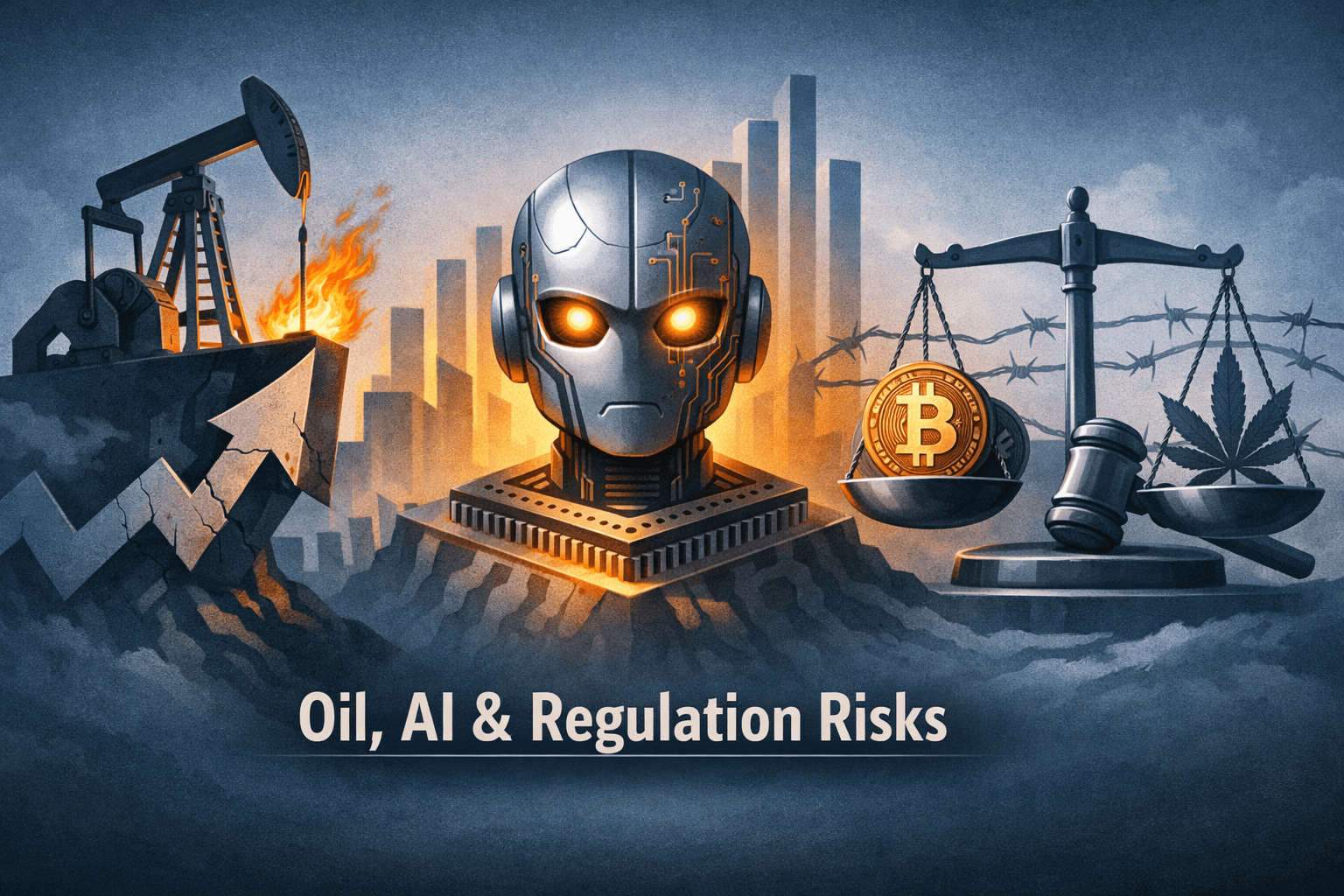
Oil Shock Meets AI and Regulatory Crosswinds: Markets End the Week on Divergent Sector Signals
Podcast • Loading audio...
Share this article
Spread the word on social media
Key Takeaways
- •Oil rose above $100/bbl, re‑energizing energy and commodity names while pressuring rate‑sensitive sectors.
- •Technology saw constructive headlines—AI demand, a potential SK hynix U.S. IPO and Waymo’s tenfold ridership surge—supporting chip and automation suppliers.
- •Crypto faced a sharp sentiment hit (Bitcoin < $68k; Fear & Greed = 13) as ETF outflows and rising yields reduced appetite for high‑beta assets.
- •Real estate interest remains strong for modern industrial/logistics assets (notably a $650M portfolio trade), reflecting demand for yield and operational efficiency.
- •Regulatory and policy risk (cannabis enforcement, finance scrutiny, stablecoin audits) is a dominant cross‑sector force that can trigger swift repricing.
Executive summary
Markets closed the week under a set of conflicting impulses: a crude oil shock that pushed WTI above $100 per barrel and re‑energized energy and commodity-linked names, a renewed tech narrative driven by AI applications, IPO talk and ridership gains at autonomous mobility players, and regulatory and rate‑sensitive pressure that hit crypto and parts of the financial complex. Real‑asset flows—highlighted by a $650 million industrial/logistics portfolio trade—point to continued investor appetite for income and hard assets even as Treasury yields and policy uncertainty tightened options for leveraged and growth sectors.
Key datapoints from Mar 27 that set the tone:
- WTI crude spiked above $100/bbl amid supply disruptions and geopolitical friction.
- Bitcoin dipped below $68,000; the Fear & Greed Index plunged to 13.
- Jushi raised $160 million at ~12.5% (financing move flagged in cannabis headlines).
- A large $650 million industrial/logistics real‑estate transaction closed.
- Apple announced a $400 million U.S. manufacturing investment; Waymo reported a tenfold ridership surge.
Taken together, headlines Friday sketched a market where commodity and real‑asset upside competes with policy‑driven volatility and rate‑sensitive downturns. Investors should expect uneven returns across sectors and increased dispersion in stock‑level outcomes in the near term.
Grouping by performance: outperformers, underperformers, stable/mixed
Note: sector performance labels below synthesize headlines and catalysts on Mar 27 rather than intraday index returns.
Outperformers
- Energy: Oil's move above $100 and LNG supply interruptions pushed energy names and commodity‑linked miners to the top of the tape. Renewables also picked up tactical interest amid transition trade narratives.
- Technology: AI‑related hardware demand, a potential SK hynix U.S. IPO, Waymo's ridership surge and legal wins for AI firms supported tech sentiment.
- Real estate (industrial/logistics): Heavy deal flow—highlighted by a $650M portfolio trade—and continued demand for modern logistics and cold storage drove constructive newsflow.
Underperformers
- Cryptocurrency: Bitcoin slid to the low end of its March range, ETFs saw outflows, and the Fear & Greed Index collapsing to 13 reflected sentiment stress.
- Finance & Banking: Rising Treasury yields, renewed regulatory scrutiny and scrutiny on high‑beta fintech names tightened conditions for the complex.
- Cannabis: Policy uncertainty spiked after a White House meeting and company‑specific financing and site closures (Jushi, PharmaCann) injected headline risk.
Stable / Mixed
- Utilities: Renewables and clean‑fuel projects advanced, but grid and transmission constraints and EV charging dynamics left the sector balanced between opportunity and investment need.
- Materials & Mining: M&A, funded exploration and new project activity lifted juniors, but project slowdowns (e.g., Barrick at Reko Diq) and longer‑dated lithium supply increases (Chile’s Salar de Atacama in 2026) tempered exuberance.
- Consumer & Retail: Investment in personalization and tech upgrades continued, but same‑store sales and leadership shifts maintained a watchful tone.
- Healthcare: M&A and positive trial news supported pockets of strength, but regulatory and reimbursement risks remain in focus.
- Industrial: Onshoring and capex commitments (Apple’s $400M move) pointed to durable demand, even as trade probes and raw‑material cost pressures create near‑term headwinds.
Cross‑sector themes and correlations
Energy shock + commodity repricing
- The WTI >$100 move rippled beyond oil names. Higher fuel costs feed through to industrials, transportation, and consumer sectors via input costs and logistics. Simultaneously, the spike strengthens the economics of some transition plays (hydrogen, solar+storage) while creating short‑term volatility for renewables developers reliant on long‑dated power purchase agreements.
Macro rates and risk assets
- A backdrop of rising Treasury yields weighed on crypto and rate‑sensitive parts of finance and growth tech. ETF outflows in crypto and the punitive Fear & Greed Index reading show correlation between yield moves and risk appetite.
Policy and regulation as market movers
- Cannabis headlines—federal enforcement meetings and immigration‑linked rhetoric—drove company‑level swings. Likewise, regulatory pressure on finance (heightened scrutiny) and crypto (stablecoin credibility and audits) reinforced the idea that policy news now moves prices materially.
Real assets and flight to tangible income
- A large industrial real‑estate portfolio trade and an active M&A/financing market in juniors suggest investors still favor physical assets that can generate cashflow amid volatility.
AI and productivity coupling across sectors
- AI continues to be a unifying upside driver—from tech chip demand and Waymo ridership gains to manufacturing productivity lifts and AI‑driven personalization in retail. This theme is creating cross‑sector investment opportunities but also concentrating risk in a narrower set of vendors and suppliers.
Supply chain and energy security overlap
- LNG outages (Australian cyclone) and geopolitical distortions that pushed oil above $100 underscore that energy security shocks can quickly propagate into industrials, transport and pricing for materials such as lithium and tungsten.
The day’s most significant moves — what happened and why it matters
Oil spikes above $100: immediate and longer‑term implications
What happened: WTI crude climbed past $100/bbl driven by supply disruptions (including Australian LNG plant outages tied to a cyclone), geopolitical risk and tighter visible global spare capacity. Why it matters: A sustained move above $100 changes margin dynamics across industries. For energy producers and oilfield services, higher prices support cashflow and upstream capex. For consumers and downstream industries—airlines, freight, chemicals—cost pressures will show up in operating margins and could force price pass‑through. Energy‑transition plays face a bifurcated reaction: short‑term gains for commodity miners, muted enthusiasm for long‑dated green projects if higher rates follow commodity inflation. Cross‑sector link: Higher energy prices contributed to pressure on rate‑sensitive assets (crypto, growth) via inflationary expectations and upward pressure on yields.
Crypto pullback: Bitcoin below $68,000; sentiment at 13
What happened: Bitcoin slipped below $68,000 with ETF outflows and rising Treasury yields crimping risk appetite. The Fear & Greed Index plunged to 13, signaling extreme fear. Why it matters: Crypto’s correlation with macro risk measures (yields, equities) reappeared this week. ETF flows indicate short‑term liquidity dynamics can drive sharp repricing even as on‑chain activity shows accumulation by some whales. Meanwhile, credibility signals—Tether moving to a KPMG audit, and institutional plays like ICE's bet on prediction markets—are attempting to shore up the structural narrative even as volatility persists. Cross‑sector link: Crypto volatility pressured fintech and payment names, and increased caution among asset allocators for illiquid or speculative positions.
Technology: SK hynix IPO talk, Waymo demand surge, and AI chip orders
What happened: Talk of a potential blockbuster U.S. IPO for SK hynix, Waymo reporting a tenfold ridership increase, and renewed corporate orders for AI chips supported broad tech headlines. Why it matters: SK hynix listing chatter lifts memory and semiconductor supply narratives, pointing to robust demand for capacity. Waymo’s ridership acceleration validates commercial adoption paths for autonomous mobility and strengthens the narrative linking AI to real‑world monetization. At the same time, legal outcomes—such as injunctions in AI‑related cases—are shaping the regulatory and operational landscape for AI firms. Cross‑sector link: Tech strength drove supplier‑level gains in industrial (automation) and materials (specialty silicon, tungsten) names and reinforced investor interest in onshoring and chip supply security (Apple’s $400M U.S. manufacturing move).
Real estate: $650M industrial/logistics trade and ongoing deal flow
What happened: Institutional appetite for modern logistics assets showed up in a $650 million portfolio trade and multiple single‑asset deals focused on cold storage and last‑mile logistics. Why it matters: Investors continue to value real estate that solves structural supply challenges—modern cold storage for e‑commerce and updated logistics facilities that lower freight and last‑mile costs. This supports valuations for quality industrial assets even as broader commercial real estate remains bifurcated by property type and location. Cross‑sector link: Higher energy costs increase the importance of energy‑efficient facilities and capex for electrification and onsite generation (solar + storage), pushing industrial owners to prioritize upgrades.
Finance: rate and regulatory headwinds
What happened: Rising Treasury yields and renewed regulatory scrutiny tightened conditions across the finance complex. Headlines included analysis of Occidental (OXY) acquisitions and some stress signals in payment and EV‑charging finance names (e.g., Blink Charging, BLNK, sliding). Why it matters: Banks and non‑bank lenders face margin compression on certain lending books as funding costs rise. Meanwhile, regulatory scrutiny raises compliance costs and creates event risk in names exposed to consumer lending, crypto custody, or heavy leveraged structures. Cross‑sector link: Higher rates feed into real‑estate financing costs and discount rates used to value long‑duration tech assets, increasing divergence across sectors.
Cannabis: policy heat and corporate financing moves
What happened: The White House held enforcement talks and federal rhetoric on cannabis‑related immigration cases intensified. At the company level, Jushi raised $160 million at ~12.5% (financing), while PharmaCann announced cultivation site closures. Why it matters: Policy ambiguity drives higher cost of capital and episodic volatility for cannabis operators reliant on state/regulatory pathways. Financing deals (like Jushi’s) provide liquidity but at a price, and operational retrenchment (PharmaCann) signals that consolidation or rationalization may continue. Cross‑sector link: Cannabis underscores how regulatory risk can outweigh underlying demand growth; the pattern is mirrored in crypto and parts of healthcare where policy decisions materially alter market dynamics.
Materials & Mining: active juniors, project pauses, and lithium timing
What happened: Funded exploration and M&A buoyed juniors (Kenorland, K2 Gold activity noted), while Barrick slowed work at the Reko Diq project and Chile’s Salar de Atacama is slated to lift lithium output in 2026. Why it matters: Short‑term wins for juniors are positive for risk appetite in the sector, but project pauses from majors like Barrick (GOLD) highlight permitting, geopolitical and capital allocation constraints. The timeline for lithium supply increases suggests near‑to‑medium‑term tightness could persist even as new Chilean supply arrives in 2026. Cross‑sector link: Metals tightness feeds battery and EV supply chains, linking materials to autos, utilities (storage) and energy transition planning.
Utilities: renewables progress amid grid and transmission constraints
What happened: Offshore wind began feeding PJM while solar, storage and nuclear momentum continued; nonetheless, commentary emphasized ongoing needs for transmission upgrades and smarter grid investment. Why it matters: Renewables additions are tangible, but the absence of parallel transmission upgrades creates curtailment risk and project interconnection backlogs. Utility regulators and companies must balance capex timing with customer rate impacts. Cross‑sector link: Transmission constraints can blunt the economics of electrification in transport and industry, indirectly affecting industrials and real estate owners who rely on reliable, low‑cost power.
Actionable investor insights (informational, non‑personalized)
Reassess rate sensitivity across portfolios: Rising Treasury yields and oil‑driven inflationary impulses increase the discount rate applied to long‑duration growth names. Analysts note that earnings visibility and free cashflow profiles matter more than headline momentum when rates fluctuate.
Watch energy vs. transition bifurcation: A spike above $100 improves near‑term cashflow for oil & gas producers but can complicate the transition narrative. Data suggests allocating attention to balance‑sheet strength and hedging strategies among energy names rather than relying on sector averages.
Treat crypto volatility as macro‑linked liquidity risk: Bitcoin’s drop below $68k and index sentiment at 13 demonstrate that macro shocks can trigger rapid outflows from ETFs and other pooled products. Investors tracking crypto exposure should monitor ETF flows, custody concentration and stablecoin audits (e.g., Tether’s move to KPMG) as signals of structural changes.
Prioritize quality in real assets: The $650M industrial trade and continued demand for modern logistics imply that investors paying for yield should prioritize assets with energy efficiency, modern loading and cold‑chain characteristics. Lease durability and tenant creditworthiness will be differentiators.
Monitor regulatory calendars for policy risk: Sectors like cannabis, crypto and parts of healthcare are being driven by policy events and enforcement priorities. Track upcoming hearings, court rulings and agency guidance that could create binary outcomes for affected names.
Follow AI demand into supply chains: Tech’s tailwinds—chip orders, SK hynix IPO chatter, Waymo adoption—flow into capital equipment, specialty materials and skilled labor markets. Companies tied to AI deployment may see accelerating orders; analysts note supply constraints and lead times could matter for revenue recognition timing.
Consider cross‑hedges for commodity exposure: For portfolios sensitive to energy or industrial input costs, derivatives or targeted commodity exposure can hedge near‑term inflation spikes while maintaining long‑term positioning in the energy transition.
What to watch next week — catalysts and risk checklist
- Oil & LNG restart timing: Any updates on the Australian LNG restarts and spare capacity will inform whether WTI’s move is sustained or temporary.
- Treasury yields and Fed commentary: Further movement in 10‑ and 30‑year yields will continue to shape risk assets and financing costs.
- Regulatory/policy windows: White House cannabis talks, crypto regulatory signals, and AI legal decisions could create quick repricing events.
- IPO/calendar events in tech: SK hynix IPO developments and any post‑deal supply chain commentary could set the tone for semis and memory players.
- Material supply updates: Chilean lithium project timelines and any Barrick (GOLD) updates on Reko Diq will affect battery metals narratives.
Conclusion and forward‑looking perspective
The market closed the week with a classic divergence: commodity and real‑asset strength driven by an energy shock versus policy and rate‑sensitive weakness across crypto and parts of finance. Tech continues to show pockets of durable upside—AI monetization paths and chip demand remain tangible positive narratives—but that upside is being priced against a higher‑rate and higher‑policy‑risk environment.
Expect elevated dispersion in coming weeks. Short‑term volatility will likely be driven by macro datapoints (yields, inflation prints), energy‑supply updates and regulatory rulings. For investors, the dominant near‑term trade will be managing the tension between commodity‑led cyclical winners and rate‑sensitive growth or speculation. Over longer horizons, structural themes—AI deployment, electrification, modern logistics and regulated energy infrastructure—remain intact, but timing, cost of capital and policy decisions will determine which names and sub‑segments capture durable value.
Investment disclaimer: This analysis is for informational purposes only. It does not constitute a recommendation to buy, sell or hold any security, and it is not personalized investment advice. Analysts note that market conditions can change rapidly; readers should consult a qualified financial advisor before making investment decisions.
Sources
+ 14 more sources
Use these insights — enter this week's contest.
Free practice contests — earn Alpha CoinsExplore More Content
Disclaimer: StockAlpha.ai content is for informational and educational purposes only. It is not personalized investment advice. Sentiment ratings and market analysis reflect data-driven observations, not buy, sell, or hold recommendations. Always consult a qualified financial advisor before making investment decisions. Past performance does not guarantee future results.
Spotted something wrong? Report an error.