 Quick Briefs
Listen to this Recap
11:26
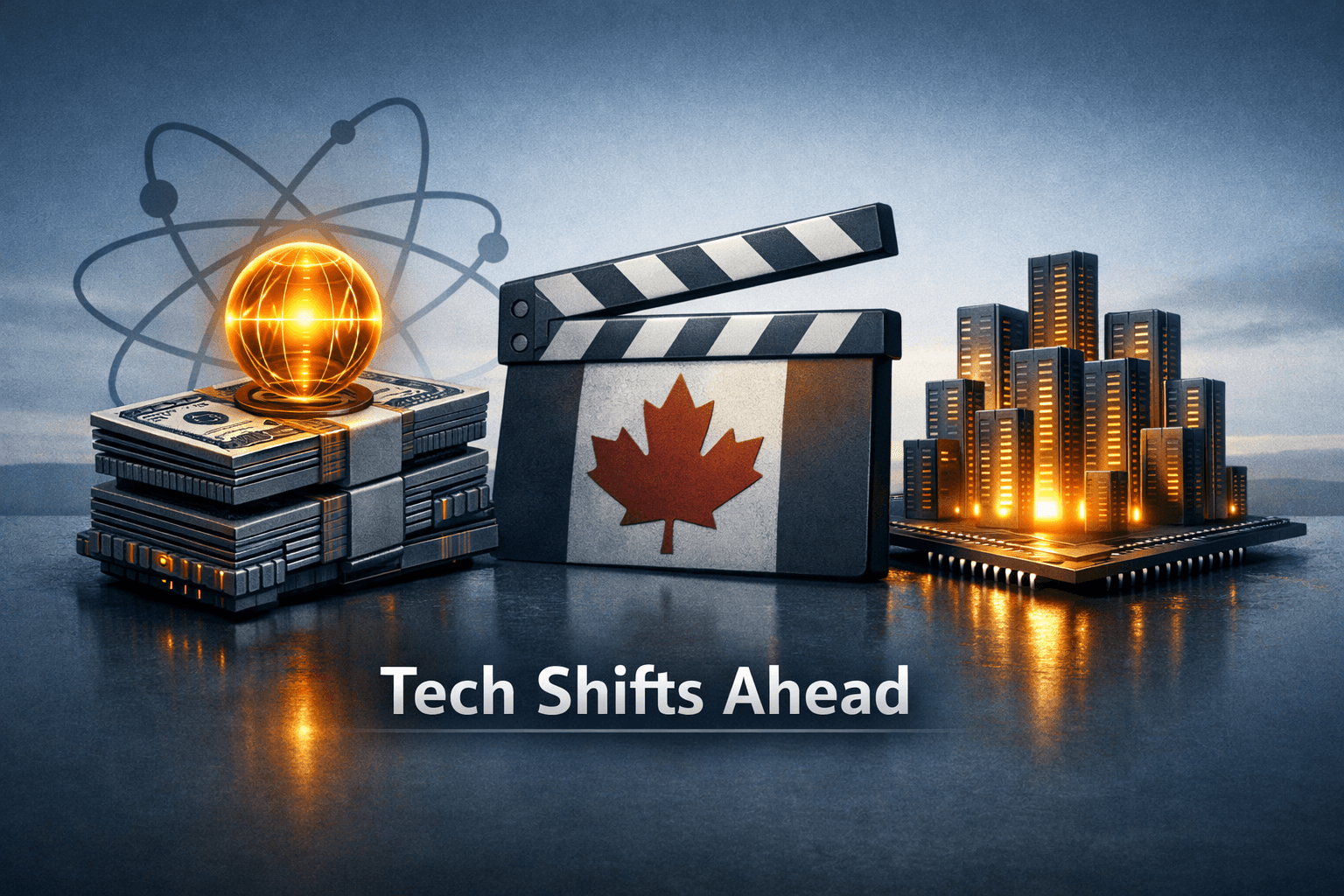
US quantum cash, Canada’s 15% content rule and a tech infrastructure re-rating dominate today's briefs
Podcast • Loading audio...
Share this article
Spread the word on social media
Key Takeaways
- •US $2B quantum program (reported to include IBM) is the day’s largest macro/tech headline and could change ownership and valuation dynamics for early quantum plays.
- •Canada’s new 15% Canadian‑content rule creates an immediate margin and compliance variable for global streamers (e.g., Netflix $NFLX, Spotify $SPOT) and raises precedent risk.
- •Tech infrastructure momentum—advanced packaging (Amkor $AMKR with AMD $AMD) and data‑center re‑rating—continues to drive sector rotation and dispersion.
- •Regulation and policy are the common theme today: enforcement (CBP), mandates (Canada), and legislative moves (H.R. 3164) are actively reshaping near‑term valuations.
Today's breakout headlines (market movers)
- US to invest $2 billion in quantum firms and take equity stakes, reportedly including IBM ($IBM). A federal push that could change ownership dynamics and valuation modeling across early commercial quantum plays. (WSJ/Investing.com relayed)
- Canada mandates streaming platforms to spend 15% on Canadian content — a direct margin and compliance shock for global streamers such as Netflix ($NFLX) and Spotify ($SPOT). Regulatory precedent risk could widen to other markets.
- Bank of America names 10 data‑center stocks as "key power players", highlighting large dispersion inside the group and refocusing attention on infrastructure names tied to AI and cloud demand. ($BAC coverage)
These three items were the clearest market‑moving briefs of the day and should shape sector positioning into tomorrow’s session.
Technology & infrastructure: public capital and private capex converge
What happened today
- Federal investment in quantum: Reported $2B in U.S. funding to accelerate commercial quantum development, with equity stakes reportedly including $IBM. The move could provide capital, commercial contracts and governance influence for recipients.
- Amkor ($AMKR) and AMD ($AMD): Amkor’s Arizona land buy and announced packaging work with AMD spurred a ~4.5% intraday rise for $AMKR, plus an upcoming $0.084 cash dividend (ex‑date Jun. 3, 2026).
- Data centers back in focus: Bank of America’s ranking of 10 data‑center names highlighted big recent movers (up to ~34%), underscoring renewed investor appetite for infrastructure exposed to AI/cloud demand.
Why it matters and how these items connect
- Public and private capital flows are aligning around compute and packaging: federal funding for quantum lifts the higher‑risk/longer‑horizon part of the compute stack, while private capex (Amkor/AMD) tightens near‑term semiconductor assembly and packaging capacity. Both support a longer runway for demand in chip and data‑center ecosystems.
- Valuation and ownership dynamics shift: government equity stakes can affect dilution, governance and contract access for portfolio models; meanwhile, capacity expansions (Amkor) change supply‑side assumptions for chip makers and their tier‑1 suppliers.
- Near‑term market impact: expect volatility and rotations inside tech — chip supply chain names, advanced packaging suppliers and selected data‑center REITs or operators could see amplified flows as investors re‑weight exposures.
What to watch next
- Official details on the $2B program (which firms, stake sizes, terms).
- AMD/Amkor announcements on packaging timelines, site buildouts and strategic terms.
- Earnings and guidance from major data‑center operators or Xcel Energy (flagged as a related catalyst) for demand and power‑cost signals.
Media & regulation: Canada’s content rule raises margin questions
What happened
- Canada’s 15% content‑spend requirement obliges streaming platforms to allocate 15% of spending to Canadian content. The brief flagged direct implications for Netflix ($NFLX) and Spotify ($SPOT) and highlighted valuation inputs investors can now model.
Why it matters
- Immediate margin pressure: The rule is a cost allocation that will show up in content spend and margins — the severity depends on each platform’s Canadian revenue share and how they categorize spending.
- Regulatory precedent risk: If other jurisdictions emulate Canada, the streaming business model faces a new, recurring expense vector that can reduce operating leverage and heighten revenue‑mix sensitivity.
Connections to other themes
- Content vs. compute trade‑offs: A larger content budget requirement could tilt streaming companies’ capital allocation away from product/tech investments, indirectly affecting demand for data‑center services and ad tech partnerships.
What to watch next
- Company statements quantifying Canadian revenue and planned content budgets.
- Any guidance changes in upcoming earnings that incorporate the new compliance costs.
Healthcare & biotech: mixed signals — promising science, legislative moves
Notable briefs
- Sapience Therapeutics: positive Phase 2 data for lucicebtide in glioblastoma presented at ASCO — mPFS projected at 28.4 months; median OS not yet reached. Small sample; early signal.
- Grants and capacity building: OREF career grant winners and HelpMeSee opening a simulation MSICS center in Guwahati — items that raise long‑term innovation and access visibility.
- Policy: APhA and NPA applaud passage moves on H.R. 3164 (Main Street Pharmacy Access Act) — a legislative development that can shape pharmacy access and payer dynamics.
Why it matters
- Early clinical data (Sapience) improves visibility and partnership potential, but Phase 2 signals carry development risk until larger reads arrive.
- Legislative and grant activity matters for the sector’s operating backdrop: policy progress and research funding can alter reimbursement, adoption and longer‑term commercial pathways for med‑tech and pharma players.
What to watch next
- Confirmatory trial announcements, partnership/licensing talk and follow‑up ASCO materials (for Sapience).
- Regulatory and legislative milestones tied to H.R. 3164 and any payer responses.
Industrials, trade and commodities: enforcement and conferences
Briefs of note
- U.S. Customs action found tariff evasion on freight rail couplers — a decision that could protect U.S. coupler makers and ease price pressure for domestic suppliers.
- Prairie Operating Co. ($PROP) management to present at the Louisiana Energy Conference; commodity and production commentary from presentations can influence small‑cap E&P sentiment.
Why it matters
- Trade enforcement can sustain pricing power for domestic manufacturers and shift near‑term earnings outcomes if import flows are curtailed or duties assessed.
- Conference presentations are typical catalysts for small‑cap energy names where management color can influence valuation assumptions.
What to watch next
- Follow‑up CBP notices, company statements from affected manufacturers and any assessed duty amounts.
- Slides/Q&A from LEC presentations and subsequent filings by presenting companies.
The other moves: fintech, ag‑biotech, retail and private rollouts
Quick hits
- City Traders Imperium flags multi‑account retail behavior that may force prop‑firm rule changes — a structural behavioral trend for trading platforms and fintechs.
- New report from the European Non‑GMO Industry Association shows a gap between regulatory change and uptake for next‑gen GMOs, highlighting adoption shortfalls and public resistance — implications for ag‑biotech suppliers such as Bayer ($BAYRY) and ADM ($ADM) were noted.
- Athlete Playmakers Group (private) expands into airports — a consumer‑facing rollout that, while private, points to travel and experiential retail trends.
- Haoxi Health Technology ($HAO) showed heavy volume and tiny price move; microcap activity can signal short‑term momentum but carries elevated execution risk.
- Volvo Financial Services and Eicher Motors ($EICHERMOT, $VOLV‑B referenced) plan a 50/50 JV in India for captive finance — a move that can support commercial vehicle sales via financing penetration.
- Stifel trimmed Intuit ($INTU) price target over TurboTax weakness — a reminder of consumer/software sensitivity in the tax cycle.
Why these matter together
- Across fintech, ag‑biotech and consumer services there’s a common thread: policy, behavioral shifts and funding cadence are dictating the pace of revenue realization. Regulatory narratives (Canada content, GMO adoption, pharmacy access) are increasingly the proximate cause of re‑rating risk for some sectors.
Emerging patterns and cross‑cutting themes
- Public capital and policy are re‑shaping sector returns. The $2B quantum plan and Canada’s content rule show that governments are active market participants — both by direct investment and by regulation.
- Infrastructure rotation is back: data centers, semiconductor packaging and advanced compute are receiving renewed attention from both private capex and public investors.
- Regulatory uncertainty is a common re‑rating trigger. From media content mandates to GMO adoption shortfalls and tariff enforcement, policy headlines are driving valuation and margin reassessments across multiple sectors.
- Event‑driven microcatalysts matter: conferences, ASCO readouts and small‑cap presentations remain reliable near‑term sentiment drivers for thinly traded names.
What to watch tomorrow
- Official U.S. release or confirmations on the $2B quantum investment: which firms are included, stake sizes and terms.
- Company responses from streaming platforms ($NFLX, $SPOT) on how they will interpret and implement Canada’s 15% spending rule.
- Earnings and commentary from data‑center participants or utility names like Xcel Energy that could re‑price infrastructure profitability assumptions.
- Amkor ($AMKR) and AMD ($AMD) updates on packaging timelines, and any disclosures tied to the Arizona site.
- Follow‑up ASCO materials or partner announcements from Sapience and any licensing chatter that could alter biotech sentiment.
Bottom line (analysis, not advice)
Analysts note that today’s flow mixes long‑duration public capital (quantum), near‑term capex (advanced packaging), and regulation‑driven re‑rating (streaming content rules). Data suggests investors should expect higher dispersion across sectors as policy and infrastructure narratives play out; momentum indicates sector rotation risk and opportunity, but outcomes hinge on granular details—government terms, company disclosures, and follow‑up clinical or conference data.
Investment disclaimer
This digest is for informational purposes only. It does not constitute investment advice or a recommendation to buy, sell or hold any security. Analysts note trends and data; readers should perform their own due diligence or consult a licensed advisor for personalized guidance.
Sources
+ 8 more sources
Use these insights — enter this week's contest.
Free practice contests — earn Alpha CoinsExplore More Content
Disclaimer: StockAlpha.ai content is for informational and educational purposes only. It is not personalized investment advice. Sentiment ratings and market analysis reflect data-driven observations, not buy, sell, or hold recommendations. Always consult a qualified financial advisor before making investment decisions. Past performance does not guarantee future results.