 Market Recap
Listen to this Recap
9:10
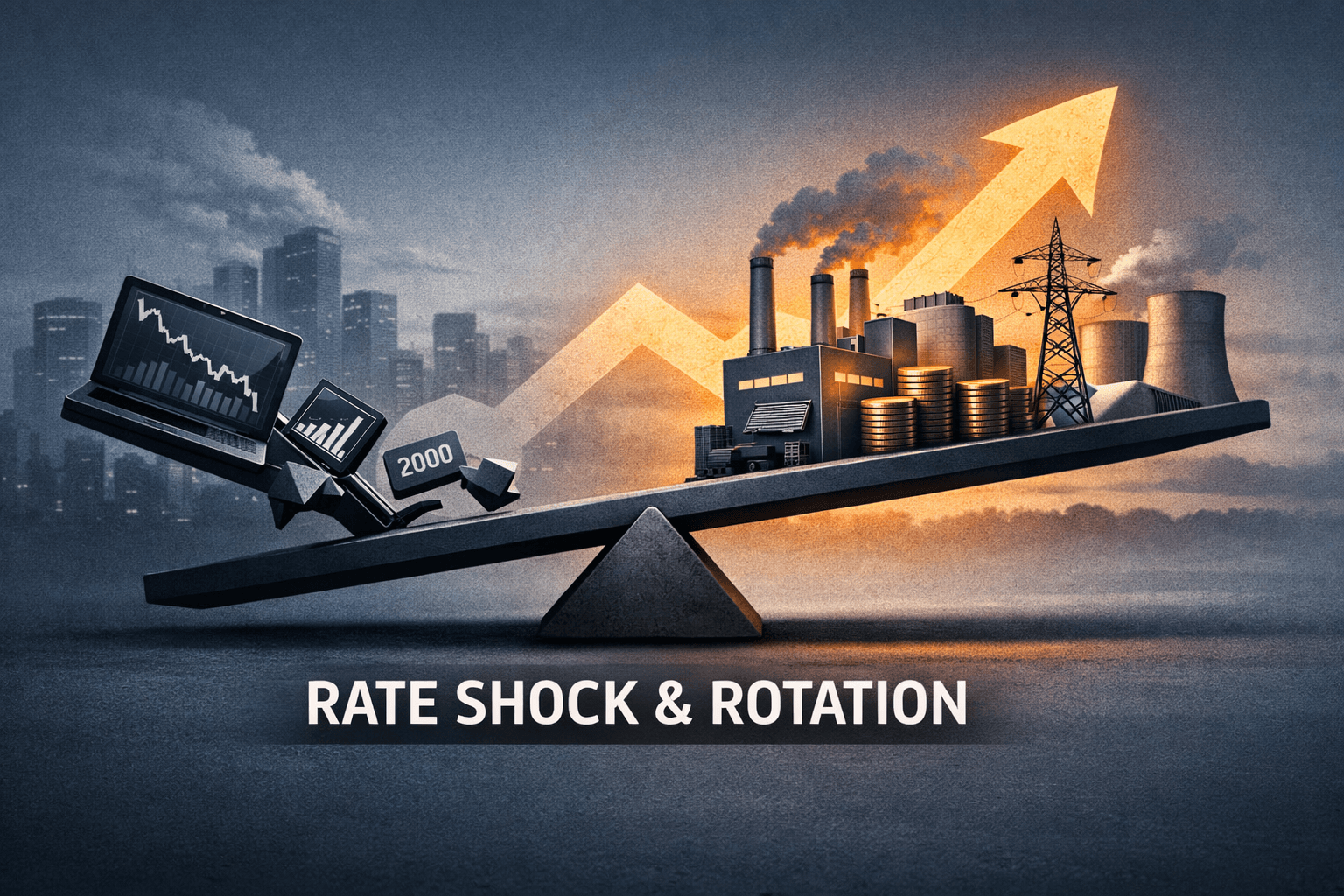
Rate Shock and Sector Rotation Drive a Mixed Tape: Yields Spike, Tech and Small Caps Slip While Industrials and Utilities Shine
Podcast • Loading audio...
Share this article
Spread the word on social media
Key Takeaways
- •Rising Treasury yields and renewed Fed-hike expectations drove a rotation away from growth and small caps toward cyclicals and select utilities.
- •SPY closed down ~0.5%, QQQ down ~1.1% and IWM down ~1.4% — QQQ and IWM led the weakness as rate sensitivity weighed on long-duration and smaller-cap names.
- •Industrials, materials and utilities (storage/solar) were relative outperformers, helped by DOD-related flows, copper moves and renewable demand.
- •Crypto and speculative digital-asset names weakened after the Clarity Act failed to provide clearer regulatory direction.
- •Near-term market direction will hinge on Treasury yields, Fed commentary and incoming economic prints; watch small-cap performance as a risk indicator.
Decisive Narrative: Yields, Fed Expectations and Sector Rotation
Markets opened and closed the day under the shadow of rapidly rising Treasury yields and a renewed consensus that the Federal Reserve is not done hiking. The S&P 500 (SPY) closed down an estimated 0.5%, the tech-heavy Nasdaq-100 (QQQ) slid about 1.1%, and small caps as measured by the Russell 2000 (IWM) lagged the most, falling roughly 1.4%. Those early moves set the tone: a classic risk-asset repricing where growth and rate-sensitive names gave back gains while cyclicals and certain dividend-rich utilities quietly attracted buyer interest.
This was not a broad sell-off so much as a rotation — investors are recalibrating exposures as the macro backdrop shifts. Rising yields have sharpened questions about valuation, margin pressure and funding costs, and today's action felt like the market testing which sectors can stand a higher-rate reality.
Why the Move Happened: Macro Drivers and the Fed Implication
Two interlocking macro dynamics shaped the tape. First, the 10-year Treasury yield moved to levels not seen since 2007, reinforcing pressure on long-duration assets. Second, market participants digested commentary and odds pointing to additional Fed hikes — the “No One and Done” storyline is back in play. Together, those forces tightened financial conditions and pushed investors toward sectors with nearer-term cash flows or direct exposure to higher rates.
Rising yields compress the present value of distant earnings, so long-duration growth stocks — many of the names concentrated in QQQ — are particularly vulnerable. Small caps (IWM) are often more rate- and credit-sensitive than large-cap value names, which helps explain the outsized weakness. Meanwhile, banks can benefit from steeper yield curves (though credit risks remain), industrials stand to gain from defense and infrastructure-related flows, and utilities with storage and solar franchises are trading like yield-plus-growth stories.
Analysts note that this is not an abrupt, one-day regime switch; rather, it’s an acceleration of a trend the market has been digesting for months: higher-for-longer rates, slower margin expansion, and more selective stock picking.
Sector-by-Sector Snapshot: Rotation in Motion
Industrials: One of the day’s bright spots. Defense-related contract wins and a fresh Department of Defense (DoD)-linked procurement backdrop lifted industrials. Names tied to heavy equipment and parts saw supportive flows after deal-related headlines. Allison Transmission (ALSN) and other suppliers trading on near-term revenue visibility were singled out by traders.
Materials & Mining: Copper’s momentum and a series of financing deals boosted mining and industrial metals names. Higher commodity prices are providing earnings tailwinds for miners and a narrative of capex-driven demand that supports cyclicals over growth.
Utilities: Storage and solar segments were in favor. Utilities with growing distributed-energy and storage franchises traded up as investors sought yield with growth optionality — a hybrid trade in a hawkish-rate world.
Energy: Mixed. Oil and gas names reacted to a jumble of supply and geopolitical headlines; some midstream and energy-services stocks rallied on the back of commodity strength, while others lagged on macro caution.
Financials: Banks showed selective strength on steeper real rates and wider net interest margin prospects, but the bank group remained guarded given lingering credit concerns and higher funding costs for smaller lenders.
Communication Services & Media: A quiet day for the group, but the sector remained vulnerable given its tech linkages and long-duration cash flow profiles.
Consumer & Retail: Retail earnings and expansion stories produced idiosyncratic winners; however, overall discretionary names were sensitive to higher rates as consumers weigh borrowing costs.
Crypto & Digital Assets: The crypto complex was notably weak after the Clarity Act failed to secure clearer regulatory treatment; names with direct or indirect crypto exposure underperformed on renewed policy uncertainty.
Notable Individual Movers (Selected)
Teledyne (TDY): Volatility after Q2 earnings and mixed analyst reactions left TDY a focal point. Traders parsed margins, backlog commentary and guidance adjustments; the stock moved on buy/sell chatter but illustrated how earnings cadence can drive outsized single-name action in this environment.
Allison Transmission (ALSN): Cited as capturing new markets, ALSN and other industrial suppliers drew attention as the DoD and broader industrial demand backdrop gained credibility.
Caterpillar (CAT): Benefited from the industrial narrative and any incremental optimism around infrastructure/defense spending flows, standing out among large-cap cyclicals.
Utilities/Solar names (e.g., NextEra Energy, First Solar): Names linked to storage and solar technology traded better as investors rotated into yield-plus-growth profiles.
Crypto-adjacent names (Coinbase, MicroStrategy): Weaker on regulatory fallout after the Clarity Act failed to deliver clarity; these stocks amplified the day’s risk-off tone for speculative and beta-exposed assets.
Oracle (ORCL): Mizuho’s reiterated rating put ORCL back into analysts’ sightlines; the stock moved on broker chatter though it was not a primary market mover.
Carnival (CCL): Post-earnings commentary and conference call notes drew attention for travel and leisure diagnostics, underscoring the dispersion between reopening beneficiaries and rate-sensitive consumer plays.
Technical and Historical Context
From a technical lens, the SPY decline was a pullback rather than a capitulation. QQQ’s deeper drop reflects the steeper de-rating long-duration tech has absorbed as yields rise. Historically, episodes of rising yields (e.g., mid-2006 to 2007) produced similar rotations: cyclicals and commodity-linked sectors outperformed while growth underperformed. That pattern is recognizable today, though differences in earnings composition and balance-sheet quality across the large-cap universe mean this rotation could be more selective than in prior cycles.
Market momentum indicators suggest we’re in a consolidation phase where sector leadership can flip quickly. Traders will watch key moving averages and volume profiles for confirmation of either a deeper correction or stabilization.
Fed Implications and What to Watch Next
The primary takeaway for policy watchers is this: markets are pricing a Fed that remains data-dependent but not docile. Commentary and futures markets imply at least one or more hikes remain on the table. What that means for stocks: valuation multiples will come under continued pressure if yields stay elevated, and investors will prefer earnings visibility and free-cash-flow generation.
Key upcoming data and events that will influence the next session:
- Any Fed speaker commentary that clarifies the “higher for longer” posture.
- Treasury auctions and intraday moves in the 2s/10s that will affect bank margins and growth valuations.
- Economic prints (inflation, retail sales, industrial production) that can reprice near-term rate expectations.
- Corporate earnings and conferences that can produce idiosyncratic winners and losers — especially in industrials and tech.
What Traders and Investors Should Monitor (Information Only)
- Treasury yields and the slope of the curve: a flattening or re-steepening will change the financial plumbing for banks, real estate and small caps.
- Sector leadership shifts: early rotation into industrials, materials and select utilities could persist if commodity and defense themes gain traction.
- Volatility in rate-sensitive growth names: watch QQQ and large-cap tech for follow-through or stabilization patterns.
- Credit spreads and small-cap liquidity: widening spreads would further pressure IWM and other small-cap benchmarks.
Outlook: Near-Term Expectations
Expect more of the same in the immediate term: volatility around interest rates, continued sector rotation, and idiosyncratic stock action around earnings or macro headlines. If yields stabilize near current levels, the market may settle into a range where cyclicals hold a premium and growth needs clearer catalysts to reassert leadership. If yields continue climbing, look for broader valuation compression and potentially deeper pullbacks in rate-sensitive pockets of the market.
Technically, watch SPY support near recent short-term lows and QQQ’s reaction around its key moving averages. IWM’s relative weakness will be an early warning sign for broader risk appetite — persistent underperformance by small caps often precedes a more cautious institutional stance.
Closing Perspective
Today’s tape was a reminder that macro forces — notably interest rates and policy expectations — still drive market leadership. The narrative was less about a uniform sell-off and more about rotation: out of long-duration growth and speculative areas (crypto, some small caps) and into cyclicals, commodity-linked names, and certain utilities with near-term cash visibility. How durable that rotation becomes depends on the path of yields and whether economic data and Fed commentary confirm the market’s higher-for-longer thesis.
Investment Disclaimer: This article is for informational purposes only. It does not constitute investment advice or a recommendation to buy, sell or hold any security. Analysts note trends and data; readers should consult a licensed professional for personalized guidance.
Sources
+ 10 more sources
Use these insights — enter this week's contest.
Free practice contests — earn Alpha CoinsExplore More Content
Disclaimer: StockAlpha.ai content is for informational and educational purposes only. It is not personalized investment advice. Sentiment ratings and market analysis reflect data-driven observations, not buy, sell, or hold recommendations. Always consult a qualified financial advisor before making investment decisions. Past performance does not guarantee future results.