 Breaking Analysis
Listen to this Recap
9:47
Fed Hike and Selective Leadership: Markets Pivot to Policy, AI Supply Signals, and Stock-Specific Catalysts
Podcast • Loading audio...
Share this article
Spread the word on social media
Key Takeaways
- •The Fed hiked to 3.75%–4.00% and signaled rates could remain higher for longer, creating macro volatility and repricing pressure on duration-sensitive equities.
- •Market action showed strong dispersion: broad indices only modestly recovered, while stock-level catalysts (buybacks, production deals, option expiries) drove pronounced moves.
- •AI chip demand and Huawei’s 2027 push intensify supply-side and competitive dynamics that could benefit or unsettle semiconductor suppliers.
- •Corporate actions — ACV Auctions’ $100M buyback, Lockheed’s accelerated AIM-260 production, and UBS’ reiteration on Costco — are changing the risk-reward calculus at the single-name level.
- •Option expiry mechanics (triple witching) and thin liquidity amplified volatility in small-cap, option-rich names (e.g., POET), underscoring execution risk for traders.
Today's top-line market development
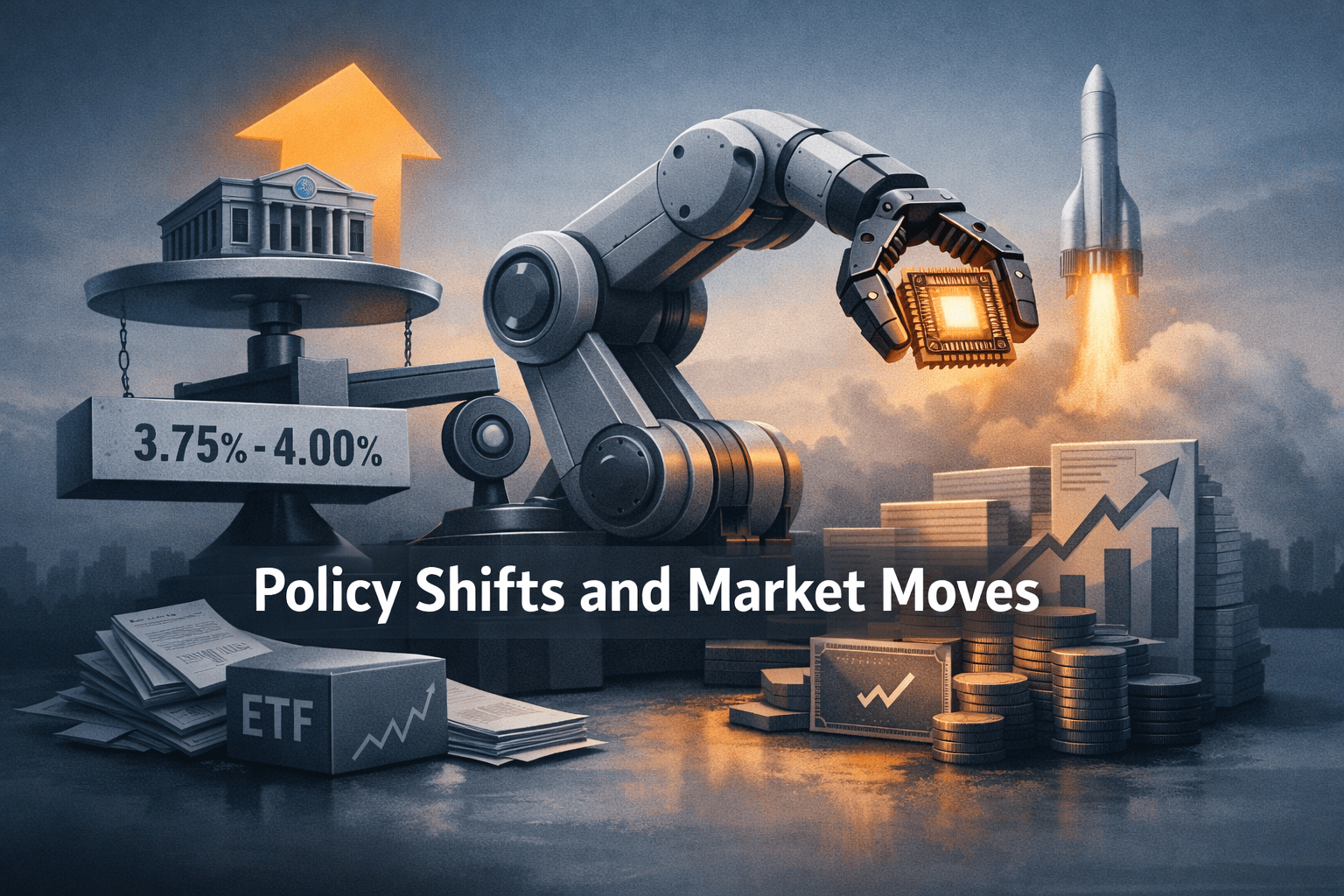
The U.S. Federal Reserve delivered a unanimous 25-basis-point rate increase to a 3.75%–4.00% policy range and, importantly, left a forecast that implies higher-for-longer rates through 2027. That policy signal precipitated heavy volatility: the Dow gave up about 631 points during the initial reaction, while pre-market and futures flows later showed a selective rebound (SPY quoted up ~1.3% pre-bell in some feeds; intraday broad indices ultimately registered a modest 0.05% bounce). Analysts singled out Fed commentary — and Kevin Warsh’s blunt remarks at the post-meeting press event — as a proximate driver of market chop.
What followed was classic 2026 market behavior: headline-driven macro swings at the index level paired with idiosyncratic stock moves driven by company-specific news, option flows and sector narratives. That combination produced the clearest theme of the day: policy risk elevated volatility while stock-level catalysts created dispersion across sectors and capitalizations.
Synthesis of key themes across analyses
- Policy remains the dominant macro narrative
- The Fed’s quarter-point hike and the projection of no easing through the median outlook into 2027 moved the goalposts for duration- and rate-sensitive assets. Market commentary used the phrase “higher for longer” repeatedly — shorthand for an environment where central bank policy stays restrictive relative to recent expectations. Traders re-priced risk accordingly, amplifying moves in interest-rate-sensitive sectors.
- Dispersion: selective leadership amid broad caution
- Despite headline-driven weakness, futures and ETFs flashed a relief bounce pre-open (SPY +1.3% pre-bell), while the intraday session showed only a modest recovery. Several analyses highlight sharp divergence: names such as TTM Technologies (TTMI) and Select Water Solutions (WTTR) continue to post outsized multi-year gains (TTMI up ~788% since Sept 2021; WTTR up ~290% since Sept 2021), while others like Dolby (DLB) and Boeing (BA) lag materially (DLB -16.01% in Q2; BA trading near $204.53 under pressure). This dispersion underscores that stock selection matters more than index betting in the current tape.
- Corporate catalysts — buybacks, production ramps and earnings surprises matter
- ACV Auctions (ACVA) authorized a US$100 million buyback following accelerating top-line growth, a classic capital-allocation move that can support per-share metrics. Lockheed Martin (LMT) announced an accelerated production framework with the U.S. government for the AIM-260 missile, and LMT shares moved higher (trading near $177, +~$5 intraday). UBS reiterated a Buy on Costco (COST) ahead of results, keeping a large-cap retailer as a focal point for analyst conviction. These company-level actions are acting as localized drivers of performance amid macro noise.
- AI demand and semiconductor supply dynamics are sharpening
- Huawei’s public comments that AI chip demand outstrips supply, together with its 2027 AI chip target to challenge Nvidia (NVDA), intensify a competitive and supply-side storyline. For U.S.-listed semiconductor names, that raises both upside demand scenarios and geopolitical/competitive risk. ON Semiconductor (ON) sits near $67 — roughly 50% below its 52-week high — highlighting how cyclicality and secular demand interplay can create deep drawdowns even as recovery signs appear in operating results.
- Technical and options dynamics are amplifying short-term moves
- Smaller-cap and option-sensitive names reflected convexity from derivatives. POET was bid pre-market at $7.67 after the Fed move; commentary connected put-side option expiry dynamics — “the put side of the barbell dies at triple witching” — to heightened intra-day tension around an $8 strike fight. Triple witching — the simultaneous expiration of stock options, index futures and stock futures — can compress liquidity and force rapid repositioning around key strikes.
Conflicting views and active debates
Hawkish Fed vs. quick risk-on bounce: Some coverage framed the Fed action as a shock that should keep volatility elevated, while pre-open ETF and futures strength suggested the market was seeking a relief bounce. The debate centers on whether the day’s bounce reflects a tactical short-covering move or an inflection toward renewed risk-taking despite policy tightening.
Momentum-driven rallies vs. fundamental checkpoints: Accenture (ACN) has rallied roughly 50% since mid-June to trade near $190 without fresh earnings since June 18. Analysts question whether this is a durable re-rating or a technical rebound — a classic tension between momentum traders and fundamental investors. Adobe (ADBE) is another example: trading near $250, down ~28% year-over-year, but trading at ~13.9x trailing earnings, which some interpret as room for multiple expansion if growth returns while others argue valuation is justified given uncertainty.
Supply-led upside vs. competitive risk in AI hardware: Huawei’s public push into AI silicon presents a two-sided thesis. On one hand, statements that demand outstrips supply imply stronger end-market growth and potential upside for suppliers. On the other hand, Huawei’s ambitions to field its own chips by 2027 present competitive risk to dominant suppliers like Nvidia and to non-U.S. suppliers’ market shares.
Deeper context on several major moves
Fed policy and market mechanics: The Fed’s “higher-for-longer” median is more than a line in a statement — it drives forward expectations for discount rates used in equity valuation models. Higher expected terminal rates raise the discount applied to future cash flows, compressing valuations particularly for long-duration growth equities. That mechanical effect helps explain why some long-duration software and AI-exposure names have been volatile even as parts of the market rally.
Option expiry and name-specific volatility: POET’s pre-market action underscores how derivatives can create outsized moves in thinly traded names. At triple witching, delta-hedging flows and option pinning can create abrupt price tests of key strikes (an $8 battle in this case). Short-term price action for option-heavy names is thus more a function of derivative mechanics than a pure change in fundamentals.
Buybacks as a catalytic tool: ACV Auctions’ $100M buyback authorization is meaningful for a smaller-cap name because it reduces float and signals management confidence. Historically, announced repurchase programs can support near-term share prices and lower earnings-per-share dilution — an important consideration when macro liquidity is tight.
Defense procurement and cash-flow timing: Lockheed’s ramp on the AIM-260 may reshape near-term cash flows and backlog recognition. In defense names, government procurement timetables, contract execution and supply-chain scaling drive realized revenue more than short-term demand cycles, and accelerated production agreements can be read as de-risking future cash flow for the company.
What this means for different investor types
Short-term traders and quant/tactical desks: Volatility from Fed communication and option expiries creates both opportunity and risk. Traders who can manage gamma exposure and time entries around triple witching may capture quick moves, but liquidity evaporation in small names can amplify slippage.
Growth-focused investors: Higher-for-longer rates raise the bar for future-growth assumptions. Momentum-driven rallies (ACN, TTMI) should be monitored against upcoming earnings cadence; absent confirmation, price action can be fragile.
Value and dividend investors: A compressed rate outlook and idiosyncratic dislocations (ADBE trading at ~13.9x trailing EPS; ON down ~50% from its 52-week high) create potential windows to reassess valuations, but the macro rate backdrop argues for careful duration management and stress-testing of cash-flow scenarios.
Thematic and AI investors: Huawei’s push and the supply-demand gap in AI chips intensify both excitement and geopolitical risk. Positions should be evaluated for exposure to supply-chain bottlenecks, concentration in a few vendors and potential policy constraints.
Fixed-income and multi-asset allocators: The Fed’s path influences duration risk and cross-asset correlations. A higher-for-longer regime suggests keeping a closer eye on interest-rate hedges and on the sensitivity of equity holdings to discount-rate re-ratings.
Strategic considerations and near-term watchlist
Watch Fed-speak and forward guidance: Markets will continue to pick over commentary for nuance on the path of rates. Traders should factor in potential re-pricing events around future Fed communications.
Monitor AI supply signals and competitor roadmaps: Huawei’s 2027 timeline and statements about supply shortages are catalytic; track vendor production figures, foundry output and export-control developments that could materially alter competitive positioning.
Track corporate capital allocation moves: Buybacks (ACVA), government production agreements (LMT) and authorizations can materially alter per-share economics and warrant attention ahead of earnings and updates.
Be selective: Dispersion is high. The day’s tape shows that index moves are less informative than stock-specific fundamentals and catalyst calendars. For many investors, a tighter focus on execution risk — liquidity, option gamma exposure and the timing of corporate releases — is prudent.
Prepare for volatility around mechanical events: Triple witching, earnings, and large buyback announcements will continue to induce periods of elevated intraday noise. Position sizing and stop frameworks should reflect the potential for rapid, non-fundamental price moves.
Conclusion
Tuesday’s market decomposition was instructive: policy-driven volatility at the macro level coexisted with concentrated, idiosyncratic rallies and declines across individual names. The Fed’s higher-for-longer signaling is the overarching structural factor, but company-level catalysts — buybacks, accelerated defense production, AI supply narratives and options mechanics — are currently the primary drivers of returns dispersion. Analysts and traders alike should digest the policy backdrop while leaning into selectivity: the prevailing environment rewards nuanced, catalyst-driven positioning rather than broad market bets.
Investment disclaimer: This synthesis presents analysis and data for informational purposes only. It is not a recommendation to buy, sell, or hold any security, nor is it personalized investment advice. Analysts note risks and catalysts; readers should consult a licensed advisor for decisions tailored to individual circumstances.
Sources
+ 9 more sources
Use these insights — enter this week's contest.
Free practice contests — earn Alpha CoinsExplore More Content
Disclaimer: StockAlpha.ai content is for informational and educational purposes only. It is not personalized investment advice. Sentiment ratings and market analysis reflect data-driven observations, not buy, sell, or hold recommendations. Always consult a qualified financial advisor before making investment decisions. Past performance does not guarantee future results.