 Breaking Analysis
Listen to this Recap
12:37
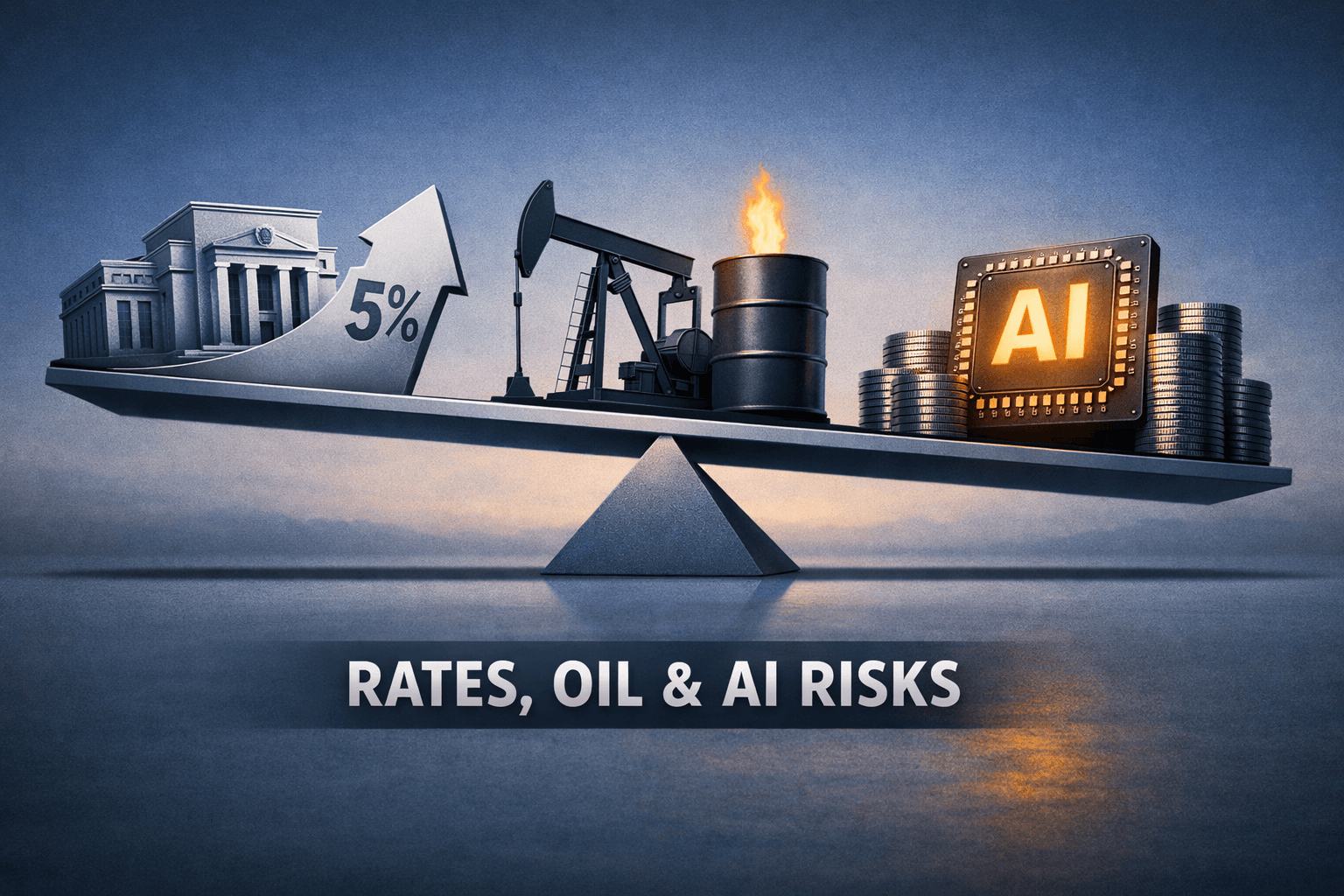
Rates, Oil and AI Regulation Collide: What the Fed Hike, 10‑Year at 5% and Diesel Shock Mean for Markets
Podcast • Loading audio...
Share this article
Spread the word on social media
Key Takeaways
- •A 25bp Fed hike was largely priced (~91%), but the dot plot, vote count and Warsh’s presser are now the main market catalysts.
- •The 10‑year Treasury back above 5% raises discount rates, pressuring long‑duration growth names while improving income comparatives.
- •Record diesel ($6.31/gal) creates an earnings shock for transport firms and feeds an upside inflation risk that could change Fed calculus.
- •AI faces simultaneous pressures from potential regulation (Sen. Blumenthal) and shifting commercialization (Alphabet’s cloud pivot), producing divergent outcomes across names.
- •Corporate heterogeneity (buybacks, guidance cuts, new service lines) means bottom‑up company analysis is critical in this regime.
Today's most significant developments
Three interlocking moves dominated market attention on Sep 16, 2026:
- The Federal Reserve was widely expected to deliver a 25 basis point hike (CME FedWatch showed the move ~91% priced), shifting policy into a new tightening phase under Kevin Warsh. Analysts emphasized that the real market drivers are the dot plot, the dissents/vote count and Warsh's post‑meeting presser — the parts of the release that reveal the Fed's reaction function.
- The 10‑year Treasury yield climbed back above 5%, repricing discount rates for equity valuations and raising the cost of capital across sectors.
- Diesel hit record levels (CNBC reported $6.31/gal), with transport companies flagging margin pressure metrics of roughly 21.8% to 30% depending on the carrier and route mix. That energy shock is the transmission channel feeding both inflation risk and operational stress for freight‑dependent firms.
Taken together, these moves establish the day’s headline narrative: policy tightening, higher real yields and commodity‑driven cost shocks are intersecting with the AI debate and company‑specific catalysts.
Synthesizing key themes across analyses
Fed mechanics matter more than the 25bp itself. Multiple writeups note that with a quarter‑point hike already priced at ~91%, the incremental market reaction will come from the Fed's guidance — the dot plot (path of rates), dissenting votes and Warsh's tone. Historical evidence cited in the coverage also shows that initial hikes rarely cap longer‑term yields, so markets can keep pushing the 10‑year higher even after the Fed moves.
Higher yields widen valuation gulf between growth and income. The 10‑year back above 5% increases discount rates used in DCF models, exerting asymmetric pressure on long‑duration names (notably parts of the AI and cloud trade) while making income and dividend growth stories relatively more attractive. Market pieces on dividend growers and the top‑performing ‘CIA’ value strategy underscore this rotation into cash‑flow and earnings quality.
Oil/diesel is a near‑term earnings shock. Reports that diesel reached $6.31/gal and strategist warnings (Albert Edwards likening current gas behavior to $150 crude) crystallize a second channel: input costs. Transport companies are already quantifying margin pressure; this feeds into inflation data, complicating the Fed’s task and potentially raising the probability of a more aggressive tightening path than markets currently expect.
AI faces a two‑front battlefield: regulation and shifting business models. Senators like Richard Blumenthal publicly urging AI oversight — and signaling potential legislation by year‑end 2026 — create regulatory risk. Simultaneously, commercial moves matter: analysts argue Alphabet's playbook centers on cloud integration (enterprise monetization) rather than model‑to‑model comparisons. That matters for which AI exposures will be resilient under higher rates and policy scrutiny.
Corporate heterogeneity: mixed earnings, buybacks and strategic pivots. From Huntington raising buybacks while trimming FY26 revenue growth, to Walmart expanding into Medicare Advantage, companies are choosing different capital‑allocation and growth responses that will produce divergent returns under higher rates and a tighter margin environment.
Conflicting views and active debates
Does the Fed control long yields? Analysts point to the historical record showing first hikes often fail to arrest longer‑term yields; Albert Edwards argues that fuel behavior points to materially higher inflation risk and a more aggressive Fed trajectory. Others caution that the market has already priced tightening (~91% for 25bp) and will look to Fed communication for nuance. The debate is whether the Fed can guide yields lower through credible forward guidance or whether external shocks (energy) will force yields up regardless.
AI: regulation vs commercial advantage. One camp highlights downside risks from heightened oversight — increased compliance, slower deployments and potential limits on certain product features. Another stresses structural re‑ranking inside large tech names: Alphabet’s cloud‑first AI commercialization could capture more durable revenue than headline model comparisons suggest. These views are not mutually exclusive: regulation raises risk premia while altered monetization pathways shift which companies capture durable value.
Growth vs value messaging. The ‘CIA’ money‑manager profile and the list of top dividend growers argue that active value selection and dividend growth remain potent in this regime. Conversely, the AI and cloud narratives argue for high‑quality secular growth exposure, though those names are more sensitive to higher yields.
Deeper context on major moves
Why the dots/dissent matter: The dot plot — Fed officials’ projections for the policy rate — provides an explicit median path for future policy. When a hike is largely priced, markets pivot to the expected path of subsequent hikes and the central bankers' confidence about inflation. Dissenting votes and a hawkish presser would suggest a higher terminal rate or a longer tightening sequence; a dovish signal would suggest the tightening cycle is limited.
Why the 10‑year matters more now: The 10‑year yield is the benchmark for long‑duration discounting. At ≈5%, the cost of capital materially reduces the present value of distant cash flows, squeezing multiples on software, AI and unprofitable growth names. It also raises funding costs for corporates and homeowners, feeding through to consumer demand.
Why diesel is a corporate‑level problem: Diesel is a direct operating expense for trucking, parcel and rail firms. At $6.31/gal, carriers cite immediate margin compression (analysts flag 21.8% and 30% measures depending on company exposure). Higher freight costs can be partially passed to shippers, but contract structures, spot vs contract mix, and competitive dynamics limit pass‑through speed and magnitude — amplifying near‑term earnings volatility.
Company and sector notes (specific metrics)
AI/semis: Analysts mapped Fed outcomes onto the AI trade, focusing on NVDA, AMD, MU, COHR, LITE and POET. Higher rates and yields compress multiples — especially for names priced for multi‑year growth — while enterprise cloud shifts (Alphabet) can reorient where AI value accrues.
Tech platform strategy: Coverage on Google stresses a cloud‑integration angle, citing a referenced 116.72% data point used in upside models for cloud monetization. If Alphabet captures enterprise AI traction, revenue durability could offset some rate pressure relative to pure‑play model vendors.
Consumer & staples: PepsiCo trades near $135, at ~17.7x earnings versus the S&P median ~22.5x. The framing is defensive cash generation versus slower growth — a valuation trade for income‑oriented portfolios.
Media & growth: Netflix has fallen ~35% over the past year while EPS improved via margin expansion and buybacks — raising the debate about earnings quality versus top‑line momentum.
Industrials/contract manufacturing: Fabrinet is down ~22.3% since its earnings release, spotlighting demand and margin sensitivity in cyclical supply chains.
Quantum: IonQ posted record revenue but trades near ~$37 and remains ~55% below its one‑year high, showing how operational milestones do not always translate to immediate sentiment recovery.
Financials: Huntington (HBAN) trimmed FY26 revenue growth guidance and increased buybacks, trading around $18.50 — a classic example of capital‑allocation shifts amid mixed top‑line signals.
Retail & services: Walmart expanding into Medicare Advantage (via a nonprofit partner) echoes Costco’s move and points to cross‑selling and in‑store traffic strategies that can create services revenue streams over time.
Implications by investor type
Fixed‑income investors: A 10‑year above 5% offers higher nominal yields but raises duration risk if yields climb further. Historical patterns cited warn that initial hikes rarely cap long yields, suggesting vigilance and horizon management are important.
Growth investors: Higher rates compress valuations on long‑duration earnings. Analysts note AI and cloud names will be differentiated by near‑term profit conversion and enterprise monetization; those with faster revenue capture and clearer paths to cash flow will be less vulnerable.
Value and income investors: Dividend growers and active value strategies are receiving renewed attention; lower multiples on defensives (PEP at ~17.7) and rising yields improve income alternatives’ relative attractiveness.
Sector specialists: Transport and logistics face immediate margin stress from diesel; monitor spot vs contract fuel exposure. Banks and insurers will react to rate curves and credit dynamics — Huntington’s mix of trimmed growth but larger buyback is emblematic of bank‑level trade‑offs.
Event‑driven/regulatory watchers: AI oversight (Sen. Blumenthal flagged pressure and fundraising of roughly $221K) and legal overhangs (e.g., the Leon Black contempt proceedings) raise idiosyncratic political and reputational risk that can become catalysts independent of macro moves.
Strategic considerations and watchlist
Analysts suggest investors should plan around scenarios rather than single outcomes. Key real‑time items to monitor:
- Fed communication: dot plot, vote count and Warsh’s presser for guidance on the rate path.
- Oil and diesel prices: whether diesel confirms a structural shock or a transitory spike; watch global crude benchmarks and regional diesel crack spreads.
- 10‑year yield trajectory: signs of curve steepening or a move above current highs will reshape valuation assumptions.
- AI regulatory calendar: hearings, proposed bills and enforcement actions. Track political signals from congressional committees and administration priorities.
- Corporate micro data: freight contract mixes, buyback authorizations vs. guidance revisions, and cloud revenue vs. consumer model metrics for large tech platforms.
Investment disclaimer: This synthesis presents market analysis and data for informational purposes only. It does not constitute a recommendation to buy, sell or hold any security, nor does it provide personalized investment advice. Analysts note trends and metrics; readers should consult a licensed professional before making investment decisions.
Bottom line
Markets are digesting a complex intersection of policy tightening, energy price shocks and structural industry shifts. The immediate leg of repricing is already visible — a priced‑in Fed move, a renewed climb in the 10‑year and record diesel — but the larger story will be written by the Fed’s communication, the evolution of energy prices, and how AI regulation and corporate strategy reshape durable revenue capture. Investors who separate near‑term noise from multi‑scenario planning — and who pay attention to the specific metrics laid out above — will be better positioned to navigate the regime where higher discount rates and commodity volatility coexist with structural technological change.
Sources
+ 10 more sources
Use these insights — enter this week's contest.
Free practice contests — earn Alpha CoinsExplore More Content
Disclaimer: StockAlpha.ai content is for informational and educational purposes only. It is not personalized investment advice. Sentiment ratings and market analysis reflect data-driven observations, not buy, sell, or hold recommendations. Always consult a qualified financial advisor before making investment decisions. Past performance does not guarantee future results.