 Breaking Analysis
Listen to this Recap
10:49
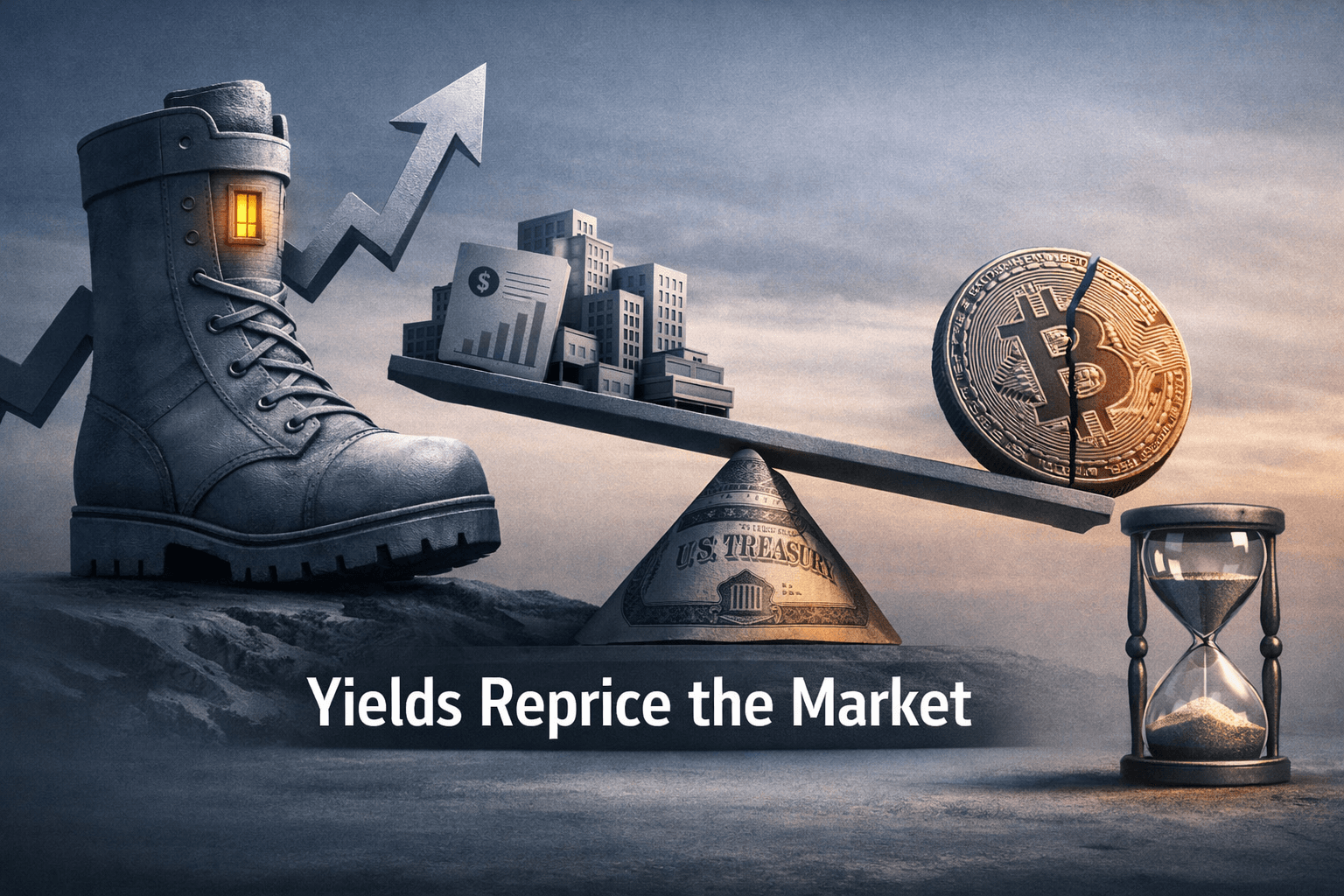
Yields Reprice the Market: Fed Hike Odds, Bond Rally, and Corporate Catalysts Dominate the Day
Podcast • Loading audio...
Share this article
Spread the word on social media
Key Takeaways
- •Long‑term yields surged today; market pricing now reflects materially higher odds of additional Fed hikes (CNBC survey ~69% expect ≥2 hikes).
- •Rising yields increase discount‑rate pressure on growth stocks while creating higher income opportunities for new fixed‑income buyers.
- •Earnings have cushioned equities so far, but that protection is conditional — company‑specific catalysts (Teledyne, Oracle, Allison, Carnival) will drive relative outcomes.
- •Regulatory setbacks (Clarity Act cloture failure) raised short‑term crypto risk, even as some analysts maintain longer‑term bullish targets.
Today's Most Significant Developments
Markets opened and traded under a heavy macro spotlight: long-term Treasury yields moved sharply higher while surveys and analysts pushed up odds that the Federal Reserve will continue to tighten. Compounding the macro story were a string of company-level updates and scheduled events — Teledyne’s post‑quarter scrutiny, Mizuho’s reaffirmation on Oracle, Allison Transmission’s strategic expansion, and Carnival’s announced Q3 release date — that together made this a day of cross‑asset repricing.
Key datapoints from coverage today: analysts reported the 10‑year Treasury trading in a range that included ~4.66%–4.69% in several pieces, while other reporting referenced the 10‑year above 5% and the 30‑year near ~5.20% as traders priced an imminent Fed rate move. The CNBC Fed survey showed roughly 69% of respondents now expect at least two hikes over the next year. Teledyne shares were cited at $597.22, reflecting a roughly 7.5% six‑month decline; crypto markets reacted to a failed Senate cloture vote on the Clarity Act even as some analysts published upside price targets for BTC, ETH and XRP.
Synthesizing the Day’s Key Themes
Rising yields and the Fed’s path are the dominant cross‑market driver. Multiple pieces — from direct coverage of Treasury moves to Fed‑focused commentaries — coalesce around one idea: markets are repricing the probability of further tightening. That adjustment raises discount rates, compresses long‑duration valuations and forces investors to reassess duration exposure.
Earnings and company fundamentals remain the primary defense for equities, but that cushion has limits. MarketWatch and other coverage note that robust corporate results so far have helped equities absorb yield shocks. At the same time, analysts warn that this insulation is conditional; if rate expectations rise further or earnings momentum softens, equity multiples can re‑rate quickly.
Fixed‑income is pivoting from price appreciation to income opportunity. Coverage arguing that the bond market may be nearing “escape velocity” highlights the tradeoff: existing bondholders face mark‑to‑market losses as yields rise, but reinvestment opportunities at higher yields look more attractive for new allocations.
Cross‑asset linkages are tightening. The CNBC and other pieces calling out a strong correlation between oil and Treasury yields — the closest since 2019, by one measure — underscore a new source of macro volatility: rising energy costs can lift inflation expectations and tighten financial conditions simultaneously.
Company‑level catalysts matter again. With macro risk elevated, firm‑specific news — Teledyne’s Q2 fallout, Oracle’s capacity signals (per Mizuho), Allison Transmission’s push into new markets, and Carnival’s scheduled Q3 call — now have outsized potential to move individual names and subsectors.
Conflicting Views and Market Debates
How many Fed hikes are priced in? The CNBC survey suggests a clear tilt toward “not one and done,” with ~69% expecting at least two hikes in the next year. Some commentators frame the upcoming Fed action as the start of a longer tightening cycle; others treat the next move as still potentially isolated. The difference hinges on incoming inflation prints, the Fed’s wording, and near‑term growth signals.
Are equities truly insulated by earnings? Several analyses argue that earnings have cushioned markets against rising yields; contrarian voices warn that this buffer is finite. The debate centers on whether earnings growth will continue to outpace the impact of a materially higher discount rate and whether profit margins will hold under higher borrowing costs.
Is the bond market vaporizing or stabilizing? One narrative calls the bond market “beaten‑up” but poised to offer attractive yields to new investors (the “escape velocity” framing). The counterpoint emphasizes the near‑term pain for existing holders and the potential for further yield repricing if fiscal and energy dynamics worsen.
Crypto regulatory outlook: the Senate’s failure to advance the Clarity Act tightened the regulatory backdrop, sending immediate negative price signals. At the same time, some analysts continue to publish optimistic long‑term price scenarios for BTC, ETH and XRP. The tension is between near‑term political risk and longer‑term conviction among sector bulls.
Deeper Context on Major Moves
Why do rising yields matter so much right now?
Discount‑rate mechanics: Equity valuations, particularly for long‑duration growth companies, are sensitive to the discount rate applied to future cash flows. A 100 basis‑point move in long yields can meaningfully reduce present values of distant cash flows, which disproportionately affects high‑growth, low‑current‑income names.
Funding and corporate behavior: Higher policy and long‑term rates increase borrowing costs for companies, which can slow investment, make buybacks less attractive, and compress margins for leveraged firms. This feeds back into earnings expectations and multiple compression.
Portfolio reallocation: As yields rise, cash‑and‑carry math changes. Higher‑income fixed income and money‑market returns can lure capital away from risk assets, changing liquidity and risk premia across markets.
Why the oil‑yield correlation matters
When oil and long‑term yields move together, it signals synchronous shifts in both inflation expectations and financing conditions. Energy price shocks lift input costs and can push inflation and wage dynamics in a way that prompts central banks to tighten — a double hit to risk assets.
Why company‑specific news stands out
In an environment where macro signals are noisy and volatility is elevated, idiosyncratic catalysts become more decisive for stock returns. Teledyne’s Q2 disclosures and price reaction, Oracle’s capacity and operating commentary (cited by Mizuho), Allison’s strategic expansion (flagged by Fidelity coverage), and Carnival’s explicit earnings timetable all represent discrete information that can move valuations independently of the broad macro trend.
Implications by Investor Type
Short‑term traders and quant funds: Expect higher intraday volatility around macro releases (Fed decision, Bessent testimony) and scheduled corporate events. Tight risk management, surveillance of liquidity, and real‑time yield moves will be critical.
Income and fixed‑income investors: The rise in long yields creates opportunities to lock in materially higher coupon income for new purchases, but existing holders will see mark‑to‑market losses. Duration positioning matters: analysts note that moving down the curve or shifting to shorter durations reduces price sensitivity.
Growth investors: Higher yields increase the discount applied to long‑dated free cash flows, making growth stocks particularly vulnerable. Earnings growth will need to outpace the higher discount rate to justify prior multiples.
Value and cyclical investors: A higher‑rate environment can benefit financials (net interest margins) but may hurt deeply cyclical firms facing higher borrowing costs. Energy exposure may be a hedge if oil stays elevated, but the correlation with yields complicates diversification.
Crypto and digital‑asset holders: Legislative setbacks like the Clarity Act cloture failure increase regulatory risk and near‑term volatility. Analysts’ long‑term price targets for BTC ($80k), ETH ($3k) and XRP (~$4) (as cited in coverage) coexist with a higher political‑risk premium in the short run.
Long‑term allocators and pension funds: The shift toward higher yields can improve long‑term return prospects for fixed income allocations and reduce the need to chase equity risk premia for yield — but it requires careful liability‑driven planning and recalibration of discount assumptions.
Company Notes Worth Watching
Teledyne (TDY): Shares cited at $597.22 after Q2 disclosures and a six‑month underperformance (~‑7.5%). Analysts emphasize modeling risks and near‑term catalysts that could reset positioning.
Oracle (ORCL): Mizuho’s reiteration highlights operational execution and a referenced capacity gain (~5%), signaling that some large houses see sustained earnings momentum that could stabilize sentiment.
Allison Transmission (ALSN): Fidelity‑flagged expansion outside core commercial vehicles suggests a widening addressable market — a watchpoint for dividend‑growth and industrial investors.
Carnival (CCL): Q3 results and the Sep 29 analyst call create a date‑specific liquidity event for travel and leisure peers.
Adecco (ADEN)/Salesforce (CRM context): The global rollout of Salesforce’s Agentforce Coworker across 40+ countries is a notable enterprise‑software/HR tech adoption story with cross‑border implications.
Strategic Considerations (Informational Only)
Monitor yield curve dynamics and Fed communications closely. Small changes in language or in the path assumptions can have outsized market effects.
Reassess duration exposure across fixed income holdings and consider the tradeoff between securing higher starting yields and potential near‑term mark‑to‑market volatility.
Treat earnings momentum as conditional protection. Company fundamentals and guidance will likely dictate relative performance within equities even as macro risk remains elevated.
Track policy and regulatory developments for crypto and other politically sensitive sectors; legislative outcomes can create abrupt repricing.
Use scheduled corporate events (Carnival’s Q3 call, Teledyne follow‑ups) as natural windows for re‑evaluation of position sizing and risk limits.
Conclusion
Today’s flow made one message clear: the repricing of interest‑rate risk is front and center. Analysts and market commentators converge on the view that higher yields alter the calculus for valuation, funding and cross‑asset correlation — but they diverge on whether current earnings momentum and company fundamentals will be enough to shield equities over the medium term. Investors should parse both macro signals (yields, Fed guidance, oil) and idiosyncratic company news to form a holistic view of risk and opportunity.
Investment disclaimer: This report is for informational purposes only. It does not constitute investment advice, a recommendation to buy or sell securities, or personalized financial guidance. Analysts note market conditions and provide data and context to aid decision‑making; individual investors should consult their own advisors regarding their unique circumstances.
Sources
+ 6 more sources
Use these insights — enter this week's contest.
Free practice contests — earn Alpha CoinsExplore More Content
Disclaimer: StockAlpha.ai content is for informational and educational purposes only. It is not personalized investment advice. Sentiment ratings and market analysis reflect data-driven observations, not buy, sell, or hold recommendations. Always consult a qualified financial advisor before making investment decisions. Past performance does not guarantee future results.