 Breaking Analysis
Listen to this Recap
10:58
Oil, Yields and AI: A Day of Cross-Currents as Markets Reprice Inflation and Growth
Podcast • Loading audio...
Share this article
Spread the word on social media
Key Takeaways
- •Oil above $100 and an East–West pipeline shutdown have tightened near‑term supply expectations and lifted inflation risk.
- •The 10‑year Treasury yield reached ~5%, repricing discount rates and pressuring long‑duration assets; outlets vary on the historical benchmark cited.
- •Citigroup warns AI development pauses could reverse much of 2026’s gains tied to earnings revisions; Anthropic’s profit headlines are qualified and opaque.
- •Extreme moves in derivative‑linked instruments (a freight fund up ~3,600%) highlight concentrated momentum but also elevated tail risk.
Today's top developments
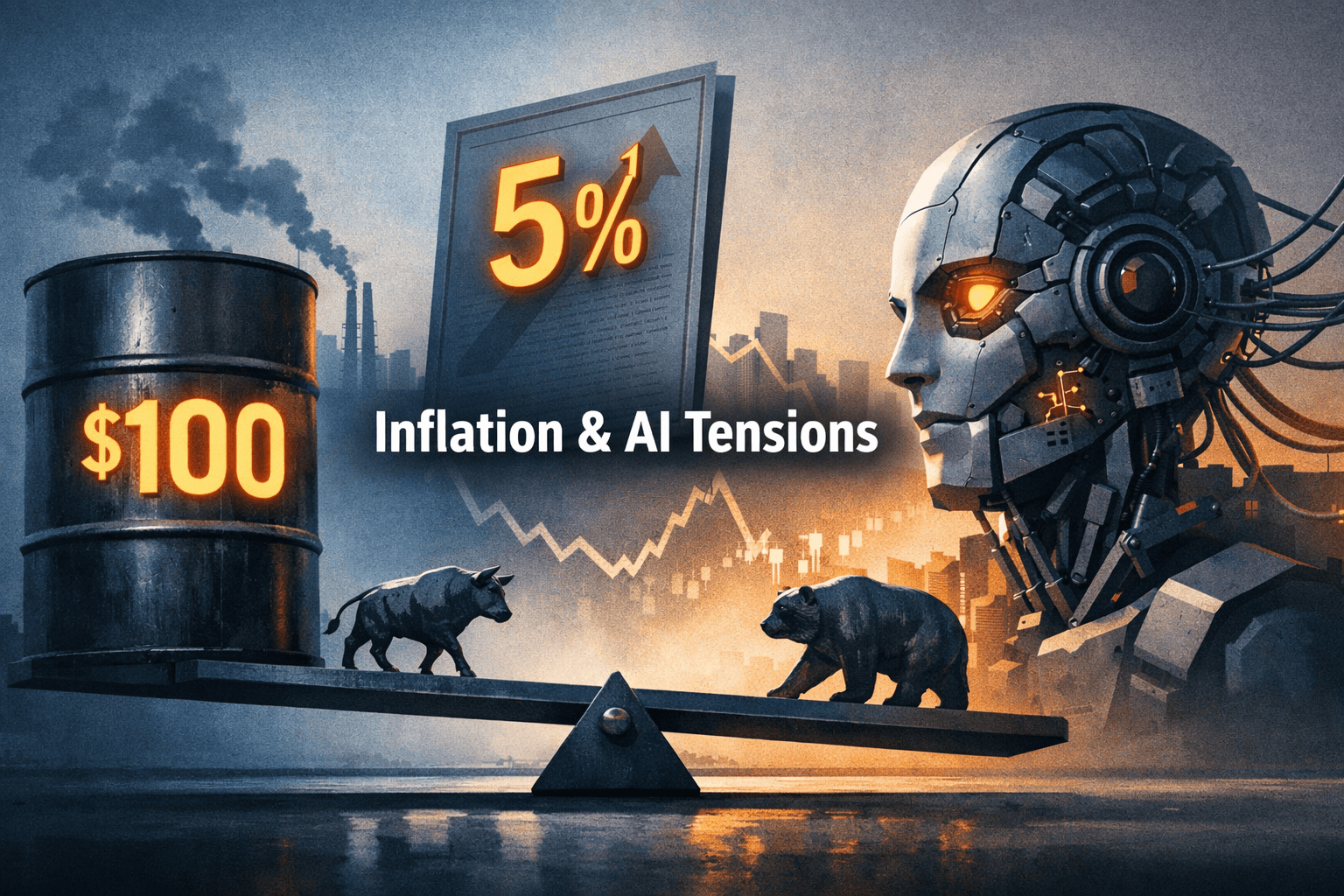
Markets opened and closed the day recalibrating around three interlocking shocks: oil surged above $100 a barrel after an East–West Saudi pipeline shutdown (drone damage cited), the 10‑year U.S. Treasury yield pushed to the 5% threshold, and renewed scrutiny of AI-sector fundamentals followed mixed corporate and analyst headlines. Each development on its own would matter; together they compress risk premia, lift financing costs, and raise the probability that recent momentum in growth-oriented pockets can be quickly reversed.
Key data and metrics from the day:
- Brent and WTI front‑month contracts traded above $100/bbl after the East–West pipeline closure (Analysis 1).
- The 10‑year U.S. Treasury yield briefly reached 5% (variously reported as the highest level since 2007 or since 2023 across outlets) — a psychological and valuation benchmark for markets (Analyses 7–13).
- A crude‑tanker freight fund tied to futures surged roughly 3,600% (trading at $108, up $6.20 on the day), signaling extreme momentum in tanker markets amid supply‑shock fears (Analysis 11).
- Citigroup flagged that the market’s 2026 gains are densely concentrated in AI exposure and warned that any slowdown in model progress could unwind earnings revisions that have driven performance (Analysis 2).
- Anthropic’s reported consecutive quarterly profit headline carries a “very big caveat” — various reports highlight qualification language and specific data points to watch (80% and 40% cited) — underscoring opacity in private AI financials (Analyses 3–4).
- A valuation exercise argued Meta (META) may have more upside than the market currently prices, with model inputs cited as 2.12%, 1.2%, 18.8%, $13.2 and $1.7 (Analysis 6).
Cross‑cutting themes
Inflation and policy risk are back in the driver’s seat. The oil spike, driven by geopolitical and supply disruptions, feeds directly into CPI dynamics and therefore the Fed’s calculus. Several pieces in today’s set (Analyses 1, 5, 7–13) link higher crude to a tighter real policy stance and an elevated probability of a rate increase at the September meeting (market consensus cited a 25 bps move). Rising yields in turn reprice equity discount rates and corporate borrowing costs.
Market leadership remains bifurcated: energy and cyclicals benefit from commodity strength while long‑duration growth faces valuation pressure. JPMorgan strategists voiced explicit concern that the oil move could precipitate a rapid market turn if volatility accelerates (Analysis 1). Meanwhile, Citigroup’s warning about AI progress (Analysis 2) and Anthropic’s murky profit headline (Analyses 3–4) expose downside to growth narratives that have supported multiples.
Short‑term momentum pockets coexist with structural uncertainty. The freight fund’s 3,600% jump (Analysis 11) is a reminder that commodity and derivatives arenas can produce outsized, transient returns that may not translate into broader market stability. These extreme moves can amplify risk‑off flows into Treasuries, further tugging on yields.
Information asymmetry in private AI firms increases tail risk for public markets. Anthropic’s reported profitability includes qualifications that could materially alter interpretation of the result; for allocators tracking private AI leaders, headline profits without transparent accounting or recurring unit economics are unreliable signals (Analyses 3–4).
Where analysts and reports diverge
Highest yield benchmark: Several outlets describe the 10‑year reaching 5% as the highest since 2007 (Analysis 7) while other reports say it was the first time since 2023 (Analyses 9–10). That discrepancy appears to reflect differences in endpoint framing (multi‑year versus recent cycle) and should remind investors to check the exact historical reference each report uses.
Significance of Anthropic’s profit: Headlines hailed back‑to‑back profitability, but follow‑on pieces stress a major caveat and specific metrics (80%/40%) that temper confidence. Analysts agree the caveat is central, but differ on how much weight to assign pending fuller disclosures (Analyses 3–4).
AI optimism versus fragility: Meta valuation work (Analysis 6) and the broader narrative of AI driving market gains are in tension with Citigroup’s caution that an AI development pause could prompt negative earnings revisions (Analysis 2). Analysts are split between models that see continued scale‑driven profit conversion and scenario analyses that assume slowing momentum and multiple compression.
Deeper context on the major moves
Oil: The immediate catalyst was a reported drone attack and the subsequent Saudi East–West pipeline shutdown, which materially tightens short‑term supply. Oil’s pass‑through to consumer prices is not instantaneous but operates through transportation, manufacturing inputs and expectations. With oil above $100, headline inflation trajectories and forward‑looking measures such as breakeven inflation are likely to rise, tightening the policy outlook.
Treasuries: The 10‑year yield at 5% recalibrates the risk‑free discount rate used in equity valuation and can pressure long‑duration assets. Even if the move is partly technical or driven by risk premia, higher yields raise borrowing costs for corporates and mortgages, affect private‑equity financing, and increase the attractiveness of cash‑like alternatives for income investors.
AI and earnings revisions: 2026’s equity gains have been concentrated in names benefiting from AI‑driven upgrades to growth expectations. Citigroup’s caution underscores the mechanical vulnerability: earnings revisions have been a central price driver, and if revision momentum fades, forward P/E multiples can compress quickly. That dynamic is compounded when private firms (e.g., Anthropic) provide opaque profitability claims that feed headline optimism without transparent unit economics.
Extreme commodity moves: The 3,600% jump in a crude‑tanker futures fund is emblematic of concentrated derivative positions and short‑dated dislocations. Such instruments can signal genuine tightening but can also reverse rapidly; they increase tail‑risk for correlated markets (energy equities, shipping, insurers) and can prompt margin calls that spill into broader liquidity channels.
Implications by investor type
Income and conservative investors: Higher 10‑year yields improve rates available on new fixed‑income allocations but reduce market value for existing long‑duration bonds. Treasury yields moving through 5% increase the opportunity cost for equities and warrant a recheck of duration exposure and laddering strategies.
Growth‑oriented investors: The Citigroup note and Anthropic caveat highlight the sensitivity of growth portfolios to earnings‑revision momentum and information quality. High multiple names already priced for continued AI progress carry higher idiosyncratic and macro risk if development slows or private players’ results disappoint.
Value and commodity investors: Energy and related cyclicals have clearer near‑term tailwinds from higher crude prices. However, officials’ ability to restore supply quickly, and the potential for recessionary impacts on demand if policy tightens, mean gains could be volatile and dependent on geopolitics.
Traders and tactical allocators: The convergence of a supply shock, a record move in yield, and volatility in derivatives markets favors active risk controls — defined loss limits, margin monitoring, and contingency plans for rapid de‑risking. Momentum opportunities (e.g., freight fund) can be alluring but carry outsized drawdown risk.
Private‑company and venture allocators: The Anthropic coverage is a reminder to demand granular metrics (unit economics, recurring profit drivers, one‑time items) before extrapolating private profitability to public valuation frameworks.
Strategic considerations and watch‑list
Fed communications and inflation reads: The market is pricing a 25 bps move at the upcoming meeting; any hint from the Fed that policy will be tighter for longer should be treated as a potential catalyst for further repricing across equities and credit.
Oil supply developments: Track repair timelines for the Saudi East–West pipeline, geopolitical escalation risk (e.g., Iran/Red Sea dynamics), and forward curves in crude markets. A sustained oil price >$100 materially raises upside risk to inflation forecasts.
Earnings‑revision flow for AI leaders: Monitor sell‑side estimate revisions, guidance language, and capital‑expenditure cadence for publicly traded AI‑exposed firms. Citigroup’s scenario framing suggests earnings momentum, not sentiment alone, will determine the next leg of market direction.
Private‑company disclosures: For private AI names, insist on repeatable revenue and profit measures and beware of headline profitability that relies on non‑recurring items or narrow scopes (the Anthropic caveat example).
Duration and liquidity management: Reassess portfolio duration, stress test bond holdings against further yield moves, and ensure liquidity buffers to meet margin or rollover needs in a higher‑rate, higher‑volatility environment.
Conclusion
Today’s market action is a vivid example of how policy, geopolitics and concentrated technology narratives can intersect to produce rapid repricing. Oil’s move above $100 and Treasury yields at the 5% threshold tighten the macro backdrop, while the AI narrative demonstrates both the upside that innovation brings and its fragility if progress falters or disclosures disappoint. Analysts and strategists are divided on how persistent these forces will be; consensus tilts toward caution, but pockets of optimism (Meta valuation work, energy/cyclicals) persist.
For informational purposes only: this summary synthesizes market reporting and analyst notes from the past 24 hours and does not constitute investment advice, a recommendation to buy or sell securities, or a personalized financial plan. Analysts note that active monitoring of Fed signals, oil‑supply developments, and earnings‑revision flows will be critical in the coming days as markets absorb these cross‑currents.
Sources
+ 5 more sources
Use these insights — enter this week's contest.
Free practice contests — earn Alpha CoinsExplore More Content
Disclaimer: StockAlpha.ai content is for informational and educational purposes only. It is not personalized investment advice. Sentiment ratings and market analysis reflect data-driven observations, not buy, sell, or hold recommendations. Always consult a qualified financial advisor before making investment decisions. Past performance does not guarantee future results.