 Breaking Analysis
Listen to this Recap
11:11
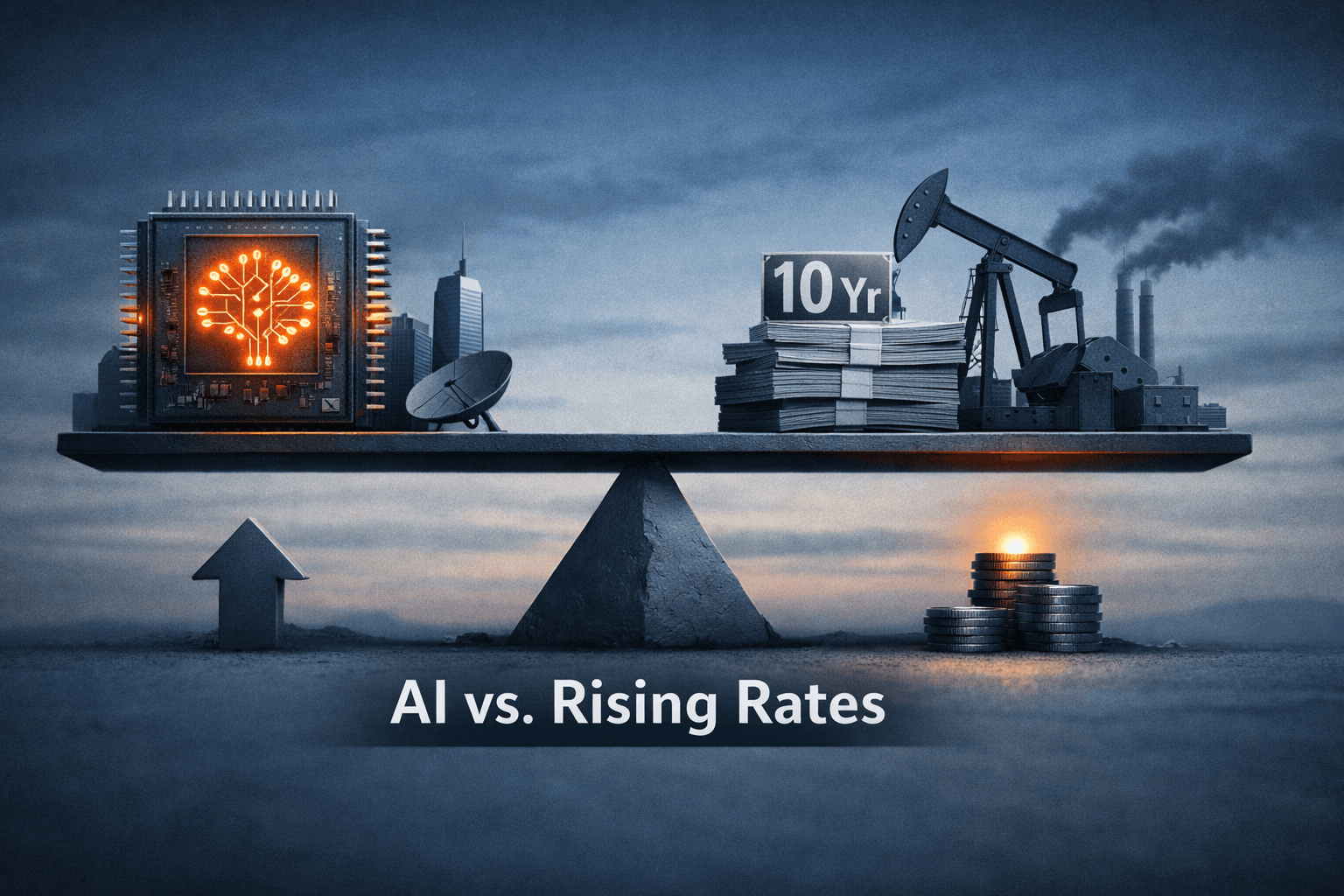
AI Momentum Meets Higher Yields: Markets Pivot Between Re‑rating and Macro Reality
Podcast • Loading audio...
Share this article
Spread the word on social media
Key Takeaways
- •AI momentum is driving strong re‑ratings (Snowflake +22% to $152.40; Dell price‑target upgrades), but rising yields (10‑yr at 1.91%) increase valuation sensitivity for high‑multiple names.
- •Earnings nuance is dominating price action: MongoDB fell ~7% despite strong EPS due to flat Atlas growth, while Yatsen reported non‑GAAP EPADS of -$0.16 on $168.3M revenue.
- •Operational inflections in cyclicals and energy are visible — Ford's Super Duty production hit a 20‑year high amid weak retail sales; Chevron plans a $7B Venezuela expansion — creating mixed risk/reward profiles.
- •Central bank and policy developments (NY Fed commentary, BoC hold at 3.75%) and geopolitical headlines remain critical near‑term catalysts that can swing sector leadership.
Today's most significant developments
Markets traded on a series of cross‑currents on Sep 2. On the positive momentum side, AI and related infrastructure names led several decisive moves: Snowflake surged about 22% to $152.40 after results and product momentum tied to an AI coding agent; Dell saw several broker upgrades after reports of a jump in AI server demand; and broad institutional interest in Alphabet rose after Berkshire disclosed an increased stake and CEO Abel called Alphabet a "significant player" in AI.
At the same time, macro and valuation signals constrained the rally. The U.S. 10‑year Treasury yield climbed to 1.91% — its highest level since November 2023 — and New York Fed President John Williams tied the move to stronger economic prospects, leaving markets to reassess duration exposure and the prospect of "higher for longer" policy. The Dow delivered a headline intraday gain of ~250 points, helped by cyclicals such as Caterpillar, but that strength sits against rising yields and fresh central‑bank precaution: the Bank of Canada held its policy rate at 3.75% while flagging trade‑shock risks.
Cross‑cutting themes from the day's coverage
AI infrastructure is re‑rating parts of tech and hardware. Snowflake's 22% pop to $152.40 underscores how quickly the market is rewarding monetization of AI developer workflows. Dell's upgraded price targets and reported acceleration in AI server orders show the demand side for compute is broadening beyond hyperscalers. POET Technologies ($POET) is another signal of the adjacency playbook: optics and photonics come into focus at ECOC 2026 in Malaga (Sept 20–24) as the industry debates 800G→1.6T→3.2T migrations — a structural tailwind for companies that can commercialize integrated photonics.
Macro repricing — rising yields are re‑introducing rate sensitivity. The 10‑year yield at 1.91% and comments from NY Fed's Williams that the surge reflects stronger economic prospects pushed a cross‑section of assets to reprice. Analysts noted the direct implications for mortgage and corporate borrowing costs and the knock‑on effect on duration‑heavy and high‑multiple growth names.
Earnings nuance matters more than headlines. Several companies posted results that produced divergent market reactions depending on which metric investors prioritized. MongoDB reported strong earnings yet shares fell roughly 7% to $343.53 because Atlas multi‑cloud growth stalled for a fifth straight quarter — illustrating that the market is differentiating between earnings quality and sustained top‑line momentum. Yatsen reported non‑GAAP EPADS of -$0.16 and revenue of $168.3M, a reminder that adjusted loss metrics and guidance still drive sentiment for consumer and smaller cap names.
Operational inflection points in cyclicals and energy are driving stock‑specific moves. Ford pushed Super Duty production to a 20‑year high after recovering from supplier fires, yet retail sales weakness (eight consecutive months of year‑over‑year declines) and volatile share trading (shares fell about 3.8% on heavy turnover, ~$1.2B) underline the disconnect between factory output and end‑market demand. Chevron announced a $7 billion plan to expand Venezuelan production — a major strategic call with geopolitical and execution risk that could change long‑term barrels and free‑cash‑flow assumptions for $CVX.
Where analysts and markets disagree (conflicts and debates)
AI optimism vs. stretched multiples: There is a clear split between analysts rushing to re‑rate AI winners (Snowflake, Dell upgrades, interest in Alphabet) and coverage flagging valuation risk (Palantir: analysis points to its worst slump since February amid concerns that upside was already priced in; Cisco has rallied ~38.2% over six months to $109.75, and some analysts warn that such concentration raises downside sensitivity). In short, some market actors see re‑rating as justified by product adoption and monetization; others see a thin margin for error if growth disappoints.
Macro strength vs. policy uncertainty: NY Fed Williams framed yield moves as consistent with better growth, while central‑bank caution elsewhere (Bank of Canada holding at 3.75% and citing trade risks) highlights the uncertain policy mix. The debate centers on whether higher yields are signal of sustainable growth (which would support cyclicals) or a tightening that will sap growth multiples.
Production recovery vs. demand softness: Ford's 20‑year high in Super Duty production is an operational win, yet U.S. new‑vehicle retail metrics remain soft. Analysts disagree on the timing and extent to which improved factory throughput will translate into better revenue and margins once end‑market demand re‑accelerates.
Deeper context on major moves
Snowflake (SNOW): The 22% rally to $152.40 was prompted by results and the market's interpretation that Snowflake is successfully monetizing AI developer workflows. This is not merely a revenue beat story; it is about optionality — software platforms that become indispensable in AI pipelines can command multiple expansion. But real‑options and forward growth assumptions now feature more prominently in valuation models.
10‑Year Treasury and Fed Signaling: The 10‑year at 1.91% is a multi‑month repricing that directly increases discount rates used in equity valuations. Williams' comments that the yield surge reflects stronger economic prospects put the onus on markets to reconcile faster nominal growth with the possibility of policy tightening. Analysts note that even a modest uptick in the discount rate compresses the present value of distant cash flows, disproportionately hurting high‑multiple growth names.
POET & Optics at ECOC: POET's presence at ECOC and a Blazar award nomination matters because the optics industry is at an inflection where copper's limits are broadly acknowledged. The tradeoff is execution and timing: industry adoption of 800G→1.6T→3.2T links product roadmaps to capital cycles in data centers and telecom, making conference outcomes and demos (POET has three partner demo paths) meaningful catalysts.
Chevron & Venezuela: The $7B investment to double Venezuelan production is strategically significant. It could materially raise long‑term supply expectations for Chevron but also introduces political and operational risk given Venezuela's complex sanctions and governance environment. Analysts will factor in project timelines, capex allocation, and geopolitical contingencies into long‑range free‑cash‑flow forecasts.
What it means for different investor types
Growth investors: The AI re‑rating offers potential upside, but the bar for durable earnings acceleration is higher. Snowflake and Dell headlines illustrate the reward for demonstrable AI monetization — yet rising yields increase the hurdle rate. Growth managers should prioritize metrics tied to monetization (revenue per customer, platform‑driven cross‑sell, ARR acceleration) rather than headline EPS alone.
Value and cyclical investors: The Dow's +250 move and Caterpillar bounce suggest pockets of cyclicality are regaining favor, especially if yields reflect real growth. Ford's production recovery and Chevron's capex plans point to industrial and energy operational leverage, but watch retail demand indicators and geopolitical risk that can offset these gains.
Income and fixed‑income investors: The 10‑year at 1.91% improves nominal yield opportunities but also raises the prospective volatility of long‑duration bond allocations. Managers should reassess duration exposure and consider the sensitivity of equity holdings (particularly high‑P/E names) to rising discount rates.
Traders and event‑driven allocators: Earnings nuance is a tradeable input. The MongoDB selloff despite strong earnings emphasizes that market expectations around growth momentum (e.g., Atlas growth) can drive abrupt repricings. Upcoming dates to watch include POET's September update, ECOC (Sept 20–24) and company guidance cycles across the next earnings windows.
Strategic considerations and watchlist items
Monitor the Treasury curve and Fed commentary: Sustained moves higher in the 10‑year or hawkish Fed rhetoric would keep pressure on duration and high‑multiple equities.
Track AI monetization signals, not headlines: Adoption metrics (developer usage, ARR growth tied to AI features, server order backlogs) are the discriminators between transient hype and durable re‑rating.
Watch operational translation: For cyclicals like Ford and industrial suppliers (e.g., Caterpillar), separate production and margin recovery from retail demand trends to avoid mistaking supply restoration for rising end‑market demand.
Geopolitics and energy capex: Chevron's $7B Venezuelan plan is a material long‑range input that should be stress‑tested across sanction scenarios and timeline slippage.
Earnings season nuance: Companies with flat or decelerating growth metrics despite earnings beats (MongoDB, Yatsen) highlight that guidance and product‑level momentum will be the primary drivers of near‑term trading.
Where consensus exists and where it fractures
Consensus: AI is a material structural force across software and hardware; rising yields influence discounting and mortgage/borrowing costs; and operational recoveries in certain industrial lines (e.g., Ford Super Duty) are real.
Fractures: Whether AI re‑ratings are broadly sustainable versus short‑lived multiple expansion remains debated; whether higher yields are a growth signal or a tightening risk for equities is unresolved; and whether production inflections will translate to durable revenue gains for cyclicals depends on timing and demand follow‑through.
Investment disclaimer
This analysis is for informational purposes only. It does not constitute individualized investment advice or a recommendation to buy, sell, or hold any security. Analysts note market data and company disclosures cited above; readers should consult their financial advisors and perform their own due diligence before making investment decisions.
Bottom line
Sep 2's tape was defined by a tension between accelerating AI‑driven re‑ratings in software and infrastructure and a macro repricing led by higher Treasury yields and central‑bank uncertainty. That combination creates a market where selective momentum can deliver outsized moves (Snowflake, Dell) even as rising discount rates and valuation sensitivity threaten downside for stretched names (Palantir, Cisco). For investors, the imperative is to distinguish monetization‑driven upgrades from momentum‑only rallies, to mind the increasing importance of macro signals like the 10‑year yield, and to watch company‑level metrics and upcoming catalysts closely — particularly in AI infra, industrial production cycles, and geopolitically sensitive energy projects.
Sources
+ 14 more sources
Use these insights — enter this week's contest.
Free practice contests — earn Alpha CoinsExplore More Content
Disclaimer: StockAlpha.ai content is for informational and educational purposes only. It is not personalized investment advice. Sentiment ratings and market analysis reflect data-driven observations, not buy, sell, or hold recommendations. Always consult a qualified financial advisor before making investment decisions. Past performance does not guarantee future results.