 Breaking Analysis
Listen to this Recap
10:57
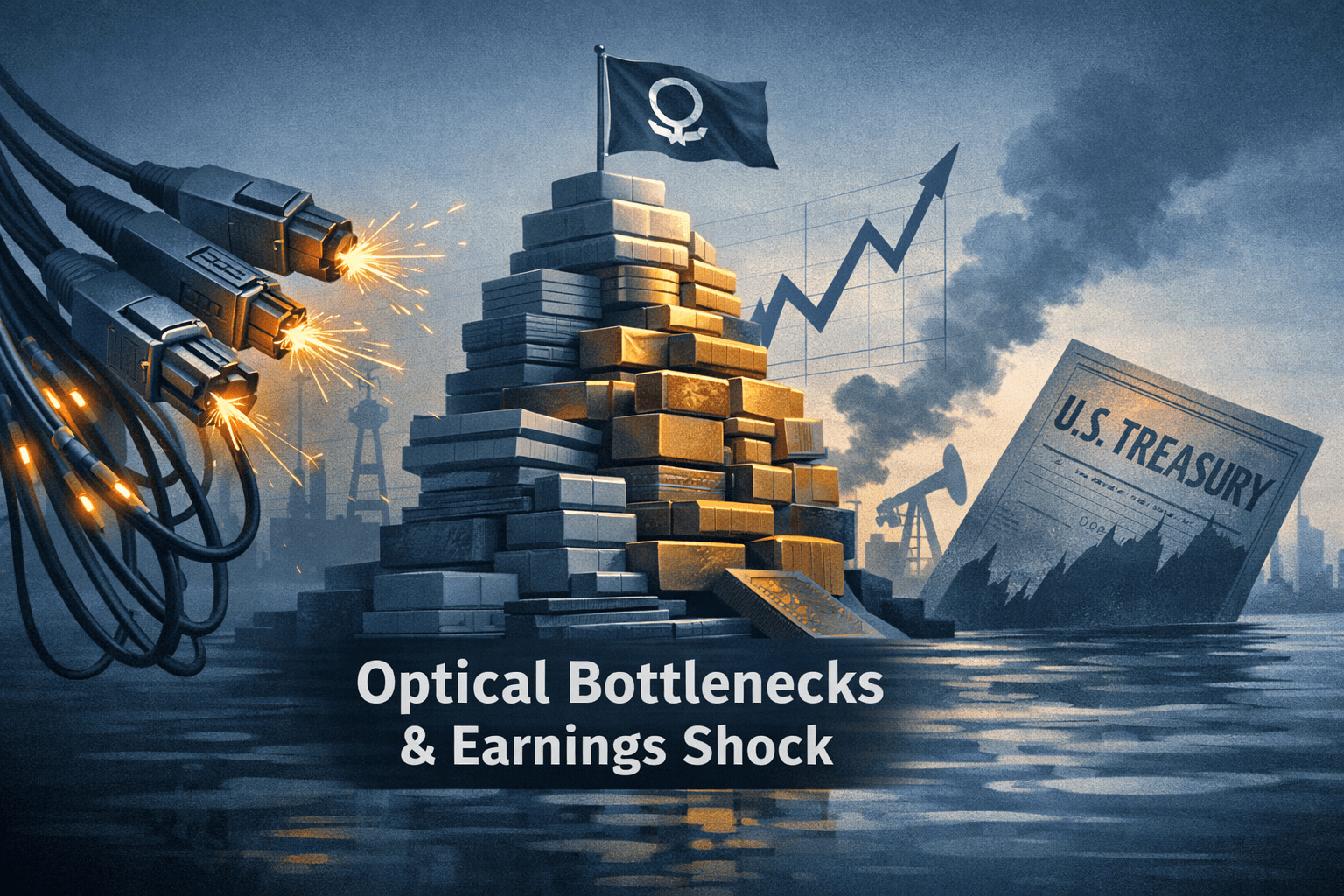
Interconnects, Earnings Rotation and a Breathless Market: Optical Bottlenecks Meet Macro Volatility
Podcast • Loading audio...
Share this article
Spread the word on social media
Key Takeaways
- •AI scale is shifting the bottleneck from chips to optical interconnects; photonics suppliers like POET are focal points and recent selloffs may reflect forced liquidations rather than demand deterioration.
- •Palantir’s Q2 topped $1B in revenue with ~150% U.S. commercial growth and a guidance lift, underscoring an earnings‑driven rotation possibility.
- •Macro risks remain elevated: traders brace for more Treasury volatility even as a geopolitical de‑escalation nudged the 10‑year to 4.688% on Aug. 3.
- •Event‑driven catalysts (SpaceX earnings, Spider‑Man’s $360M opening) are producing measurable re‑rating opportunities and near‑term volatility.
- •Investors should prioritize capex/backlog signals, Fed communication, and earnings guidance deltas while keeping liquidity and duration flexibility.
Today's most significant developments
Markets opened Aug. 3 under a patchwork of structural and event-driven forces. Three threads dominated the tape: (1) a growing industry argument that AI scale is hitting an optical interconnect bottleneck — and that photonics names sit at the choke point; (2) a burst of company‑specific news that reset sector leadership (most notably Palantir’s blowout quarter and guidance lift); and (3) renewed macro volatility as geopolitical headlines pushed oil sharply lower and briefly eased Treasury yields (the 10‑year fell to 4.688%, down a little over 1 basis point on the headline move).
Overlaying those drivers were cross‑market technical risks: traders are bracing for renewed turbulence in the $30 trillion Treasury market even as parts of equities rotated from chip‑led leadership toward earnings‑driven momentum calls from strategists.
Synthesis: the key themes tying today's analyses together
The bottleneck in AI is moving off the silicon and onto the network. Analyses flagged that as GPU clusters scale into the hundreds of thousands, data movement — not transistor count — is the immediate constraint. Optical interconnects and photonics suppliers (POET among names cited) now occupy a critical position in AI infrastructure rollouts. The sector's recent violent July drawdown was aggravated by a leveraged hedge‑fund liquidation (the “Citadel trade” and related blowups), leaving prices arguably disconnected from demand fundamentals.
Earnings are reasserting themselves as market leadership drivers. Morgan Stanley’s Michael Wilson argued that momentum investing could revive as earnings strength replaces a chip‑led run. That thesis found a concrete counterpoint in Palantir, which reported revenue topping $1 billion for the quarter and U.S. commercial revenue growth of nearly 150% — metrics that triggered a roughly 12% intraday move and a guidance lift.
Macro volatility and policy signaling remain central. Goldman Sachs warned about the risk of muddled Federal Reserve communication — an important input for both rates markets and equity volatility. Separately, traders continue to prepare for a “wild stretch” in Treasuries even as the 10‑year eased on de‑escalation hopes tied to the U.S.–Iran situation. The juxtaposition — elevated preparedness for rising yields vs. a headline‑driven yield decline — creates short‑term directional uncertainty.
Idiosyncratic catalysts matter again. From SpaceX’s first earnings report — where CEO commentary could move markets more than numbers — to Spider‑Man’s record $360 million domestic opening (a direct revenue impulse for Sony and exhibitors), discrete nonmacro events are generating measurable valuation and cash‑flow implications.
Conflicting views and market debates
Photonics: warning versus dislocation. One camp sees the July selloff as a signal that demand forecasts were overheated and that capex in optical interconnects will be lumpy. The opposing view argues the move was a forced‑liquidation dislocation: fundamentals for data movement remain intact and will reassert as AI deployments continue.
Rates outlook: higher for longer versus headline‑driven pullbacks. Traders and some strategists are positioning for higher yields and elevated volatility in Treasuries; yet geopolitical headlines pushed the 10‑year slightly lower to 4.688% on the day. This divergence highlights sensitivity to short‑term risk premia and the unequal weighting of headline risk versus secular rate expectations.
Momentum’s return: broad rotation or isolated beats? Morgan Stanley’s call that earnings could revive momentum sits alongside uneven corporate reports — Tesla eked out a third daily gain at $96.75 (up 0.04% early Monday) amid regulatory questions, while other travel and crypto names, such as Marriott and American‑Bitcoin exposures, pulled back on regional and digital‑asset headwinds. The debate is whether momentum is structural or event‑driven and narrow.
Deeper context on major moves
Optical interconnects and photonics: As AI models scale, GPUs are necessary but not sufficient. Large models require extremely high‑bandwidth, low‑latency links between accelerators and memory. Those links increasingly rely on photonics (optical transceivers, silicon photonics modules) rather than copper. The supply chain is specialized: a few suppliers — including POET and others — sit at critical nodes. When leveraged positioning and a hedge‑fund unwind compressed liquidity in July, companies with unchanged demand outlooks still experienced deep share price stress. For investors, the relevant lens is capex cadence and lead times for optical modules — if data‑center rollout schedules remain intact, revenue should follow with lag; if hyperscalers defer upgrades or adopt alternative architectures, demand could be permanently slower.
Palantir: The company’s quarter marks a narrative inflection. Revenue surpassed $1 billion for the quarter and management raised guidance after U.S. commercial revenue jumped nearly 150%. That combination of scale, accelerating commercial adoption and a guidance lift is what moved the stock ~12% intraday. Analysts note that the significance is not just the beat, but the shift in revenue mix away from government work toward potentially stickier, higher‑margin commercial contracts. For valuation models, the implications include reexamining multiple upside and revenue runway assumptions.
Treasuries and oil: The 10‑year’s move to 4.688% tied to oil plunging on hopes of U.S.–Iran de‑escalation shows how geopolitical risk feeds inflation expectations and rate markets. Traders’ broader expectation — that yields may head higher and volatility will rise — clashes with episodic headline relief rallies. Importantly, higher yields affect borrowing costs, corporate margins (especially energy input‑sensitive industries), and the discount rates applied to long‑duration growth stocks.
Corporate and sector rotations: BNP Paribas’ unusual double upgrade on Boeing (from Sell to Buy) is a reminder that single analyst actions can reframe institutional interest and flows in a sector. Likewise, Sony (benefitting from Spider‑Man’s $360M domestic opening) and exhibitors face immediate top‑line impulses that feed earnings revisions, while Hilton Grand Vacations’ investor letter and HGV’s $1.33B revenue snapshot (with shares around $49) reiterate the importance of company‑level narratives.
What this means for different investor types
Active growth/momentum traders: Expect more narrow leaders and sharp intraday moves. Palantir’s reaction and Tesla’s short‑term drift (trading near $96.75, up 0.04% early Monday) underscore the need to balance earnings catalysts with headline/regulatory risk. Momentum strategies may find fresh leadership outside pure chip names, per Morgan Stanley, but signals could be short‑lived and sector‑specific.
Long‑term allocators and value investors: Structural shifts (AI interconnects, more commercial traction at Palantir) warrant re‑examining multi‑year theses rather than reacting to forced liquidations. For steadier allocations, Coca‑Cola’s profile — where longer‑term returns are detachably company‑specific from the market — offers a reminder that not all equity performance tracks macro swings. Analysts cite short‑term moves (2.32%, 0.18%) alongside larger multi‑period moves (38.10%) to show dispersion between transient and secular gains.
Fixed‑income managers and liability‑sensitive investors: The $30 trillion Treasury market's rising volatility and split signals on yield direction argue for active duration and liquidity management. A single‑day easing to 4.688% does not remove the tail risk of faster rate repricing if Fed communication falters (a risk flagged by Goldman Sachs).
Income and retirement investors: Monthly distributions — such as the JPMorgan Inflation Managed Bond ETF’s $0.2390 payout — matter for cash‑flow planning. Separately, the Social Security funding analysis underscores policy and behavioral risks (delayed claiming, COLA math) that can materially affect retirement income projections and portfolio construction.
Event and volatility traders: SpaceX’s first earnings report and the likelihood that CEO commentary will dominate price action make this an obvious volatility event. Options markets and implied vols should be monitored closely around such reports, where narrative can drive outsized moves independent of headline numbers.
Strategic considerations and watchlist
Watch capital‑expenditure signals and backlog data from hyperscalers for confirmation of sustained photonics demand. Distinguish forced liquidity corrections from durable demand softening.
Focus on earnings cadence: as analysts highlight, earnings season can reconstitute market leadership. Track guidance deltas and U.S. commercial metrics (Palantir’s nearly 150% U.S. commercial growth is a clear example).
Monitor Fed commentary closely. Communication clarity remains a risk to yields and volatility; Goldman’s note is a reminder that narrative, not just data, moves markets.
Scenario‑plan for rates: prepare both for headline‑driven yield retreats (as seen today) and for structurally higher yields that raise discount rates for long‑duration equities.
Use discrete catalysts as valuation inputs: box‑office shocks (Spider‑Man’s $360M opening) and first‑time filings (SpaceX’s earnings) require separate modeling for downstream revenue flows and volatility assumptions.
Final note and disclaimer
The analysis above synthesizes Alpha Breaking coverage from Aug. 3 to provide context for recent market moves and thematic shifts. This summary presents data and interpretations for informational purposes only. Analysts note metrics, trends and scenarios; this write‑up is not a recommendation to buy, sell or hold any security, nor is it personalized investment advice. Readers should consider their own circumstances and consult a qualified advisor before taking action.
Sources
+ 9 more sources
Use these insights — enter this week's contest.
Free practice contests — earn Alpha CoinsExplore More Content
Disclaimer: StockAlpha.ai content is for informational and educational purposes only. It is not personalized investment advice. Sentiment ratings and market analysis reflect data-driven observations, not buy, sell, or hold recommendations. Always consult a qualified financial advisor before making investment decisions. Past performance does not guarantee future results.