 Breaking Analysis
Listen to this Recap
10:13
Volatility and Policy Risk Lead: Intel and Nokia Slump, Small‑Cap Bloodbath, Tariff Lawsuit and AI‑Fueled Industrial Surge
Podcast • Loading audio...
Share this article
Spread the word on social media
Key Takeaways
- •Heavy volume confirmed big moves: INTC -7.89% to $92.32 on 179.12M shares; NOK -6.83% to $9.06 on 117.46M — volume validates near‑term momentum.
- •Policy shock from new tariffs (including a reported 25% on some Brazilian imports) plus an immediate lawsuit at the Court of International Trade creates binary legal risk that can amplify earnings volatility.
- •Microcap crisis: SXTC -80.82% to $0.06 (225.12M shares), VSTD -45.22% to $0.10, CISS -45.94% to $0.52 — these look like liquidity‑driven collapses rather than valuation resets for stable cash generators.
- •Secular concentration persists: an industrial stock tied to AI infrastructure has surged ~533% over two years, while SpaceX’s post‑IPO Starship test flight shifts program risk into the public‑market radar.
- •Investor priorities differ: short‑term traders should monitor weekend legal headlines and volume; long‑term investors should reassess assumptions around tariffs and secular demand; microcap holders must focus on liquidity and disclosure catalysts.
Today's biggest market moves — the headlines
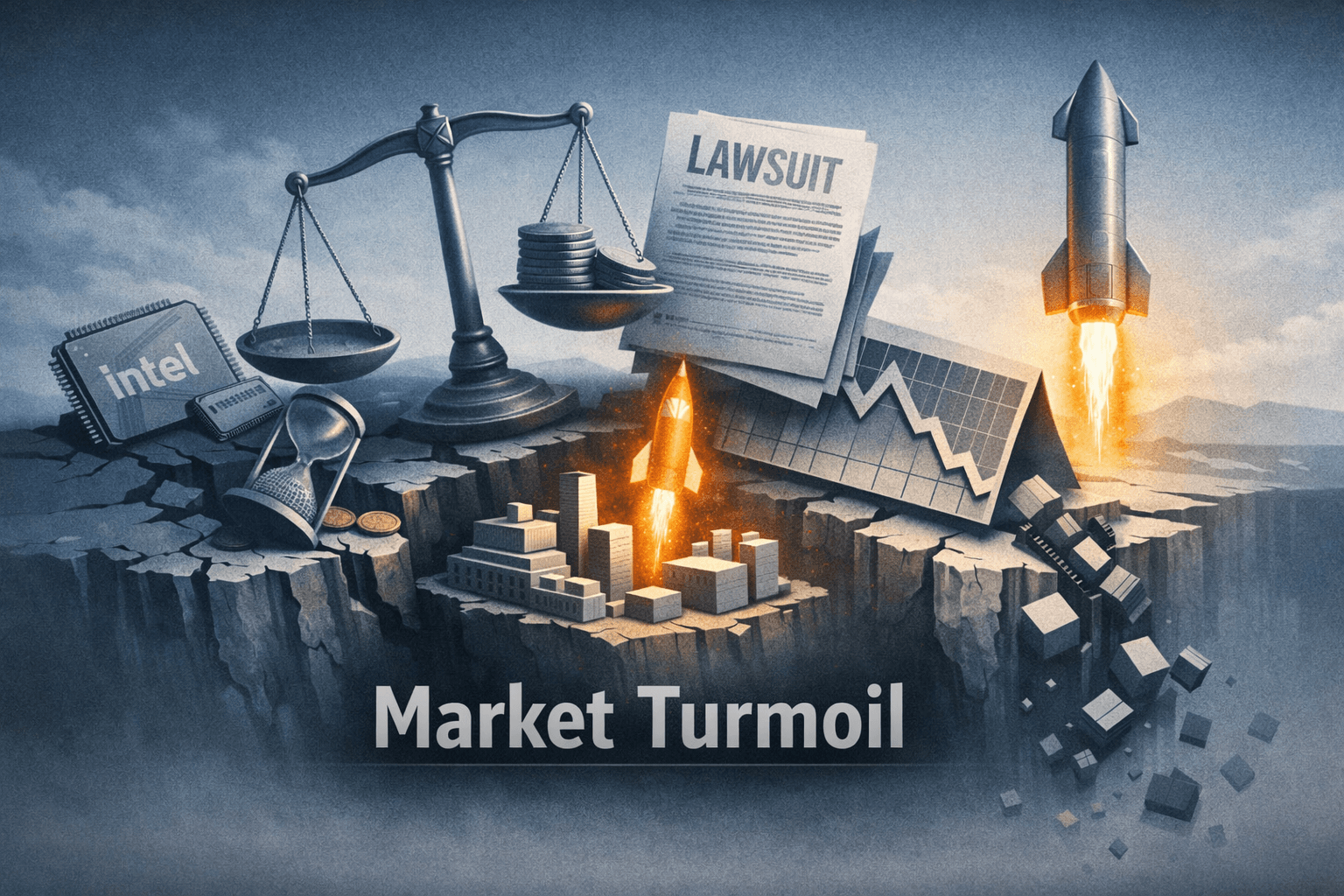
Today’s Alpha Briefings reveal a market defined by sharp dispersion: headline large‑cap falls, extreme small‑cap crashes, policy uncertainty, and concentrated winners tied to secular themes. Key data points from the last trading session (Friday, July 24) include:
- Intel (INTC) plunged 7.89% to $92.32 on heavy turnover — 179.12 million shares — marking one of the session’s largest and most conviction‑driven declines.
- Nokia (NOK) fell 6.83% to $9.06 on 117.46 million shares traded, another large‑cap name with heavy volume confirming downside momentum.
- Several small‑cap names suffered crisis‑level moves: SXTC collapsed 80.82% to $0.06 on an eye‑watering 225.12 million shares; VSTD fell 45.22% to $0.10 on 2.46 million shares; CISS dropped 45.94% to $0.52 on 1.47 million shares.
- Defensive and financial names held up: Hershey (HSY) closed at $174.30, up 1.25%; T. Rowe Price (TROW) closed at $116.50, up 1.35%.
- Policy shock: the administration’s new tariffs took effect and were met by an immediate lawsuit — a 25% headline tariff on certain Brazilian imports was cited in coverage — leaving corporate cost trajectories and supply‑chain forecasts in doubt over the long weekend.
- Aerospace development: SpaceX carried out a Starship test flight — the company’s first since its recent IPO — shifting the program’s public‑market risk/catalyst profile.
These pieces, taken together, create a market environment where liquidity and headline risk are driving larger re‑pricings than fundamentals alone would suggest.
Synthesis: what ties these stories together
Three cross‑cutting themes emerge from the day's analyses:
Liquidity‑confirmed repricing. Heavy volume confirmed many of the largest moves. Intel’s 179.12m share day and Nokia’s 117.46m share session suggest market participants treated these as conviction trades rather than thin‑market blips. On the other end, SXTC’s 225.12m share washout — despite a penny‑stock price — shows how rapid deleveraging or news‑driven margin calls can force extreme moves in small caps.
Policy and legal risk as a near‑term volatility amplifier. The tariff round that went into effect and the immediate litigation (filed at the U.S. Court of International Trade) place an uncertain binary event into corporate planning. Analysts note that tariffs that are enforced but legally contested can create temporary margin pressure if stays or injunctions are not granted — or persistent cost increases if the courts uphold them.
Concentration of secular winners versus broad weakness. While many names sold off, an industrial stock highlighted in our coverage has surged ~533% over two years — a run tied to AI infrastructure demand and named alongside GE Vernova — illustrating how secular themes (AI infrastructure, energy transition) are concentrating capital even as policy, liquidity and technical risk depress broad swaths of the market.
Where analysts converge — and where they diverge
Agreement:
- Volume matters. Across multiple briefings, analysts use heavy turnover as a confirming signal that moves are conviction‑driven and likely to sustain short‑term volatility.
- Tariff uncertainty raises real earnings risk. Most sources agree tariffs, once announced, produce immediate input‑cost pressure until legal resolution.
- Small‑cap collapses are liquidity events. For VSTD, SXTC and CISS, reporting teams concur these are more likely liquidity or idiosyncratic crisis events than re‑ratings of durable cash flows.
Disagreement and open debates:
- Tariff trajectory: some commentators expect courts to quickly enjoin parts of the tariff package, arguing procedural weaknesses in the rollout. Others warn that even delayed judicial relief can leave companies exposed for multiple quarters; thus the market’s reaction depends on timing risk as much as the substantive legal merits.
- Interpretation of SpaceX’s Starship test. One read: the test reduces technical execution risk and aligns program milestones with analysts’ more bullish revenue models for future launch capacity. Counterpoint: public‑market scrutiny post‑IPO raises volatility around program setbacks; a single successful test does not erase long lead‑time commercial risks.
- The 533% industrial sprint: some experts frame the surge as a classic momentum‑driven reallocation that will correct once tax/valuation realities reassert themselves; others see structural demand for AI infrastructure (and corporate actions like potential stock splits) as a durable rerating catalyst.
Deeper context on major moves
Intel (INTC): A 7.89% single‑day drop on 179.12 million shares is not an ordinary pullback. Analysts point to several mechanisms that can deepen such a move: position trims by large holders ahead of an extended weekend, derivative hedging flows, and updates to near‑term margins tied to PC server cycle commentary. From a valuation standpoint, such a shock matters because it can re‑price the optionality embedded in future IDM/IDM‑2.0 expectations; practitioners often turn to 'real‑options' frameworks when assessing the value of management’s execution options under greater uncertainty.
Nokia (NOK): The 6.83% decline on outsized volume suggests either negative near‑term news (carrier spending concerns, 5G cycle softness) or macro repositioning among telecom equipment exposures. For traders, the magnitude and volume combination raises technical questions about short‑term support levels.
Small caps (SXTC, VSTD, CISS): The extreme percentage moves — SXTC down 80.82% to $0.06 (225.12m shares), VSTD down 45.22% to $0.10 (2.46m), CISS down 45.94% to $0.52 (1.47m) — reflect two structural realities of microcap markets: shallow liquidity and higher sensitivity to single‑event risk (reverse splits, delisting worries, fraud allegations, or sudden funding collapses). For holders, these are crisis events that often require operational or disclosure catalysts to stabilize pricing.
Tariffs and litigation: The timetable matters. A 25% tariff on specific Brazilian imports — if implemented broadly and sustained — would act like a margin tax for affected producers and OEMs that rely on those inputs. The filing at the Court of International Trade introduces the possibility of expedited precedent setting; market participants must watch for injunctive relief, partial stays and the speed at which government agencies implement enforcement actions.
SpaceX Starship and post‑IPO dynamics: A post‑IPO test flight reframes the investor conversation from private‑market progress to public‑market accountability. If tests proceed successfully, analysts can justify roadmaps that accelerate revenue recognition from Starship capabilities; if tests fail or produce muted executive guidance, public valuation multiples can compress more rapidly than in private rounds because of immediate sell‑side model revisions.
Implications by investor type
Short‑term traders and liquidity providers: Heavy volume across large names and sharp microcap moves increase intraday volatility opportunities but also widen spreads and execution risk. Traders should monitor post‑session legal headlines (tariff litigation) and weekend developments that can create Monday gap risk.
Income and dividend investors: Defensive names (HSY at $174.30, +1.25%; TROW at $116.50, +1.35%) provided stability in the session. Analysts note these sectors can act as ballast when policy shocks compress cyclical earnings, but investors should re‑check payout sustainability in the face of input‑cost shocks from tariffs.
Long‑term fundamental investors: Large single‑day repricings (e.g., INTC) may present opportunities to re‑examine underlying assumptions (unit growth, capacity rollouts, margin mix). However, the path to resolution for policy and technical programs (SpaceX, tariff litigation) can be binary and drawn out — patience and a clear read on catalysts are important.
Speculative and microcap holders: The VSTD/SXTC/CISS moves are cautionary. These positions can experience near total loss; holders should be prepared for extended illiquidity and to prioritize operational or disclosure updates before expecting price recovery.
Institutional allocators: The mix of policy risk and concentrated secular winners suggests a two‑pronged approach: manage cross‑sectional exposures to policy‑sensitive names, and selectively increase conviction in high‑quality secular plays where the earnings runway is visible and not dependent on contested trade policy.
Strategic considerations heading into next week
Watch legal timelines. The Court of International Trade filing is a clear binary event: injunctions or expedited rulings will materially alter the margin outlook for exposed companies. Track filings and potential government responses over the weekend.
Use volume as a confirmatory filter. Large moves on light volume can be noise; large moves on large volume — as seen in INTC and NOK — are more likely to influence positioning and follow‑through.
Treat microcap collapses as liquidity events until proven otherwise. A functioning recovery in names like SXTC typically requires an operational or regulatory catalyst; absent that, price action can remain depressed.
Distinguish secular momentum from valuation compression risk. The 533% industrial runner tied to AI infrastructure demonstrates how concentrated flows can reallocate market cap quickly. But analysts caution that high momentum requires scrutiny of margins, capital intensity and potential corporate actions (splits, index reconstitution).
Expect post‑IPO program news to be binary. SpaceX’s Starship progress sits on a timeline where technical milestones can swing expectations quickly. Public investors should expect faster model revisions and more volatile pricing than private‑market investors experienced.
Bottom line
The last session compressed multiple market dynamics into a single, headline‑driven day: policy uncertainty (tariffs + lawsuit), liquidity‑confirmed re‑pricings in large caps (INTC, NOK), microcap contagion and concentrated thematic rallies tied to AI and aerospace. Analysts note that each driver carries its own timing risk — legal deadlines, technical test schedules and liquidity windows — and that investors should prioritize liquidity management, catalyst tracking, and valuation clarity rather than treating headline moves as mechanically prescriptive for portfolio action.
This summary is informational and synthesizes the Alpha analyses from the past 24 hours. It does not constitute investment advice. Analysts emphasize that sentiment readings (bullish/bearish) reflect observed market behavior and not recommendations.
Sources
Use these insights — enter this week's contest.
Free practice contests — earn Alpha CoinsExplore More Content
Disclaimer: StockAlpha.ai content is for informational and educational purposes only. It is not personalized investment advice. Sentiment ratings and market analysis reflect data-driven observations, not buy, sell, or hold recommendations. Always consult a qualified financial advisor before making investment decisions. Past performance does not guarantee future results.