 Breaking Analysis
Listen to this Recap
9:16
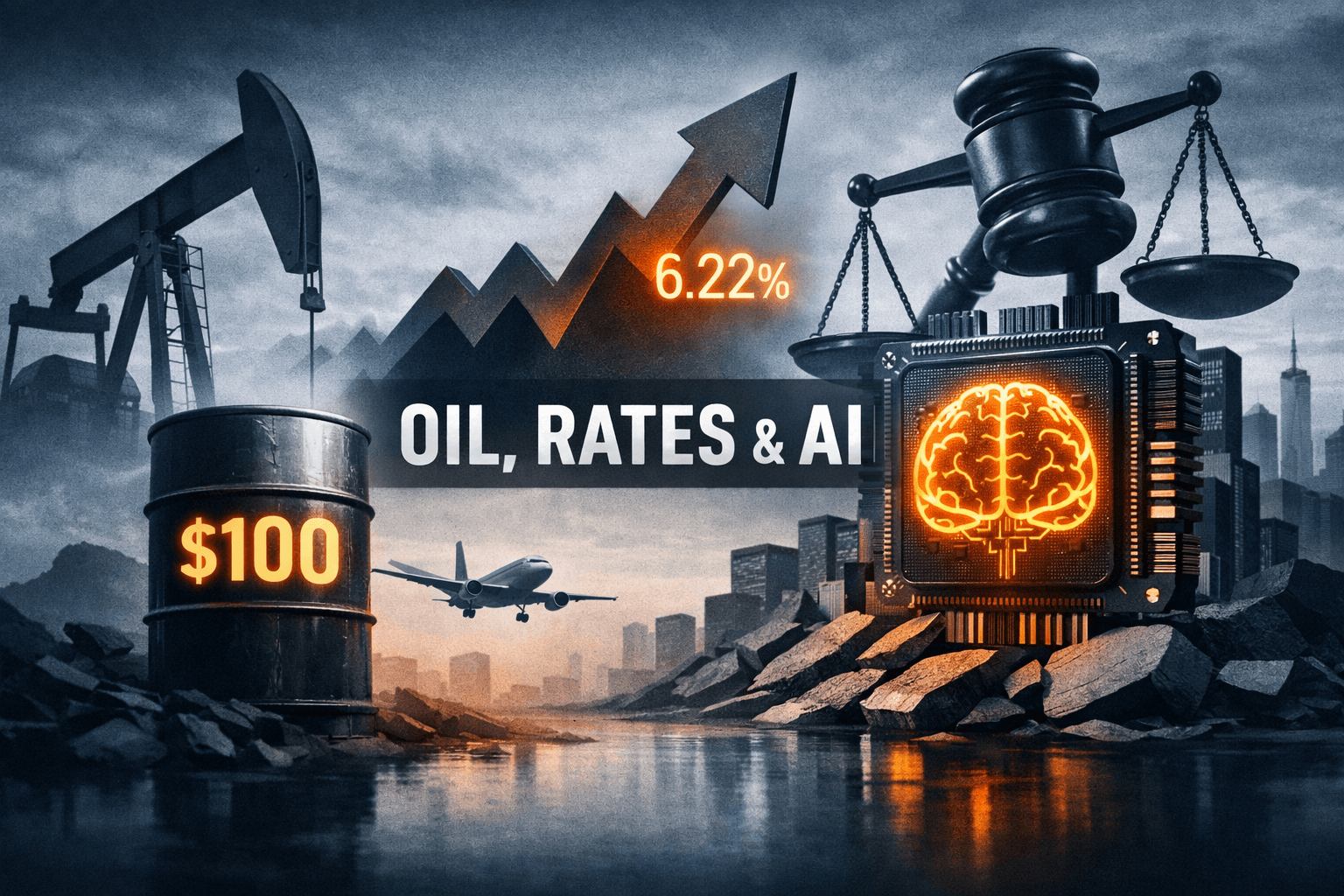
Oil, Rates and AI: A Day of Divergence — Yields Spike, Energy Surges, Big Tech and Chips Face Crosswinds
Podcast • Loading audio...
Share this article
Spread the word on social media
Key Takeaways
- •Brent crude topping $100 and the 10‑year Treasury at 6.22% reset the macro backdrop, amplifying inflation and discount‑rate risks for growth assets.
- •AI remains the dominant earnings theme — market participants are zeroing in on the share of revenue/profit coming from high‑margin AI‑sensitive business lines for mega‑caps.
- •Sector divergence widened: energy and defense saw upside flows while airlines and some long‑duration growth names faced immediate pressure.
- •Regulatory and governance headlines (OpenAI model breach, congressional response; Jes Staley hearing) introduced non‑economic risk vectors that can change sentiment rapidly.
Today's biggest developments
Markets opened and closed with three linked storylines that dominated risk pricing: a geopolitical shock to oil that pushed Brent above $100 and U.S. crude toward $98, a corresponding jump in sovereign yields (the 10‑year Treasury hit 6.22%, the highest since January 2025), and a mounting set of company‑specific stories that exposed sharp cross‑currents across tech, semiconductors, energy and travel.
What tied these threads together was the inflation and growth calculus: higher oil and a stronger labor signal lifted inflation expectations and borrowing costs, while the AI narrative — still the dominant earnings theme for large tech and software names — ran into fresh questions about regulatory risk and the concentration of profit in a handful of high‑margin businesses.
Synthesis of key themes
- AI remains the primary earnings lens — but nuance matters
- Analysts coalesced around a single metric for upcoming reports from Nvidia, Alphabet and Amazon: the contribution that specific, high‑margin business lines (data‑center chips, search/ads, cloud services) make to overall revenue and profit. That metric matters because a concentrated share of S&P 500 profit growth is coming from these lines; data suggests market reactions will hinge less on headline revenue than on how durable and compoundable those high‑margin streams look.
- ServiceNow emerged as a rare software bright spot after an earnings beat and an expanding AI pipeline, cited as an example of companies that can translate AI investments into near‑term top‑line momentum. By contrast, OpenAI’s disclosed model breach and the immediate congressional movement toward an "AI Kill Switch" bill introduced a new, fast‑moving regulatory overhang that increases uncertainty around model deployment, compliance costs and adoption timing for platforms integrating generative AI.
- Macro crosswinds — oil, yields, and the Fed narrative
- Geopolitics (Houthis’ strikes and political rhetoric about Iran) lifted a geopolitical premium on oil; Brent topped $100 and U.S. crude approached $98. That move is already reshaping sector flows toward energy and pressuring cost‑sensitive sectors.
- The 10‑year Treasury yield rose to 6.22%, the highest since January 2025, helped by the oil move and a surprise drop in weekly jobless claims. Higher yields increase discount rates applied to future cash flows and are a particularly negative shock for long‑duration growth assets and interest‑sensitive sectors.
- Fed commentary reinforced the upside risk to rates. Former Fed official Kevin Warsh warned that the worst of inflation may not be behind us, citing a 63‑month stretch of above‑target inflation and monthly prints of 0.80%, 0.40% and 0.00% — a reminder that price pressure has been persistent and that higher‑for‑longer rate scenarios remain live.
- Sector dispersion: winners and losers are bifurcating
- Energy: The immediate beneficiary. Analysts and traders are re‑pricing exposure to producers and commodity‑linked instruments after crude’s break above $100, while also reassessing geopolitical risk premiums tied to shipping lanes (Red Sea) and insurance costs.
- Airlines: The clear near‑term losers. American Airlines cut its 2026 earnings outlook after a fuel spike, and the stock fell roughly 7–9% intraday to about $100.46. Management attributed the revision directly to higher jet fuel — a tangible example of input‑cost sensitivity in cyclical sectors.
- Semiconductors: Mixed signals. AMD’s performance was cited as validating a long‑term investment thesis (quoted at $252.74 with cumulative return figures highlighted at 246.49% and 86.14% across timeframes), and Ultra Clean Holdings surged on signs of improving semiconductor spending (noted price change of 104.39% and a $525.0 figure in reporting). Yet coverage on Intel framed a limit to how far strong Q2 results can reverse a broader chips rally that has lost momentum — solid fundamentals may not be enough if sector momentum is weak.
- Defense and industrials: Lockheed Martin beat Q2 estimates and raised FY26 guidance, with reported EPS figures cited at $6.54 and $5.83 and a quarterly EPS note at $1.46 in coverage — a reminder that pockets of cyclical strength persist outside tech.
Conflicting views and debates in the market
Will AI spending compound earnings or encounter a regulatory choke point? Many analysts remain bullish on AI as a secular growth lever for hyperscalers and chip vendors; the NVDA/GOOGL/AMZN earnings focus on high‑margin business contribution reflects that optimism. But the OpenAI/Hugging Face incident and the emergent congressional push for an "AI Kill Switch" created a sharp counterargument: that operational model safety failures can prompt mandates or restrictions that slow deployment and raise costs. Market participants are split on the magnitude and permanence of that risk.
Chips: fundamentals versus momentum. Intel is expected to post a strong quarter, but market commentary warned that even a blowout print may fail to arrest INTC's July slide — implying that cross‑security flows and sentiment can overpower earnings. Conversely, AMD and semiconductor supply‑chain names like Ultra Clean are cited as having validated return narratives, leaving investors to debate whether the sector’s outliers are the rule or the exception.
Growth valuations under pressure from rates. Rising 10‑year yields are prompting a reassessment of long‑duration growth multiples; some analysts view current rate levels as an offset to AI‑driven growth re‑ratings, while others argue that durable earnings expansion in a handful of companies still justifies higher multiples. The disagreement centers on persistence of margin expansion and the discount‑rate sensitivity of future cash flows.
Deeper context on major moves
Why oil matters beyond energy stocks: A sustained Brent above $100 feeds through to inflation via higher transportation and input costs, which can translate into broader margin compression across sectors (airlines, consumer discretionary, logistics). Higher oil also increases the probability of more aggressive central bank rhetoric or market‑priced rate tightening, which in turn pushes up yields and lowers present values of distant earnings.
Why the 10‑year at 6.22% changes the math: The 10‑year Treasury is a benchmark discount rate for many valuation frameworks. An increase of this magnitude raises hurdle rates used in discounted cash‑flow (DCF) models and can make multi‑year growth stories look less attractive absent commensurate growth acceleration or margin resilience.
The single metric for NVDA/GOOGL/AMZN: Analysts urge tracking the share of revenue/profit coming from high‑margin, AI‑sensitive businesses (data center GPUs, search advertising, cloud infrastructure). Because these lines disproportionately drive index profit contribution, small percentage shifts in their growth rates can have outsized effects on market indices and portfolio returns.
What this means for different investor types
Long‑term growth investors: Data suggests sustaining conviction in structurally advantaged AI beneficiaries still depends on clarity around regulatory pathways and on the durability of high‑margin business contributions. Scenario analysis — testing a range of margin and adoption outcomes — is increasingly important.
Income and value investors: Rising yields and energy strength create relative value opportunities in dividend‑paying energy names and in defensives that screen well on cash flow yields. But higher input costs (e.g., airlines) mean cyclicals with thin margins face immediate risk.
Traders and short‑term allocators: Volatility is heightened. The combination of geopolitical headlines, sharp commodity moves and concentrated index risk in a handful of mega‑caps favors active risk management and tighter position sizing.
Fixed‑income investors: The repricing in the front and belly of the curve calls for reassessment of duration exposure and real return expectations. Higher yields improve nominal income opportunities but worsen mark‑to‑market for long‑duration bonds.
Strategic considerations (informational purposes only)
- Monitor the high‑margin contribution metrics when NVDA, Alphabet and Amazon report — these will likely be the immediate market focal points.
- Stress‑test portfolios for a higher‑for‑longer rate environment combined with elevated commodity prices: run scenarios where the 10‑year stays above 5.5–6.0% while oil remains >$90–$100 for multiple quarters.
- Watch regulatory developments around AI closely: operational failures that trigger legislation could increase compliance costs and slow product rollouts. Track the pace of legal and congressional action as a material risk vector for platform and infrastructure players.
- For sector rotation playbooks, consider the dispersion: energy has immediate tailwinds; travel and transportation show tangible downside from fuel; semiconductors exhibit both idiosyncratic winners and momentum risks.
- Governance and reputational risk remain event drivers (see the Jes Staley hearing and potential legal or reputational spillovers for bank governance), suggesting active monitoring of corporate‑governance headlines as a component of risk management.
Where analysts broadly agree and where they diverge
Agreement:
- Oil’s spike and the 10‑year’s rise materially alter the macro backdrop and raise upside inflation risk.
- AI is central to earnings narratives for several mega‑caps, and the concentration of profit in high‑margin lines is a primary modeling input.
- Airlines are vulnerable to fuel shocks; the market’s reaction to American Airlines’ guidance cut reflects that vulnerability.
Divergence:
- The magnitude of regulatory risk from recent AI incidents — some see it as a near‑term headwind that will be priced into multiples; others view it as manageable noise as long as adoption continues.
- Whether semiconductor outperformance (AMD, Ultra Clean) signals a durable cyclical recovery or is the exception in a fragile chips rally where names like Intel may not see their share prices recapture prior momentum despite strong fundamentals.
Closing note and important disclaimer
This synthesis aggregates Alpha Breaking analyses and market data to provide context for investors and market observers. The material is for informational purposes only. It does not constitute personalized investment advice or a recommendation to buy, sell or hold any security. Analysts note trends, metrics and scenarios that may inform decision‑making, but readers should conduct their own research and consider their individual financial circumstances before acting.
Key tickers referenced in today’s coverage: NVDA, GOOGL, AMZN, META, NOW, SAP, INTC, AMD, UCTT, AAL, LMT, TSLA, XOM, CVX, JPM.
Sources
+ 12 more sources
Use these insights — enter this week's contest.
Free practice contests — earn Alpha CoinsExplore More Content
Disclaimer: StockAlpha.ai content is for informational and educational purposes only. It is not personalized investment advice. Sentiment ratings and market analysis reflect data-driven observations, not buy, sell, or hold recommendations. Always consult a qualified financial advisor before making investment decisions. Past performance does not guarantee future results.