 Breaking Analysis
Listen to this Recap
11:23
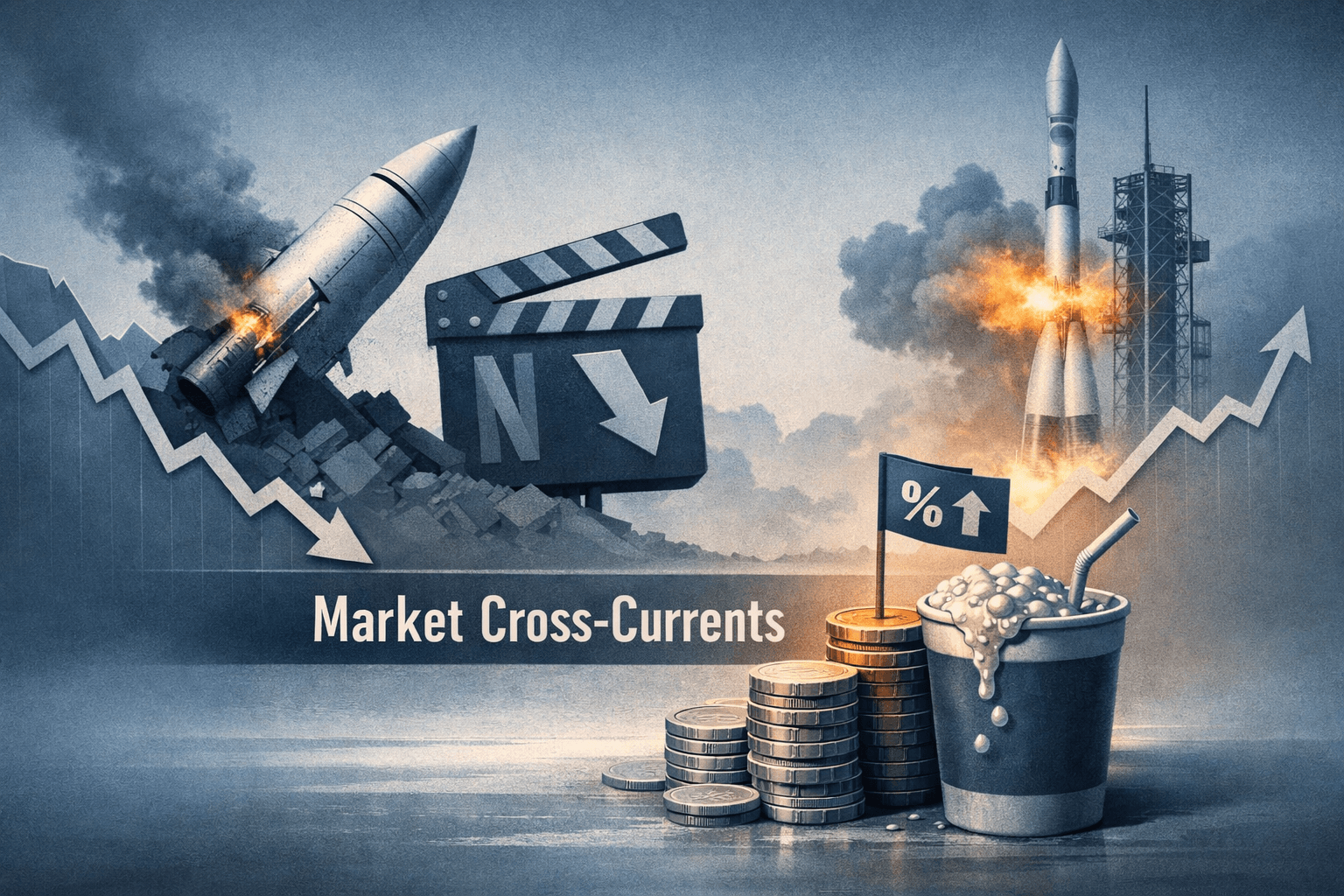
Guidance, Launch Failures and Dividend Ink: Today's Cross-Current Market Signals
Podcast • Loading audio...
Share this article
Spread the word on social media
Key Takeaways
- •Markets down as oil climbs and Netflix guidance rattles the streaming complex; SpaceX aborted launch amplified near‑term volatility.
- •PepsiCo raised its quarterly dividend to $1.48 (4% y/y; annualized $5.92), reinforcing income stability amid headline risks.
- •Analysts are split between a persistent momentum narrative (Goldman metrics) and concerns about weak consumer sentiment and operational shocks.
- •Innovation signals (POET's ECOC nomination) and capital‑allocation debates (Amazon/Wedgewood) remain important thematic drivers.
- •Data discrepancies (notably on SpaceX share levels) underscore the need to verify share‑class and source details before drawing conclusions.
Today's most significant market developments
Equity markets moved lower on Jul 17 as two headline drivers converged: rising oil prices and company-specific shocks. The Dow and Nasdaq both slipped in early trade amid energy strength that weighed on cyclicals, and Netflix's soft guidance triggered a notable pullback in the streaming group. At the same time, an aborted SpaceX mission produced a quick market reaction — analyses reported intraday premarket drops of roughly 4% — and raised fresh questions about operational risk ahead of the company's high-profile listing timeline.
Two other developments punctuated a busy session: PepsiCo's board approved a 4% increase in its quarterly dividend (new quarterly payout $1.48, annualized to $5.92), underscoring steady capital-return discipline, while Goldman Sachs' analysis continued to frame the broader rally as historically powerful (with headline metrics cited in coverage such as 123.20% and 49.40%), keeping momentum arguments on the table.
Synthesizing the day's key themes
- Event-driven volatility vs. structural momentum
Short‑term shocks are moving individual names and small groups: Netflix guidance pushed the streaming complex lower; SpaceX's aborted launch produced a sharp but concentrated negative reaction. Analysts note these moves highlight how quickly headline events can move sector concentration and implied volatility.
At the same time, macro-level indicators of breadth and a multi-year bull market remain prominent in commentary. Goldman’s numbers (presented in today's coverage) are cited as evidence that the rally has outpaced historical patterns, which keeps momentum arguments alive for many strategists.
- Capital allocation and income discipline as anchor points
PepsiCo’s 4% dividend increase (quarterly $1.48, annualized $5.92 from $5.69 prior) is noted as a signal of predictable income policy — a reminder that corporate capital returns continue to be a stabilizing force for income-oriented portfolios.
The Wedgewood commentary on Amazon highlighted questions over free‑cash‑flow reinvestment and how management choices may shape the tradeoff between growth and return of capital — a recurring theme as investors scrutinize where cash is deployed in large-cap tech.
- Sector rotation and differentiated leadership
- Energy strength (oil climbs) pressured cyclical names and contributed to a sector-rotation narrative. Simultaneously, individual momentum stories — Bloom Energy’s long run (trading around $205.07, cited 912% cumulative gain since July 2021 and a 35.1% six‑month rally) and Stride Education’s multi-year outperformance (about $87.64 and a 161% five‑year rise) — illustrate how leadership remains bifurcated between thematic winners and more defensive, dividend-oriented names.
- Innovation signals and optics for thematic investors
- POET Technologies’ Blazar light-source engine was nominated for an ECOC 2026 Industry Award alongside incumbents (Coherent, Lumentum, Marvell, Nokia). Analysts point to such nominations as a non‑financial signal of product validation that can matter for semiconductor/optical supply-chain investors who follow innovation catalysts.
Where analysts diverge — the day's debates and conflicting signals
Bull market durability vs. consumer/political sentiment: Goldman’s bullish framing of the rally sits in tension with the All‑America Economic Survey showing U.S. economic sentiment at pandemic-era lows and political attribution to Trump in many responses. Analysts emphasize this is a live debate: strong market internals can coexist with weak consumer sentiment, but the latter can amplify downside on negative macro surprises.
How material is SpaceX’s aborted launch? Coverage reported roughly 4% premarket declines after the failed mission, but there are conflicting item-level reports on the stock level (one analysis referenced a $26.50 premarket trade; another referenced shares slipping under $135). Those discrepancies underline the need to reconcile data feeds and share-class references. The debate is whether the aborted mission is a transitory operational glitch or a substantive setback that meaningfully shifts IPO timing and valuation assumptions.
Earnings interpretation asymmetry: Avery Dennison’s Q1 readouts produced mixed analyst reactions — some call it a beat, others a miss. That divergence reflects how different models weight margins, revenue timing and FX adjustments. Similarly, MasterCraft’s post‑Q1 momentum (stock ~ $25.08, 17.4% six‑month gain) prompts debate: is rising share price anchored in operational improvement or valuation rerating?
Momentum vs. fundamentals in growth names: Bloom Energy and Stride draw enthusiastic “3 reasons”‑style coverage emphasizing momentum metrics, while other pieces flagged valuation and position‑sizing risks. Analysts disagree on how much of the upside is justified by fundamentals versus market appetite for thematic narratives (clean-energy, ed‑tech).
Deeper context on the major moves
Netflix: Guidance is still one of the fastest ways to reset narrative expectations in richly valued subscription businesses. Soft outlooks can compress multiple quarters of forward cash-flow assumptions, and streaming multiples are sensitive to subscriber-growth trajectory and ARPU trends. The day's tumble demonstrates how guidance updates propagate across sector peers even when individual fundamentals diverge.
SpaceX: Operational events — launches, mission outcomes — are binary catalysts that the market treats as material for a company that sells both services and a future equity story. The aborted mission increases the probability that nearer-term milestones governing IPO cadence and valuation will be delayed or re‑underwritten by the market. Analysts point to greater implied volatility and a heightened premium on operational transparency from management.
PepsiCo: The 4% dividend increase is modest but meaningful in the context of a large-cap, consumer-staples payer. For income portfolios, steady payout growth contributes to yield stability and can blunt the impact of index volatility. The declaration underscores the firm’s continued emphasis on shareholder returns even as macro uncertainty persists.
Goldman’s bull-market framing vs. consumer gloom: This juxtaposition reflects a classic market paradox — asset-price gains and real‑economy sentiment can diverge. The explanatory channels include monetary conditions, sector concentration (growth stocks driving indices), and earnings momentum in select pockets. The risk is that sentiment shocks (surveys, political events) can trigger re-pricing when liquidity or earnings momentum wanes.
Implications for different investor types
Income-oriented investors: PepsiCo’s dividend raise (quarterly $1.48, 4% y/y) reaffirms the role of reliable dividend growers in defensive buckets. Analysts suggest dividend consistency remains an anchor amid headline volatility.
Growth/momentum investors: Names with strong multi-year runs (Bloom Energy: ~912% since July 2021; Stride: 161% five‑year) continue to attract attention. Coverage highlights momentum but also flags position‑sizing and re‑assessment of valuation assumptions — particularly where stretched gains have compressed margin for error.
Event-driven and thematic traders: SpaceX’s launch abort and Netflix guidance are prototypical catalysts that create tradeable dispersion. For these strategies, the emphasis is on timing, volatility, and resolution of binary risks (launch outcomes, earnings comps, guidance updates).
Value and cyclical investors: Rising oil and sector rotation dynamics place a premium on valuation discipline. Stocks with mixed Q1 prints (Avery Dennison) or post‑earnings bounces (CarMax: ~9% since earnings) highlight the need to reconcile near‑term momentum with durable cash‑flow prospects.
Long‑term fundamental investors: Capital allocation debates (Amazon and the Wedgewood letter on FCF reinvestment) matter for multi‑year return profiles. Analysts note that where and how companies redeploy free cash flow — buybacks, M&A, capex — will shape long‑run valuation outcomes.
Conflicting data note — check share-class and source details
A practical reminder from today's feeds: two SpaceX reports used different share‑level references (one citing ~$26.50, another indicating a slide under $135). Analysts advise reconciling the reported price with the share class, pre/post‑split adjustments, and off‑exchange quotations before deriving conclusions about magnitude or position sizing.
Strategic considerations and watchlist items
- Track the follow‑through to Netflix’s guidance shock for signs of cross‑sector contagion in media and ad‑sensitive cyclicals.
- Monitor SpaceX operational updates and management commentary on timeline/IPO implications; binary catalysts can materially change implied volatility and valuation assumptions.
- Reconcile conflicting price and data points across sources before acting — particularly for private/dual‑class or post‑IPO light stocks where quotes can diverge.
- For income allocations, use dividend‑growth signals (e.g., PepsiCo’s 4% raise) as one input of many; assess payout ratio sustainability and free‑cash‑flow coverage.
- Keep an eye on capital‑allocation narratives at large-cap tech (Amazon) — how free cash flow is redeployed will affect the growth vs. return trade-off that underpins long-term positioning.
Conclusion
Today's tape exemplifies the market's current cross‑currents: durable breadth and record rally metrics coexist with event-driven shocks, political/sentiment stress, and active sector rotation. Analysts broadly agree that headline events (launches, guidance, earnings) will continue to produce dispersion and that capital allocation and dividend discipline remain central to multi‑horizon risk management. Where they diverge is on the persistence and breadth of momentum versus the risk that worsening consumer sentiment or operational setbacks could trigger a broader re‑rating.
This summary is intended to synthesize the day’s analyses and highlight the data points and debates investors are watching. It is informational in nature: analysts note trends, metrics and catalysts, but this piece does not constitute investment advice.
Investment disclaimer: This content is for informational purposes only. It does not constitute an offer, solicitation or recommendation to buy, sell, or hold any security, nor does it provide personalized investment advice. Analysts’ sentiment ratings reflect market analysis and should not be interpreted as individual financial guidance.
Sources
+ 6 more sources
Use these insights — enter this week's contest.
Free practice contests — earn Alpha CoinsExplore More Content
Disclaimer: StockAlpha.ai content is for informational and educational purposes only. It is not personalized investment advice. Sentiment ratings and market analysis reflect data-driven observations, not buy, sell, or hold recommendations. Always consult a qualified financial advisor before making investment decisions. Past performance does not guarantee future results.