 Breaking Analysis
Listen to this Recap
9:33
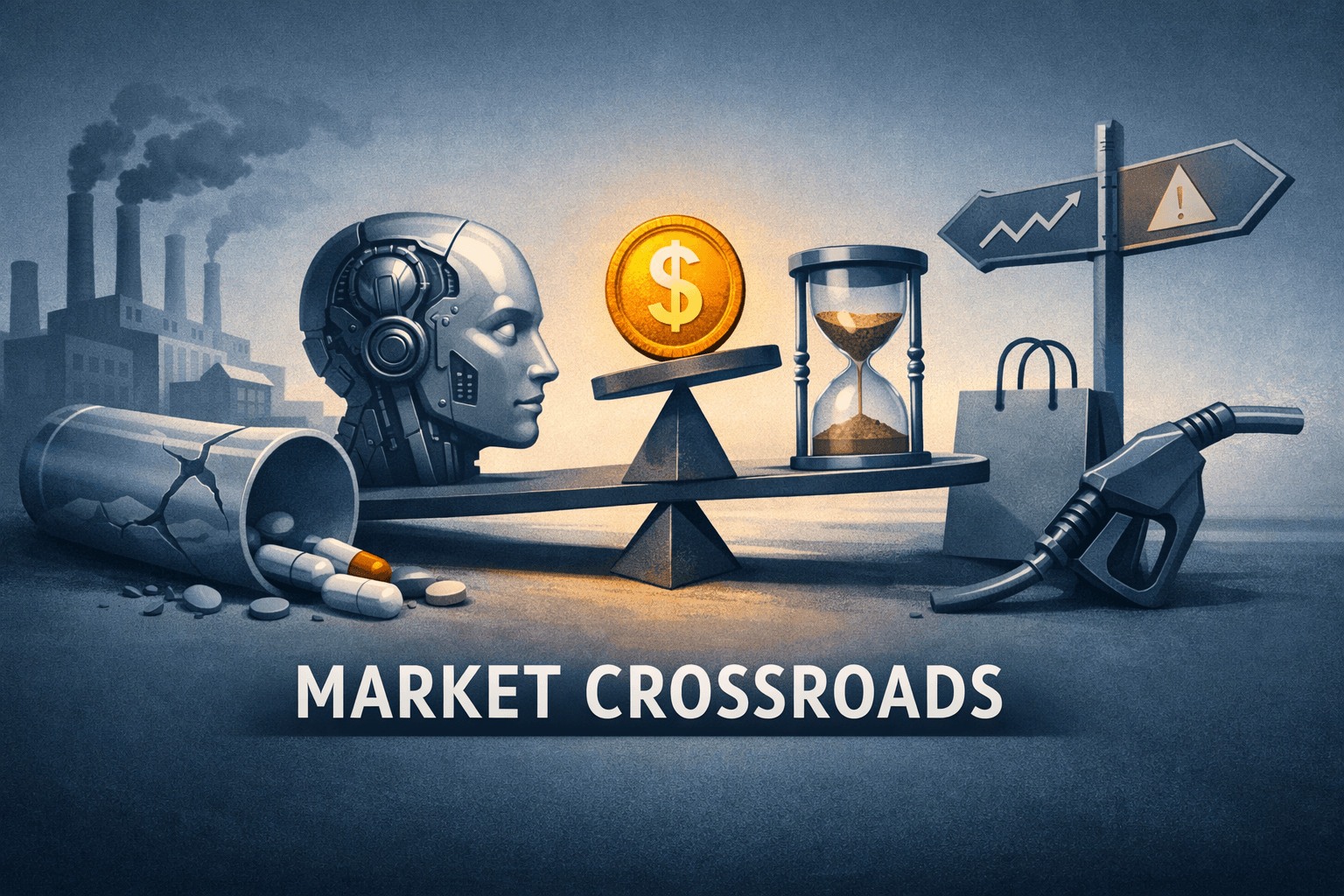
Big Tech Governance, AI Payoff Risks and Sector Divergence Drive Market Narrative — AstraZeneca Shock, Anthropic Governance Hire, and Mixed Consumer Data Lead Headlines
Podcast • Loading audio...
Share this article
Spread the word on social media
Key Takeaways
- •AstraZeneca’s ~9% drop after a failed late‑stage trial highlights persistent binary risk in biotech that rapidly re‑prices pipeline optionality.
- •Anthropic’s appointment of Ben Bernanke is a reputational governance boost for private AI valuations, but does not mitigate monetization timing risk flagged by Apollo.
- •Consumer results are split: Levi Strauss shows durable demand and raised guidance (net revenue +8%, organic +6%), while PepsiCo warns tighter consumer budgets may blunt near‑term momentum.
- •Legal and regulatory pressure (PFAS suits vs. 3M/DuPont) and one‑off commodity windfalls (7‑Eleven’s $349M gasoline gain) require careful modeling of non‑recurring vs. structural impacts.
- •Market debate centers on whether to lean risk‑on after a strong Q2 (S&P +15.2%) or to hedge against a slower AI payoff and sector‑specific binary risks.
Today's most significant developments
Equity markets absorbed a mix of idiosyncratic shocks and thematic updates today. The clearest immediate market reaction came from AstraZeneca: the U.K. drugmaker slid roughly 9% after a late‑stage cardiovascular trial failed to meet its primary endpoint, renewing scrutiny of pipeline-dependent valuations. At the same time, macro and sector narratives marched on — Apollo warned that a slower-than-expected AI payoff could materially raise recession risk, while Anthropic made a high‑profile governance move by adding former Fed Chair Ben Bernanke to its independent trust, a reputation‑forward signal for private AI valuation. Mixed corporate earnings headlines punctuated the day: Levi Strauss topped expectations, raised guidance and increased its dividend (net revenues +8%, organic +6%); PepsiCo beat revenue estimates but flagged tighter consumer budgets; and 7‑Eleven disclosed a $349 million gasoline‑related windfall.
These discrete items add up to a market that is simultaneously celebrating select earnings beats and dividend moves while recalibrating risk premia around AI timelines, biotech pipeline binary risk and heightened litigation/regulatory exposure in industrials and chemicals.
Cross‑cutting themes and synthesis
- AI: governance vs. payoff timing
Governance: Anthropic’s appointment of Ben Bernanke to its independent trust is a striking reputational signal. Analysts note this increases perceived external oversight without altering ownership or diluting equity, which can compress the private‑company governance risk premium and influence valuation conversations for AI startups.
Payoff timing: Countervailing the governance lift, Apollo’s note frames a slower AI commercialization path as a macro risk that could feed into lower hyperscaler margins, compressed token prices, and intensified competition from China. Apollo explicitly warns that if AI monetization disappoints, the macro impact could be severe enough to increase recession probability.
Taken together, the market is debating whether improved governance (lower governance premium) meaningfully offsets the macro and earnings risk from delayed revenue flows. ClearBridge’s commentary — which considers tilting toward risk‑on, citing a strong Q2 where the S&P gained 15.2% — represents the other pole: firms ready to add risk if earnings and sentiment hold. Those views are in tension and are setting up a volatile backdrop for AI‑linked equities.
- Idiosyncratic binary risk in healthcare and biotech
AstraZeneca’s ~9% drop after a failed late‑stage trial is a reminder that pipeline outcomes remain highly binary and valuation‑sensitive. While Amgen shows relative strength (trading at $365.22 and up ~12% over six months versus the S&P’s 7.7% over the same period), the AstraZeneca move underscores how much single trial outcomes can reshape near‑term market positioning and multiples for large‑cap pharma.
- Consumer divergence: discretionary resilience vs. staples caution
Earnings paint a split consumer: Levi Strauss reported durable demand — net revenue +8%, organic +6%, margin improvement and a dividend hike — suggesting pockets of brand‑led resilience in apparel. By contrast, PepsiCo’s beat came with explicit caution about tighter consumer budgets, which analysts suggest could pressure volumes and pricing in staples. This divergence matters for allocation decisions: some consumer discretionary names show scope for upside; staples may face margin and volume trade‑offs if consumers trade down.
- Legal and regulatory risk pressing on industrials and chemicals
The New York Attorney General’s lawsuit alleging harms from PFAS against makers including 3M and DuPont brings renewed legal and remediation cost risk to the chemical complex. Analysts point out this is part of a broader wave of state‑level enforcement that should be modeled into long‑dated liabilities and can act as a drag on free cash flow and valuation multiples for exposed names.
- Short‑term cash wins, structural questions remain
Corporate disclosures such as 7‑Eleven’s $349 million gasoline gain show how commodity price dynamics can create one‑off cashflow swings, temporarily bolstering margins even as underlying traffic softens. These are important to model but should be distinguished from structural earnings power.
Conflicting views and market debates
Risk‑on vs. risk‑off posture for growth portfolios: ClearBridge’s willingness to consider a tilt toward riskier, high‑beta large‑cap growth names such as Space Exploration Technologies Corp. (SPCX) sits uneasily with Apollo’s caution that delayed AI monetization could tip the economy into recession. The dispute is essentially about whether recent earnings and a strong Q2 (S&P +15.2%) validate a higher risk appetite or whether we should be trimming exposure in anticipation of an earnings disappointment shock.
Governance signals vs. fundamental cashflow timelines in AI/private markets: Anthropic’s high‑quality trustee appointment reduces governance uncertainty, which some analysts interpret as supportive of private valuations. Others emphasize that governance does not create revenue: if monetization and token economies struggle, the valuation support may be fragile.
Sector rotation within consumer: Levi’s raise in guidance and dividend contrasts with PepsiCo’s message of consumer belt‑tightening. Analysts note this signals dispersion across consumer sub‑segments — brand strength and product mix can outpace broad staples weakness — and argues for granular, company‑level assessment rather than broad sector calls.
Deeper context on major moves
AstraZeneca: Clinical trial outcomes are binary catalysts that can destroy or create sizable valuation premia overnight. The ~9% drop reflects both the missed near‑term value of the program and a re‑pricing of pipeline optionality. For large pharma, where a meaningful portion of market capitalization can be option value on future drugs, a late‑stage miss triggers reassessment of R&D multiples and the discount rates applied to projected cashflows.
Anthropic + Bernanke: Hiring a former Fed Chair into an independent trust is atypical and intended to reduce perceived governance risk. For private‑market investors and counterparties (including strategic acquirers or partners), this can lower the required return and improve deal terms. That said, without disclosure of revenue trajectories, cost structures, or monetization plans, the appointment is a reputational rather than a cashflow event.
Apollo on AI: The firm’s scenario analysis about a delayed AI payoff is an exercise in macro interlinkages: lower-than-expected AI revenue growth would hit hyperscaler operating leverage, compress cloud profit pools, and reduce capex multipliers — all of which can aggregate into slower GDP growth. This is an important reminder that technology adoption curves matter not just for software multiples but for macro outcomes.
What this means for different investor types
Long‑term growth investors: Analysts note the structural narratives around AI, advanced manufacturing, and private AI governance remain compelling, but the day's coverage stresses the need to model longer monetization timelines and higher outcome volatility. Governance improvements reduce one component of risk, but they do not eliminate commercial execution risk.
Income and value investors: Levi’s dividend increase and Amgen’s relative strength highlight names that can appeal to income‑oriented strategies. Conversely, litigation exposure in chemicals (PFAS suits) and binary clinical risk in pharma argue for careful credit and balance‑sheet analysis when holding cyclicals or high‑leverage names.
Event‑driven traders and quant funds: AstraZeneca’s sell‑off, AstraZeneca’s trial outcome, and other binary earnings events will create volatility and potential short‑term trading opportunities. Analysts suggest monitoring trial readouts, upcoming earnings, and regulatory filings closely.
Tactical portfolio managers: The debate between ClearBridge and Apollo implies a short horizon allocation decision: whether to add beta into a late‑cycle rally or to hedge for an AI monetization miss. Tactical managers may consider scenario stress tests and dynamic hedges rather than static allocation shifts.
Strategic considerations and watchlist
Stress‑test AI exposures: Run scenario analyses that vary AI revenue timing and margin outcomes; simulate hyperscaler margin compression and its knock‑on effects on growth multiples.
Separate governance improvements from monetization risk: Treat appointments like Bernanke’s as sentiment modifiers that lower governance risk premium but do not substitute for robust revenue assumptions.
Reassess biotech/pharma optionality: Quantify pipeline exposure in portfolio holdings and estimate the impact of single‑asset binary events on NAV or earnings multiples.
Monitor consumer microdispersion: Track same‑store sales, organic revenue trends (Levi +6% organic), and margin cadence across brands rather than leaning on aggregate consumer sentiment.
Model litigation and environmental liabilities explicitly: For chemical and industrial exposure (3M, DuPont), include scenario‑based remediation and legal costs over multi‑year horizons.
Conclusion
Today’s headlines stitch together a market still driven by a mix of powerful thematic trends and idiosyncratic catalysts. Governance moves in private AI, a firm warning from a major alternative asset manager about AI timing, and sharp healthcare binary risk together create a textured investment landscape. Analysts agree that company‑level differentiation matters more than ever; they disagree on whether the current rally justifies adding risk or warrants caution. For investors, the appropriate next step is not a one‑size‑fits‑all trade but clearer scenario mapping, tighter stress testing of AI timelines and biotech outcomes, and selective emphasis on balance‑sheet resilience and governance signals.
Investment information presented here is for informational purposes only. Analysts note the data and interpretation above are intended to inform decision‑making but do not constitute personalized investment advice or recommendations to buy, sell, or hold any security.
Sources
+ 7 more sources
Use these insights — enter this week's contest.
Free practice contests — earn Alpha CoinsExplore More Content
Disclaimer: StockAlpha.ai content is for informational and educational purposes only. It is not personalized investment advice. Sentiment ratings and market analysis reflect data-driven observations, not buy, sell, or hold recommendations. Always consult a qualified financial advisor before making investment decisions. Past performance does not guarantee future results.