 Breaking Analysis
Listen to this Recap
11:40
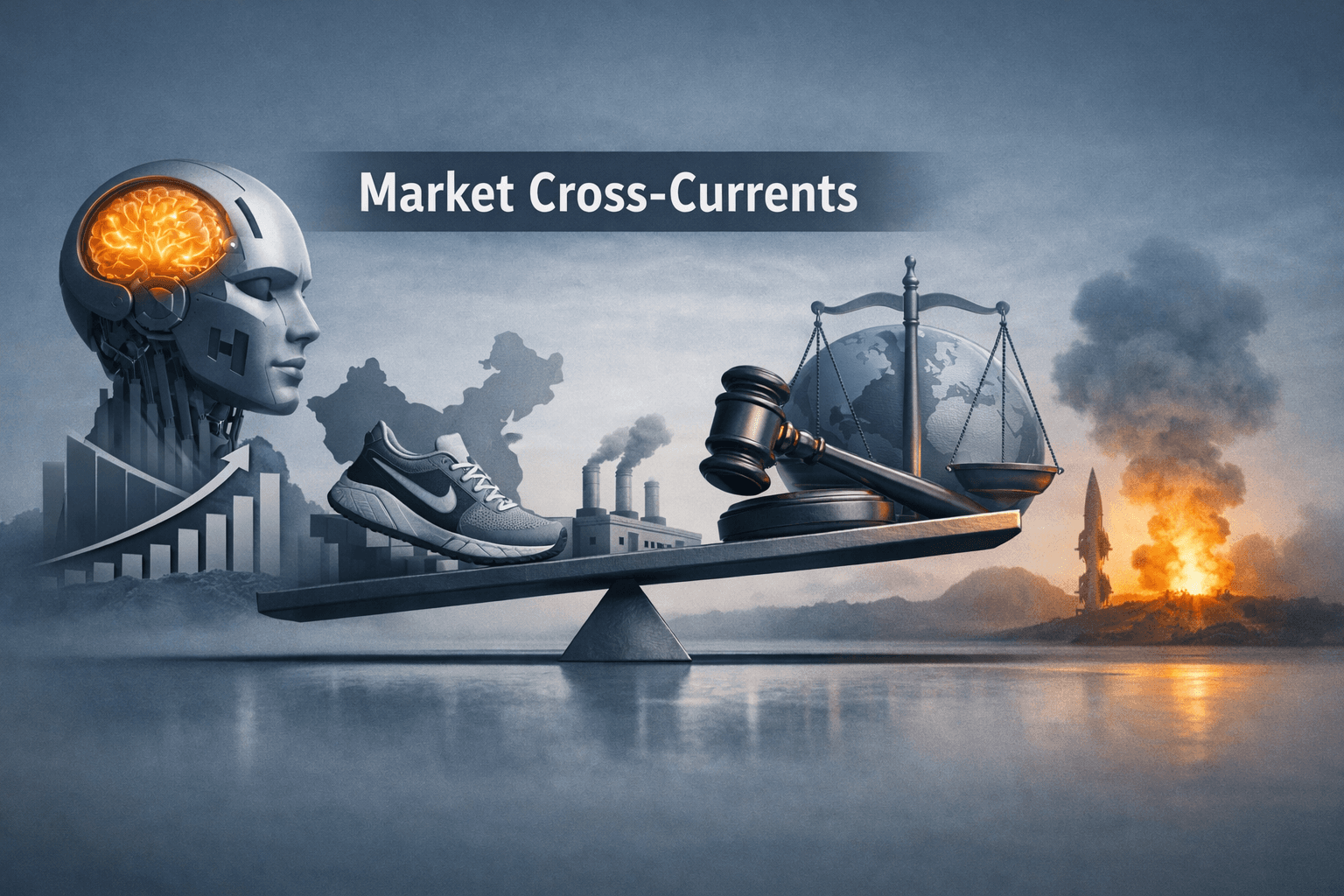
AI-Fueled Earnings Hopes, a Manufacturing Pivot, and Political/Regional Shocks — Today's Market Cross-Currents
Podcast • Loading audio...
Share this article
Spread the word on social media
Key Takeaways
- •Wells Fargo’s AI-driven S&P thesis sits alongside skepticism about earnings quality; outcome depends on whether AI gains diffuse beyond a handful of winners.
- •Cizzle’s acquisition of CWENCH brings $183.9M of contracted revenue and ~$157.6M in take-or-pay protections, altering its margin and supply-chain profile but concentrating operational risk.
- •Market breadth is a concern: 20 S&P 500 names posted triple-digit gains in H1 2026, increasing concentration risk for passive and benchmarked investors.
- •Policy and governance news (Supreme Court ruling on Fed governance; a 10‑year sentence in Indonesia) are reshaping political risk and market stability considerations.
The day’s headline developments
Today’s tape was defined less by a single market-moving macroprint than by a set of high-conviction narratives intersecting: 1) a bullish research call that AI will meaningfully lift S&P 500 earnings and valuation (Wells Fargo); 2) a strategic shift by an early-stage consumer brand into owned manufacturing capacity (Cizzle’s acquisition of the CWENCH Hydration Factory); 3) concentrated equity leadership through H1 2026 that raises breadth and valuation questions; and 4) a stream of legal and political developments — a Supreme Court win affecting the tenure of Fed governor Lisa Cook and a 10‑year prison sentence for a former Indonesian minister — that add idiosyncratic policy risk.
Each of these threads has distinct implications for earnings, sector leadership, and portfolio construction.
Key themes across the coverage
AI as a macro earnings driver vs. skepticism on earnings quality
- Wells Fargo’s research note frames an “AI-driven earnings boom” as a plausible engine to lift S&P 500 profits and re-rate parts of the market. That call underpins a constructive case for growth/technology exposure if the productivity and revenue gains are realized across corporates.
- Countervailing voices flag concerns about earnings quality and concentration: several analyses pointed to the fact that 20 S&P 500 companies delivered triple-digit returns in H1 2026 — a concentration that inflates headline returns even if broad earnings strength is less uniform.
Asset ownership vs. asset-light models in consumer goods
- Cizzle’s purchase of Flow Water’s co-manufacturing business (rebranded as the CWENCH Hydration Factory) changes the risk/reward profile for the brand. The factory brings roughly $183.9 million of contracted production revenue over five years and about $157.6 million of take-or-pay penalties — contractual commitments that materially de‑risk near-term revenue visibility compared with pure asset‑light peers.
- Analysts note this shifts margins (by capturing factory economics) and supply‑chain control, but it also concentrates operational risk on Cizzle’s balance sheet in ways that asset-light brands avoid.
Growth vs. value rotation tied to inflation and rates
- The coverage reiterated a persistent macro trade: value tends to outperformance when inflation or rate uncertainty is elevated. A newsletters roundup highlighted 13 value‑oriented ideas and singled out Freeport‑McMoRan as a name to watch into Q2 (consensus EPS around $0.60, an ~11.1% expected increase noted in the coverage). This contrasts with the AI-growth optimism and illustrates how macro crosscurrents can diverge across sectors.
Policy, governance and country risk resurfacing
- The Supreme Court ruling protecting the tenure of Fed governor Lisa Cook raises the legal bar for removal and, by extension, reduces near‑term governance uncertainty at the Fed — a stability factor for markets.
- Conversely, Indonesia’s 10‑year sentence for a former education minister in a Google Chromebook graft case sharpens political and procurement risk for regional investors and funds with direct exposure to government contracts.
Conflicting views and market debates
Can AI lift broad index earnings or will gains be concentrated? Wells Fargo posits a broad‑based uplift as AI adoption diffuses. Skeptics point to the H1 concentration in returns — 20 names with triple‑digit gains — and warn that headline index EPS growth can be skewed by a handful of large-cap winners. The practical question is whether AI’s earnings upside is sufficiently diffused across mid‑ and small‑caps to sustain a broader rerating.
Inflation: overblown or persistent? MarketWatch argued inflation fears are overblown, citing softer signals and an apparently less hawkish Fed posture. Others highlight that pockets of the market (value sectors like materials and financials) still price in elevated inflation or rate uncertainty. This disagreement matters because it determines duration exposure and the relative attractiveness of growth vs. value.
Ownership of production: moat or balance-sheet risk? Cizzle’s factory deal is read two ways: as a genuine moat (take-or-pay contracts — roughly $157.6M in penalties provide downside protection) and as margin expansion via vertical integration; or as a capital‑intensive move that contrasts with nimble, asset‑light competitors (e.g., Monster, Celsius) and concentrates execution risk on the brand.
Deeper context on major moves
Why the Cizzle acquisition matters
- Take‑or‑pay contracts are important because they convert uncertain volume into contracted revenue; the CWENCH Hydration Factory brings $183.9M of contracted revenue over five years and an estimated $157.6M of associated take‑or‑pay penalties. For a small or early‑stage brand, that level of forward‑secured revenue is unusually high and changes both value‑creation mechanics and risk profiles: it boosts near‑term cash‑flow visibility, supports capital allocation to grow utilization, and creates customer stickiness for counterparties committed to minimum volumes.
- The tradeoff is operational leverage: if demand falls below contract minima, Cizzle benefits from penalty payments but may still face fixed cost burdens. Investors should watch utilization rates, margin accretion over time, and capital expenditure required to maintain and expand the plant.
Wells Fargo’s AI earnings thesis — mechanism and risks
- The bank argues AI will lift earnings by enabling higher productivity, new product features, and margin expansions in software and services. In practice, this plays out through higher revenue per employee, better pricing power, and faster product cycles in tech‑enabled businesses.
- The main risk is earnings quality: if AI lifts headline operating income through one‑time gains, reclassification, or cost‑savings that are non‑recurring, the re‑rating could be fragile. Investors tracking this thesis should look beyond GAAP EPS to free cash flow conversion and recurring revenue composition.
Market breadth and concentration
- The fact that 20 S&P names posted triple‑digit returns in H1 2026 emphasizes concentration risk. Passive investors and funds benchmarked to the S&P may have benefited materially from a small number of mega‑caps; but that also leaves portfolios exposed to mean reversion if those winners correct.
Policy rulings and political risk
- The Supreme Court outcome around Fed governance increases policy continuity. That reduces a tail‑risk vector (sudden chair/board changes) that can spike volatility. Conversely, high‑profile corruption sentences in Indonesia are a reminder that country risk can crystallize quickly and affect sectors tied to government procurement.
What this means for different investor types
Long‑term, buy‑and‑hold equity investors
- Be mindful of concentration risk. The strong H1 winners may have materially raised passive exposure to a narrow set of names; rebalancing or periodic stress testing of long-term holdings against valuation and scenario outcomes is prudent.
Active equity managers and stock pickers
- The divergence between AI winners and value cyclicals creates potential dispersion to exploit. The manufacturing pivot by Cizzle signals opportunities in differentiated business models (owned production vs. asset‑light) — but due diligence must focus on contract durability and capital requirements.
Income and value investors
- Selectivity in financials and commodities remains key. Coverage highlighted specific plays in financials and commodity names (Freeport noted among value bets with an expected EPS of ~$0.60 into Q2). Inflation dynamics will determine which value sectors outperform.
Macro and quant strategies
- Monitor breadth indicators and factor performance: if AI leadership continues to compress breadth, momentum and factor tilts will matter. Additionally, the Fed governance ruling dampens one source of headline-risk volatility, which may marginally benefit carry and stability-seeking strategies.
International and EM investors
- The Indonesian graft sentence is a reminder to re‑price governance and procurement risk in country allocations and to monitor any contagion to related sectors or sovereign spreads.
Signals and data to watch next
- Factory utilization and contract realization metrics for Cizzle (turnover of contracted volumes vs. full capacity) to understand margin conversion.
- AI‑related revenue recognition patterns and recurring vs. one‑time savings in Q2/Q3 earnings that will validate (or challenge) Wells Fargo’s thesis.
- Breadth indicators: proportion of S&P market‑cap contributed by the top decile; any sign of a rotation off concentrated winners.
- Fed communications and legal developments around governance — they alter policy continuity expectations.
- Earnings beats/misses in financials and commodity cyclicals (e.g., bank earnings in the coming week, Freeport results) as barometers for the value vs. growth debate.
Strategic considerations (no recommendations)
- Reassess concentration and valuation exposure: the H1 concentration argues for periodic portfolio stress tests that quantify downside to large-cap winners.
- Differentiate between structural and cyclical stories: Cizzle’s vertical integration is structural for that firm; other winners may be cyclical beneficiaries of AI hype.
- Monitor earnings quality, not only headline EPS: pay attention to recurring cash flows, margin sustainability, and real‑world adoption rates for AI features that underpin higher revenue assumptions.
- Incorporate country‑specific governance risk into EM allocations, especially in sectors tied to public procurement.
- Maintain scenario playbooks: one scenario where AI lifts broad earnings and re‑rates growth; another where gains remain concentrated and inflation/credit risks re‑assert themselves, favoring selective value plays.
Bottom line
Today’s market narratives are not singular: a bullish technical thesis (AI lifting index earnings) sits alongside structural corporate moves (manufacturing ownership), concentrated market winners, and renewed political/legal headwinds. That mix creates both dispersion and uncertainty — investors, analysts and allocators will need to parse earnings quality, breadth metrics and contractual protections (like take‑or‑pay covenants) to separate durable winners from transient momentum. As always, the next rounds of earnings and macro prints will be the arbiter of which of these narratives dominates price action.
Disclaimer: This analysis is for informational purposes only. It does not constitute investment advice or a recommendation to buy, sell, or hold any security.
Sources
+ 4 more sources
Use these insights — enter this week's contest.
Free practice contests — earn Alpha CoinsExplore More Content
Disclaimer: StockAlpha.ai content is for informational and educational purposes only. It is not personalized investment advice. Sentiment ratings and market analysis reflect data-driven observations, not buy, sell, or hold recommendations. Always consult a qualified financial advisor before making investment decisions. Past performance does not guarantee future results.