 Breaking Analysis
Listen to this Recap
10:48
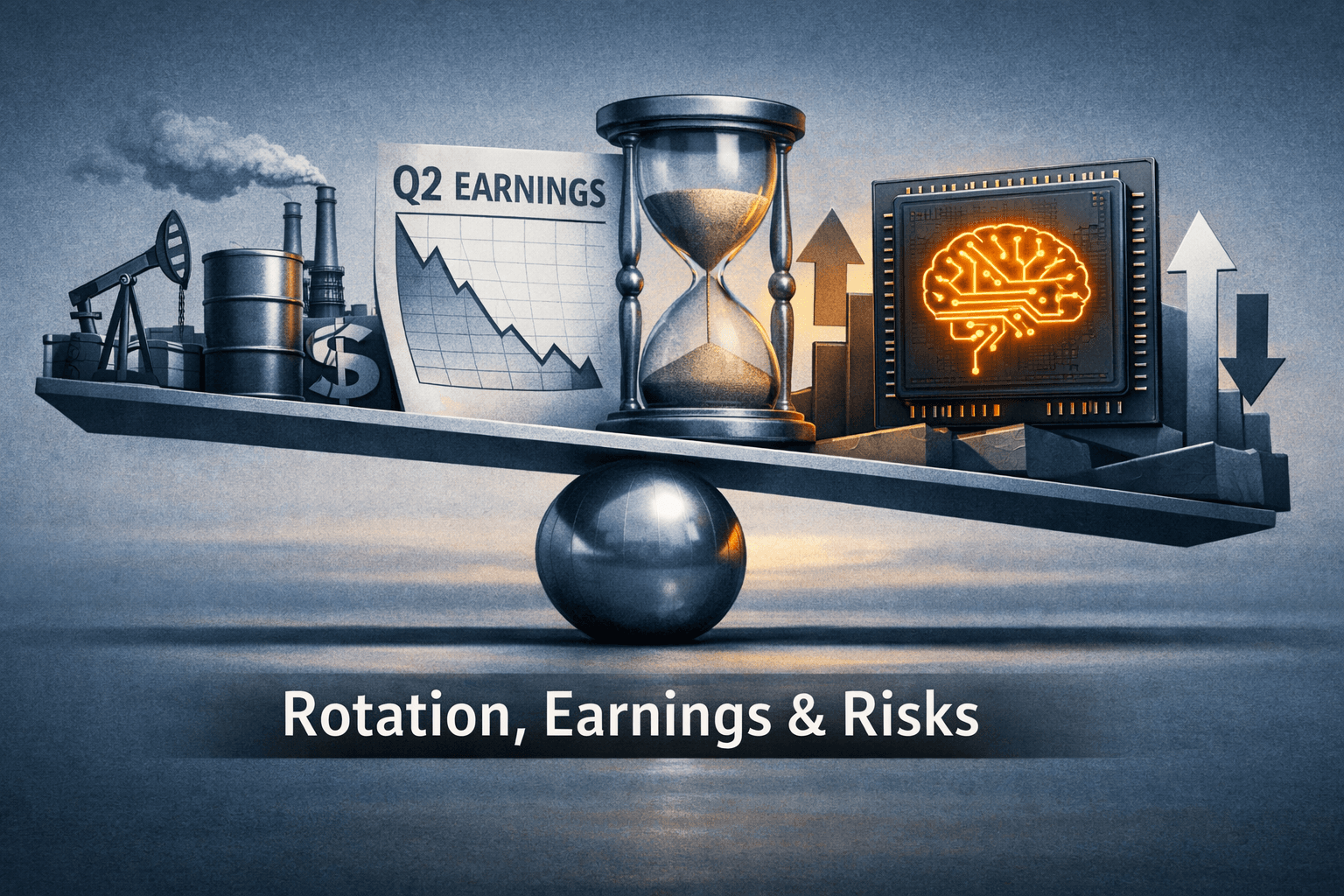
Rotation, Earnings and Event Risk: Markets Weigh Value’s Resurgence, Q2 Earnings Test, and AI/Oil-Driven Sector Shifts
Podcast • Loading audio...
Share this article
Spread the word on social media
Key Takeaways
- •Q2 earnings season is the immediate arbiter of whether the current rally is earnings-driven or vulnerable to multiple compression (Goldman Sachs).
- •Inflation-linked dynamics are renewing interest in value stocks, but growth has rallied ~9% YTD—leadership remains contested.
- •Idiosyncratic catalysts—NVDA’s GB300 validation in Azure, oil supply shocks boosting Chevron, and elevated options-implied moves in Nike—are driving concentrated sector and stock-level moves.
- •Investor types will need to weigh persistence of inflation, earnings guidance, and event-driven volatility when sizing exposure across value, growth, and cyclical sectors.
Today's most significant developments
Markets entered the day under a mix of macro cross-currents and event-driven rotations. Three developments stand out: (1) renewed attention to value stocks amid inflation-linked performance dynamics, (2) Goldman Sachs' reminder that Q2 earnings are the "critical test" for this rally, and (3) a cluster of idiosyncratic catalysts—chiefly NVIDIA validation in cloud AI and an oil-driven bounce in energy names—that are driving concentrated moves across sectors.
Taken together, these threads frame the immediate market picture: positioning is active, leadership remains contestable, and discrete catalysts (earnings, options-event risk, commodity shocks, and partner/tech validation) will likely determine whether the rally broadens or narrows into a handful of winners.
Synthesis of the key themes
- Value vs. Growth: metrics, rotation, and inflation
- Multiple briefs today revisit a recurring thesis: value tends to outperform when inflation is elevated. One Alpha note highlights that a single metric explains much of the relative performance gap between value and growth in high-inflation regimes and that many newsletters are redeploying into 13 value-oriented names. The piece notes that while value-led performance dominated much of 2026, growth has surged back and is now up roughly 9% year-to-date, altering the risk-reward calculus for many portfolios.
- The substantive economic channel behind this pattern is familiar: higher inflation often implies higher nominal discount rates and a steeper term structure, which compresses the present value of long-duration cash flows (typically associated with growth names). Conversely, near-term cash flows and cyclical earnings—traits of many value stocks—are comparatively less sensitive to higher discount rates.
- Earnings as the proximate arbiter of the rally
- Goldman Sachs (Ben Snider) reasserts that this year's gains appear driven by earnings growth rather than multiple expansion and labels Q2 corporate results a "critical test." The firm's note (published June 28) frames mid-July earnings as the next major catalyst: a robust round of beats would reinforce the earnings-driven narrative; broader disappointments could expose the rally to multiple compression.
- This is consequential because if price appreciation is mostly earnings-backed, leadership is more likely to be fundamental and persistent. If instead investor optimism is outpacing corporate results, any shortfall could trigger a rapid repricing.
- Persistent consumer inflation anxiety
- Morgan Stanley's research underscores that inflation remains Americans' top perceived risk even as some headline measures have eased. The persistence of consumer concern matters because it feeds into spending patterns, margin pressure for consumer-facing firms, and valuation multiples for retailers and discretionary names.
- The behavioral angle here keeps defensive exposures and cash-flow‑rich sectors relevant, while leaving room for selective growth exposure if inflation data and payroll/consumption prints continue moderating.
- Event-driven, sector-level reshuffles
- Energy: Meridian Funds flags that a late‑February strike and subsequent positioning pushed crude higher, contributing to Q1 strength in Chevron (CVX) and other energy names. That same note attributes part of the Meridian Hedged Equity Fund’s Q1 performance to timely exposure to commodity-driven moves.
- Tech/AI infrastructure: NVIDIA confirmed Anthropic’s models run on the NVIDIA GB300 within Microsoft Azure—an operational validation that supports cloud GPU demand and bolsters NVDA’s enterprise adoption narrative.
- Corporate-specific moves: earnings beats and investor letters lifted Royalty Pharma (RPRX) after a profit surprise, while consumer and retail names show higher event volatility (Nike at a 12-year low with options pricing ~20% implied move into earnings).
Where market views diverge
Value vs. Growth: Analysts are split between a macro-driven preference for value (when inflation is elevated) and the argument that resumed earnings growth for high-quality growth companies justifies the recent (9% YTD) outperformance. The disagreement centers on the persistence of inflation and the sustainability of organic earnings growth for growth names.
Source of market gains: Goldman Sachs emphasizes earnings growth as the foundation; skeptics note that market internals and compositional leadership can mask latent multiple risk if earnings season disappoints. The practical implication: conviction will likely hinge on Q2 results and subsequent guidance.
Defensive vs. cyclical tilts: Morgan Stanley’s survey data—showing lingering consumer inflation worry—supports defensive positioning. By contrast, fund letters (Meridian) highlight the upside from tactical cyclical exposure (energy, data centers) when discrete shocks (supply disruptions, geopolitical events) shift flows.
Context and mechanics behind major moves
Inflation and the valuation transmission mechanism: When inflation rises, real yields typically climb and nominal discount rates move higher. Long-duration equities (growth stocks with earnings far in the future) are most sensitive to these rate shifts; value firms with nearer-term cash flows face less present-value erosion. That is the kernel of the analysis linking inflation to a value premium.
Earnings-driven rally vs. multiple expansion: An earnings-driven rally implies rising corporate profits justify higher index levels. Multiple expansion, by contrast, is when investors are willing to pay more for the same earnings (P/E expansion). Goldman’s framing implies that if Q2 EPS growth holds up, the rally has a stronger fundamental underpinning. If Q2 disappoints, markets may revert to pricing based on multiples and sentiment.
Commodity shocks and concentrated sector moves: The Meridian letter illustrates how a single supply shock—a strike in late February—can abruptly reweight returns across sectors. Energy can flip from a defensive drag to a positive contributor, and hedged equity strategies (which write options to generate income) can see their downside protection and upside participation rebalanced by sudden oil moves.
Options-implied moves and event risk: Nike’s options market is pricing roughly a 20% move into the company’s upcoming earnings—an elevated level of implied volatility. When implied moves are large relative to historical volatility, short-term directional traders and volatility sellers face material tail risk; long-term holders need to consider the potential for sharp, earnings-driven dislocations even if fundamentals point elsewhere.
Notable stock- and sector-level data points cited today
- Growth up ~9% YTD (broad characterization from the value/growth note).
- Selective Insurance Group (SIGI): trading at $96.40 after a six-month run that outpaced the S&P by 7.3%; the note cites a 14% advance over the period.
- Globe Life (GL): $178.90, up 26.2% over six months and outperforming the S&P by 19.4%.
- Jacobs Solutions (J): $125.68, a six‑month decline of 7.1% vs. S&P +6.8%.
- MediaAlpha (MAX): trading at $12.19 after mixed Q1; consensus leans Moderately Buy amid recent underperformance.
- Nike (NKE): at a 12-year low with options pricing ~20% implied move into earnings.
- NVIDIA (NVDA): confirmation that Anthropic’s models run on the GB300 inside Azure—product validation supporting cloud GPU demand dynamics.
- Chevron (CVX) and selected energy names: Q1 strength called out in Meridian’s letter, tied to oil spikes after a late‑February strike.
- Equinix (EQIX) and Royalty Pharma (RPRX): flagged by Meridian for Q1 lifts tied to macro flows and earnings surprises; RPRX cited metrics including 124.67%, 49.89% and 0.89% in the investor note context (these figures were presented as valuation/metric callouts in the letter).
- Lockheed Martin (LMT): announced a missile sustainment center in Finland—an operational expansion with potential long-term service revenue implications.
What this means for different investor types
Long-term, fundamentals-focused investors: Analysts note that the coming Q2 earnings cycle is the most important near-term signal for judging whether recent gains are fundamentally supported. For these investors, monitoring margin guidance and order/backlog statements in cyclicals and tech will be critical.
Value-oriented allocators: The inflation-value linkage keeps the case for value on the table. Data suggesting persistent consumer inflation worries reinforces the need for careful selection among value names (those with resilient near-term cash flows and margin stability).
Growth and AI-focused investors: NVDA’s GB300 validation in Azure strengthens the hardware-adoption narrative. But growth holders should weigh earnings trends and rate sensitivity—if earnings disappoint, long-duration names can reprice quickly.
Income and defensive investors: The survey evidence of inflation anxiety and the outperformance of some insurance/life names (SIGI, GL) argues for continued attention to cash-flow stability and dividend coverage.
Traders and volatility-focused players: Nike’s ~20% options-implied move, along with elevated event risk around earnings and geopolitical noise in oil, means short-term volatility strategies face heightened tail risks. Options pricing can be an early indicator of market fear and expected price dispersion.
Strategic considerations and watchlist
- Monitor Q2 earnings beats and guidance cadence (mid‑July is the key window flagged by Goldman). Analysts note that actual EPS growth versus prior expectations will be the immediate arbiter of leadership.
- Track inflation prints and consumer sentiment data—persistence in inflation anxiety can sustain defensive and value demand, while tangible easing could reaccelerate growth leadership.
- Watch commodity headlines (supply disruptions, strikes) and positioning flows in energy-sensitive funds; these episodic shocks can materially reweight short‑term returns.
- Follow options-implied moves around major names (Nike, other retailers) as a gauge of event risk and short-term market nervousness.
- For thematic investors, monitor cloud AI adoption signals (GB300 deployments, Azure confirmations) that can influence capex cycles and GPU demand beyond quarter-to-quarter earnings.
Conclusion — framing the next 30–90 days
Today’s flow of research and corporate news underscores a familiar but consequential truth: market leadership is contingent on macro and micro confirmation. Goldman Sachs’ emphasis on Q2 earnings as a "critical test," combined with lingering consumer inflation worries and concentrated event risk (oil, options-driven consumer moves, cloud-AI validation), suggests a near-term environment where active information (earnings, data releases, and discrete corporate confirmations) will matter more than broad sentiment alone.
Analysts and fund managers remain divided on whether recent growth strength is sustainable or whether value will reassert itself as inflation and rate dynamics evolve. For investors, the prudent approach is to treat the coming earnings window and macro prints as signal-rich events—use them to reassess exposure, risk budgets, and scenario plans—while remembering that headlines can sharply reallocate returns across sectors.
This summary is for informational purposes only. Analysts note market dynamics and data; it is not personalized investment advice and does not constitute a recommendation to buy, sell, or hold any security.
Sources
+ 4 more sources
Use these insights — enter this week's contest.
Free practice contests — earn Alpha CoinsExplore More Content
Disclaimer: StockAlpha.ai content is for informational and educational purposes only. It is not personalized investment advice. Sentiment ratings and market analysis reflect data-driven observations, not buy, sell, or hold recommendations. Always consult a qualified financial advisor before making investment decisions. Past performance does not guarantee future results.