 Breaking Analysis
Listen to this Recap
9:17
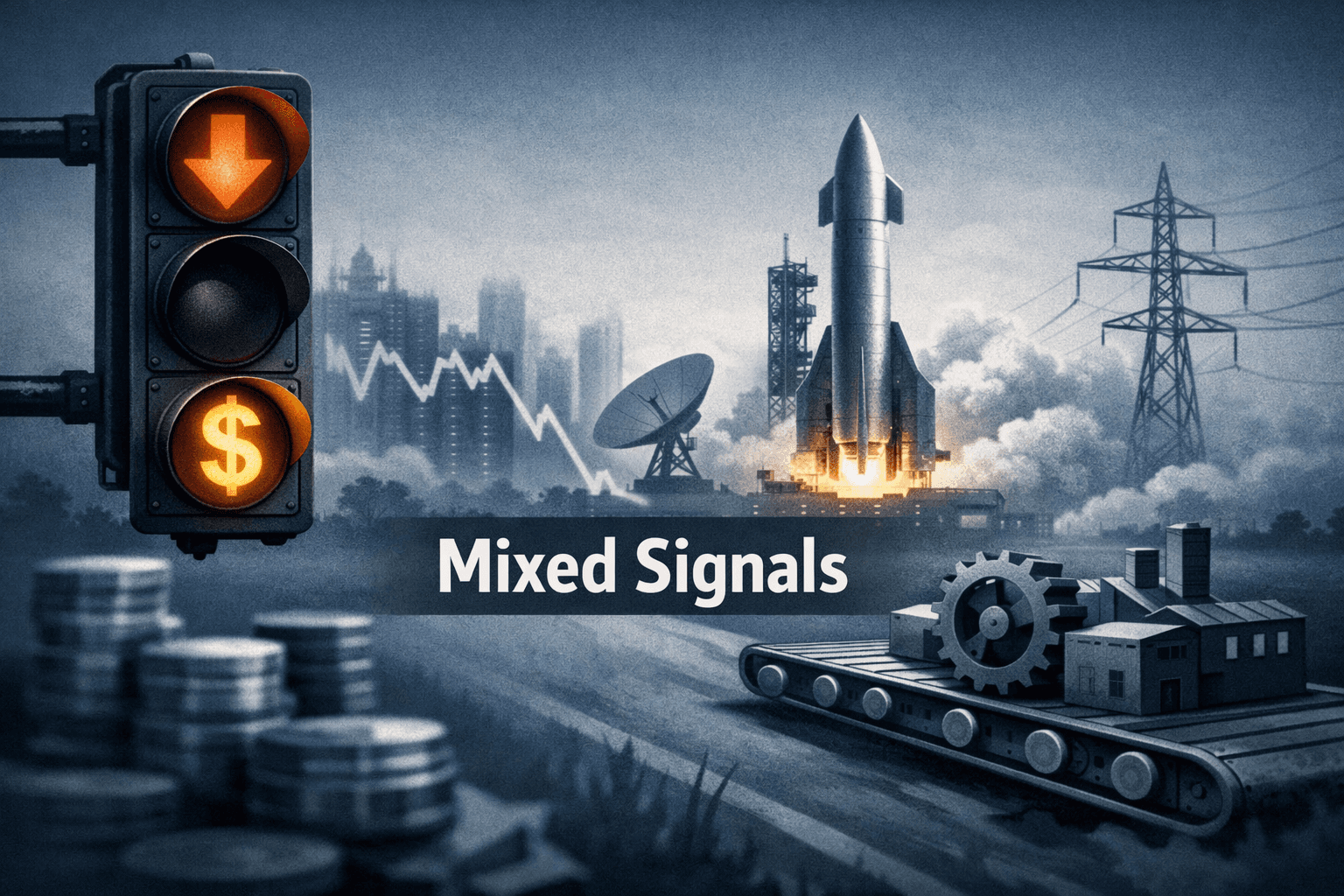
Mixed Signals: Tech Correction, SpaceX IPO Uncertainty, and Cash-Flow Signals from Industrials and Utilities
Podcast • Loading audio...
Share this article
Spread the word on social media
Key Takeaways
- •Tech sector entered a correction driven by semiconductor weakness (Micron, Marvell), increasing volatility for growth-heavy portfolios.
- •SpaceX’s IPO juxtaposes meaningful Starlink revenue (> $11B) with unclear firm-level profitability timing, creating valuation uncertainty.
- •Value and income signals are drawing attention: Caterpillar hiked its dividend 8% to $1.63 with Q1 revenue +22% and $62.7B backlog; Vistra’s forward P/E of 16.84x shows possible upside.
- •Analysts are cautious/neutral across several large caps (RBC on ORCL, Bernstein on PEP); near-term direction depends on inflation prints, yields, and upcoming earnings (e.g., Carnival on June 23).
Today's most significant market developments
Equity markets opened the session digesting a string of corporate and macro headlines that pushed two themes to the foreground: a nascent, tech-led correction and continuing uncertainty around profitability for high-profile growth stories. Micron (MU) and Marvell (MRVL) helped tip the U.S. tech sector into an official correction this week, according to coverage, increasing downside pressure on semiconductor-linked and AI-exposed names. At the same time, the SpaceX IPO — widely flagged as historic — is generating intense interest because Starlink revenue has reportedly topped $11 billion even as CEO Elon Musk admits he "cannot predict" when the company will become profitable. That juxtaposition of strong top-line traction and murky cash-flow timing is resonating across investor circles.
Overlaying these equity developments are steady U.S. Treasury yields as markets weigh fresh geopolitical headlines (reports of U.S. strikes in Iran) and await upcoming inflation prints. The fixed-income backdrop matters: stable-to-higher yields compress valuations on long-duration growth names while supporting select value and income plays.
Synthesis of key themes across analyses
- Tech de-risking and sector rotation
- Multiple notes point to a shift in market leadership. Coverage of Micron and Marvell says the tech sector has moved from a pullback into an actual correction, increasing volatility for growth-heavy portfolios. Momentum indicators and sector breadth have weakened, and analysts are watching memory and networking demand as proximate drivers.
- Growth vs. cash-flow divergence in marquee names
- SpaceX captures the tension between revenue scale and profitability visibility: Starlink revenue > $11B is materially large for a private company, yet management’s inability to forecast firm-level profit timing elevates valuation uncertainty. Similarly, Meta’s aggressive AI infrastructure spend (Bank of America flagged metrics including 12.60%, 6.11% and 0.01% in published analysis) highlights a trade-off: heavier near-term capex for potential longer-term monetization. These dynamics underline that revenue growth alone is no longer sufficient to sustain rich growth multiples when cash-flow timing is uncertain.
- Active search for yield and valuation anchors
- With some growth assets resetting, attention is moving to companies showing durable cash flow or attractive forward multiples. Caterpillar raised its quarterly dividend by 8% to $1.63 while reporting Q1 revenues up 22% and a backlog of $62.7 billion — data points that signal operational resilience in a capital-intensive cycle. Vistra (VST) stands out on valuation: a forward P/E of 16.84x places it among the S&P 500’s ten cheapest by that metric, with an upside estimate referenced near 50.20% in coverage. Even modest dividend moves — Target’s 1.8% raise to $1.16 per share — are being read for their allocation implications.
- Analyst posture is broadly cautious/neutral on large staples and legacy software
- RBC maintained its rating on Oracle (ORCL) after a mixed-results review, flagging uneven metrics (notably cited figures of 46.44% and 21.01% in the note) and no change to price targets in the available report. Bernstein initiated PepsiCo (PEP) at Market Perform, supplying discrete percentage figures (5.47%, 2.77%, 0.02%) that frame a neutral, valuation-focused stance. These notes underscore analyst conservatism where near-term catalysts are unclear.
Where analysts and coverage disagree — the debates to watch
AI capex: necessary investment or margin sink? Bank of America’s framing of Meta’s AI push highlights potential for enhanced monetization if infrastructure translates into product improvements. But other market voices caution that the timing and scale of returns are uncertain; heavy capex can depress near-term margins and create downside to expectations if monetization lags. This is not a binary outcome — success hinges on execution, ad product innovation, and user engagement.
Growth at scale vs. profitability clarity (SpaceX): coverage is unanimous that Starlink revenue is substantial (> $11B), but opinions diverge on how markets should value that revenue without profit visibility. Some analysts treat early price signals as provisional and suggest models should prioritize cash-flow scenarios; others point to private-market demand and strategic optionality (satcom, defense, global broadband) as partial valuation offset. The core debate: which is the better anchor for an IPO valuation — growth trajectory or demonstrable free cash flow?
Value vs. momentum deployment: Vistra’s low forward P/E and an advertised upside of roughly 50% sit at odds with the momentum-driven selling in semiconductors. Value analysts point to mean reversion in multiples; momentum managers argue that macro and sector risks can erode near-term earnings and widen dispersion further.
Deeper context on major moves
Tech correction mechanics: corrections typically follow concentrated leadership and stretched valuations. Semiconductor cyclicality — particularly memory for MU and networking/ASIC demand for MRVL — can quickly alter revenue trajectories and inventory cycles. When those firms miss or signal weaker orders, the multiple compression can cascade through related software and hardware names, especially those pricing in long-duration growth.
Treasury yields and inflation: bond-market stability matters because a move above key rate thresholds (or a surprise CPI/PCE print) would re-price discount rates used for valuing growth companies. Even steady yields today maintain pressure on long-duration equities: higher discount rates reduce present value of distant cash flows. Conversely, stable or lower yields can support multiple expansion for firms demonstrating credible cash-flow improvement.
Dividend hikes and backlog signals: Caterpillar’s 8% dividend increase to $1.63, together with a 22% revenue increase and $62.7B backlog, is not just an income story — it signals demand durability in heavy equipment and pricing power. In capital-intensive sectors, backlog functions as a forward revenue indicator; a large, growing backlog reduces short-term cyclical risk.
Valuation asymmetry in utilities/energy: Vistra’s forward P/E of 16.84x stands out in a market that has seen technology multiples compress. For value-focused portfolios, such single-name metrics present an optimization problem: rotate to lower-multiple, cash-generative sectors now, or await clearer macro signs that yield and growth risk have stabilized.
Implications for different investor types
Income and dividend investors
- Caterpillar’s sizable 8% dividend bump and a 32-year streak of increases provide a meaningful signal of cash-flow resilience; Target’s modest 1.8% increase is informative but not transformative. Investors focused on yield should weigh payout sustainability (free cash flow and leverage) and not treat nominal raises as the only input.
Value-oriented investors
- Vistra’s forward P/E of 16.84x and ~50.20% upside estimate make it an archetypal value candidate in the current tape. But due diligence should account for regulatory, commodity, and earnings variability that can alter forward multiples.
Growth and momentum investors
- The tech correction raises immediate risk thresholds. Momentum traders should prepare for higher volatility and potential trend reversals, while growth investors ought to re-anchor models to nearer-term cash-flow scenarios (particularly in semiconductors and AI hardware/software names).
Event-driven and IPO-focused allocators
- SpaceX’s impending IPO is a headline event where private-market pricing, optionality (Starlink), and unclear firm-level profitability converge. Scenario analysis and real-options thinking — valuing strategic optionality separately from base-case cash flow — are especially relevant here.
Macro/fixed-income sensitive portfolios
- With Treasury yields steady but inflation prints pending, portfolio managers should monitor breakpoint levels in the curve that matter for duration-sensitive assets. Geopolitical developments (e.g., reported U.S. strikes in Iran) also complicate safe-haven flows.
Strategic considerations and next steps for investors
Re-assess cash-flow visibility across holdings: prioritize companies where revenue growth is paired with clear free-cash-flow trajectories or credible paths to profitability. For headline IPOs and AI-scaped investments, model multiple scenarios rather than relying on single-point forecasts.
Watch earnings and event calendars: Carnival’s Q2 call on June 23 will update travel-sector re-rating possibilities, while semiconductor earnings and inventory data will be pivotal for gauging whether the correction deepens or stabilizes.
Monitor macro triggers that re-price discount rates: incoming inflation data and the trajectory of Treasury yields are proximate catalysts that can amplify sector moves — especially for long-duration growth names.
Blend valuation and momentum signals in rebalancing: the current tape favors a hybrid approach. Use valuation screens (forward P/E, backlog, dividend sustainability) to identify candidates for overweighting in a rotation, but keep tactical execution aligned with momentum and volatility signals.
Maintain flexibility around IPO allocations: for high-profile listings with uneven profitability transparency, treat initial public-market prices as provisional and allocate with staged exposure or options-based hedging where appropriate.
Bottom line
Today's coverage reflects a market at a crossroads: headline growth narratives are encountering hard questions about timing of profits and capital intensity, while value and income metrics regain prominence as anchors for reallocation. Analysts’ stances are largely cautious and data-driven — from RBC’s watchful stance on Oracle to Bernstein’s Market Perform initiation on PepsiCo — and the near-term path will be shaped heavily by inflation prints, upcoming earnings (including Carnival on June 23), and whether tech’s correction finds a durable bottom. For investors, the immediate task is not to chase headlines but to reframe models around cash flows, scenario outcomes, and the macro signals that determine discount rates.
Investment disclaimer: This article presents market analysis and data for informational purposes only. It does not constitute investment advice or a recommendation to buy, sell, or hold any security.
Sources
+ 3 more sources
Use these insights — enter this week's contest.
Free practice contests — earn Alpha CoinsExplore More Content
Disclaimer: StockAlpha.ai content is for informational and educational purposes only. It is not personalized investment advice. Sentiment ratings and market analysis reflect data-driven observations, not buy, sell, or hold recommendations. Always consult a qualified financial advisor before making investment decisions. Past performance does not guarantee future results.