 Breaking Analysis
Listen to this Recap
9:46
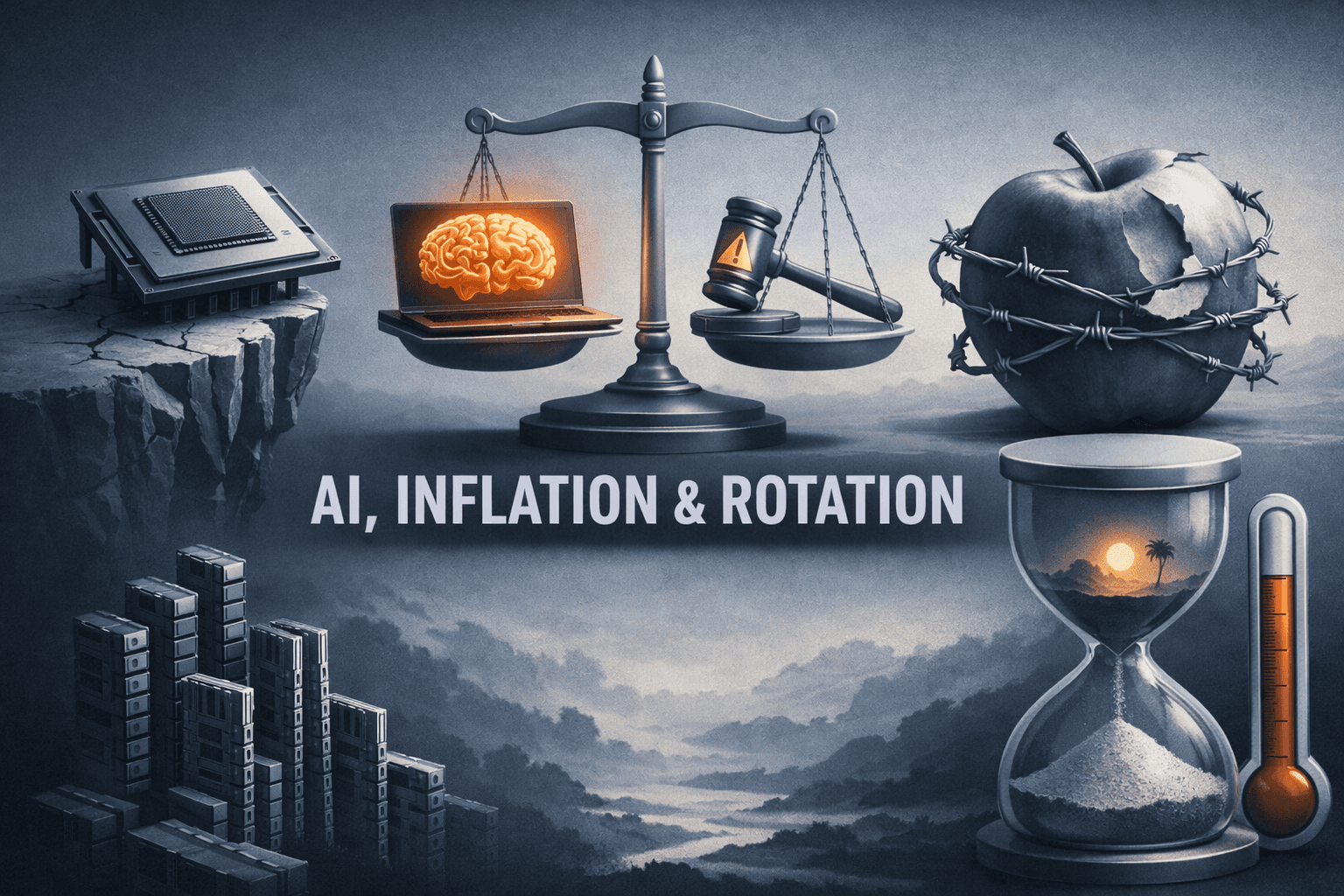
AI, Inflation and Rotation: Market Momentum Meets Fresh Risks — Nvidia Tests Support as Oracle, Apple and Memory Names Drive Divergence
Podcast • Loading audio...
Share this article
Spread the word on social media
Key Takeaways
- •AI optimism is under strain: Nvidia’s technical test and Oracle’s upcoming earnings mean the AI narrative must convert to revenue and margins to sustain rally.
- •A possible Micron‑led memory supercycle could improve visibility for equipment vendors, but hardware suppliers face mixed prospects amid potential margin pressure from high‑end devices.
- •Regulatory action in the EU against Apple injects discrete compliance risk into AI rollouts and raises the bar for global product launches.
- •Macro crosscurrents—pre‑market risk‑on flows vs. El Niño inflation risk—create a scenario where rotation and hedging decisions are increasingly driven by near‑term data and weather‑linked commodity dynamics.
Today's Most Significant Market Developments
Equity futures and ETFs opened higher pre‑bell (with $SPY up ~0.4%), signaling a short‑term risk‑on bias, but beneath that lift several large structural narratives are colliding. Nvidia ($NVDA) slipped to a key technical support level during Tuesday’s sell‑off, putting pressure on AI‑trade momentum. At the same time, Oracle ($ORCL) faces a pivotal fiscal Q4 earnings call where investors expect management to translate AI positioning into revenue and margins. Regulatory heat also rose: the European Commission publicly found that Apple ($AAPL) failed to bring an AI tool into compliance with EU rules, elevating regulatory uncertainty for AI deployments in consumer tech.
Concurrently, UBS‑sourced analysis points to a potential memory "supercycle" driven by Micron ($MU) and peers — a development that would favor chip equipment vendors and alter earnings visibility across the semiconductor supply chain. Meanwhile, macro signals are stirring anxiety: MarketWatch and strategists warn El Niño could ratchet commodity and food inflation higher, a structural headwind to real purchasing power.
These clustered themes—AI narrative testing, regulatory interventions, a memory demand cycle, and rising inflation risk—are the dominant forces shaping positioning across growth, cyclical and income portfolios today.
Cross‑cutting Themes and Synthesized Readouts
- AI narrative: hype vs. deliverables
- The market’s AI enthusiasm is bifurcating. Nvidia’s retreat to a technical support line is a concrete signal that momentum can be fragile; technical traders treat those levels as potential inflection points for algorithmic funds and stop orders. Analysts note a decisive bounce would restore conviction in the AI trade; a break could precipitate broader sector revaluation.
- Oracle has rallied on AI positioning (cited as ~+9% year‑to‑date in coverage), but MarketWatch and other coverage stress that the fiscal Q4 earnings and management commentary on data‑center build‑out are the moment of truth. In other words, narrative needs to convert to topline and margin evidence.
- Apple’s EU noncompliance finding adds a regulatory dimension that directly intersects with the AI story: even large incumbents face localized enforcement risk that can require product changes, delays, or potential fines. Analysts highlight this as an underappreciated execution risk for AI rollouts in Europe.
- Structural demand in memory vs. hardware margin squeeze
- UBS’s coverage arguing for a Micron‑led memory supercycle suggests multi‑year visibility for equipment firms and improved forward revenue sings for memory suppliers. A supercycle is a prolonged period of elevated demand (often tied to secular shifts such as AI compute growth) that pushes utilization and pricing power across the supply chain.
- At the same time, MarketWatch warns of pressure on certain hardware suppliers from emerging high‑end devices (e.g., reports of a next‑gen videogame console that could cost ~$1,000). That development could shift value capture toward software/cloud and compress margins for component and OEM suppliers, creating dispersion within tech.
- Rotation and risk appetite: cyclical vs defensive
- Pre‑market ETF flows and SPY’s early lift indicate rotational tendencies toward cyclicals and growth if inflation prints continue to ease rate expectations. Yet the inflation risk flagged by El Niño proponents complicates that rotation: a commodity shock would favor real‑asset and inflation‑hedge strategies, and it could make fixed income and duration exposures more vulnerable.
- Regional financials and niche winners
- Smaller, regional banks and specialized industrial names are getting renewed attention: Nicolet Bankshares ($NIC) trading at $144.06 and slated for an S&P 500 addition in June is a classic example of index‑driven flows; Columbia Financial ($CLBK) has climbed 23.1% over six months to $20.76 after Q1. On the industrials front, RBC Bearings ($RBC) has surged to ~$590.64 (five‑year gain ~195%; six‑month +35.3%), underlining idiosyncratic winners outside megacap tech.
Conflicting Views and Market Debates
Is AI momentum sustainable without earnings? One camp views recent weakness in NVDA and the caution around Oracle’s upcoming report as evidence the AI rally is overdue to prove out on fundamentals. The opposing view argues these are temporary pullbacks in a multi‑year secular adoption cycle where even dips represent buying opportunities for long‑term exposure — but that view depends on execution (i.e., Oracle, Micron) and absent regulatory shocks (i.e., Apple/EU rulings).
Memory supercycle vs. hardware margin squeeze: UBS’s equipment‑visibility claim suggests broadening demand that benefits suppliers. Conversely, hardware margin pressure—driven by expensive AI‑enabled consumer devices—suggests some hardware suppliers could face margin degradation even as overall compute demand rises. The net outcome may be more dispersion: winners among equipment and cloud providers; losers among commodity component makers and low‑margin OEMs.
Inflation: transitory disruption or structural reacceleration? El Niño proponents see sustained commodity pressure that would force portfolios to reweight toward inflation hedges. Other strategists note that central bank credibility and inventory dynamics can blunt the pass‑through. The debate matters because it directly affects sector leadership, rate expectations, and real returns across asset classes.
Deeper Context on Major Moves
NVDA technical test: Technical support levels matter beyond chart patterns. Many institutional strategies and retail algos are programmed around these levels; a failure can amplify selling via stop triggers and margin calls. The importance today is less about a single stock and more about signaling for the AI complex where NVDA is a benchmark for sentiment.
Oracle’s earnings as a milestone: For many software incumbents, the shift to AI involves both capex (data centers) and a reallocation of R&D toward large‑model hosting and services. Investors are watching whether Oracle’s bookings, cloud revenue growth, and incremental margins justify premium multiples allocated to AI winners.
Apple and EU enforcement: Regulatory compliance issues in the EU can impose localization costs, product redesigns, or restrictions that blunt revenue growth in a major market. With AI tools increasingly integrated across devices and services, localized enforcement raises legal and product‑roadmap risk for global rollouts.
Memory supercycle mechanics: A supercycle implies sustained elevated capex from memory producers, longer lead times for equipment, and more predictable order flow for vendors. That visibility can compress uncertainty premiums and support higher multiples for equipment makers — but only if demand sustains and pricing power remains with suppliers rather than customers.
Index additions and stock mechanics: Nicolet’s S&P addition and similar index flows are mechanical demand drivers. When a small‑cap or regional name is added to a major index, ETFs and index funds must buy shares to match the benchmark, delivering near‑term demand irrespective of fundamentals. Over time, market pricing will re‑reflect fundamentals, but the index event can materially alter liquidity and ownership structure.
Implications by Investor Type
Short‑term traders / momentum funds: Technical setups (NVDA support) and pre‑market ETF flows provide actionable timing signals. Traders should monitor volatility spikes around company‑level catalysts (Oracle earnings) and regulatory headlines (Apple/EU) that can trigger intraday repricing.
Growth investors: The AI theme still offers structural upside, but analysts highlight execution risk — conversion of AI positioning into recurring revenue and margins is essential. Dispersion within tech suggests selective exposure (software/cloud vs. hardware suppliers) will matter more than broad sector bets.
Value / income investors: Rising inflation risk (El Niño) and commodity pressures could erode real yields and influence the preferred exposure to cyclicals and real assets. Regional banks experiencing index flows (Nicolet, Columbia Financial) present idiosyncratic valuation dynamics unrelated to macro alone.
Long‑term allocators / multi‑asset investors: The memory demand thesis and inflation debate both point to potential regime shifts. A sustained memory supercycle could justify higher allocations to semicap and equipment names, while El Niño‑driven inflation would argue for real assets and inflation‑sensitive hedges. These are macro tilts rather than short‑term tactical trades.
Risk‑averse or regulatory‑sensitive holders: The Apple EU finding underscores that regulatory exposures can be binary and fast‑moving. Investors sensitive to legal/regulatory risk should monitor regional enforcement trends, especially for AI‑enabled consumer services.
Strategic Considerations and Questions for Portfolio Review
Reassess conviction in AI names by separating narrative risk from earnings risk: which holdings have demonstrable monetization paths and which rely primarily on sentiment?
Stress‑test hardware exposures for margin pressure from high‑end consumer devices and potential component commoditization.
Evaluate inflation sensitivity across allocations given El Niño risk — consider scenario analysis for commodity price shocks and their impact on margins and consumer demand.
For index event names (e.g., Nicolet), determine how much of recent performance is technical (index flows) versus fundamental improvement; liquidity and ownership concentration can change volatility profiles.
Monitor near‑term catalysts closely: Oracle’s Q4 call, Nvidia’s price action around support, regulatory developments around Apple in the EU, and any new inventory/order guidance from memory producers.
Where Analysts Agree and Where Views Diverge
Agree:
- AI remains a central structural theme driving investor attention and flows.
- Company‑level execution (earnings, guidance) will determine whether AI narratives translate into sustainable valuation gains.
- Inflation risks tied to climate/weather patterns (El Niño) are non‑trivial and merit monitoring.
Diverge:
- The durability of the AI rally: some treat current weakness as a buyable dip; others want concrete revenue/margin proof points before re‑committing.
- The breadth of benefitting segments: UBS/Memory proponents expect broad equipment wins, while other voices warn that hardware suppliers could be squeezed by shifting consumer spending toward expensive, integrated devices.
Investment Disclaimer
This analysis is for informational purposes only. It does not constitute personalized investment advice or a recommendation to buy, sell, or hold any security.
Bottom Line
The market’s short‑term tone is constructive, but beneath that surface the interaction of AI execution risk, regulatory scrutiny, potential memory demand acceleration, and emerging inflation pressures is creating a more complex backdrop. Investors should prioritize catalyst calendars, differentiate between narrative‑driven and fundamentals‑driven exposures, and run scenario analyses that incorporate both commodity/inflation shocks and company‑level delivery risks.
Sources
+ 5 more sources
Use these insights — enter this week's contest.
Free practice contests — earn Alpha CoinsExplore More Content
Disclaimer: StockAlpha.ai content is for informational and educational purposes only. It is not personalized investment advice. Sentiment ratings and market analysis reflect data-driven observations, not buy, sell, or hold recommendations. Always consult a qualified financial advisor before making investment decisions. Past performance does not guarantee future results.