 Breaking Analysis
Listen to this Recap
12:57
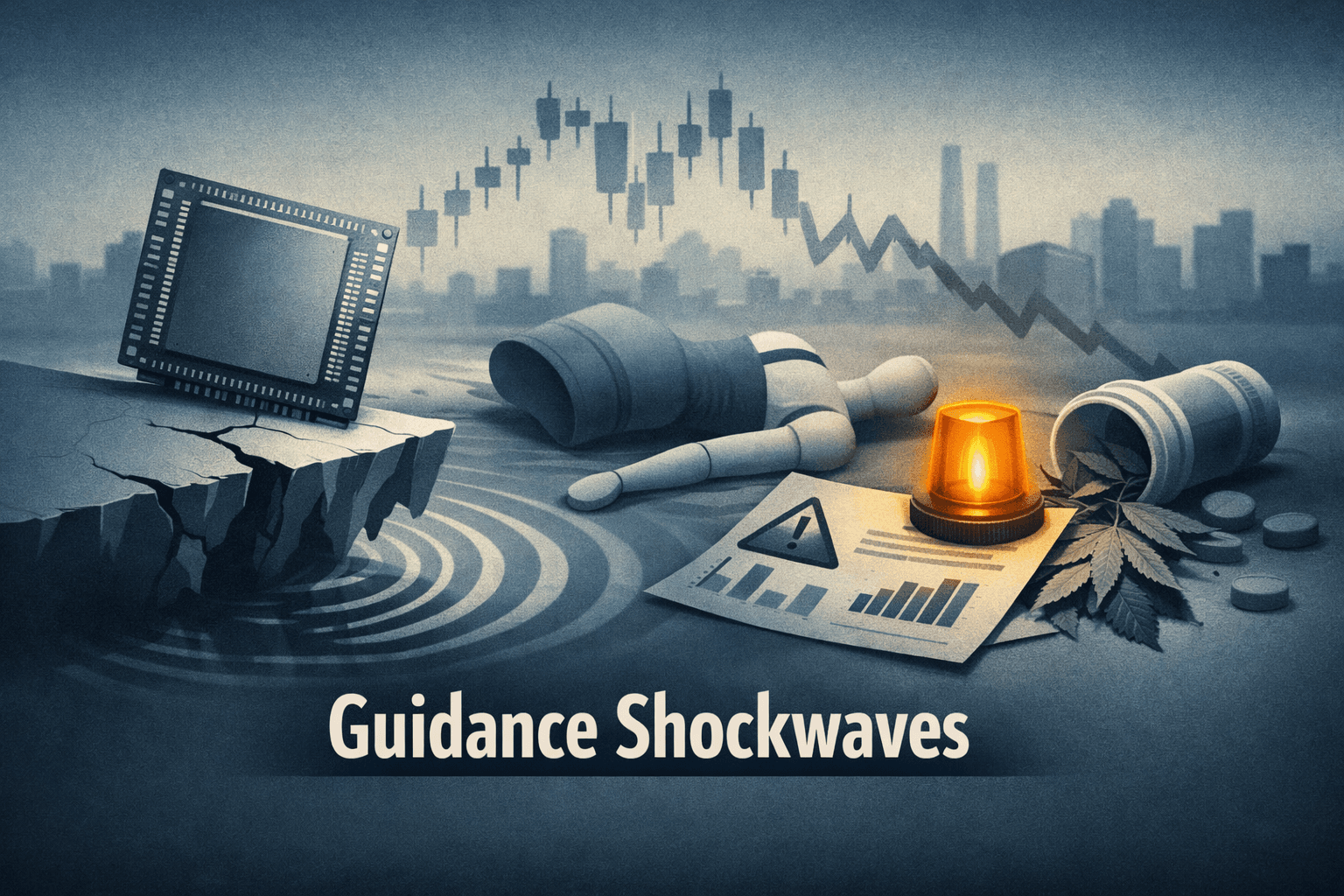
Guidance-Driven Volatility: Broadcom’s Wake, Chip Dispersion, and Cross-Industry Ripples Dominate the Tape
Podcast • Loading audio...
Share this article
Spread the word on social media
Key Takeaways
- •Broadcom’s refusal to lift AI revenue guidance was the day’s primary catalyst, triggering a broad chip selloff and re-pricing across AI-exposed sectors.
- •Valuation dispersion in semiconductors and memory (very large scenario ranges cited, e.g., 707.32%) raises tail-risk for tech-heavy allocations.
- •Narrative risk is real: Lululemon’s outlook cut tied to negative media shows perception can materially affect near-term demand and guidance.
- •Structural and regulatory moves matter — Trulieve’s deconsolidation filing validates a medical-first uplisting pathway that other cannabis operators may emulate.
Today's most significant developments
The headline story for June 4 is guidance-driven volatility originating from Broadcom’s earnings — the company declined to raise its AI revenue outlook — and the immediate, broad selloff that followed across chipmakers, memory names and AI-adjacent equities. Analysts and traders treated Broadcom’s restraint as a signal that the market’s growth expectations for AI are still fragile, producing rapid re-pricing across the technology complex.
That sector shock is the market’s connective tissue today: Micron ($MU) was flagged as vulnerable to a potential record market-cap contraction after Broadcom’s results, with coverage highlighting extreme valuation dispersion (one cited metric: 707.32%). The spillover extended to ARM, other chip designers, optical-networking names such as Ciena (adjusted fiscal Q2 EPS $1.64 cited), and technology-adjacent equities including Tesla ($TSLA), where progress on robo-taxi efforts failed to insulate the stock from AI-sector sentiment pressure.
Other major intraday items included:
- Lululemon ($LULU) cutting its annual outlook and issuing weak Q2 guidance, with management blaming negative media coverage and disappointing product launches — a narrative/perception-driven downgrade that raises questions about near-term top-line and margin assumptions.
- Trulieve Cannabis ($TCNNF) formally deconsolidating its Schedule III medical assets from adult-use operations — a structural, regulatory maneuver widely interpreted as positioning the medical business for an NYSE uplisting.
- Apple ($AAPL) reporting a fourfold increase in App Store billings for AI-focused apps, signaling accelerating monetization in platform services.
- Brookfield Renewable ($BEPC) being highlighted in an investor letter as a beneficiary of growing, AI-driven demand for dependable, low-carbon power.
- Macro labor cracks: a report showing long-term unemployment surging, with about 58% of unemployed categorized as long-term jobless in cited coverage — a data-driven warning on consumption and earnings risk.
Cross-cutting themes and synthesis
- Guidance sensitivity in AI and the tech complex
- Broadcom’s decision not to lift AI revenue guidance was treated as a material negative, not merely a missed beat. Coverage emphasized that markets are pricing much of AI’s upside into forward assumptions; absent explicit beats or guidance raises, multiple compression and near-term selloffs can follow. Analysts and commentators repeatedly cited guidance as a focal point for near-term risk.
- This guidance sensitivity produced spillovers: memory cyclicality (Micron), IP and design risk (ARM), and hardware/optics execution risk (Ciena) all re-rated on sentiment, not solely on company fundamentals.
- Valuation dispersion and concentrated downside risk in cyclical tech
- Several notes highlighted wide valuation dispersion across chip names. One piece quantified extreme valuation outcomes for memory-related businesses, noting figures such as 707.32% and other large percentage swings in scenario analyses. That dispersion translates into higher tail risk for portfolios concentrated in semiconductors and memory suppliers.
- Narrative vs. fundamentals in consumer and platform stories
- Lululemon’s admission that negative media commentary materially affected demand is an example of narrative risk: perception can amplify operational issues and force downward revisions to revenue and margin forecasts. Investors are parsing whether short-term perception effects evolve into structural demand changes.
- By contrast, Apple’s 4x billings increase for AI-focused App Store apps suggests strengthening platform monetization fundamentals that could support services revenue growth beyond hardware cycles.
- Regulatory and structural workarounds in regulated industries
- Trulieve’s deconsolidation filing is a salient example of how corporate structuring can be used to navigate federal securities exchange rules. Isolating Schedule III medical assets from adult-use operations is framed as the cleanest path to an NYSE uplisting, validating a thesis held across prior coverage.
- Macro labor trends as a cross-sector earnings risk
- The report on long-term unemployment rising — with ~58% of the jobless classified as long-term unemployed in cited coverage — raises a slower-consumption scenario that could weigh disproportionately on cyclical discretionary names (retail, specialty consumer staples) and constrain durable recovery in certain service segments.
Points of disagreement and market debates
Is AI growth structural enough to withstand near-term guidance conservatism? Some analysts emphasize secular AI demand (catalyzed by platform monetization and clean-energy inputs like BEPC’s power offerings), while others argue that guidance — not topline narratives — will determine near-term returns. Broadcom’s restraint crystallized this debate.
Retail outlook: structural weakness vs perception-driven slowdown. Lululemon’s management blamed media and specific product rollouts; the market is divided on whether this is a temporary brand/perception issue or evidence of deeper demand deceleration. Contrast this with Zumiez, which posted a revenue beat ($193.3M) but an EPS miss (GAAP EPS -$0.82), complicating the read on specialty retail resilience.
Valuation posture across defensive and cyclical names. D.A. Davidson kept Costco ($COST) at neutral despite strong May sales, signaling cautious optimism from some corners. Meanwhile, BofA upgraded UnitedHealth ($UNH) to Buy on favorable Q2 trend data, highlighting disagreement on when strong trends justify revisiting ratings versus holding on valuation discipline.
Deeper context on the biggest moves
Why Broadcom’s guidance mattered
- In growth-adjacent sectors investors pay premium multiples for forward visibility. When a large, AI-exposed supplier like Broadcom declines to raise its AI revenue outlook, it implicitly signals either near-term demand softness, uncertainty about customer procurement patterns, or a conservative management posture. Because Broadcom sits high in many AI supply chains, investors read the company’s guidance as an information-rich proxy, prompting re-pricing across memory, IP, and systems suppliers.
Memory cyclicality and Micron
- Memory companies are inherently more cyclical: earnings are highly levered to utilization and inventory cycles. Coverage noted extreme outcome dispersion for Micron, and the phrase "record market-cap wipeout" reflects scenario analyses where multiple compression and volume hits coincide. For memory holders, today’s moves accentuate the path-dependency of recovery and the binary nature of outcome scenarios.
Ciena and optics: execution sensitivity
- Ciena’s EPS of $1.64 (adjusted, fiscal Q2) showed improvement but fell short of the "beat-and-raise" expectations priced into the sector. Optical networking is capital-equipment-dependent; sequencing of customer spending and clearer guidance tend to matter more than headline EPS improvements.
Trulieve and regulatory tailoring
- Deconsolidation of Schedule III medical assets is a targeted corporate-structure response to NYSE listing constraints (exchanges typically restrict companies with federally illegal operations). By isolating medical assets that fall within certain regulatory definitions, Trulieve is attempting to create a compliance pathway for a conventional exchange listing — a move that investors and peers will watch as precedent.
What this means for different investor types
Momentum and event-driven traders
- Expect heightened intraday and cross-sector volatility. Guidance events and named-investor calls (e.g., Michael Burry reiterating a Palantir short on technical patterns) can trigger outsized moves. Short-term traders should focus on liquidity, intraday risk controls and catalyst calendars.
Growth-oriented and AI-exposed investors
- The market is placing a premium on explicit, upward guidance from bellwether suppliers. Analysts note that companies that articulate clearer forward AI revenue paths (and translate them into raised guides) will likely enjoy disproportionate multiple support; conversely, conservatism can prompt re-pricing even with solid current execution.
Value and income investors
- Themes such as renewable power serving AI infrastructure (Brookfield Renewable discussed in Green Alpha’s letter) and consumer staples underperformance (Campbell’s down ~25% YTD in cited coverage) highlight divergent income and defensive narratives. Stable cash-flow profiles and yield characteristics remain valuable under heightened equity volatility, but rising long-term unemployment is an earnings headwind for consumer-facing names.
Long-term allocators
- Structural regulatory changes (Trulieve) and platform monetization trends (Apple App Store 4x billings for AI apps) are multi-quarter themes to monitor. However, near-term guidance noise and cyclical re-pricing argue for revisiting scenario assumptions and stress-testing allocations against downside guidance shocks.
Strategic considerations going forward
Treat guidance as a primary catalyst: prioritize upcoming earnings and guidance language from AI-supply-chain bellwethers. Absent clear raises, expect continuing volatility in semiconductors and AI-adjacent stocks.
Re-assess scenario ranges and valuation dispersion: wide outcome distributions for cyclical names call for probability-weighted modeling rather than single-point estimates.
Monitor macro labor indicators: rising long-term unemployment can erode consumption and introduce asymmetric downside to discretionary and staple earnings forecasts.
Watch regulatory playbooks: deconsolidations and structural separations (e.g., Trulieve) can materially change comparability and listing eligibility. These moves may create liquidity and index-inclusion implications over time.
Maintain risk controls for momentum-driven volatility: given the presence of high-profile technical calls (Michael Burry on Palantir), and guidance-driven shocks (Broadcom), institutional and retail traders alike should reinforce position-sizing and stop-loss discipline according to risk tolerances.
Final note and required disclaimer
Analysts and reporters cited in today’s coverage emphasize that market reactions are a function of expectation management — guides, not just results, are dominating near-term moves. Data points worth bookmarking from today’s coverage include Ciena’s adjusted fiscal Q2 EPS of $1.64, Teledyne’s $618.31 share price and 19.4% six-month gain, Enact trading at $40.58 (six-month +7% vs S&P +11%), Zumiez GAAP EPS -$0.82 (miss by $0.01) on $193.3M revenue (beat by $2.28M), Apple’s 4x App Store AI billings growth, and cited dispersion metrics for memory/semiconductor scenarios reaching into the multiple-hundreds of percent.
This note is for informational purposes only. It does not constitute personalized investment advice or a recommendation to buy, sell or hold any security. Analysts note that markets are inherently uncertain; investors should evaluate the data and scenarios presented here in the context of their own objectives, risk tolerances and time horizons.
Sources
+ 12 more sources
Use these insights — enter this week's contest.
Free practice contests — earn Alpha CoinsExplore More Content
Disclaimer: StockAlpha.ai content is for informational and educational purposes only. It is not personalized investment advice. Sentiment ratings and market analysis reflect data-driven observations, not buy, sell, or hold recommendations. Always consult a qualified financial advisor before making investment decisions. Past performance does not guarantee future results.