 Breaking Analysis
Listen to this Recap
10:04
AI Infrastructure Drives a Risk-On Session as Retail and Macro Data Complicate the Outlook
Podcast • Loading audio...
Share this article
Spread the word on social media
Key Takeaways
- •AI demand led a tech-driven rally: Dell's AI-server revenue rose 757% y/y and Snowflake jumped ~34% on an AWS-linked beat.
- •Core PCE inflation at 3.3% keeps a higher-for-longer rate narrative alive, adding valuation risk to long-duration growth names.
- •Retail showed positive inflection signals (Kohl's comps, Best Buy beat, Costco +9.8% same-store sales) but mixed underlying fundamentals.
- •Small-cap outperformance faces analyst skepticism — Wells Fargo warns the rally masks slipping earnings estimates.
- •Investors should monitor order-book sustainability, earnings-revision trends, and Fed communications rather than relying solely on headline momentum.
Today's top development
The clearest market narrative on May 28 was an AI-anchored risk-on move that lifted major benchmarks: Dell surged after a blowout quarter centered on GPU-dense servers, Snowflake exploded on an Amazon-linked beat, and Microsoft-related momentum helped push indexes higher. Yet the macro backdrop and sector divergences complicate the picture — core PCE inflation held at an annual 3.3% in April, keeping a "higher-for-longer" Fed narrative intact, while Wells Fargo flagged valuation risk in the small-cap rally.
This synthesis draws together coverage across the tape: explosive company-specific results (Dell, Snowflake), theme-driven leadership (Microsoft, Google partnerships), mixed retail signals (Kohl's, Best Buy, Costco), and macro and flow data that temper enthusiasm (core PCE, $6B rotation figure, small-cap caution).
How the AI story moved markets
Multiple analyses point to AI infrastructure as the proximate cause of today's risk-on tone.
- Dell: Investors pushed Dell shares toward record highs after management reported AI-server revenue up 757% year-over-year in the quarter and a profit beat described as the widest in five years. Another piece cited a roughly 19% intraday jump tied to the fastest sales growth since Dell's 2018 return to public markets.
- Snowflake: Results tied to AWS momentum produced a 34% one-day surge; coverage cited a post-close trading level near $68.9. Analysts emphasized Snowflake's role in data warehousing for AI workloads — a high-growth end market.
- Microsoft/market flow: Market indexes advanced (two benchmark moves noted at +1.07% and +0.53%) as traders leaned into Microsoft-led AI infrastructure exposure. Trading-flow commentary flagged a roughly $6 billion signal of money rotating toward growth and AI-oriented names.
- Google tie-ins: A Google Cloud partnership (EQT) to accelerate AI adoption underscores the broader enterprise push into agentic AI platforms and models.
Taken together, the datapoints suggest both demand (billings/revenue beats) and capital rotation (flow data) are reinforcing a re-rating of AI infrastructure providers. Analysts repeatedly caveat sustainability: a single quarter or partnership can drive sentiment, but durable cash flow and margin profiles — and the timing of enterprise AI adoption cycles — will determine long-term value creation.
Retail: mixed fundamentals, strong headline reactions
Retail produced one of the day's most headline-grabbing moves, but it was a story of nuance beneath the surface:
- Kohl's: The retailer reported its best comparable-store sales growth in four years and saw intraday jumps reported variously around +15% to +20% (coverage cited a ~20.05% spike). However, revenue fell year-over-year, making the rally a momentum response to comps improvement rather than a clean top-line recovery.
- Best Buy: The consumer electronics retailer beat on both top and bottom lines, signaling tactical and strategic steps to reverse a sales slump. The beat offers fresh data for valuation re-evaluation.
- Costco: Same-store sales rose 9.8% with gasoline identified as a significant driver of traffic and ticket size, illustrating how commodity shocks (higher pump prices) can mechanically boost membership-retailer metrics.
The common thread is that investors rewarded positive inflection signals even where fundamentals remain mixed. That dynamic increases headline-driven volatility: short-term traders and momentum-oriented funds may benefit from swift re-pricing, while longer-horizon allocators must parse sustainability (store-level economics, gross margins, and the path from comps to revenue and EPS recovery).
Small-cap strength vs. bearish analyst view
Small-cap indexes (Russell 2000) have outperformed recently, but Wells Fargo issued a sell view, pointing to a divergence where prices have risen while earnings estimates have slipped. Key implications:
- Rising prices with falling earnings estimates compress forward multiples and increase downside if estimate revisions continue.
- Small caps are more sensitive to cyclical shifts and to credit and liquidity conditions; a macro shock or a renewed rate repricing would likely be felt unevenly and sharply in smaller names.
This is a clear conflict between market breadth (buyers flowing into risk) and fundamental-watchers warning of a valuation squeeze.
Macro context: sticky core inflation and policy implications
Core PCE, the Fed's preferred inflation gauge, held at an annual 3.3% in April — exactly in line with expectations, according to coverage. The read matters for three reasons:
- It leaves the Fed's inflation-to-target gap material and preserves a "higher-for-longer" interest-rate narrative.
- Equity valuations — particularly for long-duration growth names that drove today's rally — remain sensitive to real yields and discount-rate changes. In practice, every 25–50 bps move in terminal rate expectations can re-price multiples on high-growth firms materially.
- Sectors benefit unevenly: financials and cyclical value names respond differently to a stable-yet-elevated-rate outlook versus a disinflation surprise that would compress yields.
Analysts note that a benign inflation print would help justify stretched growth multiples; a sticky print preserves downside risk for those same multiples.
Narrative and reputational volatility: Loeb, SBF and headline risks
Separately, a high-profile admission from Dan Loeb — that he was fooled by Sam Bankman-Fried while simultaneously profiting from Elon Musk-related positions — underscores how narrative and reputational news can create idiosyncratic volatility. Coverage emphasized short-term market reactions for names linked to the story, and it serves as a reminder that headline risk (and social-media-driven narrative shifts) can move stocks independently of fundamentals.
Where experts agree and where they diverge
Areas of agreement:
- AI demand materially contributed to the day's market-leadership — Dell's +757% AI-server revenue and Snowflake's AWS-linked beat are cited across analyses as the primary drivers.
- The core PCE reading keeps the Fed's 2% target distant and preserves rate uncertainty as a central market risk.
- Retail headlines were driven more by sales-momentum signals than by uniform improvement in fundamental metrics.
Areas of disagreement or tension:
- Sustainability of AI-driven growth: some analyses frame Dell and Snowflake moves as validated secular opportunity; others caution that these are early-cycle data points and that order-book durability, supply-chain dynamics (GPUs, OEM capacity), and margin pressure will determine long-term outcomes.
- Small-cap positioning: the market is buying small caps, yet Wells Fargo's sell signal reflects a belief that the rally is vulnerable to estimate downgrades — a direct disagreement over the fragility of the current risk-on posture.
Implications by investor type (informational)
- Growth/momentum traders: Today's action favors short-term momentum strategies — AI and cloud linkage names saw outsized intraday moves. Sentiment-driven flows ($6B rotation cited) can amplify returns but also increase reversal risk.
- Long-term growth investors: Analysts advise re-assessing valuation inputs and adoption curves. Exceptional revenue growth (Dell's 757% AI-server y/y) should be tested against sustainable EBITDA margins and potential capital intensity for continued scale.
- Value and income-focused investors: Sticky core inflation and rate uncertainty keep a premium on cash flows and dividend strength. Retail comps improvements (Kohl's, Best Buy) merit watching, but top-line durability is not yet uniform.
- Risk-managed and institutional allocators: The divergence between flow-driven rallies and earnings-estimate deterioration (small caps) argues for disciplined exposure sizing and scenario analysis on estimate revision risk.
Strategic considerations and monitoring checklist
Analysts across the day's coverage suggest several concrete monitoring items for market participants:
- Order books and backlog: For AI hardware names (Dell), incremental evidence of sustained order flow and multi-quarter backlog visibility will be crucial.
- Partner and cloud tie-throughs: For data and software (Snowflake, Google Cloud partnerships), pipeline metrics, customer adoption rates for agentic AI, and revenue recognition changes matter.
- Inflation and Fed communications: Core PCE at 3.3% preserves uncertainty. Watch Fed speakers and real-yield moves that will re-price long-duration assets.
- Earnings estimate revisions: Track analyst revisions in small caps and select tech names; a string of downgrades would validate Wells Fargo's caution.
- Flow indicators: Monitor large-money rotation signals (the $6B figure cited today) and liquidity metrics that can swing sentiment quickly.
Conclusion — balancing narrative momentum with macro reality
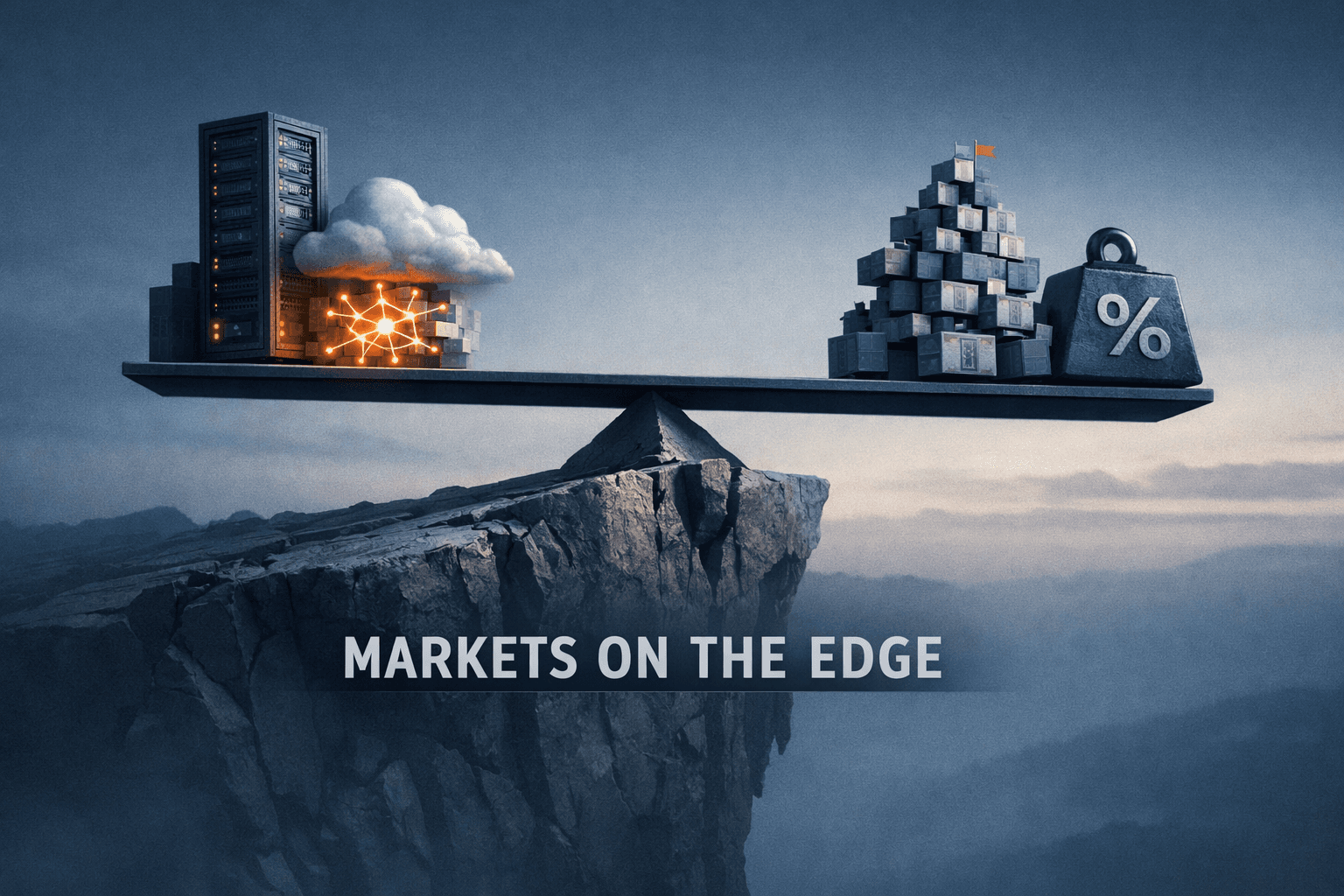
Today was a classic example of a markets-in-flux session: concentrated, high-conviction wins in AI infrastructure and cloud (Dell, Snowflake, Microsoft-led flows) produced a clear risk-on headline, while macro readings and sector-level nuances kept the path forward ambiguous. Analysts note the rally's dual character — substantively driven by demand beats but materially exposed to valuation and rate sensitivity.
For investors, the pragmatic takeaway from the day's cross-cutting coverage is to treat headline-driven repricings as an input, not a verdict. The data suggest opportunity and risk coexist: AI adoption is accelerating and being priced in, but persistent inflation and mixed fundamental breadth leave room for reversals if earnings revisions or rate expectations shift. This requires active monitoring of order books, partner contracts, estimate trends, and Fed signaling.
Investment disclaimer: This summary is informational and analytical only. It does not constitute personalized investment advice or recommendations to buy, sell, or hold any security.
Sources
+ 7 more sources
Use these insights — enter this week's contest.
Free practice contests — earn Alpha CoinsExplore More Content
Disclaimer: StockAlpha.ai content is for informational and educational purposes only. It is not personalized investment advice. Sentiment ratings and market analysis reflect data-driven observations, not buy, sell, or hold recommendations. Always consult a qualified financial advisor before making investment decisions. Past performance does not guarantee future results.