 Breaking Analysis
Listen to this Recap
9:32
AI Earnings, Retail Resilience and a Brewing Macro Disconnect: Nvidia, Lowe’s, Meta and the Market’s Pulse
Podcast • Loading audio...
Share this article
Spread the word on social media
Key Takeaways
- •Nvidia’s guidance (consensus ~ $78B revenue, data‑center ~ $73B) is the primary market catalyst; it will shape capex and supplier narratives across semiconductors and optics.
- •Retail is bifurcated: Lowe’s beat and Home Depot’s reaffirmation contrast with consumer stress signals (E.l.f. rolling back price hikes; PepsiCo implementing selective price increases).
- •Macro divergence is growing — equity strength is colliding with a revised misery index that incorporates mortgage rates and signals rising household strain.
- •Event volatility is elevated (Salesforce implied move ~7.9%); traders and risk managers must price earnings and guidance risk explicitly.
Today's top developments
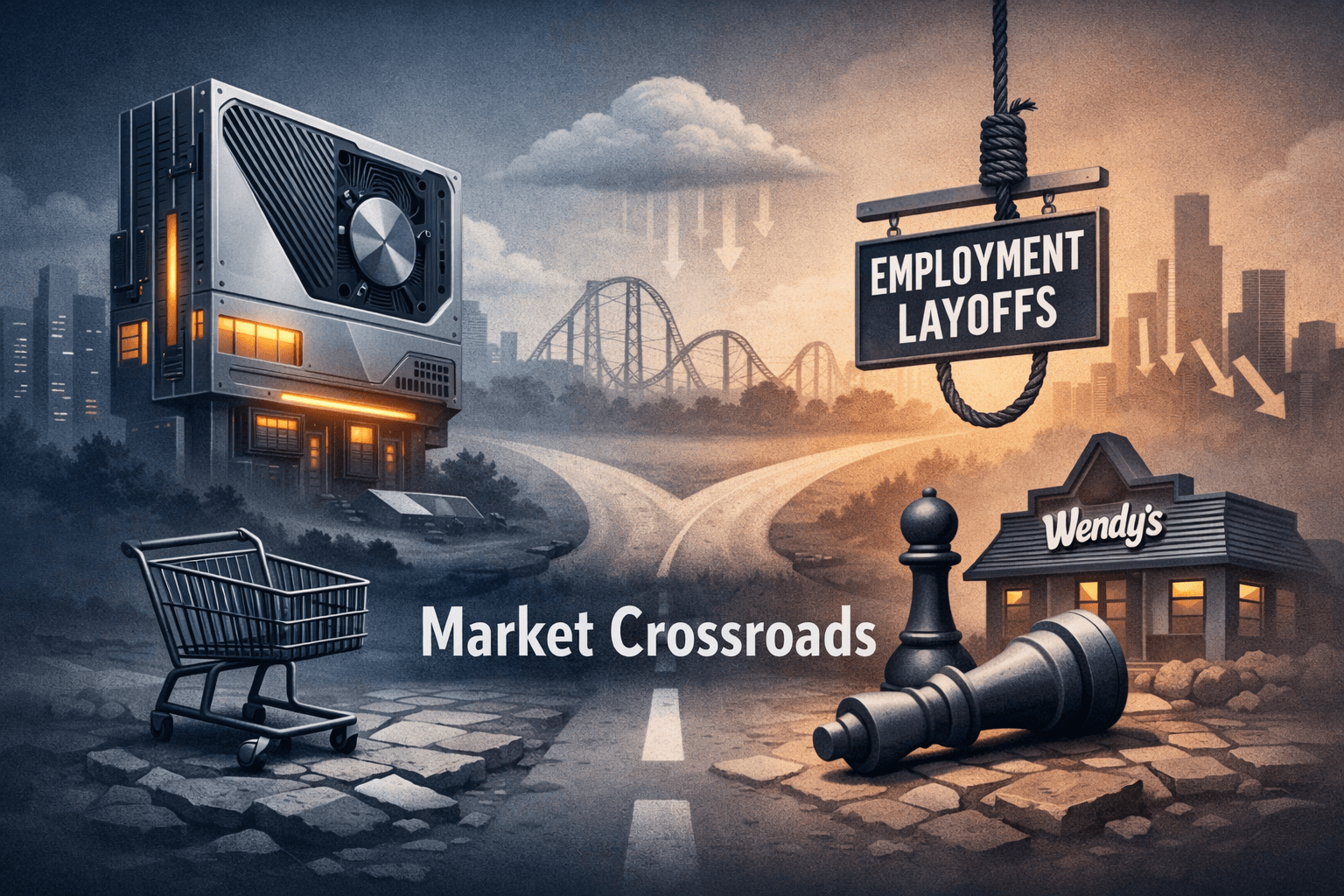
The market day is dominated by a trio of interrelated storylines: Nvidia’s looming fiscal Q1 2027 report and the guidance that will signal the pace of the AI data‑center build; surprising resilience in the home‑improvement patch led by Lowe’s; and a wave of corporate moves that highlight both cost discipline and shareholder activism (Meta layoffs, Wendy’s leadership change and Trian’s financing effort). Overlaying those headlines is an increasingly loud macro debate: equity markets are pushing higher while a revised “misery index” that now includes mortgage rates is flashing near‑warning levels for household stress.
What ties these threads together is twofold: capital allocation choices driven by the AI cycle and an uneven consumer backstop that’s testing pricing power across sectors.
Synthesis of the day’s key themes
- AI data‑center demand remains the primary market hinge
Nvidia ($NVDA) reports after the close, and guidance will be the tell. Consensus for fiscal Q1 2027 revenue sits near $78 billion with non‑GAAP EPS around $1.77; data‑center revenue consensus is roughly $73 billion. Some desks sit higher (Goldman near $80 billion) and Q2 consensus is already tracking toward ~$86 billion. Analysts and traders note that management commentary on cadence—how quickly customers ramp capacity and how supply‑chain timing plays out—will set the tone for chipmakers (AMD among peers) and a broad set of optics and packaging suppliers (e.g., POET called out in coverage).
The implication: Nvidia’s guidance does not only move its own multiple; it is a macro signal for capex, sales cycles for infrastructure vendors, and near‑term inventory flows that ripple through semiconductors, board vendors and optical suppliers.
- Retail is bifurcated — operational resilience vs. pocketbook pressure
Lowe’s ($LOW) repeatedly beat expectations for fiscal Q1 and reaffirmed full‑year guidance. One note quantified a share price reaction at $283.76 (up ~1.5% intraday in one writeup) and referenced key internal metrics such as 2.13% and 1.06% in the company materials. Home Depot ($HD) received a reiteration from Guggenheim after ‘strong results’, underscoring how select big‑box operators are holding up despite a sluggish housing market.
Offsetting that, consumer strain is evident in other coverage: E.l.f. Beauty is walking back some tariff‑driven price increases after a $1 lift last August, citing consumer “suffering” and high gas prices; PepsiCo ($PEP) signaled selective price increases to offset input costs but is doing so cautiously (PEP trading roughly in the $186–$190 range). These moves illustrate a broader dynamic: firms with stronger pricing power or essential categories are defending margins, while more discretionary brands are trimming or reversing price actions to protect volume.
- Corporate actions and activism are intensifying strategic turnover
Meta’s workforce reduction—about 10% of staff, roughly 8,000 jobs—was a blunt reminder that scale players are reshaping cost bases even as they race to secure AI advantages. CEO commentary that “success isn’t a given” injects additional near‑term execution risk into the AI narratives for the FAANG cohort.
Wendy’s ($WEN) named former Potbelly CEO Bob Wright to lead the chain as reports emerged that Nelson Peltz’s Trian is lining up financing for a potential take‑private push. That combination of management change and activist financing speaks to an active M&A and governance backdrop in consumer names.
- Event volatility and investor positioning matter more than usual
- Options pricing implies Salesforce ($CRM) could move about 7.9% on its earnings release, a level that emphasizes elevated event risk and the potential for outsized short‑term moves. Qualcomm ($QCOM) was highlighted for its AI optionality, trading near $150 with intraday moves around 3.95% in some coverage—another sign of how quickly markets reprice narratives tied to AI participation.
Conflicting views and market debates
AI optimism vs. consumer fragility: Analysts tracking Nvidia and Qualcomm see a durable, multi‑quarter capex surge tied to generative AI. At the same time, the MarketWatch‑highlighted ‘misery index’ that now includes mortgage rates suggests household finances are under strain. The core debate: will corporate capex and AI‑driven enterprise demand be sufficient to offset weakening end‑consumer dynamics? Experts are split; some point to durable software and cloud contracts, others warn about the lagged knock‑on effects of stressed consumers for cyclical revenue streams.
Pricing power vs. margin preservation: PepsiCo’s selective price increases and E.l.f.’s rollback present a case study in price elasticity. Do brands with established channels and inelastic demand continue to pass costs through, or will elevated living costs force broader reversions in pricing, hurting margins? Coverage shows firms taking divergent tactical responses, signaling a lack of consensus on where the consumer line lies.
Growth narrative vs. cost control at scale tech firms: Meta’s layoffs are read two ways—either prudent cost‑structure optimization to fund long‑term AI R&D, or a sign that management is recalibrating after overhiring for an AI future that remains uncertain in monetization. Analysts note both possibilities, producing divergent sentiment on how durable margins and revenue growth will be.
Deeper context on the biggest moves
Why Nvidia guidance matters beyond the stock: With consensus data‑center revenue near $73 billion and Q2 expectations pushing toward $86 billion, Nvidia’s guidance is effectively a real‑time read on enterprise AI investment cycles. A beat and upward cadence would validate carryover demand for networking optics, memory, and advanced packaging; a cautious guide could prompt immediate supply‑chain repricing and knock‑on pressure for suppliers and rivals.
The ‘misery index’ wrinkle: Traditional misery indexes combine inflation and unemployment to capture household pain. The updated version folding mortgage rates into the mix raises sensitivity to housing costs—an important channel when mortgage service burdens can quickly undercut discretionary spending. Markets can detach from these fundamentals for extended periods, but the new gauge is a warning light for inflation‑sensitive, consumption‑driven sectors.
Event volatility quantified: The 7.9% options‑implied move for Salesforce is meaningful because it’s a market‑priced expectation for a single discrete event. For option buyers/sellers and short‑term traders, that alters risk calculus: implied vol is elevated, making hedges costlier but also offering defined‑risk ways to express views.
Implications by investor type
Growth/AI‑focused investors: Nvidia’s guidance will be the day’s focal point. Data‑center revenue trajectory and commentary on customer cadence will influence multiple subsectors (chips, optics, cloud services). Analysts note that AI exposure can still mask execution risk—watch management’s language on order timing and inventory.
Value and income investors: Sound Shore’s view of BP as “valuable” beyond short‑term commodity spikes re‑emphasizes the value case in energy amid geopolitical noise. Affiliated Managers Group ($AMG) has outperformed modestly (about 17.4% over six months vs. S&P 500 at 13.3%), which matters to investors assessing financials and asset‑manager exposure.
Consumer/retail hands: Lowe’s beats and Home Depot’s reiterated strength suggest big‑box resilience, but E.l.f. and PepsiCo’s actions flag bifurcated pricing dynamics. Traders should track same‑store sales, basket size, and margin commentary; strategists will parse which categories are durable versus discretionary.
Event traders and options players: Salesforce’s 7.9% implied move and recent intraday swings in Qualcomm (~3.95%) imply opportunities and risks around earnings/announcements. Elevated implied volatility means hedges cost more; dealers and risk managers will be watching skew and term structure.
Activist and event‑driven investors: Wendy’s leadership change plus Trian’s financing maneuvering exemplifies how activist pressure can catalyze strategic reviews and potential M&A. Monitor proxy season signals and financing terms.
Strategic considerations and closing thoughts
Watch guidance cadence not just headline beats. For AI infrastructure names, the timing of customer rollouts and supply‑chain flow is as consequential as absolute revenue numbers.
Position for bifurcation, not uniformity. The market is carving winners (some large retailers, selected chips and infrastructure providers) and pressured names (lower‑priced discretionary goods). Sector allocation should reflect that dispersion, and not assume broad‑based strength.
Manage discrete event risk explicitly. Elevated options‑implied moves around earnings (Salesforce) and major guidance events (Nvidia) make short‑term hedging and position sizing essential for volatile exposures.
Track macro signals that feed consumption: mortgage rates and the revised misery index are now must‑watch metrics for consumer‑exposed stocks. A persistent divergence between equity performance and household stress increases tail‑risk for cyclical sectors.
Corporate governance matters again. Layoffs, activist financing, and CEO turnover are active themes; they influence both near‑term liquidity (buyouts, dividends, capex) and long‑term strategy.
Investment disclaimer: This summary is for informational purposes only. It does not constitute personalized investment advice or an explicit recommendation to buy, sell or hold any security. Analysts’ sentiments and data cited here reflect market observations and should be considered alongside your own research and professional guidance.
For readers monitoring tomorrow’s market moves, Nvidia’s guidance and the cadence sentences on data‑center demand will be the single most important catalyst; beyond that, the interplay between consumer indicators (mortgage rates, discretionary volumes) and corporate cost/pricing actions will determine whether current equity gains are durable or vulnerable to a sentiment shift.
Sources
+ 9 more sources
Use these insights — enter this week's contest.
Free practice contests — earn Alpha CoinsExplore More Content
Disclaimer: StockAlpha.ai content is for informational and educational purposes only. It is not personalized investment advice. Sentiment ratings and market analysis reflect data-driven observations, not buy, sell, or hold recommendations. Always consult a qualified financial advisor before making investment decisions. Past performance does not guarantee future results.