 Breaking Analysis
Listen to this Recap
8:55
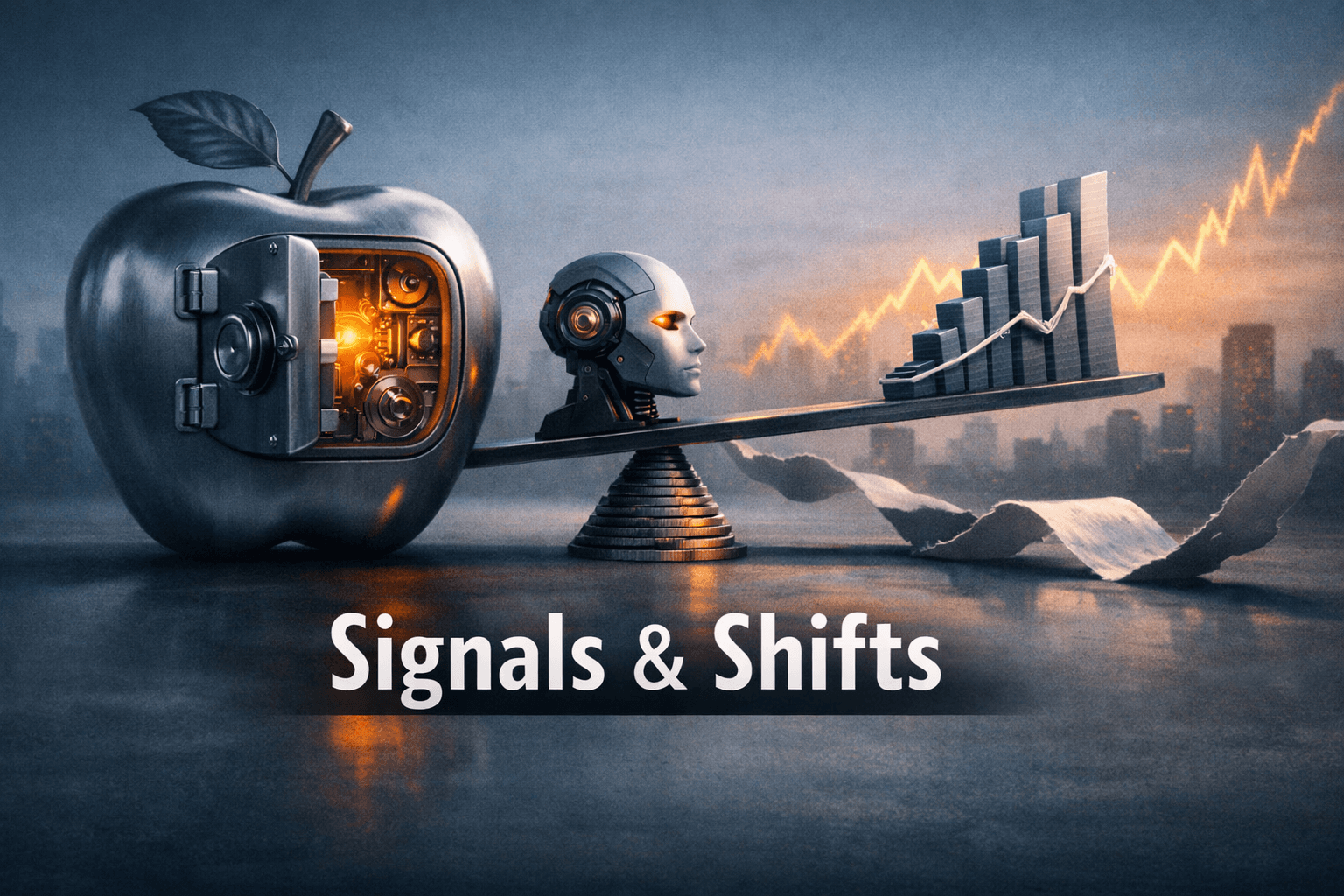
Apple's M&A Signal and Market Resilience: What the Net-Cash-Neutral Shift and a 'Powered-Through' Tape Mean for Investors
Podcast • Loading audio...
Share this article
Spread the word on social media
Key Takeaways
- •Apple’s retirement of a net-cash-neutral target materially increases its M&A optionality and raises the prospect of a large AI-focused acquisition.
- •Market commentators say the market ‘powered through’ a heavy earnings week, but stress that resilience does not guarantee durable strength — downside risks remain.
- •The capital-allocation shift at Apple forces a trade-off analysis between potential long-term AI-driven growth and near-term shareholder-return dynamics (buybacks/dividends).
- •Investors should watch corporate filings, guidance trends, volatility measures (e.g., VIX), and credit spreads for signals on deal financing and market breadth.
Today's Most Significant Developments
Two interconnected market narratives dominated Alpha's breaking coverage over the past 24 hours: first, Apple’s (AAPL) announcement that it has retired its long-standing net-cash-neutral target — a move market-watchers read as clearing the way for larger, balance-sheet-intensive M&A, potentially in AI. Second, high-profile commentators such as Jim Cramer argued the market “powered through” a difficult earnings slate, but cautioned that resilience does not equal safety.
Taken together, these stories frame a market that is operationally resilient yet strategically unsettled: capital-allocation regimes at mega-cap techs may be changing at the same time investors are parsing whether recent breadth and earnings absorption will sustain into the summer.
Synthesis of the Key Themes
Capital-allocation regime shift at a market bellwether: Alpha’s reporting highlights that Apple’s retirement of a net-cash-neutral posture removes a formal limit on running net debt and, by extension, the size of acquisitions the company will consider. Analysts note this is a structural change in how one of the largest corporate treasuries can be deployed.
Potential acceleration of AI-driven revenue expectations: The Apple story is being framed specifically through an AI lens — market-watchers suggest that the company could finance a transformational AI acquisition to accelerate product-level AI integration and revenue mix change. That possibility has re-priced expectations around Apple’s strategic optionality even absent an announced deal.
Market resilience vs. latent fragility: Commentators captured in the second report emphasize that, while the market absorbed a heavy earnings calendar (reported as the tape having "powered through"), doubts remain about forward guidance, seasonal rotation, and macro sensitivity. The consensus among the commentators is cautious: momentum exists, but downside risks persist.
Volatility and event risk remain elevated: Both threads imply elevated event risk — corporate (M&A and capital-allocation announcements) and macro/earnings (guidance misses, sequential deceleration). Traders and risk managers are therefore watching volatility indicators and corporate filings more closely.
Points of Agreement and Debate Across Analyses
Where analysts converge:
- Observers agree the net-cash-neutral retirement is material: even if Apple does not imminently announce a megadeal, removing that constraint changes the company’s optionality and investor expectations about future capital allocation.
- There is recognition that the market has shown short-term resilience in the face of a heavy earnings calendar; many commentators credit this to better-than-feared beats and contained downside surprises.
Where views diverge or remain uncertain:
- Magnitude and timing of M&A: Some market participants interpret Apple’s posture change as a near-term signal that a sizable AI acquisition is imminent; others view it as a longer-term strategic repositioning that preserves the flexibility to act when the right target emerges.
- Net effect on shareholder returns: One camp emphasizes potential upside (accelerated AI-driven growth and re-rating), while another highlights trade-offs (reduced buybacks, potential dilution if stock-financed, higher leverage if debt-financed) that could temper EPS trajectories in the near term.
- Durability of the market’s recent resilience: Jim Cramer’s framing — “powered through… but not out of the woods” — illustrates debate on whether recent breadth and earnings absorption indicate a sustainable recovery or a transient reprieve ahead of tougher macro or earnings news.
Deeper Context: Why Apple's Capital-Allocation Shift Matters
What net-cash-neutral meant: The target essentially limited Apple’s willingness to run net debt for long periods, directing excess cash toward buybacks and dividends and constraining the scale of acquisitions. Retiring that target signals management is prepared to alter the balance between returning capital to shareholders and investing in strategic M&A.
Financing options and balance-sheet implications: If Apple pursues a large acquisition, financing could come from cash on hand, new debt issuance, or stock consideration — each path carries different implications.
- Cash-financed deals reduce liquidity buffers and may prompt investors to re-evaluate short-term cash returns.
- Debt-financed deals increase leverage and bring scrutiny of interest-coverage and credit spreads; for credit investors, increased issuance could widen corporate bond supply dynamics.
- Stock-financed deals dilute existing shareholders and can compress near-term EPS if the acquired asset does not immediately contribute at comparable margins.
Valuation and strategic rationale: Market commentary ties the M&A thesis to AI — a high-impact area where Apple has been building software and silicon capabilities. A large acquisition could accelerate device-level AI experiences and create new monetization pathways (services, software subscriptions, developer ecosystems). But big acquisitions carry integration risk, execution risk, and the danger of overpaying for growth that markets priced ambitiously.
Regulatory and competitive overlay: Large-scale tech M&A continues to face elevated antitrust scrutiny globally. Any transformative acquisition would face regulatory review that could delay or alter deal terms, which in turn affects the timing and degree of any valuation uplift.
Deeper Context: Interpreting the 'Powered Through' Narrative
What “powered through” actually connotes: Commentators mean the headline indices rallied or held up despite a heavy earnings calendar, implying that negative surprises were limited or offset by positive guidance/forward commentary.
Why Caution remains warranted: Analysts emphasize that absorbing one tough earnings week does not insulate markets from subsequent risks — in particular, cumulative guidance trends across sectors, inflation and rate path surprises, and geopolitical shocks. The fragmentary data in the coverage (a partial mention of “2.93%” in one report) underscores that some metrics cited during the commentary were incomplete or context-dependent in the initial briefings.
Volatility measures and breadth: Practitioners track the VIX, credit spreads and market breadth to assess whether the rally is broad-based or narrow (e.g., concentrated in mega-caps). A narrow rally led by a handful of stocks is less durable than broad participation across cyclical and defensive sectors.
Implications for Different Investor Types
Long-term, fundamental investors:
- Analysts note the Apple move increases optionality for generating long-term growth via strategic M&A, especially in AI. These investors should parse management’s strategic rationale and assess acquisition targets’ fit with Apple’s ecosystem, margins and long-horizon revenue potential.
Income and buyback-focused investors:
- The removal of a net-cash-neutral target signals a potential rebalancing away from aggressive buybacks. That matters for investors who have relied on large-cap buybacks to underpin EPS growth; they will want to monitor buyback cadence and dividend policy commentary.
Active, event-driven traders:
- Expect increased dispersion and event risk: M&A speculation and earnings-season follow-through create trading opportunities but also heightened tail risk. Traders may watch filings (8-Ks, 10-Q commentary), M&A rumor flow, and volatility measures closely.
Fixed-income and credit investors:
- If Apple or other megacaps opt for debt to finance acquisitions, corporate debt supply and credit spreads could move. Credit investors should track leverage metrics, rating agency commentary and the terms of any issuance.
Risk managers and allocation committees:
- The twin developments argue for scenario planning: recalibrate stress tests around potential large-cap M&A, and incorporate path-dependent scenarios where buybacks slow and corporate leverage rises.
Conflicting Signals to Watch
- Firm-level optionality vs. near-term returns: Will capital reallocated to M&A be value-accretive enough to offset lower buybacks? Analysts disagree, making pricing and management commentary pivotal.
- Market resilience vs. latent volatility: The market’s ability to absorb earnings is encouraging but incomplete data and guidance trends could still trigger a re-pricing.
Key data points to monitor over the coming weeks: Apple’s investor communications and any 8-K/press releases; subsequent earnings guidance from major bellwethers; VIX and market-breadth metrics; credit spread movements for investment-grade corporates.
Strategic Considerations (Informational Purposes Only)
- Monitor corporate disclosures: For Apple, watch formal filings, management commentary at investor events, and any M&A-related language beyond policy changes. Those documents will reveal how management plans to finance and integrate deals.
- Watch forward-looking signals: Earnings guidance, capex plans, and R&D commentary will indicate whether companies are shifting focus toward AI-driven investments versus shareholder distributions.
- Pay attention to market structure: Track breadth, VIX and credit spreads to distinguish a concentrated mega-cap rally from a broad market recovery.
- Scenario-plan across time horizons: Consider cases where M&A accelerates growth (longer-term re-rating) versus where buyback slowdowns compress near-term EPS growth (near-term multiple pressure).
Conclusion
Alpha’s coverage over the past 24 hours surfaces a meaningful inflection: a leading tech company has formally expanded its strategic toolbox by dropping a net-cash-neutral constraint, reintroducing the possibility of transformational, balance-sheet-funded M&A in an area — AI — that investors prize. Simultaneously, market commentators argue the tape has shown resilience through a difficult earnings stretch, but emphasize that momentum is not the same as durability.
The intersection of these themes creates a market environment where strategic corporate moves and macro/earnings follow-through will be the primary drivers of risk and opportunity. Investors and risk managers should therefore prioritize forward-looking disclosures, volatility and credit signals, and differentiated scenario analysis — while remembering that the debate over whether such M&A will be accretive or dilutive remains unresolved.
Investment disclaimer: This analysis is for informational purposes only. It does not constitute a recommendation to buy, sell, or hold any security, nor is it personalized investment advice. Analysts note risks and trade-offs; readers should consult their own advisors and perform due diligence before making investment decisions.
Sources
Use these insights — enter this week's contest.
Free practice contests — earn Alpha CoinsExplore More Content
Disclaimer: StockAlpha.ai content is for informational and educational purposes only. It is not personalized investment advice. Sentiment ratings and market analysis reflect data-driven observations, not buy, sell, or hold recommendations. Always consult a qualified financial advisor before making investment decisions. Past performance does not guarantee future results.