 Breaking Analysis
Listen to this Recap
10:28
Energy-Driven Rotation and Guidance Sensitivity Dominate: Carvana Rally, Coke Upgrade, Gasoline Pain for Restaurants
Podcast • Loading audio...
Share this article
Spread the word on social media
Key Takeaways
- •Carvana reported record Q1 retail sales of 187,393 units (+40% YoY), sparking a positive share reaction but raising valuation and cyclicality questions.
- •Coca‑Cola posted 10% organic growth, raised EPS outlook to 8%–9%, and reported $47.9B in revenue and $3.04 full-year EPS, underscoring resilience in staples.
- •Higher gasoline prices (U.S. average near $4.23/gal) are squeezing restaurant traffic (Wingstop cited gasoline as a drag), creating a cross‑sector consumer headwind.
- •Bloom Energy’s Q1 beat and an Oracle partnership highlight the rising AI-infrastructure narrative; KKR’s earnings miss versus fundraising momentum illustrates tension between short-term headlines and long-term structural drivers.
- •SoFi’s record lending prints failed to generate an upside move after management kept full-year guidance unchanged, showing the market’s emphasis on forward signaling.
The day's most significant developments
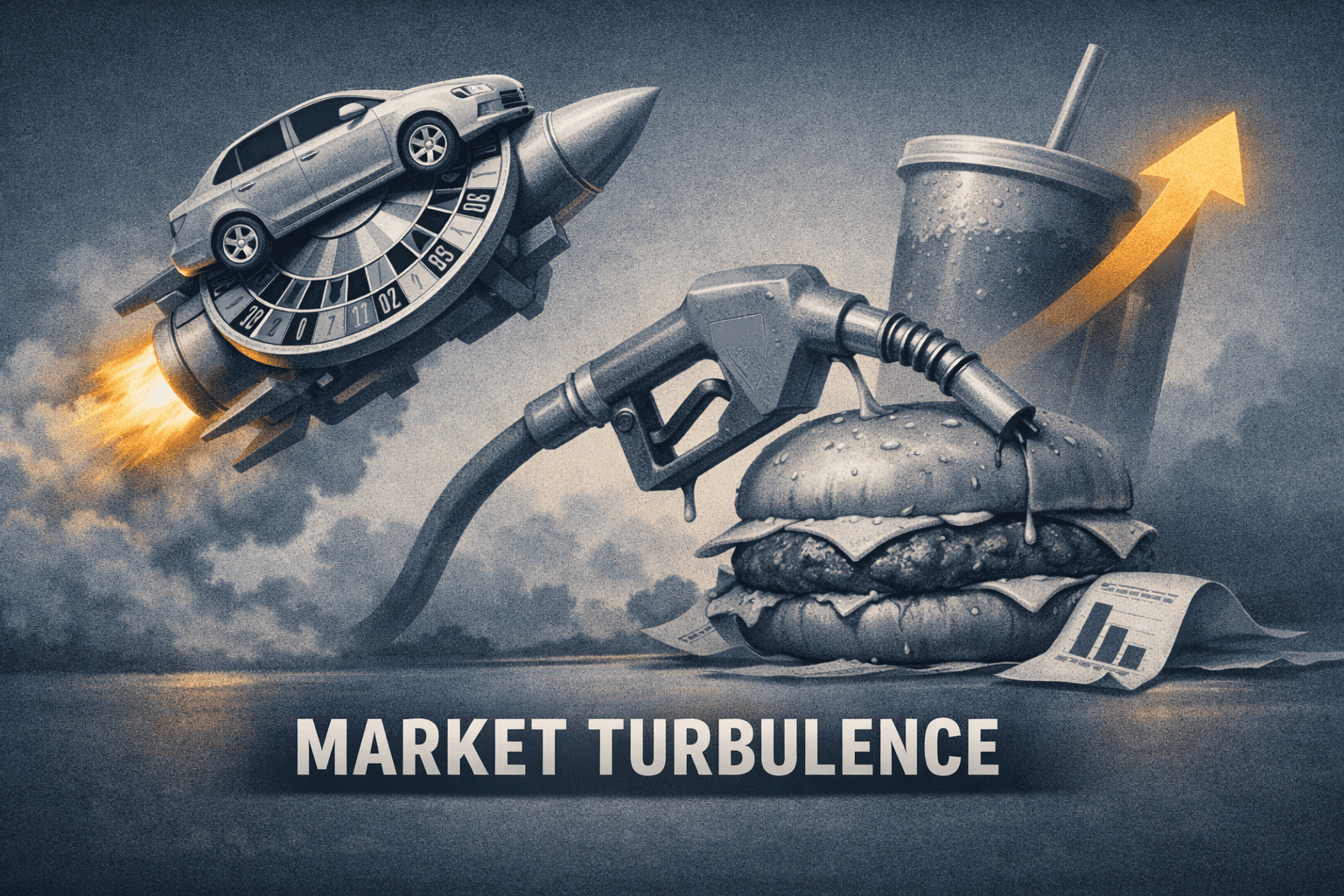
Several cross-cutting stories set the market tone today: Carvana ($CVNA) popped after reporting record first-quarter retail sales of 187,393 units, a 40% year-over-year increase; Coca‑Cola ($KO) posted 10% organic growth, lifted its full-year EPS outlook to 8%–9%, and reported $47.9 billion in net revenue and a $3.04 full-year EPS figure; and energy moved back into focus as oil prices jumped, helping names such as Bloom Energy (ticker: $BE) power higher on Q1 beats and a disclosed Oracle partnership tied to an "AI pipeline." At the same time, consumer-facing chains — most notably Wingstop ($WING) — blamed rising gasoline costs for weaker traffic, while SoFi ($SOFI) and KKR ($KKR) illustrated the market’s growing bifurcation between operational beats and guidance or near-term headline risk.
Two cross-currents are especially important: (1) an energy/commodity impulse that is lifting energy-linked equities but pressuring discretionary consumption through higher pump prices (the average U.S. gasoline price is near $4.23 per gallon, and energy-related volatility was cited as having surged up to 300%), and (2) a market that increasingly separates operational outperformance from forward-looking catalysts — a dynamic that can mute rallies even after beats.
Synthesizing the key themes
- Beats vs. guidance — market punishment for muted outlooks
- SoFi posted record lending metrics and topped quarterly expectations, yet the stock fell because management left its full-year outlook unchanged. Analysts and traders interpreted the withheld guidance upgrade as the removal of a forward catalyst.
- KKR missed earnings and dropped on the print, but the firm simultaneously reported strong fundraising momentum. The contrast highlights a recurring theme: near-term earnings surprises can drive short-term headline risk, while secular or structural business developments (fundraising, deal pipelines) are increasingly treated as longer-horizon positives.
- Energy-driven rotation and the consumer squeeze
- An uptick in oil prices lifted energy and energy-adjacent names (Bloom Energy was highlighted among Dow futures earnings movers), but the same move is compressing discretionary spending. Restaurant executives at Wingstop explicitly pointed to higher gasoline costs as a drag on traffic and spend, a concrete example of how commodity-driven price pressure transmits to consumer behavior.
- The gasoline pump price reference point ($4.23/gal) and cited spikes in energy volatility (up to ~300%) illustrate why investors are watching real-economy channels rather than only headline equity flows.
- AI and strategic re‑positioning of business models
- Bloom Energy’s Q1 beats and management commentary around a “robust AI pipeline” — amplified by a partnership with Oracle — signal investor interest in companies that can transition from legacy equipment or services to AI-enablement infrastructure. Polen Capital’s Q1 letter also flagged AI disruption as a driver of re‑pricing in growth names, underlining that AI is both an opportunity and a source of valuation uncertainty.
- Divergence within consumer and industrial cycles
- Coca‑Cola’s 10% organic growth and raised EPS outlook contrast with stress across fast-casual and casual-dining names. Caterpillar’s Q1 preview (analysts expect revenue +13.7% YoY) suggests durable industrial demand, even as consumer discretionary faces a gasoline-induced headwind.
Where analysts and market participants disagree
Valuation vs. execution: Carvana’s record retail-unit performance (187,393 units, +40% YoY) prompted a positive share reaction, but analysts note the tradeoff between improving demand/execution and valuation/volatility. Some coverage frames the print as a clear operational turnaround; others urge caution about cyclicality and near-term margin pressure.
Operational beats vs. management signaling: SoFi’s record lending metrics (company-disclosed figures included several large percentage datapoints — for example, reported values such as 126.50%, 50.50%, 1.57% in one summary and 160.61%, 61.43% in another) are opening a debate on whether product-level momentum is being constrained by risk‑management conservatism or macro uncertainty. The market’s negative reaction to unchanged guidance reflects one camp that prioritizes forward signals, while another emphasizes the raw operating trends.
Short-term headline risk vs. long-term structural growth: KKR’s earnings miss versus fundraising momentum encapsulates a broader disagreement. Traders reacted to the earnings miss as headline risk; strategists point to fee-related earnings and AUM growth as a multi-quarter positive. The difference in time horizon explains much of the discord.
Deeper context on major moves
Carvana (used cars): The 40% YoY increase to 187,393 retail units is meaningful for a sector that has been cyclical and sensitive to credit and macro volatility. A sustained recovery in units sold points to normalization of used-car demand after pandemic-era dislocations, but online used-car retailers remain exposed to margin squeeze, inventory turns, and credit markets.
Coca‑Cola (staples/resilient discretionary): Coca‑Cola’s 10% organic growth and raised EPS outlook (8%–9%) reflect pricing power and favorable product mix (management cited smaller packaging and premium products). For income-oriented investors, raised EPS guidance often signals higher expected cash flow durability, while growth investors see confirmation of resilient demand for branded consumer staples.
Restaurants and gasoline: Wingstop’s executive commentary about gasoline costs undercutting traffic is a direct microeconomic transmission of energy price moves into consumer behavior. When gasoline is materially higher, households may cut frequency in lower‑priority discretionary categories such as dining out or choose lower-ticket options — a mechanism that is already showing up in same-store-sales and margin chatter across the segment.
Bloom Energy and AI: Bloom’s quarter beat alongside the disclosure of an Oracle partnership repositions the company as more than an energy-equipment vendor; it suggests a potential revenue stream from AI data-center or edge-power solutions. Market participants will parse whether the partnership is revenue-accretive near term or primarily strategic signaling that supports a higher long-term multiple.
Polen Capital’s repositioning: Exits such as Abbott Laboratories ($ABT) and commentary about AI and Middle East geopolitical risk underscore a broader rotation among active managers. When asset managers reallocate, it can accelerate repricing in concentrated growth names and bite into liquidity for large-cap growth if concerns metastasize.
Implications for investor types
Short-term traders: Volatility around earnings, guidance messaging, and energy headlines creates intraday and event-driven trading opportunities. Key items to watch are guidance revisions, same-store-sales prints, and commodity price moves.
Growth investors: AI-related narratives (Bloom Energy, Polen’s AI commentary) and operational beats without an immediate guidance lift (SoFi) demand a longer horizon. Growth investors should focus on signposts such as contract wins (e.g., Oracle), scalable revenue pipelines, and margin trajectory rather than single-quarter noise.
Income and value investors: Coca‑Cola’s raised EPS outlook and stable organic growth speak to resilient cash flows. However, energy-driven inflationary pressure and consumer discretionary weakness warrant monitoring of margin trends and input-cost pass-throughs.
Cyclical and commodity-focused investors: The oil-led rotation benefits energy names and equipment suppliers (e.g., Caterpillar if demand persists), but also raises the risk of dampened consumer demand via higher pump prices. Track oil, refining margins, and gasoline pump prices closely.
Private equity and institutional allocators: KKR’s mixed print (earnings miss, fundraising momentum) underlines the importance of separating near-term sensitivity in public earnings from durable fee-related revenue streams tied to fundraising and AUM growth.
What to watch next (catalysts and indicators)
- Upcoming earnings: Ford (reporting after the bell), Caterpillar (analyst preview +13.7% YoY revenue expected), and major tech names scheduled to report later in the week will help define sector leadership.
- Commodity metrics: U.S. gasoline average near $4.23/gal and the reported jump in energy volatility (~300%) are key macro inputs for consumer discretionary exposure.
- Guidance language: Watch not just beats but whether managements raise guidance or revise forward-looking assumptions; the market is treating guidance moves as primary catalysts.
- AI commercial traction: For companies positioning around AI infrastructure, look for concrete contract sizes, pilot-to-production cadence, and revenue recognition timelines (Bloom Energy’s Oracle disclosure is an example of a signal worth parsing).
Strategic considerations (disclaimer and final thoughts)
Analysts note that today’s action reflects a market increasingly driven by cross‑sector divergences: energy and AI narratives are creating winners even as higher gasoline prices and guidance caution are creating losers. That bifurcation favors active monitoring of catalysts (guidance, commodity prices, fundraising flows) and a focus on time horizon alignment when interpreting headlines.
Investment disclaimer: This summary is for informational purposes only. It does not constitute a recommendation to buy, sell, or hold any security, nor is it personalized investment advice. Analysts note trends, data points, and market reactions; readers should consult a qualified financial advisor before making investment decisions.
Bottom line
Today’s tape serves as a reminder that operational beats alone are no longer a guaranteed share-price catalyst — forward guidance, energy prices, and strategic narratives (AI, fundraising momentum) are equally decisive. Investors and allocators who can differentiate short-term headline risk from durable structural change will be better positioned to interpret the coming flow of earnings, commodity data, and geopolitical news.
Sources
+ 8 more sources
Use these insights — enter this week's contest.
Free practice contests — earn Alpha CoinsExplore More Content
Disclaimer: StockAlpha.ai content is for informational and educational purposes only. It is not personalized investment advice. Sentiment ratings and market analysis reflect data-driven observations, not buy, sell, or hold recommendations. Always consult a qualified financial advisor before making investment decisions. Past performance does not guarantee future results.