 Breaking Analysis
Listen to this Recap
10:26
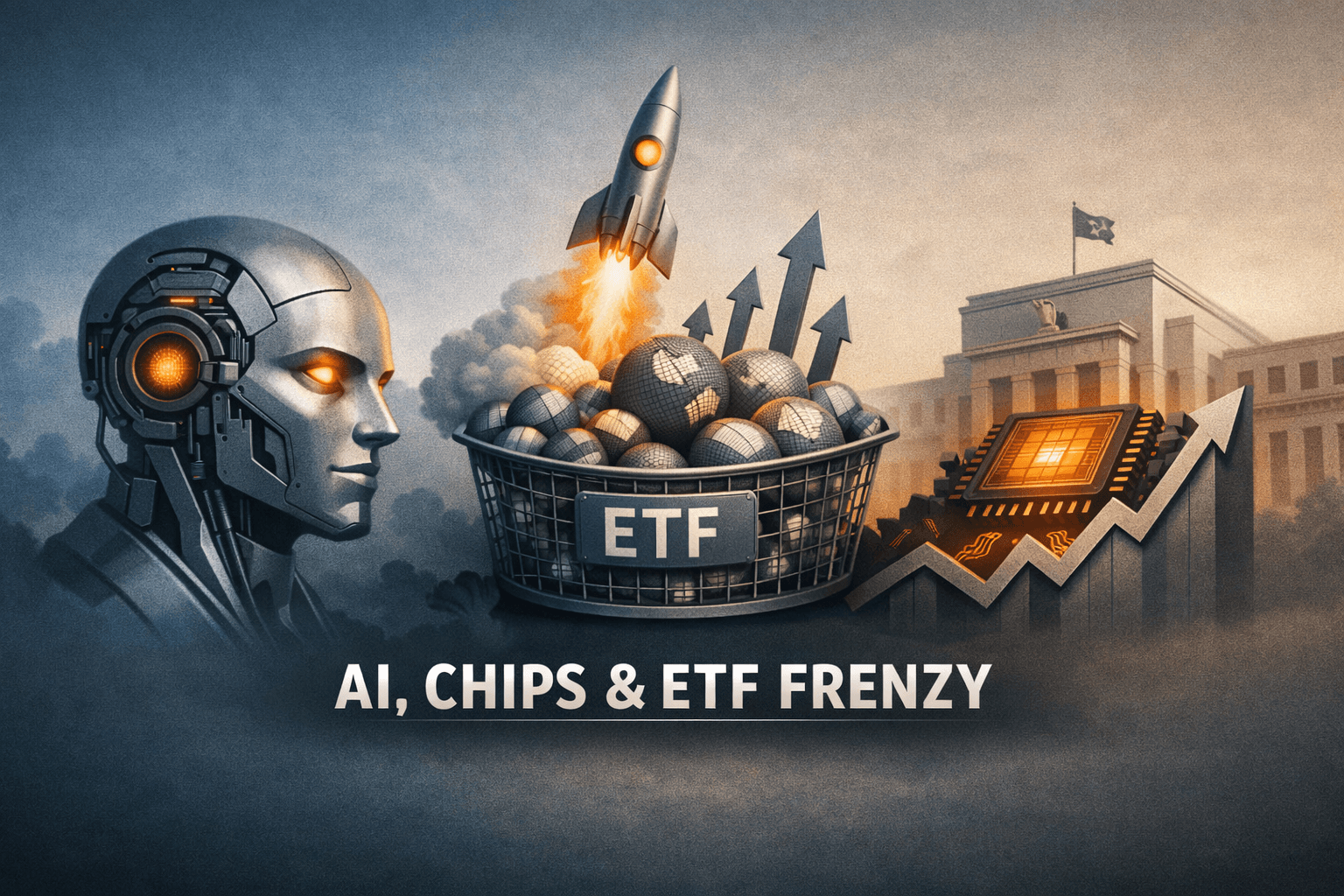
AI, Chips and ETFs Drive Divergence as Fed Calm Meets Sector-Specific Shocks
Podcast • Loading audio...
Share this article
Spread the word on social media
Key Takeaways
- •Google’s up-to-$40B Anthropic commitment and multiple model previews (DeepSeek, UII) reignite the AI infrastructure and software narrative, shifting demand assumptions for chip and cloud suppliers.
- •Semiconductor momentum is strong (SMH +30% month-to-date) but raises valuation and volatility risks; elevated participation (e.g., INTC 124.9M shares) intensifies sensitivity to earnings and guidance.
- •The Fed pause and the DOJ ending its probe into Chair Powell remove major macro/political uncertainty, leaving company-specific catalysts and sector rotation to drive near-term performance.
- •Thematic ETF inflows (space, international) highlight investor preference for concentrated exposure, but product construction and concentration risk deserve scrutiny for portfolio sizing.
Today's top developments
The most consequential headlines combined macro stability with concentrated, high-conviction sector flows. Two large structural tech stories—Google's announced up-to-$40 billion investment in Anthropic and DeepSeek's V4 preview—reanimated the AI narrative and shifted investor attention toward model makers and infrastructure suppliers. That impulse coincided with an intense chip rally (SMH up more than 30% this month) and heavy volume in individual names (Intel traded 124.9M shares and rose 2.31% to $66.78). At the same time, the Fed’s settled stance (markets expect a hold) and news that the DOJ ended its probe into Fed Chair Jerome Powell removed a political overhang, preserving policy continuity as a backdrop.
These dynamics produced a bifurcated market: exchange-traded funds and thematic templates (space, international equities, semiconductors) attracted flows, while certain cyclical or guidance-driven names (Graphic Packaging, Kyndryl) faced immediate pressure after earnings or mixed updates.
Cross-cutting themes from today’s analyses
- Acceleration of the AI and infrastructure narrative
- Google’s commitment to invest up to $40 billion in Anthropic is a watershed: the scale of capital redeploys valuation inputs for foundation-model vendors, cloud providers and chip makers. Analysts note this is both a liquidity event and a strategic diversification by Google away from exclusively internal model development.
- Separately, DeepSeek’s public V4 preview signals active competition in China’s AI ecosystem. Even as DeepSeek is private, its model releases represent fresh signals for public hardware and software suppliers that support training, inference and model deployment.
- Meta’s decision to adopt hundreds of thousands of AWS Graviton chips (and its broader $48 billion AI commitments) underscores a multi-vendor approach to AI capacity. Graviton chips are Arm-based processors that typically offer better price-performance for certain workloads; this matters for cloud cost structures and capital allocation across hyperscalers.
- Momentum-driven semiconductor rally versus valuation compression
- Traders have driven a sustained rally in semiconductors: the VanEck Semiconductor ETF (SMH) is up more than 30% this month. Heavy rallying compresses expected future upside for late buyers, a point analysts flagged as raising the bar for near-term returns.
- Intel’s intraday move (+2.31% to $66.78 on 124.87M shares) is symptomatic of elevated participation. Higher prices coupled with concentrated flows increase sensitivity to earnings beats/misses and guideposts on capital intensity for AI workloads.
- Thematic ETF reallocation and product evolution
- Space and aerospace ETFs are attracting incremental flows, fueled by an 8.8% constant-currency growth signal and Q1 sales of roughly $502 million across relevant companies. ETF issuers are launching more niche funds to capture investor enthusiasm around a potential SpaceX IPO and expanding government and commercial space budgets.
- MarketWatch and others flagged international equities and country/region ETFs as potential sources of outperformance versus the S&P 500, prompting a portfolio-construction conversation about geographic allocation.
- Earnings and sector-specific idiosyncrasies
- Graphic Packaging slid after missing expectations, calling attention to margin stability and guidance sensitivity across packaging and materials stocks — sectors that are particularly rate- and cost-driven.
- Kyndryl reported $3.9 billion in revenue for Q1 (a 3% year-over-year rise), a modest top-line uptick that nonetheless came alongside multiple headwinds; the story is mixed momentum rather than clear acceleration.
- Macro and political backdrop: Fed pause and leadership clarity
- Analyses indicate the Fed is likely to hold rates steady at the April meeting. That pause keeps consumer borrowing and mortgage rates elevated and preserves a higher-for-longer environment for rate-sensitive sectors.
- The Justice Department’s decision to end the criminal probe into Powell removes a political overhang but leaves a high‑stakes personnel decision on his continuation as chair. Markets reacted to the removal of uncertainty, but future policy signaling remains the critical channel for asset allocation.
Where analysts and market players diverge
- Valuation vs. momentum on chips: Some analysts emphasize structural demand from AI (supporting higher multiples for chipmakers and infrastructure names), while others warn that the 30%+ SMH move compresses future return potential and raises volatility risk for momentum-driven traders.
- The scope of international outperformance: MarketWatch-oriented pieces argue for increased allocations to international equities and show tactical ETF options; other coverage stresses that U.S. tech leadership and large-cap momentum could sustain domestic outperformance in the near term. The disagreement centers on whether valuation gaps and macro differentials will persist.
- The net effect of Google–Anthropic and DeepSeek: Optimists view capital injection and model progress as an accelerant for the entire AI stack (software, chips, data centers). Skeptics highlight concentration risk (the same large players capture most value) and potential regulatory or competitive backlash that could slow monetization.
Deeper context on major moves
- Google’s up-to-$40 billion commitment matters beyond headline size: it alters risk premia for private & public suppliers and effectively underwrites Anthropic’s scaling plans. For public companies that provide training GPUs, data-center interconnects, and storage, the prospect of larger, funded model training increases near-term demand assumptions.
- The Graviton adoption by Meta is notable because it reflects a cost-optimization shift. Arm-based Graviton chips can reduce cloud per-inference costs; when hyperscalers mix vendors at scale, it reshapes vendor bargaining dynamics and capex allocation.
- Semiconductor valuation compression: when an ETF like SMH advances 30% in a month, the market is pricing substantial improvement in revenue and margin trajectories. That pricing can be sensitive to sequencing risk — any missed guidance or nascent weakness in AI spending would likely precipitate sharp re-pricing.
- Space thematic ETFs: inflows into highly thematic products often produce concentrated exposures to a handful of suppliers and primes. That can amplify both upside and downside and requires investors to parse index construction carefully.
Implications by investor type
- Traders and momentum investors: Today's environment rewards event-driven and momentum plays. Heavy volume in names like Intel and ETFs like SMH provides liquidity, but traders should note that stretched valuations increase the potential for sharp reversals on earnings or guidance misses.
- Long-term thematic investors: The AI capital commitments and open-source model previews (DeepSeek, UII’s medical video LLM) bolster the long-term case for AI infrastructure and specialized healthcare AI applications. However, structural adoption timelines remain multi-year, and product-market fit for many applications is still being determined.
- Income and value investors: The Graphic Packaging miss underscores execution and margin risk in cyclical, cash-generative sectors that many income-oriented portfolios rely on. Kyndryl’s modest growth is a reminder that legacy IT services will need clearer signals of durable upside before re-rating.
- Fixed-income and duration-sensitive holders: A likely Fed hold keeps rates elevated; income-seeking strategies may benefit from yield carry, but consumers and rate-sensitive sectors will have constrained relief.
- Contrarian/event-driven allocators: Greenlight’s Q1 outperformance (+6.5% vs. S&P -4.4%) tied to trades in coal-linked Core Natural Resources shows that niche, commodity-linked exposures can provide differentiated returns in specific macro windows. These remain high-beta and policy-sensitive positions.
Key data points to watch next
- SMH flows and month-to-date performance; any sign of slowing breadth within the semiconductor complex.
- Intel (INTC) volume and near-term guidance following recent moves.
- Google–Anthropic deal specifics and any related procurement signals to chip/infra vendors.
- DeepSeek and UII demonstrations for model capability and adoption signals that might affect public AI suppliers.
- Graphic Packaging updates to guidance and margin commentary; Kyndryl’s progress on execution and backlog trajectory.
- Fed communications after the meeting and any personnel announcements regarding Fed leadership.
Strategic considerations (not investment advice)
- Reassess position sizing in high-momentum thematic exposures. When ETFs rally aggressively, construct-specific risk (index concentration, single-stock dominance) matters as much as headline performance.
- Distinguish between structural and cyclical drivers. Large-scale AI investments and open-source model releases are structural; chip momentum and earnings surprises can be cyclical and headline-sensitive.
- Maintain a catalyst-driven watchlist. For many names, the next directional move will be earnings, guidance, or cloud procurement announcements — not macro data.
- Stress-test rate-sensitive allocations. A steady-rate environment sustains elevated borrowing costs for consumers and influences sectors differently (banks vs. housing-related names vs. REITs).
Bottom line
Today’s tape was defined less by a single macro force and more by concentrated thematic flows: a reinvigorated AI race, a blistering chip rally, and targeted ETF demand for space and international strategies, all underpinned by a stable Fed backdrop and reduced political uncertainty around the Fed chair. Analysts broadly agree that the near term will be driven by company-level catalysts and sector rotation rather than a renewed broad-market impulse, but they disagree on whether current valuations, particularly in semiconductors and AI suppliers, have priced in too much improvement. Investors are therefore encouraged to parse index construction, monitor real procurement signals from hyperscalers and cloud vendors, and keep an eye on upcoming earnings and policy communications as the next set of decisive inputs.
This analysis is informational and synthesizes Alpha Breaking coverage; it does not constitute personalized investment advice or a recommendation to buy, sell or hold any security.
Sources
+ 9 more sources
Use these insights — enter this week's contest.
Free practice contests — earn Alpha CoinsExplore More Content
Disclaimer: StockAlpha.ai content is for informational and educational purposes only. It is not personalized investment advice. Sentiment ratings and market analysis reflect data-driven observations, not buy, sell, or hold recommendations. Always consult a qualified financial advisor before making investment decisions. Past performance does not guarantee future results.