 Breaking Analysis
Listen to this Recap
11:32
Photonics Platforming, Geopolitical Tech Risk and Retail Volatility: Market Narrative Threads from April 1
Podcast • Loading audio...
Share this article
Spread the word on social media
Key Takeaways
- •POET’s $430M pro‑forma cash and $375M raised mark a capital inflection point, but hitting the 30K engines target in 2026 is the critical execution milestone.
- •A reported Iran threat to Nvidia and Apple elevates headline risk for large‑cap tech; monitor corroboration, supply‑chain notices and volatility measures.
- •CloudM’s Continuity product reframes enterprise resilience and vendor risk, with potential long‑term procurement implications for Microsoft’s ecosystem.
- •Retail attention spikes (Nike: 10.0K searches, +100%) and routine 8‑K filings create near‑term volatility catalysts that favor active monitoring over structural conviction.
Today's most significant developments
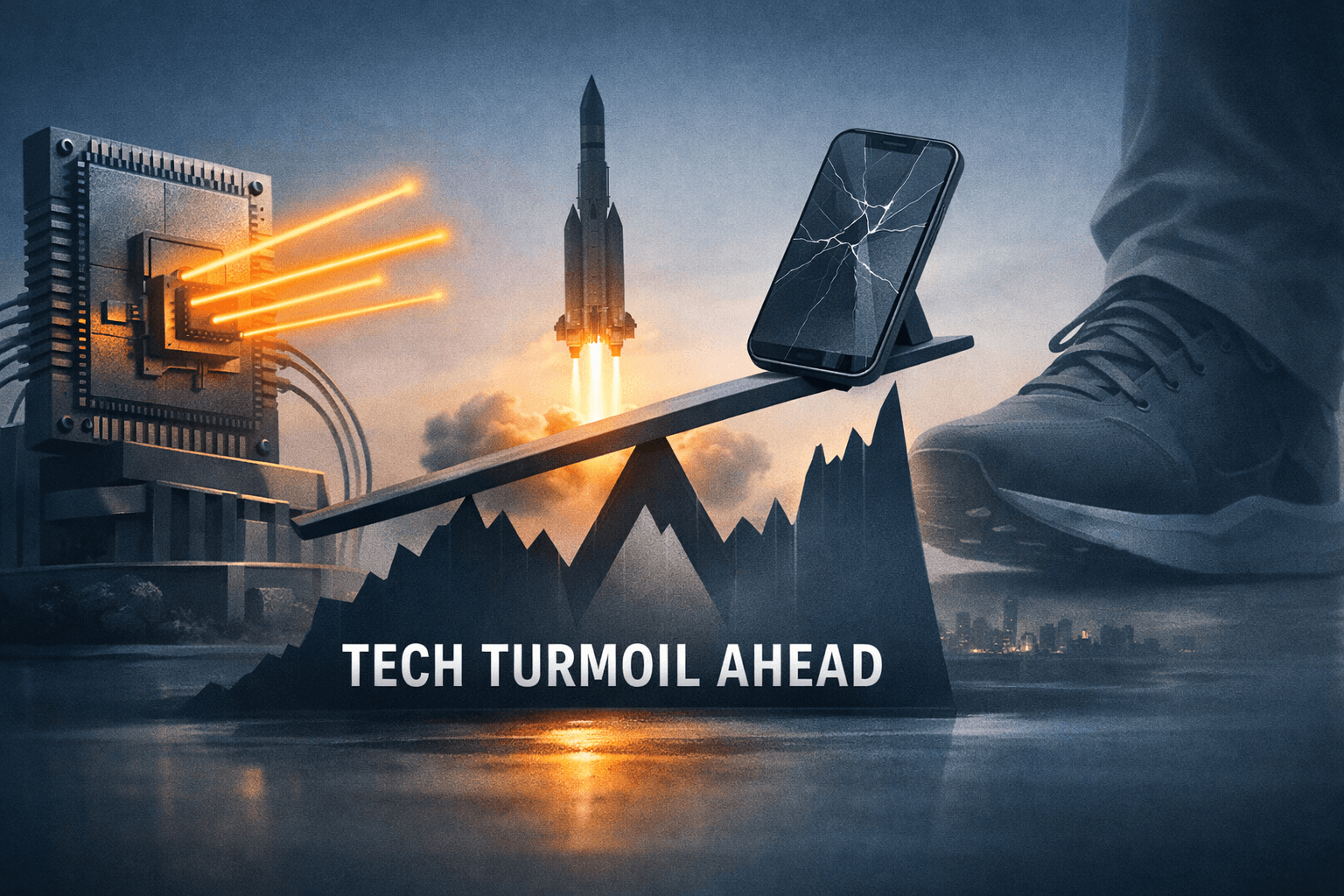
- POET Technologies (POET) took center stage as a structural story: analysts note the company now reports pro‑forma cash of $430 million, a 2026 target of 30,000 photonic engines, and $375 million raised across three funding rounds — metrics that together signal the transition from R&D story to commercial execution in 2026.
- A geopolitical report alleging Iran has threatened attacks on Nvidia (NVDA), Apple (AAPL) and other tech majors surfaced, introducing a fresh headline-driven risk for large-cap technology and global supply chains.
- CloudM launched “Continuity” (Apr 1), a product positioned to provide instant recovery between Microsoft 365 and Google Workspace; market observers flagged the launch as a vendor‑risk and resilience story that bears on Microsoft’s (MSFT) enterprise ecosystem dynamics.
- Retail attention spiked for Nike (NKE): Google Trends logged 10.0K searches — a 100% increase versus baseline — a datapoint that historically correlates with near‑term volume and intraday volatility.
- A cluster of Form 8‑K filings from smaller public companies (Jones Soda Co., Profound Medical, RYTHM, Atlas Energy Solutions, Target Hospitality, BioXcel Therapeutics, etc.) created a steady stream of company‑specific disclosure events that can act as catalysts for micro‑cap price moves.
Synthesizing the key themes
- Platform maturation vs. execution risk
POET’s update encapsulates a common market arc: build the platform, prove the technology and secure institutional capital. The pro‑forma $430M cash balance and $375M raised are objective signs that institutional investors are willing to fund scale-up. Analysts draw a parallel to Marvell’s multi‑year arc — when skeptics called it “just a story” before hyperscalers converted potential into large, recurring revenue. But the central question remains execution: hitting the 30K‑engine target in 2026 is the operational pivot that will determine whether market sentiment re‑rates the company.
- Geopolitical headlines are a latent shock vector for Big Tech
The Iran report naming Nvidia and Apple elevates geopolitical risk as a short‑term volatility driver. The coverage contains limited attribution and no immediate price data, but market participants note that even unconfirmed threats can prompt risk‑off moves, sector‑wide implied‑volatility repricing, and heightened focus on supply‑chain continuity and cyber resilience.
- Enterprise resilience and vendor‑risk are becoming investable conversations
CloudM’s Continuity product demonstrates increasing vendor activity around resilience. For regulated enterprises and procurement teams, the ability to failover between Microsoft 365 and Google Workspace reframes vendor lock‑in and exposes operational dependencies. Analysts caution it’s early to quantify revenue or market‑share effects for Microsoft, but the feature set and coordinated PR rollout (two PR Newswire releases on Apr 1) suggest a vendor ecosystem contest that could shift procurement dynamics over time.
- Retail flows and income investing remain distinct but interlinked microstory sets
The Nike search surge is a classic retail‑attention flare: 10.0K searches and a 100% jump in interest often precede higher trading volume and wider intraday moves. Separately, the Dividend Aristocrats follow‑up highlights income investors’ appetite for high‑quality dividend names (last year’s picks — NWN, ADM, PEP — produced positive 12‑month returns). The behavioral link is straightforward: spikes in retail attention and steady income narratives both move capital, but on different horizons and with different risk tolerances.
Where experts agree — and disagree
Agreement
- Observers concur that POET’s capital and cash position materially reduce short‑term financing risk and make commercialization in 2026 plausible.
- Analysts uniformly treat the Iran report as a headline risk that merits monitoring rather than an immediate valuation shock in the absence of corroboration.
- There is broad recognition that the CloudM continuity offering is relevant to regulated customers and that resilience features will influence procurement and vendor evaluation.
Divergence
- Bullish comparators vs. caution: Some analysts liken POET’s path to Marvell’s, implying the potential for outsized re‑rating if execution follows; others underscore the high hurdle of turning photonics prototypes into repeatable, margin‑generating hardware volume and emphasize milestone risk (shipments, yield, service contracts).
- Impact assessment for the Iran report: one camp argues the story will be limited to transient volatility and headline risk; another cautions that any credible continuation or escalation could trigger deeper supply‑chain repricing for semiconductor equipment and consumer hardware manufacturers.
- Vendor‑lock implications of CloudM: some observers view cross‑platform recovery as a resilience enhancement that could boost enterprise confidence (and indirectly benefit incumbents), while others see it as a nascent competitive pressure that erodes single‑vendor stickiness in large contracts over time.
Deeper context on the major moves
POET and the photonics runway
- The $430M pro‑forma cash figure matters because photonics hardware often requires capital to scale production lines and validate yields across multiple customers. The $375M raised across three rounds implies institutional due diligence has been passed, but historical comparisons (e.g., Marvell’s protracted path from niche to hyperscaler backbone) remind investors that market re‑ratings hinge on multi‑quarter commercial traction.
- The 30K engines target for 2026 is an operational KPI to watch: shipment cadence, ASP (average selling price) stability, gross margin progression and customer concentration will determine whether the thesis is durable.
Geopolitics and tech concentration
- Threats targeting NVDA and AAPL highlight two distinct exposure channels: Nvidia is core to high‑end compute and data center supply chains; Apple’s hardware‑centric manufacturing and retail footprint create multiple attack surfaces. Even if attacks remain rhetorical, the market prices insurance, contingency planning and potential supply‑chain rerouting, which can compress margins or create delivery delays.
Enterprise resilience and vendor ecosystems
- CloudM Continuity speaks to a broader industry trend: customers, especially regulated entities, are demanding operational continuity and cross‑platform portability. This can reallocate bargaining power in procurement — not necessarily overnight, but over multiple renewal cycles — and create incremental budgets for third‑party resilience tooling.
Retail attention and short‑term market mechanics
- Google Trends spikes (Nike’s 10.0K searches, +100%) are a probabilistic indicator of heightened retail trading. Empirical patterns show these moments can amplify intraday volatility, liquidity flows and sometimes create short squeezes or gamma moves in options markets. However, unless coupled with fundamental news, they often produce transient moves that reverse once attention wanes.
What to watch next — metrics and catalysts
- POET: quarterly shipment figures, revenue recognition from engine sales, customer logos, gross margin progression, and any cadence updates to the 30K target.
- Nvidia / Apple: official company statements, supply‑chain notices, semiconductor equipment providers’ commentary, and any corroborating intelligence on the alleged threats.
- Microsoft / CloudM: enterprise adoption signals, case studies from regulated customers, and any partner announcements that clarify commercial reach.
- Nike: trading volume, intraday volatility, put/call option flows and SEC‑required disclosures if retail action produces material business news.
- Micro‑caps with 8‑K filings (Jones Soda, Profound Medical, RYTHM, Atlas Energy, Target Hospitality, BioXcel): read each 8‑K for the precise nature of disclosures (Item 2.02, Item 8.01, Reg FD notices, material definitive agreements) since these filings often precede more substantive updates.
Implications for different investor types
- Short‑term traders / retail market participants: heightened attention spikes (Nike) and 8‑K events create opportunities for volatility‑driven trading. Traders should monitor liquidity and options‑market behavior; remember that retail attention is a timing signal, not a valuation change.
- Long‑term growth investors: POET’s capital runway and institutional backing reduce financing risk, but the thesis requires multi‑quarter operational proof. Tracking execution KPIs (shipments, unit economics, customer diversification) will be decisive.
- Income investors: the Dividend Aristocrats follow‑up reinforces that high‑quality dividend names can deliver steady returns over 12 months, but investors should weigh payout sustainability (payout ratio, free cash flow) rather than past returns alone.
- Conservative savers: the CD vs. Treasury decision pivots on liquidity, tax treatment and familiarity. Treasurys can offer comparable safety with different liquidity and tax attributes; for households unfamiliar with Treasurys, the execution friction is a real cost and merits stepwise learning rather than an abrupt switch.
- Institutional allocators: geopolitical headline risk and vendor‑resilience dynamics require scenario stress tests in portfolios with large tech exposure; consider insurance of supply chains and counterparty concentration.
Strategic considerations and closing view
- Distinguish structural signals from tactical noise: POET’s capital and targets are structural; the Iran report is a tactical headline. Portfolio responses should reflect investment horizon and risk tolerance.
- Anchor decisions to measurable execution milestones: for platform stories (POET), covenants include shipment volumes, margin expansion and contracted revenue. For vendor ecosystems, watch adoption metrics and renewal outcomes.
- Monitor volatility drivers: Google Trends and 8‑Ks are reliable near‑term catalysts. Use them to size exposure and manage intraday risk rather than as standalone investment theses.
- Maintain layered risk management: geopolitical headlines, vendor dependency shifts and execution slippage are distinct risks — hedge and diversify exposures accordingly.
Investment disclaimer: This synthesis is for informational purposes only. It does not constitute investment advice or a recommendation to buy, sell or hold any security. Analysts note the data and market commentary above are intended to inform further research and risk assessment.
Sources
+ 2 more sources
Use these insights — enter this week's contest.
Free practice contests — earn Alpha CoinsExplore More Content
Disclaimer: StockAlpha.ai content is for informational and educational purposes only. It is not personalized investment advice. Sentiment ratings and market analysis reflect data-driven observations, not buy, sell, or hold recommendations. Always consult a qualified financial advisor before making investment decisions. Past performance does not guarantee future results.