 Breaking Analysis
Listen to this Recap
9:27
Silicon Photonics Takes Center Stage as AI Hardware Bets Collide with Market Rotation
Podcast • Loading audio...
Share this article
Spread the word on social media
Key Takeaways
- •NVIDIA’s $2B strategic investment in Marvell and Samsung Foundry’s entry into silicon photonics pushed optical interconnects to the top of the market agenda; MRVL rose ~11% intraday on the NVDA announcement.
- •Foundry involvement (Samsung, TSMC, GlobalFoundries) increases the likelihood of component commoditization over time, but the integration layer (co-packaged optics and optical engine platforms) remains the high-value, unsolved problem.
- •Momentum-driven rallies (TSLA premarket $358.08, +0.9%; HOOD +48% since a media mention) coexist with macro pressures: an $8B gas squeeze and Morgan Stanley’s shift toward cash and U.S. Treasuries.
- •Earnings and filings continue to create idiosyncratic risk (Chagee EPS $0.07 miss; revenue $425.3M miss; multiple 8-K filings flagged), underscoring the need to monitor company-level disclosures alongside thematic trends.
Today's most significant market developments
The market’s clearest headline today was NVIDIA’s (NVDA) $2 billion strategic investment in Marvell Technology (MRVL) and a formal NVLink Fusion partnership that explicitly centers silicon photonics and advanced optical interconnects. Marvell shares jumped roughly 11% intraday on the announcement. In parallel, Samsung Foundry confirmed its entry into silicon photonics at OFC 2026 — joining TSMC and GlobalFoundries in a race that analysts say will shape the infrastructure layer beneath next-generation AI datacenters.
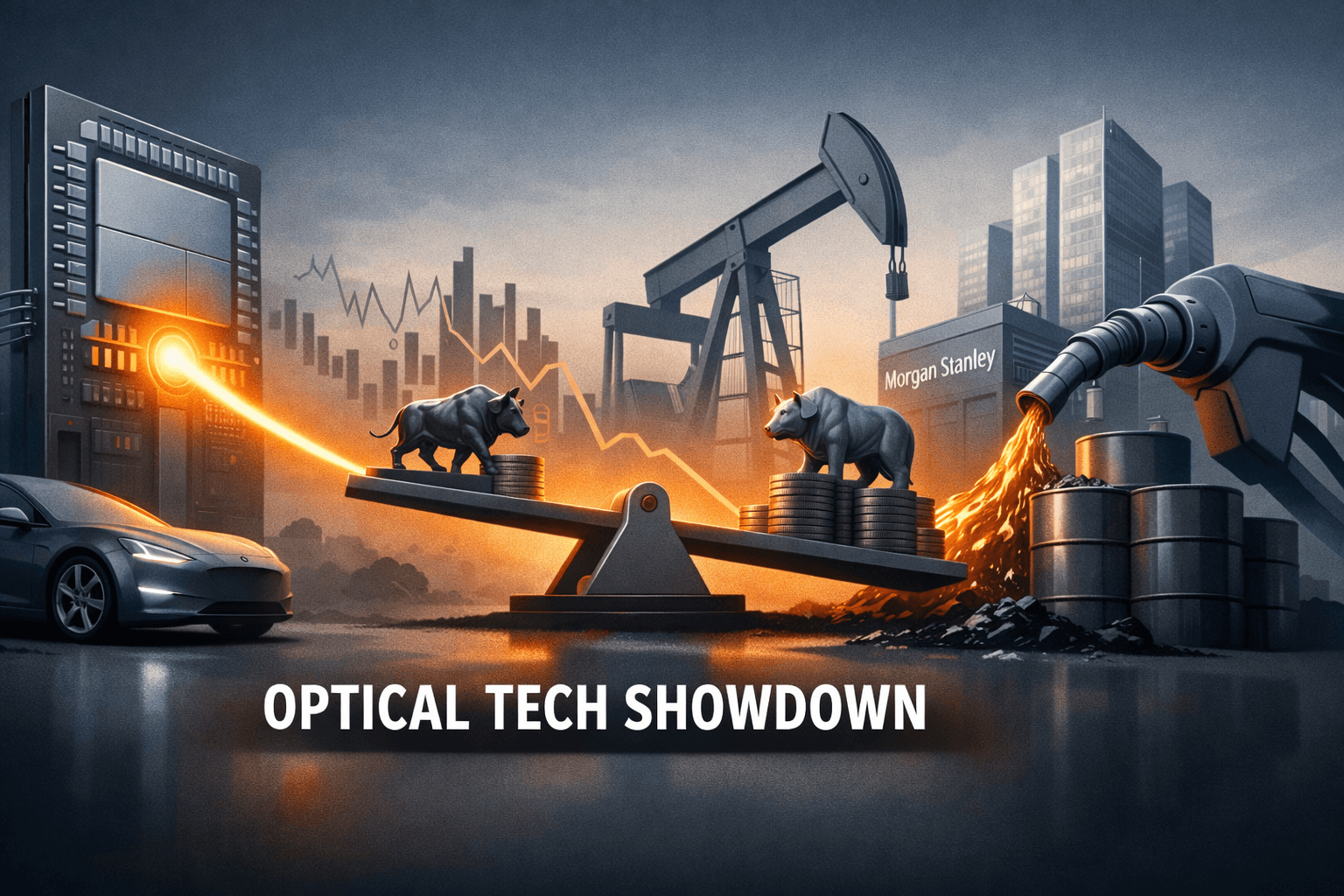
These supply-chain and capital-allocation moves landed against a broader market backdrop of thematic dispersion: momentum-driven rallies in names such as Tesla (TSLA; premarket $358.08, +0.9%) and Robinhood (HOOD; +48% since a high-profile media mention, +57% year-over-year), a notable earnings miss at Chagee Holdings (non-GAAP EPS $0.07, missing by $0.15; revenue $425.3M, missing by $39.37M), and macro/positioning signals including an estimated $8 billion extra Americans paid for gas this month and Morgan Stanley strategist guidance to shift to a more defensive posture (hold more cash and U.S. Treasuries; lowered rating on global stocks).
Key themes across today’s analyses
Silicon photonics and the optical interconnect thesis moved from niche to mainstream. The NVDA–MRVL deal and Samsung's OFC announcement make clear that optical interconnects are a structural priority for AI-scale networking. Analysts point to three linked developments: (a) a large-cap platform player (NVIDIA) committing sizable capital to a component/integration supplier (Marvell); (b) foundry-level competition (Samsung joining TSMC and GlobalFoundries) that signals volume roadmaps; and (c) continued emphasis on integration technologies like co-packaged optics (CPO) and optical engine platforms that remain unsolved at scale.
The commoditization vs. integration debate is accelerating. When top-tier foundries converge on a technology layer, historical patterns show components tend to commoditize and margin pool to higher-level integration and systems layers. Samsung’s CPO roadmap (publicly extended toward 2029) highlights a gap between foundry readiness for volume silicon photonics and the real-world integration solutions datacenter customers need now. That gap is where vendors such as Marvell — and strategic partners like NVIDIA — are attempting to capture value.
Momentum and sentiment remain potent short-term drivers. Tesla’s 37% Y/Y gain and double-digit multi-year returns (102% over two years) illustrate how price momentum can overshadow softer operational signals. Retail- and media-driven swings (Robinhood and Block rallying after Jim Cramer mentions) underscore volatility that is disconnected from near-term fundamentals in spots.
Macro and defensive positioning are reasserting themselves. An $8 billion net increase in gasoline expenditures this month is an immediate headwind for discretionary spending (flagged relative to names like Nike). Morgan Stanley’s strategist shift toward cash and Treasuries signals increased concern about downside risk in risk assets — a countermovement to pockets of stock-specific enthusiasm.
Conflicting views and market debates
Where will value settle in the silicon photonics stack? One camp argues that foundry entry (Samsung, TSMC, GlobalFoundries) will drive rapid commoditization of the photonics die, compressing prices for basic components. Another camp — reinforced by NVIDIA's strategic investment — contends that integration (co-packaged optics, optical engines, software/hardware interfaces) will remain the high-margin, scarce capability, favoring companies that can deliver system-level solutions and close hardware–software stacks.
Momentum vs. fundamentals: Momentum trades (TSLA, HOOD, XYZ/Block) point to a market prioritizing price action and narratives, while Morgan Stanley’s defensive shift argues for a macro-led reassessment of equity risk. The tension is real: traders leaning on price momentum may continue to outperform until macro forces (inflation, consumer squeeze, credit spreads) reassert value pressures.
Time horizon differences: Strategic, long-cycle infrastructure investments (silicon photonics with multi-year roadmaps) contrast with short-term earnings misses (Chagee) and headline-driven rallies. The market is effectively negotiating between a long-duration technology reallocation and near-term liquidity/earnings realities.
Deeper context on the day's major moves
NVIDIA’s $2B in Marvell is notable for scale and signal. A few implications:
- Signaling effect: A large platform vendor making a multi-billion-dollar strategic investment communicates conviction that optical interconnects are not optional for exascale AI infrastructure. It creates a potential moat if it influences supply, co-design, and customer lock-in through NVLink Fusion compatibility.
- Marvell’s role: Marvell is now more tightly associated with AI-scale networking and silicon photonics, increasing its exposure to datacenter capex cycles. The market’s ~11% intraday response reflects recalibrated expectations about contract wins and integration roadmaps.
- The technical gap: Co-packaged optics (placing optical transceivers near the switch ASIC to cut power and latency) is complex. While foundries can supply photonic dies, the challenge is in packaging, thermal management, alignment, and optical-electrical co-design — the unresolved “integration layer” cited across analyses.
Samsung’s foundry announcement matters because foundries historically determine volume economics. When TSMC and Samsung moved into advanced CMOS process nodes, they shaped entire ecosystems. Here, the foundry move suggests an eventual downshift in component margins, but the calendar (Samsung’s CPO roadmap to 2029) leaves a multi-year window for integration specialists and platform partners to capture disproportionate value.
Implications for different investor types
Infrastructure/tech-focused investors: Data suggests optical interconnects will be a multi-year structural theme. Analysts note that companies involved in integration (co-packaged optics, optical engines, switch/ASIC pairing) may capture outsized returns if they can demonstrate scale and reliability. That said, the foundry push warns of potential commoditization of silicon photonics dies, pressuring margins for pure-play component suppliers.
Momentum traders and short-term allocators: Price behavior in TSLA, HOOD and XYZ shows media and momentum remain potent catalysts. Traders should watch volume confirmation and cross-asset signals (e.g., Treasury yields) as potential rotation triggers.
Income/defensive investors: Morgan Stanley’s guidance to increase cash and Treasury exposure reflects a tactical defensive posture. The $8B gasoline squeeze is a reminder that higher consumer costs can translate into weaker discretionary earnings and increased macro risk.
Event-driven and small-cap investors: Earnings misses (Chagee: EPS $0.07 miss of $0.15; revenue $425.3M miss of $39.37M) and 8-K disclosures (Odysight.ai, Quality Industrial, Battalion Oil’s unregistered equity sales) underline continued idiosyncratic risk and the need to review filings for dilution, guidance changes, or material events.
What analysts agree on — and where they diverge
Agreement:
- Optical interconnects are strategically important for AI datacenters.
- Foundries entering the space will change supply-chain economics.
- Integration remains the harder, higher-value technical problem.
Divergence:
- How quickly commoditization will compress margins for component makers versus the timeframe in which integrators can scale profitable platforms.
- Whether current market momentum (large tech and retail-driven rallies) is sustainable in the face of rising consumer headwinds and macro caution from institutional strategists.
Strategic considerations for investors (informational only)
- Distinguish technology exposure by layer: photonic die suppliers vs. integration/platform providers vs. systems integrators. Each faces different competitive dynamics as foundries scale production.
- Monitor cadence and content of partnership announcements: platform investments (like NVDA’s in MRVL) can presage preferred-supplier dynamics that reshape tender outcomes for hyperscale customers.
- Watch macro signals that could flip risk-on sentiment: consumer spending (impacted by the $8B gas squeeze), earnings beats/misses, and strategist positioning updates (e.g., shifts to cash/Treasuries) are proximate triggers.
- Read filings and earnings closely for dilution, guidance changes, and customer concentration risk — particularly in smaller cap or event-driven names.
Conclusion
Today’s market narrative was dominated by a replay of a classic tech-sector inflection: a big-platform player (NVIDIA) placing a large strategic bet on a supplier (Marvell) precisely as foundries (Samsung, TSMC, GlobalFoundries) commit to the same technology layer. The immediate market response — Marvell’s ~11% pop — rewarded the perception of a nearer-term path to commercial scale and preferential relationships. Yet the structural debate is unresolved: commoditization of photonic dies seems likely over time as foundries scale, but the integration layer (CPO, optical engines, packaging and system co-design) remains scarce and potentially lucrative for those who solve it first.
At the same time, the market’s bifurcation is evident. Momentum-driven rallies in large-cap growth and retail-oriented names sit alongside a tactical defensive repositioning from institutional strategists, and macro noise such as higher gasoline costs threatens discretionary earnings. For investors, today’s message is to separate horizon and exposure: long-duration structural bets in AI infrastructure require different evaluation criteria than short-term momentum plays or macro-sensitive consumer names.
Investment disclaimer: This analysis is for informational purposes only. It does not constitute a recommendation to buy, sell, or hold any security, nor personalized investment advice. Analysts note market developments, data, and sentiment indicators to inform investor research and decision-making.
Sources
+ 2 more sources
Use these insights — enter this week's contest.
Free practice contests — earn Alpha CoinsExplore More Content
Disclaimer: StockAlpha.ai content is for informational and educational purposes only. It is not personalized investment advice. Sentiment ratings and market analysis reflect data-driven observations, not buy, sell, or hold recommendations. Always consult a qualified financial advisor before making investment decisions. Past performance does not guarantee future results.