 Breaking Analysis
Listen to this Recap
9:17
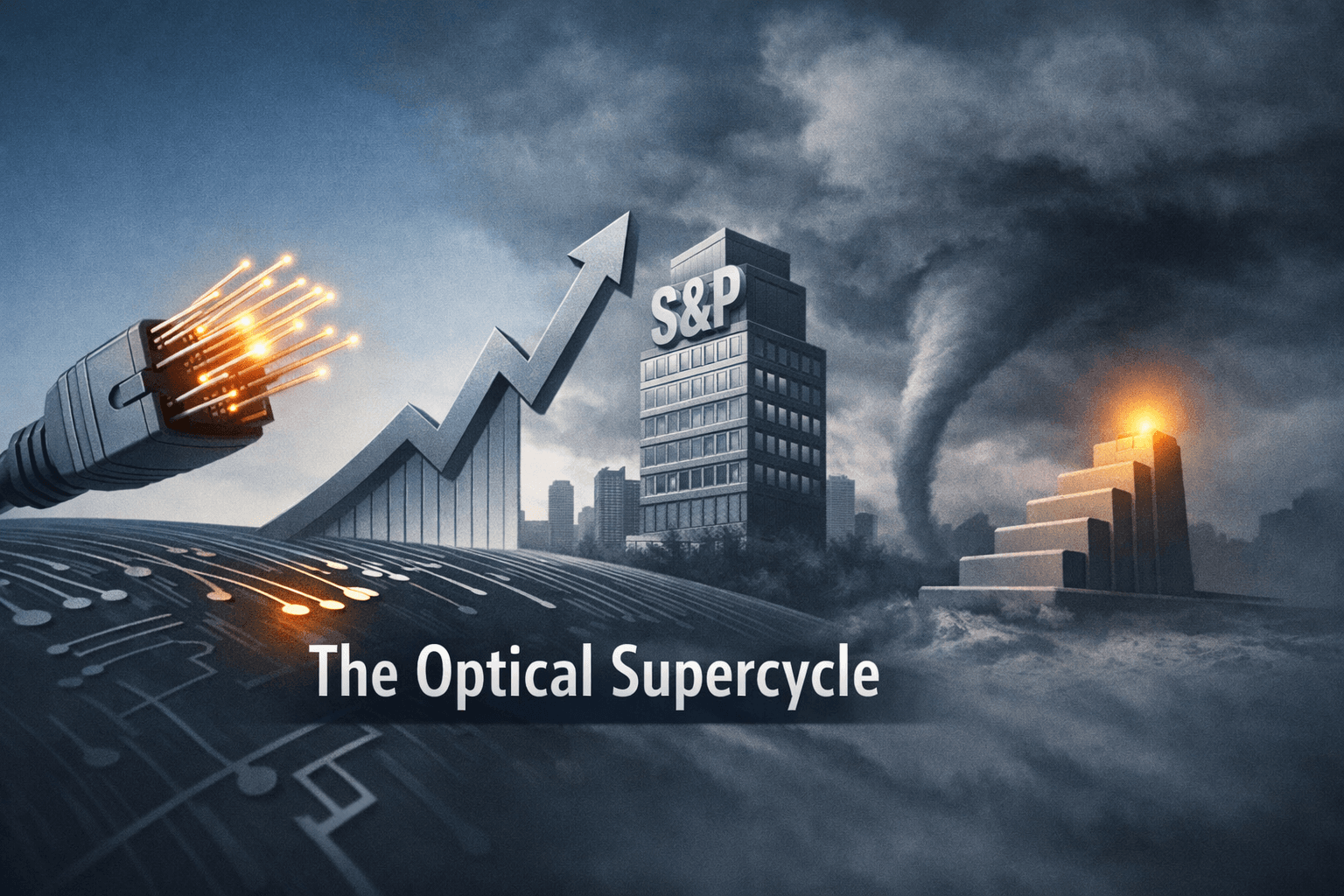
OFC Declares an Optical Supercycle — Photonics Repricing Meets Macro Crosswinds and Uplisting Hopes
Podcast • Loading audio...
Share this article
Spread the word on social media
Key Takeaways
- •OFC 2026 crystallized a potential optical supercycle: interconnects, not just GPUs, are becoming a critical bottleneck for AI infrastructure.
- •POET’s Starlight Gen 2 (8‑laser ELS with WDM) and S&P inclusions for COHR and LITE signal revenue growth and capital flows are shifting into photonics.
- •H.R. 7987 could unlock institutional liquidity for U.S. cannabis (GTBIF, TCNNF, CURLF), but uplisting requires governance and audited-history remediation to realize full repricing.
- •Macro risks (Iran war → higher oil) highlighted by JPMorgan could counteract rate‑cut optimism and introduce downside to cyclical and growth-sensitive sectors.
- •Investors should monitor hyperscaler capex, transceiver/backlog metrics, oil prices, H.R. 7987 legislative progress, and detailed 8‑K exhibits for actionable signals.
Today's Top Development: Photonics Takes Center Stage
The Optical Fiber Communications (OFC) Conference in Los Angeles emerged as the day’s market-moving event. Multiple Alpha analyses characterize OFC 2026 as the locus of a sector-wide repricing: Coherent (COHR) and Lumentum (LITE) earned S&P 500 additions concurrently, Applied Optoelectronics (AAOI) delivered billion-dollar guidance and POET Technologies (POET) unveiled its Starlight Gen 2 external light source (ELS). Together these items form the clearest market signal yet that the AI infrastructure conversation is broadening beyond GPUs to the optical interconnect layer.
POET’s Starlight Gen 2 demo is particularly instructive. Alpha coverage notes the module integrates eight high‑power lasers in a compact ELS supporting wavelength-division multiplexing (WDM), enabling multiple data streams over a single fiber. Analysts frame this as a structural response to demands at 800G and beyond, where copper traces and traditional electrical interconnects are reaching physical limits on bandwidth and power density.
Key Themes Across the Desk
Optical supercycle and sector repricing: OFC confirmed what the supply chain has been building toward. Alpha reports that the market is beginning to price a multi-year capital cycle in photonics — not just incremental growth but an architectural shift for hyperscale and AI datacenters. Evidence: S&P additions (COHR, LITE), AAOI’s large guidance, and rapid partnership announcements and disclosures around POET.
Infrastructure bottlenecks are migrating: The dominant AI narrative (GPUs) is giving way to a newer trade: solve interconnect constraints. At extreme scale, compute is necessary but insufficient; latency, power, and thermal floors are now hinging on optical fabrics. The technical concept: at high aggregate bandwidth, optical links win on energy per bit and thermal scaling versus copper.
Policy-driven re‑rating potential in cannabis: Separately, H.R. 7987 — a proposed federal safe harbor for exchange listings of cannabis businesses — surfaced as a structural catalyst. Analysts estimate that uplisting could unlock institutional pools sidelined since prime broker custody restrictions began in 2021 and could produce a multi‑billion-dollar re‑pricing across leading U.S. multi-state operators (MSOs) such as GTBIF, TCNNF and CURLF.
Macro crosswinds: Rate-cut hopes remain alive per the Morning Brief, keeping risk appetite on a hair trigger ahead of corporate earnings from heavyweights (FDX, CCL, DRI). Yet JPMorgan warns the market is complacent on the Iran war; energy-driven inflation could materially damage growth and margins. That creates a near-term tug-of-war between easing expectations and a tangible commodity-risk shock.
Where Analysts Agree — and Where They Don’t
Areas of consensus:
- The interconnect is now a top engineering constraint for hyperscale AI clusters. Alpha reporting from OFC underscores broad industry alignment on this point.
- If H.R. 7987 materially lowers legal and listing risk for U.S. cannabis firms, institutional demand and liquidity could increase markedly.
- Near-term monetary policy remains a central price driver: Fed comments that leave the path to looser policy "plausible" keep traders positioned for volatility.
Points of debate and uncertainty:
- Timing and magnitude of the photonics repricing. Some analysts treat the OFC signals as immediate revaluation material; others argue much of that is priced into high‑growth names and that supply‑chain bottlenecks and capex cadence will stagger realization over quarters.
- The duration of energy-driven macro risk. JPMorgan’s note frames a credible scenario where oil spikes materially slow growth. Other market participants point to forward prices and current inventories as counterarguments that could mute the shock.
- Legal and governance hurdles for cannabis uplisting. Proponents view H.R. 7987 as a potential ignition switch for institutional flows; skeptics highlight that exchange listing standards, audited histories and governance upgrades will still be gating factors that could delay or blunt the upside.
Deeper Context on Major Moves
Photonics and the 800G+ transition: At scale, electrical interconnects face bandwidth, power, and density ceilings. Optical solutions — exemplified by POET’s ELS and WDM approaches — reduce per‑bit energy costs and enable higher aggregate throughput per fiber. The market reaction at OFC reflects investor recognition that capex will shift from incremental board‑level enhancements toward system‑level optical fabrics and pluggable optics.
Corporate signals matter: Coherent’s and Lumentum’s S&P inclusions are meaningful both for passive flows (index-tracking funds) and as a validation signal of photonics’ maturation. AAOI’s billion‑dollar guidance is cited by Alpha analysts as evidence that demand is not hypothetical but revenue‑backed.
Cannabis uplisting mechanics: H.R. 7987 would create a federal safe harbor to permit major exchanges to list cannabis-related businesses. The practical effect analysts highlight is unlocking prime broker custody, enabling institutional ownership, and compressing the valuation discount many MSOs endure while trading OTC or on Canadian boards. Yet the analysis stresses that corporate readiness (audits, governance) will determine how much capital actually flows and how quickly.
Macro overlay — the Iran war and rate expectations: JPMorgan’s strategists warn that markets may be underpricing the economic fallout from escalating Iran conflict risks. Their framing ties rising oil to margin compression across cyclical sectors and to recession risk; that would work against equities and complicate the narrative that rate cuts are just around the corner.
What This Means for Different Investor Types
Thematic and long‑term growth investors: The optical supercycle thesis strengthens the case for exposure to the photonics supply chain — not only manufacturers of lasers and transceivers but also firms supplying packaging, testing, and system integration. Analysts suggest monitoring capex plans of hyperscalers as leading indicators.
Event and momentum traders: OFC-driven repricings and upcoming earnings (FDX, CCL, DRI) create near-term volatility windows. Similarly, progress on H.R. 7987 or exchange statements on uplistings could be sharp catalysts for OTC-listed MSOs.
Income and value investors: JPMorgan’s energy-risk warning argues for renewed vigilance on cyclical exposure. REITs and dividend payers with energy‑sensitive cost structures deserve closer scrutiny if oil moves materially higher.
Fixed-income and macro allocators: The interplay between rate-cut expectations and commodity shocks increases reinvestment and duration risk complexity. Analysts emphasize watching oil forward curves and real-time Fed communications.
Corporate event watchers: A slew of 8‑K filings (Picard Medical, Micro Imaging Technology, Humacyte, Titan Machinery, Acrivon Therapeutics, Global Net Lease, Inception Growth Acquisition) were filed Mar 19. Alpha highlights that some are routine (Reg FD, administrative exhibits) while others — Micro Imaging’s Item 2.01 completion of asset transaction and multiple Item 2.02 filings on results of operations — require close reading for potential market-moving details. Humacyte’s 12MB filing (Accession No. 0001104659-26-031780) is flagged for containing multiple exhibits.
Risks, Frictions, and Things to Watch
- Execution risk in photonics: Supply-chain constraints, component lead times, and the capital intensity of system integration could stretch timelines. Not all companies will capture value equally; watch gross margins and backlog evolution.
- Legislative and regulatory risk in cannabis: Passage of H.R. 7987 is not guaranteed and even enactment won’t remove listing standards; governance and audit remediation will determine actual inflows.
- Macro shock potential from geopolitics: JPMorgan’s scenario is a sober reminder that commodity shocks can quickly reverse risk-on narratives even when central bankers are signalling looser policy ahead.
- Event clustering: Earnings from large companies (FDX, CCL, DRI) could reprice demand proxies that feed back into the AI equipment cycle narrative.
Strategic Considerations (Informational Only)
- Monitor leading demand indicators for photonics: hyperscaler capex announcements, transceiver ASPs, backlog growth, and S&P/index inclusion flows. These data points determine whether OFC’s signals translate into durable revenue growth.
- Track legislative progress and corporate governance upgrades in U.S. cannabis. The uplisting thesis depends on a sequence: legal safe harbor → listings → institutional custody → meaningful capital flows.
- Watch oil and energy-market signals in real time. JPMorgan’s memo underscores the asymmetric impact of supply shocks on margin-sensitive sectors and growth trajectories.
- Read 8‑Ks and Reg FD updates for nuance. Several firms filed routine disclosures today, but others disclosed asset transactions or operational updates that could be consequential once exhibits are parsed.
Bottom Line
Alpha coverage from today presents a bifurcated market narrative: a technology‑driven reallocation toward photonics and optical interconnects that could underpin a multi-year capital cycle, and a macro-political overlay that could either accelerate or stifle that repricing depending on energy prices and monetary policy. Separately, structural policy catalysts like H.R. 7987 carry the potential to unlock dormant liquidity in cannabis, but timing and corporate readiness remain open questions. Analysts agree on the significance of these themes but disagree on timing and magnitude — making careful signal watching and active parsing of corporate and policy developments essential.
Investment disclaimer: This synthesis is informational and analytical only. Analysts note potential catalysts and risks; this is not a recommendation to buy, sell, or hold any security, nor is it personalized investment advice.
Sources
+ 4 more sources
Use these insights — enter this week's contest.
Free practice contests — earn Alpha CoinsExplore More Content
Disclaimer: StockAlpha.ai content is for informational and educational purposes only. It is not personalized investment advice. Sentiment ratings and market analysis reflect data-driven observations, not buy, sell, or hold recommendations. Always consult a qualified financial advisor before making investment decisions. Past performance does not guarantee future results.