
 Alpha Breaking
Yygh Drops -37.70% in the Last Trading Day - Jun 20
Share this article
Spread the word on social media
The Big Picture
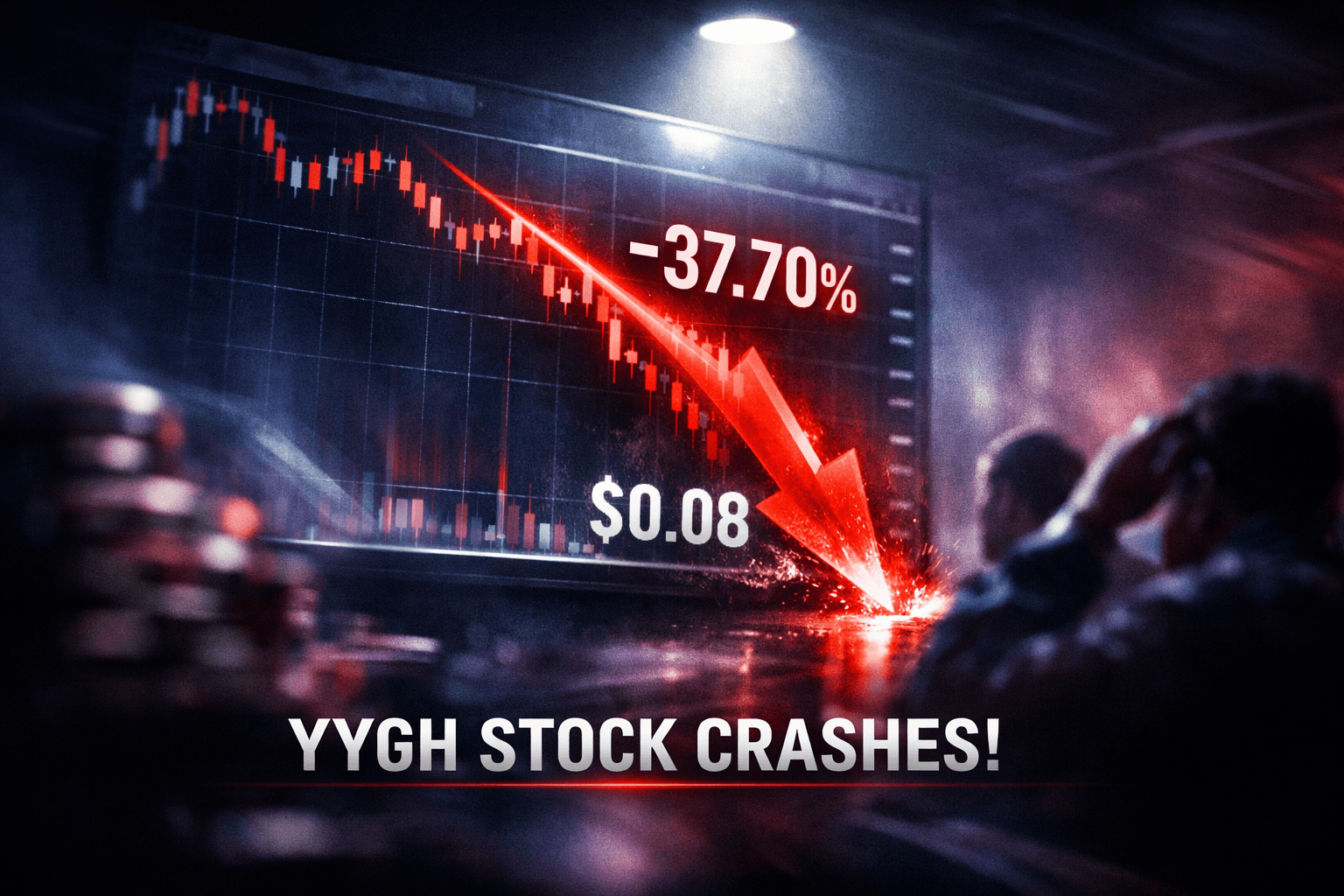
As of Thursday, June 18, $YYGH dropped 37.70%, settling at $0.08, making it one of the biggest losers on the last trading day. That collapse, paired with a volume spike to 77.04 million shares, raises immediate questions about liquidity and downside risk for holders heading into the long weekend.
For investors, a near-40% daily drop in a sub-dollar stock is a red flag that calls for a fresh look at valuation, outstanding shares, and short interest before considering any exposure.
What's Happening
$YYGH suffered a sharp one-day decline in the last trading session, with market data pointing to unusually high turnover and deep selling pressure. Here are the key figures to know right up front:
- Price change: -37.70%, the reported last-session decline that pushed the share price to $0.08, a dramatic intraday move.
- Trading volume: 77.04 million shares, indicating heavy trading and likely reduced liquidity at higher price levels.
- Additional valuation datapoints provided for scenario analysis: 99.80%, 95.58%, 0.56% — these figures can feed sensitivity checks or stress-test models.
- Price level context: the $0.08 quote places $YYGH firmly in penny-stock territory, where volatility and trading dispersion tend to be larger than for established large-caps.
These numbers matter because a near-40% drop plus outsized volume typically reflects either a sudden change in fundamentals, a liquidity-driven sell-off, or concentrated trading activity by large holders. For portfolio managers and traders, volume and price together help indicate whether the move was broad-based or driven by a small number of participants.
Why It Matters For Your Portfolio
The sell-off in $YYGH has immediate implications depending on your investment style. For growth investors, the drop signals heightened execution risk and increased uncertainty around any thesis tied to the company. For traders, the volume spike can create short-term opportunities but also magnify risk due to thin order books at these low prices.
Analyst coverage and formal guidance were not cited in the source data, so market participants will need to rely on public filings, company statements, and liquidity metrics to reassess fair value. Use the provided 99.80%, 95.58%, and 0.56% datapoints to run conservative scenario analyses before adding exposure.
Risks To Consider
- Liquidity risk: at $0.08 per share, even modest sell orders can move the price sharply. Heavy volume on the drop suggests liquidity evaporated at higher prices.
- Information risk: the available market data does not include an explicit catalyst. If the decline stems from adverse news or a regulatory event, the stock could face further downside.
- Dilution and capital-structure risk: penny stocks often raise capital through equity issuances that dilute existing shareholders, a material downside in the absence of clear operational improvement.
The bear case is straightforward: a continued lack of positive company-specific news combined with thin liquidity could push $YYGH toward lower price bands, making recovery slow and volatile.
What To Watch Next
With markets closed for the weekend, here are the concrete items and levels to monitor before placing any trades or reallocating capital.
- Volume and price action on the next trading day, Monday, June 22, to see whether selling pressure persists or if buyers step in to stabilize the stock.
- Company announcements, regulatory filings, or press releases that could explain the drop, especially any disclosures related to financing, litigation, or leadership changes.
- Short interest and float changes, plus any unusual options activity if available, as these can amplify moves in low-priced names.
- Key metrics for technical traders: watch for a failure to reclaim even small resistance levels above $0.08, and monitor whether support forms near recent lows.
The Bottom Line
- $YYGH plunged 37.70% to $0.08 on heavy volume of 77.04M shares as of the last trading day, signaling major near-term risk.
- The provided datapoints 99.80%, 95.58%, and 0.56% should be used in valuation stress tests and scenario analyses before adjusting positions.
- Because public information about catalysts was not included in the source, confirm company disclosures and regulatory filings before making decisions.
- If you hold exposure, consider monitoring liquidity, potential dilution, and next-session price behavior rather than acting on headline moves alone.
- Traders may find short-term setups around liquidity and momentum, but expect wider bid-ask spreads and execution risk at penny-stock prices.
FAQ
Q: What caused $YYGH to drop 37.70%?
A: The market data shows the price decline and heavy volume, but the source did not specify a catalyst. Check company filings and press releases for an explanation before drawing conclusions.
Q: How should I use the 99.80%, 95.58%, and 0.56% figures?
A: Treat those numbers as inputs for valuation sensitivity or downside stress tests. They can help you model worst-case, base-case, and recovery scenarios for portfolio impact analysis.
Q: Is this a buying opportunity?
A: This report is informational only and not personalized advice. Given the steep one-day decline and liquidity risks at $0.08, many investors will wait for clearer signals from filings, volume stabilization, or confirmed catalysts before considering new exposure.