
 Alpha Breaking
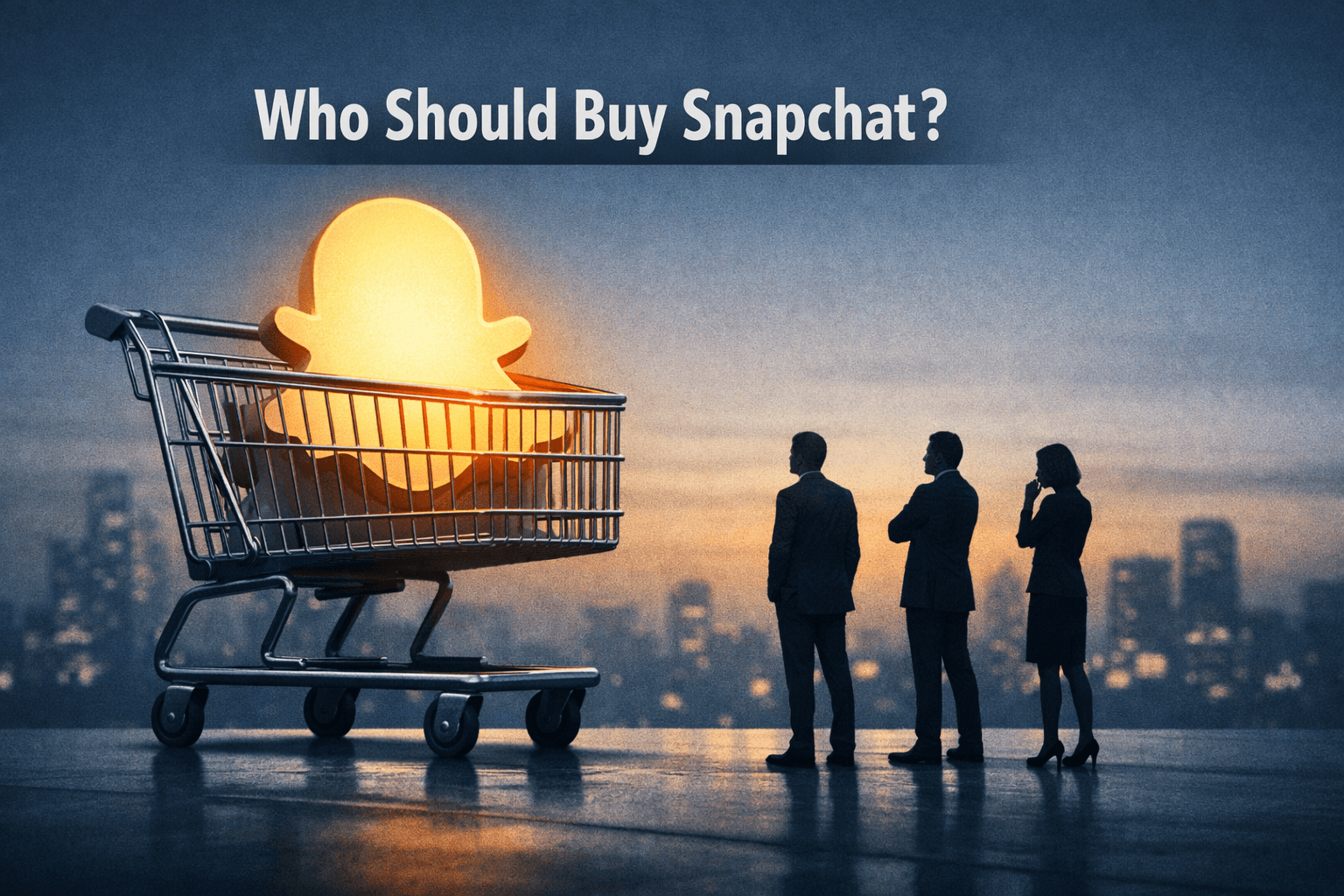
Who Should Buy Snapchat?
Share this article
Spread the word on social media
Who Should Buy Snapchat? Let’s run the numbers…
~$7.5B
MARKET CAP (MAR 2026)
−53%
1-YEAR PRICE DECLINE
$5.93B
REVENUE (TTM)
$437M
FREE CASH FLOW (TTM)
THE SETUP
A $7.5 Billion Company With 440 Million Users Is Trading Near Its All-Time Low
Something unusual is happening in Silicon Valley. Snap Inc. — the parent company of Snapchat — is now valued at roughly $7.5 billion, down more than 53% over the past year and nearly 95% from its 2021 peak of $83 per share. For a platform with hundreds of millions of daily active users, a meaningful AR hardware roadmap, and nearly $440 million in annual free cash flow, that number is starting to look less like a valuation and more like an invitation.
The reasons for the decline are real: persistent losses, regulatory heat in the UK and Australia over teen safety, a structurally challenged advertising business, and the long shadow of TikTok and Instagram Reels eating into its core use case. But the assets underneath the distress tell a different story. Snap commands fierce loyalty among Gen Z users aged 13–34, owns one of the most sophisticated augmented reality platforms in the world, and is preparing a public launch of Snap AR glasses in 2026 — a bet that could redefine wearable computing.
At under $8 billion — a rounding error for most big tech balance sheets — Snap is cheap enough that a deal could happen on a Tuesday afternoon. The question isn't whether Snap can be bought. The question is who benefits most from buying it.
WHY NOW? THE ACQUISITION WINDOW
Valuation floor: Snap recently hit all-time lows near $4.34, putting the company at a fraction of what Google reportedly floated in informal talks a decade ago ($30 billion in 2016). The stock has lost over 73% of its value since its IPO.
Structural vulnerability: With $4.1 billion in debt against $2.9 billion in cash and a negative return on equity of −19%, Snap faces real pressure to improve performance. CEO Evan Spiegel — long the firewall against any sale — is under more scrutiny from investors than at any point in the company's history.
The AR wild card: Snap's AR platform processes billions of lens interactions daily. Its Spectacles hardware line and planned 2026 consumer AR glasses represent years of proprietary R&D that any buyer would inherit immediately — and that no competitor could replicate quickly.
THE SUITORS
Five Acquirers, Five Different Theses
Each potential buyer brings a different strategic logic — and a different set of complications. Here is the case for each, ranked by strategic fit.
APPLE INC.
The AR Hardware Play — Snap's Glasses Meet Apple's Ecosystem
Apple is the most architecturally compelling acquirer, even if it's the least likely to pull the trigger. Snap has spent years building consumer AR hardware and a developer platform with billions of daily lens activations — exactly the kind of real-world AR engagement layer that Apple's Vision Pro has struggled to generate at scale. Acquiring Snap would give Apple an immediate social AR footprint and a young user base that has so far resisted the iPhone-to-Apple-device funnel.
The strategic logic extends to advertising, too. Apple has been quietly building its own ad network, and Snap's first-party data on Gen Z users — combined with Apple's privacy-preserving infrastructure — could create a differentiated ad product that doesn't rely on third-party tracking. For Apple, the deal would be less about social media and more about owning the AR consumer layer before the hardware wars begin.
FOR
Deep AR R&D and Spectacles pipeline
Gen Z engagement Apple lacks
Could integrate with iOS natively
Snap's camera-first UX fits Apple's ethos
AGAINST
Apple rarely acquires social platforms
Advertising model conflicts with privacy brand
Antitrust scrutiny likely elevated
Spiegel's voting structure complicates control
AMAZON.COM INC.
The Commerce Pipeline — Visual Shopping for a Billion Gen Z Wallets
Amazon's interest in Snap would be almost purely commercial. Snapchat's camera and AR try-on features have already demonstrated strong conversion rates for retail brands — users can virtually try on sunglasses, shoes, and clothing before purchasing. For Amazon, which has invested heavily in visual shopping features through its app with limited uptake, Snap represents a ready-made social commerce engine pointed at the exact demographic driving the next decade of consumer spending.
Snap Map, which has become a surprisingly powerful local discovery tool used by young people to find restaurants, stores, and events, would also integrate naturally into Amazon's growing local and same-day logistics business. The deal would be Amazon's most aggressive move into social since its Fire Phone era stumbles, and it would give AWS a valuable new advertising data stream — though regulatory scrutiny, given Amazon's recent FTC battles, would be substantial.
FOR
AR try-on accelerates visual commerce
Snap Map drives local discovery
Gen Z shopper pipeline is strategic gold
Ad tech synergies with Amazon DSP
AGAINST
Amazon has no social DNA
FTC scrutiny is at historic highs
Culture clash risk is extreme
Snap's ad model overlaps awkwardly with AMZ
ALPHABET INC.
The Social Redemption — Google's Graveyard Gets a Revival
Google's history with Snap is well-documented: informal acquisition talks at a reported $30 billion valuation in 2016 went nowhere, and CEO Evan Spiegel rebuffed the approach. Today, Snap is available for roughly one quarter of that price. Google has failed repeatedly at social — Google+, Google Buzz, and others now occupy the company's product graveyard — making Snap the clearest shortcut to relevance with a young audience that uses TikTok and Snapchat as their primary search tools.
The advertising angle is equally powerful. Snap's AR ad formats have demonstrated strong brand recall metrics, and integrating them with Google's programmatic infrastructure would create a new category of immersive advertising inventory. Google Cloud already powers parts of Snap's infrastructure through a multi-billion dollar partnership, creating a technical integration path that no other acquirer has. The main obstacle, aside from Spiegel's historic resistance to selling, is an antitrust environment that would subject any Google acquisition to intense scrutiny.
FOR
History of serious acquisition interest
Google Cloud infrastructure already integrated
Fills Google's chronic social media gap
AR ad formats complement Google's inventory
AGAINST
Antitrust risk is the highest of any suitor
Spiegel has rejected Google before
Google's social track record is poor
DOJ scrutiny could block the deal
OpenAI
OPENAI (PRIVATE)
The AI Distribution Deal — 440 Million Users as a Training Moat
Analysts at eMarketer flagged OpenAI as a dark-horse acquirer in mid-2025, with the thesis being simple: OpenAI has the technology but not the users, and Snap has the users but not the technology. An acquisition would instantly give OpenAI a social distribution layer with hundreds of millions of active accounts, rich behavioral data for model training, and an AR hardware platform to build AI-powered spatial experiences on — years ahead of building from scratch.
Snap already integrated its AI chatbot "My AI" — powered by OpenAI's GPT models — into the platform in 2023, and recently signed a partnership with Perplexity AI, signaling openness to AI infrastructure partnerships. The stumbling block is financial: OpenAI, despite its eye-watering valuation, is still burning cash and would likely need to involve a strategic co-investor or backer (Microsoft being the obvious candidate) to structure a deal of this size.
FOR
Instant social distribution at scale
Gen Z behavioral data is invaluable for LLMs
Existing OpenAI integration via "My AI"
AR hardware becomes AI-native interface
AGAINST
OpenAI is not profitable — financing unclear
No social platform operating experience
Cultural and regulatory complexity
Microsoft involvement could complicate governance
META PLATFORMS INC.
The Nuclear Option — Eliminate the Last Independent Rival
Meta acquiring Snap would be the most strategically logical and most legally impossible deal on this list. Zuckerberg famously offered $3 billion for Snap in 2013 — when it had no revenue — and was rejected. Since then, Meta has systematically cloned every major Snapchat feature (Stories, Reels, disappearing messages) across Instagram and WhatsApp, and the two companies have been engaged in decade-long direct competition for the same young demographic.
From a pure product and user-base standpoint, a Meta-Snap deal would eliminate the last meaningful independent social platform competitor in the U.S. outside TikTok. But that's precisely why it will never happen: the FTC has already sued Meta over its Instagram and WhatsApp acquisitions and has made preventing further social media consolidation a stated priority. Any attempt would face a near-certain injunction before the ink dried. Meta is included here not as a realistic scenario but as a reminder of how strategically coveted Snap's assets truly are.
FOR
Eliminates last independent Gen Z rival
AR hardware would turbocharge Ray-Ban Meta glasses
Deep social operating expertise
AGAINST
FTC would block on Day 1 — non-starter
Active antitrust litigation against Meta
Would trigger bipartisan Congressional opposition
Spiegel would never sell to Zuckerberg