
 Alpha Breaking
US.S. Treasury Yields Near 5% Ahead of Fed - Sep 14
Share this article
Spread the word on social media
The Big Picture
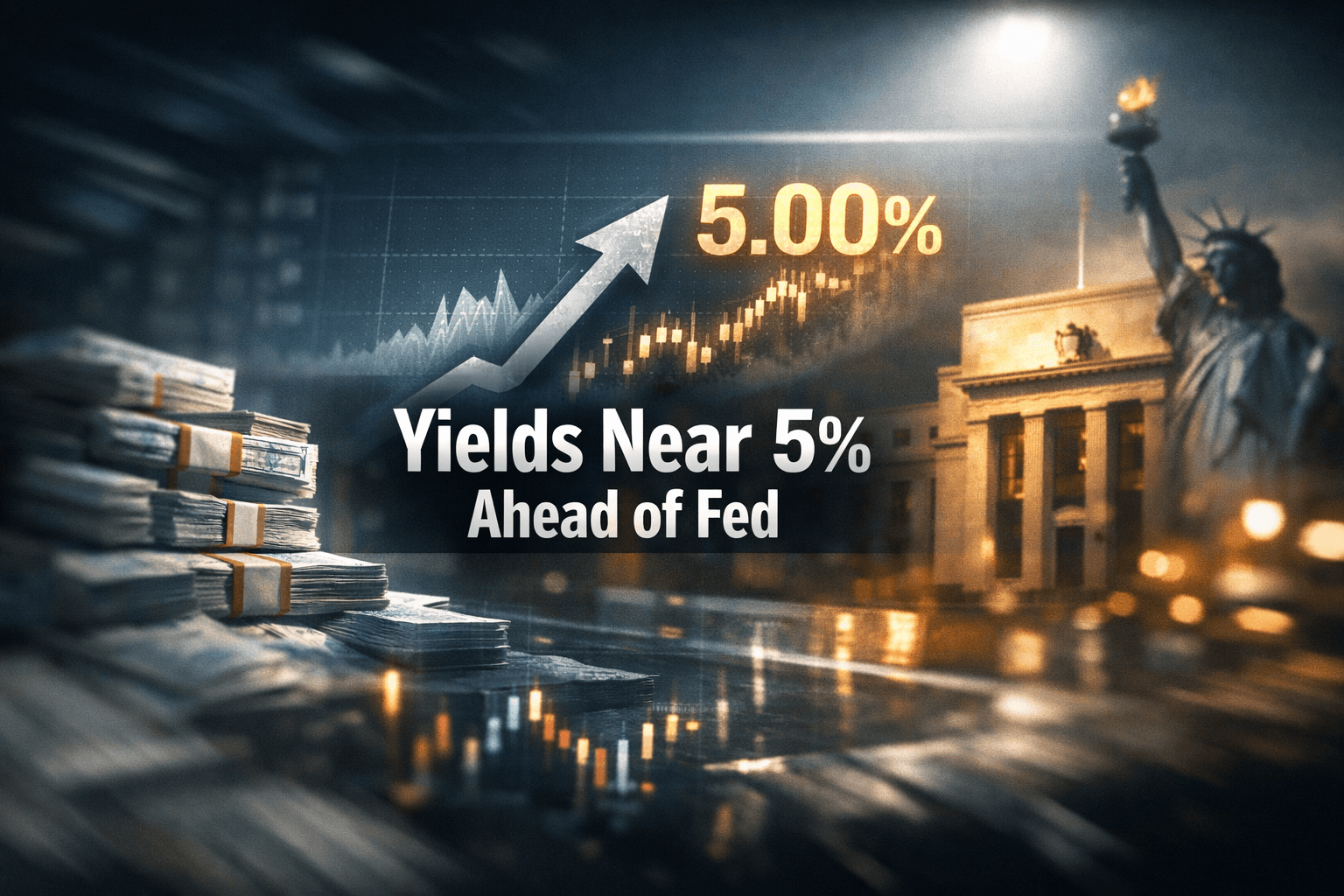
The 10-year U.S. Treasury yield is closing in on the psychologically important 5% level, a move that has markets and portfolios on alert ahead of the Federal Reserve's next rates decision. On Sep 14 markets showed yields steady as investors parsed economic signals and Fed policy comments.
For fixed-income holders, rising yields mean lower bond prices and potential recalibration of income benchmarks. For equity investors, yield moves can shift valuations and change risk appetite.
What's Happening
Bond markets are focused on a simple but consequential fact: the 10-year Treasury yield is approaching 5%, a level last reached in October 2023. Strategists quoted in reporting emphasize that the fundamental drivers behind the move matter more than the headline level itself.
- 10-year Treasury yield — closing in on 5%.
- 5% — cited as the key psychological threshold investors are watching.
- October 2023 — the last month the 10-year touched the 5% level.
- Sep 14, 2026 — the current date as markets react ahead of the Fed rates decision.
Those points matter because a sustained move at or above 5% would be a clear signal about how markets are pricing growth, inflation and the path for short-term rates. Strategists in the coverage note that whether higher yields are fueled by resilient growth, a hotter inflation outlook, or technical repositioning will dictate market reactions.
Why It Matters For Your Portfolio
Higher Treasury yields influence multiple corners of an investor's portfolio. Bond values fall as yields rise, but yield gains can boost income for new buyers and money market alternatives. Equity valuations, especially for long-duration growth names, can be pressured when real rates climb.
Who should care: income investors, fixed-income managers and growth-focused equity holders. Strategists quoted in reporting stress the importance of the drivers behind yield moves rather than the level alone. Watch large-cap tech and growth-sensitive sectors, for example $AAPL and $NVDA, which historically respond to shifts in discount rates.
Risks To Consider
- Policy uncertainty: The Fed rates decision is the immediate catalyst. Mixed signals from the Fed could amplify market volatility around yields.
- Growth versus inflation drivers: If yields rise because inflation expectations climb, real returns could compress further, hurting fixed-income returns and some equity valuations.
- Cross-market stress: Rapid moves in yields can trigger repricing in credit markets and impact risk assets, as noted by market commentators tracking AI, oil, and rate dynamics.
What To Watch Next
Investors should monitor several specific items as the situation evolves.
- Federal Reserve communications and the upcoming Fed rates decision, which is the immediate policy event markets are pricing into yields.
- The 5% level on the 10-year, including whether the yield closes and holds above that threshold on a sustained basis.
- Economic data that can move inflation or growth expectations, which will in turn affect yield direction.
- Market reaction in risk assets and short-term funding markets, where spillovers from a sustained yield rise can show up quickly.
The Bottom Line
- Yields are steady but notable: the 10-year is closing in on 5%, a level last seen in October 2023, and markets are eyeing Fed guidance closely.
- Interpretation matters more than the headline: analysts stress whether higher yields reflect growth resilience, inflation persistence, or technical repositioning.
- Portfolio impact is mixed: rising yields hurt existing bond prices but can offer higher income for new allocations and pressure rate-sensitive equities.
- Monitor the Fed decision and the 5% threshold; sustained moves above that level would shift benchmarks and risk assessments.
- Maintain focus on risk management and liquidity while awaiting clearer signals from incoming data and Fed commentary.
FAQ
Q: Does the 10-year closing at 5% mean the Fed will raise rates?
A: Not necessarily. The 10-year yield reflects market expectations about growth, inflation and policy; it does not directly determine Fed action. The Fed will respond to a range of data and its policy meeting outcomes.
Q: How does a 5% 10-year yield affect bond investors?
A: Existing bond prices fall as yields rise, but new buyers can lock in higher income. The net effect depends on your portfolio duration and time horizon.
Q: What should equity investors watch as yields approach 5%?
A: Watch Fed signals, inflation data and whether higher yields persist. Growth and long-duration stocks tend to be more sensitive to rising yields, while financials and value sectors can react differently.