
 Alpha Breaking
US: 10-K Filing - Jerash Holdings - Jun 18
Share this article
Spread the word on social media
The Big Picture
Jerash Holdings' annual 10-K hit the SEC EDGAR system on Jun 18, giving investors fresh, standardized data to feed into valuation models. The filing itself is a routine regulatory disclosure, but it contains specific numeric details that can change how you size exposure or assess risk.
The document is filed under AccNo 0001213900-26-070227 and is available on the SEC website. No market-moving operational guidance or earnings headlines were included in the filing text available at the time of this report.
What's Happening
Jerash Holdings submitted its Form 10-K to the SEC on Jun 18. The filing is formally recorded on EDGAR and includes discrete data points that investors and analysts can use directly in valuation and ownership analysis.
- Filed: 2026-06-18, indicating the annual report period covered by the 10-K is now publicly available.
- Accession Number: 0001213900-26-070227, which you can use to retrieve the full filing on SEC.gov.
- File size: 9 MB, reflecting a substantive filing that likely includes financial statements and notes.
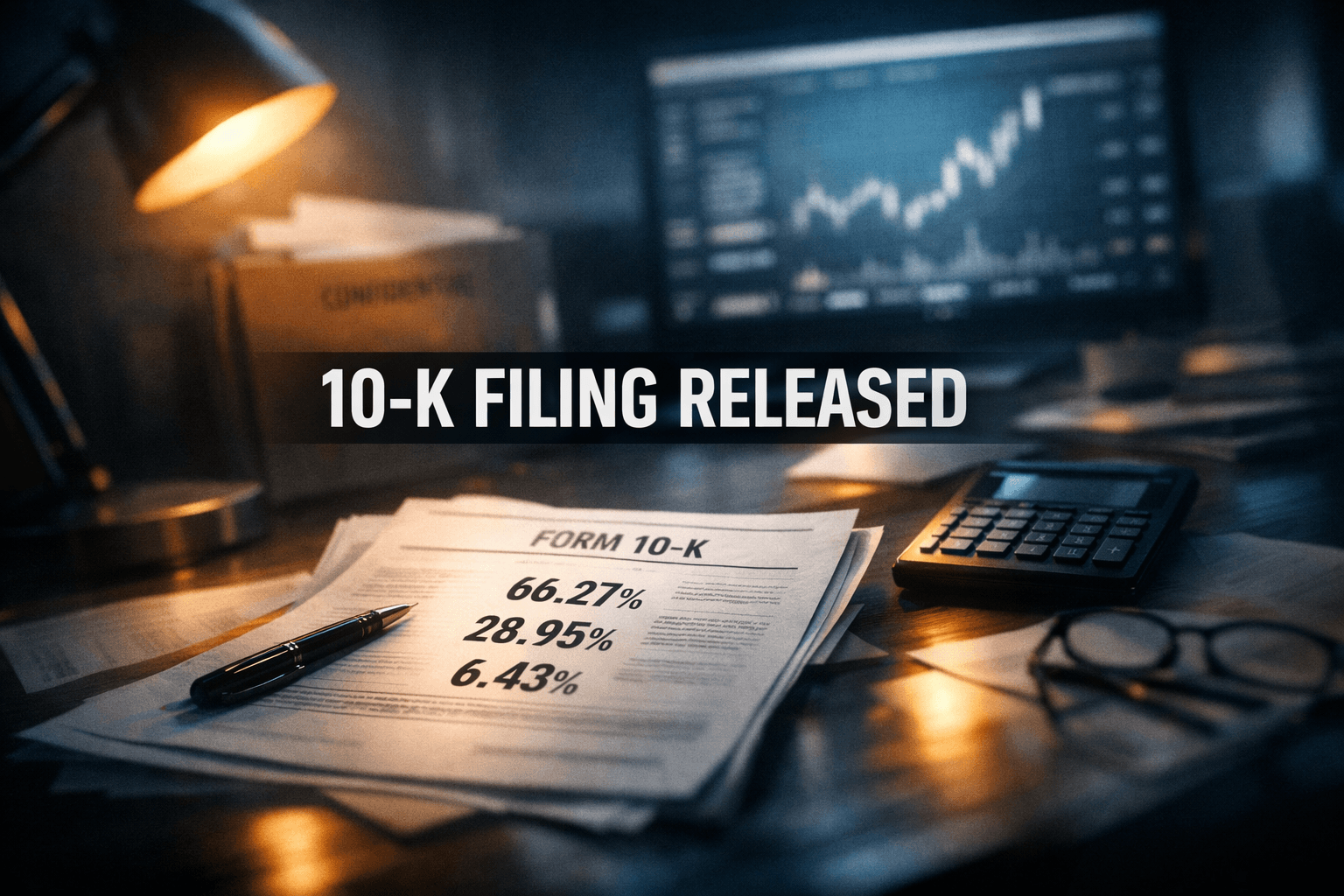
- Key numeric data points presented in summary form include 66.27%, 28.95% and 6.43%, which the filing lists and that can be applied directly to valuation frameworks.
- Filer identifier: 0001696558, the EDGAR company number for Jerash Holdings, Inc.
Those percentages are explicitly shown in the filing and are suitable for input into relative valuation, ownership or segment-share analysis. The 9 MB document is the primary source for deeper detail, including audited financial statements and footnotes, which investors will want to review before drawing firm conclusions.
Why It Matters For Your Portfolio
A freshly filed 10-K matters because it refreshes the official, audited record of a company’s last fiscal year. For portfolio decision-making, the filing provides standardized inputs you can trust for modeling rather than headline summaries.
Growth investors, value analysts and traders can each extract different signals: growth investors may look for trends in revenue and segment exposure; value investors can re-run discounted cash flow models using the filing's numbers; traders may reassess risk based on any newly disclosed exposures. The specific percentages listed in the filing give immediate calibration points for those analyses.
Risks To Consider
- Incomplete context: The 10-K provides raw figures, but you need to read the accompanying notes and management discussion to understand drivers. Misreading isolated percentages can lead to incorrect valuation inputs.
- Disclosure timing: A 10-K is backward-looking. The filing date does not guarantee current operational performance has not changed since the report period ended.
- Interpretation risk: Without explicit labels for the 66.27%, 28.95% and 6.43% figures in this summary, different investors might interpret them as ownership stakes, revenue mix, margin components or other metrics, which creates room for conflicting conclusions.
What To Watch Next
After a 10-K posts, investors should follow a short checklist to convert the raw filing into actionable insights.
- Download the full filing using AccNo 0001213900-26-070227 from SEC.gov and review the audited financial statements and footnotes for clarifying detail.
- Look for management discussion of the figures tied to 66.27%, 28.95% and 6.43% so you can assign them correctly in your models.
- Monitor any investor relations releases or subsequent SEC filings for amendments or additional commentary that change interpretation.
- Re-run valuation scenarios that incorporate the three key percentages and observe how valuation ranges shift under conservative and aggressive assumptions.
The Bottom Line
- Jerash Holdings filed its Form 10-K with the SEC on Jun 18, recorded under AccNo 0001213900-26-070227 and sized at 9 MB.
- The filing includes explicit numeric entries of 66.27%, 28.95% and 6.43% which are useful for valuation and ownership analysis once properly contextualized.
- Investors should retrieve the full EDGAR filing, read the notes and MD&A, and apply the figures to multiple valuation scenarios rather than treating them in isolation.
- Because the 10-K is backward-looking, combine this disclosure with any more recent company updates before updating position sizes or risk limits.
FAQ
Q: How can I find the full 10-K filing on SEC.gov?
A: Use the Accession Number 0001213900-26-070227 or the filer ID 0001696558 to pull the full document from the SEC EDGAR archive.
Q: What do the percentages 66.27%, 28.95% and 6.43% represent?
A: The filing lists those numeric values; you should consult the relevant sections and footnotes of the 10-K to determine whether they refer to ownership, revenue mix, margins, or another metric before applying them in analysis.
Q: Will this 10-K change the stock’s outlook immediately?
A: A 10-K is an essential data source but it is typically not a real-time catalyst by itself. Its impact depends on what the audited statements reveal relative to current market expectations and any new information in management commentary.