
 Alpha Breaking
The War Trade Nobody Wants to Admit
Share this article
Spread the word on social media
The broad market is pricing hope. Energy and defense are pricing reality. And the political architects of this Middle East catastrophe — Trump, Netanyahu, and a negotiating team that cannot spell "supply chain" — are pricing your retirement account out of existence.
The Market Is Still Living in a Fantasy
Wall Street keeps trying to price a clean landing, a calming world, and a fast return to normal. That is the fantasy. The real market is sitting on expensive broad-index valuations, crumbling macro visibility, and an oil market that can reprice the entire tape in a matter of hours.
As of April 10, the S&P 500 was still trading at a forward P/E above its long-term average — even after recent volatility. That means investors are still paying a comfort premium the macro backdrop does not remotely justify. A lot of sectors require disinflation, lower rates, smooth supply chains, and a stable geopolitical backdrop to hold current multiples. None of those conditions exist. Even after the latest round of ceasefire headlines, U.S.-Iran talks ended without a breakthrough, leaving the ceasefire fragile and the risk premium embedded in global energy markets fully intact.
The broad market remains vulnerable. And at the center of that vulnerability is a chokepoint most retail investors could not find on a map — but whose disruption would wreck their finances faster than any earnings miss or Fed pivot ever could.
The Strait of Hormuz Is Not a Bargaining Chip. It Is a Loaded Gun Pointed at Main Street.
Let's be direct about what a Hormuz blockade actually means — not in geopolitical abstraction, but at the gas pump, in the grocery store, and in the mortgage payment that millions of Americans are already barely making.
Roughly 20% of the world's oil and 20% of global LNG transits the Strait of Hormuz. That is not a statistic. That is the circulatory system of the modern global economy. Disrupt it for thirty days and you are not looking at a commodity repricing event. You are looking at a simultaneous supply shock across every cost input in the economy — fuel, freight, food, manufacturing, chemicals, plastics, fertilizer. Everything moves on oil. Everything is priced on oil. $MOS $XOM $CVX $JETS $QQQ
A blockade does not just spike energy prices. It lights the inflation fuse all over again at exactly the moment the Fed is trying to hold rates steady and the American consumer is already drowning in credit card debt at 22% APR. The EIA projected Brent averaging $103 in March with a peak near $115 in Q2 2026 — and that is the base case before a serious Hormuz disruption. Goldman Sachs has outlined scenarios where severe disruption pushes Brent back above $115. Barclays warned that delays restoring Hormuz flows could blow past even those forecasts.
The people who feel this first and worst are not hedge fund managers running energy longs. They are the Americans driving 45 minutes each way to a job that does not pay enough, heating homes with fuel oil, buying groceries on a budget that is already fiction. A prolonged blockade does not hurt Wall Street first. It destroys Main Street — and it does so at a speed that is genuinely brutal. Pump prices reprice within days. Supply chain costs reprice within weeks. Full inflationary pass-through hits within months. And once that inflation is embedded, the Fed cannot extract it without breaking something else. This is Economics 101. Apparently a foreign language in the current administration.
The Negotiating Team That Did Not Read the Syllabus
Let's call this what it is. The diplomatic architecture managing this conflict on the American side reflects a breathtaking absence of basic economic literacy — and a level of geopolitical improvisation that would be embarrassing in a college seminar, let alone on the world stage.
You do not need a PhD in supply chain logistics to understand that a military confrontation in the Persian Gulf, during a period of already-elevated global inflation, is not a tactically isolated event. You need a newspaper, a calculator, and twenty minutes of intellectual honesty. None of those appear to have been consulted.
What the market is watching is an administration that has repeatedly demonstrated confusion about how shipping timelines work, what rate-of-change inflation means in practical terms, and why a supply disruption in the world's most critical maritime chokepoint cannot be papered over with press releases issued after markets close. Oil does not wait for a press conference. Tanker diversions around the Cape of Good Hope add two to three weeks to delivery schedules and hundreds of dollars per voyage in additional fuel costs — costs that do not disappear, they just migrate downstream to refiners, distributors, truckers, and eventually the family filling up a minivan on a Thursday morning.
The negotiating team in the room does not appear to understand that this is not a bilateral trade dispute where you flash tariff threats and walk away with a handshake deal. This is a physical commodity with no substitutes, transiting a chokepoint with no practical alternative at scale, in a theater where a single miscalculation has a non-trivial probability of becoming full regional escalation. That combination demands the most technically competent, economically literate, geopolitically serious minds the country can field. What it has received instead is improvisation delivered with arrogance — which is, historically, the most dangerous combination in crisis diplomacy.
Trump's team did not wander into this blind. They were warned. Economists warned. Energy analysts warned. Intelligence assessments warned. The warnings were either not read, not understood, or not cared about — and every one of those possibilities is disqualifying.
The NATO Delusion: When You Haven't Read the Treaty You're Invoking
Then there is the chorus of voices inside and adjacent to the Trump orbit calling for NATO involvement — as though that is a solution, or even a legally coherent proposition. It is neither.
Article 5 of the NATO charter provides for collective defense, but it is geographically bound by Article 6 to attacks on Alliance territory in Europe and North America. The Middle East is explicitly outside the scope of Article 5 obligations. Calling for NATO to absorb American-generated Middle East exposure is not a strategy. It is proof that the people making the call have not read the document they are citing — a document that is publicly available, requires no security clearance, and runs to fewer than 15 pages.
This is not a subtle legal distinction buried in treaty footnotes. It is the foundational architecture of the Alliance, and invoking NATO as a Middle East backstop while being ignorant of Article 6 is the diplomatic equivalent of calling for a fire department response and not knowing what fire departments do. It would be funny if the stakes were not so catastrophic.
The deeper problem: even if NATO allies wanted to expand involvement, the political appetite is nonexistent. European members are managing their own eastern flank, their own energy vulnerabilities, and their own domestic political pressure. Asking the Alliance to socialize the consequences of decisions made unilaterally in Washington and Jerusalem is not a serious diplomatic proposition. It is an attempt to escape accountability, and every NATO capital knows exactly what it is.
This Quagmire Has Two Owners — And Their Names Are Not Hard to Spell
There is a direct line of accountability here, and it runs through two offices: the White House and the Prime Minister's residence in Jerusalem. The strategic decisions that expanded American military exposure in the Middle East, escalated rather than contained the conflict envelope, and created the conditions for a potential Hormuz confrontation — those decisions were made by Donald Trump and Benjamin Netanyahu. Not by NATO. Not by geopolitical fate. Not by some inevitable historical tide.
Trump ran on "America First." The explicit promise was retrenchment. Less foreign entanglement. No more American blood and treasure spent on other people's regional wars. What has happened instead is a deeper, more expensive, and more economically dangerous re-entrenchment into exactly the theater he promised to exit — with less diplomatic credibility, fewer allied relationships, and a negotiating team that has made the United States look strategically incoherent on the world stage.
Netanyahu's incentive structure is equally transparent. A leader facing domestic legal jeopardy, commanding a coalition that requires perpetual conflict to maintain political cohesion, with a military doctrine built around drawing American power into its security perimeter — Netanyahu has consistently steered this conflict toward maximum American involvement and minimum Israeli accountability. And it has worked. Because Washington has let it work.
The damage to the United States' brand as a constructive global actor is compounding quietly and will matter loudly. Allies who spent decades calibrating their foreign policy around American consistency, American credibility, and American institutional competence are now building contingency plans for a world where Washington is unreliable. That is not a perception problem fixable with a better press strategy. It is structural erosion of influence — the kind that takes a generation to rebuild and zero years to destroy.
"America First" is not dead because of bad luck. It is dead because the people who ran on it did not understand what it meant, did not have the intellectual tools to execute it, and were, as we shall discuss, likely not free to pursue it even if they had.
The Epstein Variable: When Foreign Policy Stops Being About America
It would be intellectually dishonest to ignore the question that serious analysts are increasingly unwilling to dismiss publicly but discuss openly in private: whether American foreign policy in the Middle East reflects a coherent national interest calculation — or whether it reflects leverage.
Jeffrey Epstein's operation was not a private sex scandal. By any serious forensic read of the available public record, it was a sophisticated intelligence asset — a long-running mechanism for compromising powerful men, manufacturing dependencies, and generating coercive influence at the highest levels of Western political, financial, and judicial life. The client list remains substantially sealed. The full operational picture has never been made public. The intelligence agencies whose fingerprints appear throughout the case have not been compelled to explain their relationship to it.
The documented connections between Epstein's network and Israeli intelligence are not rumor. They have been reported by credentialed journalists, referenced in court documents, and acknowledged by intelligence analysts on the record. The question of how many current or former American officials carry exposure from that network — and what that exposure might mean for their foreign policy posture — is not a fringe question. It is the most important unanswered accountability question in American public life.
The United States is currently fighting, funding, and diplomatically covering a Middle East conflict at extraordinary economic and reputational cost, in ways that consistently and disproportionately serve Israeli strategic interests over identifiable American ones. The public rationale shifts constantly. The result does not. When foreign policy outcomes are systematically misaligned with the stated national interest of the country supposedly setting the policy, the correct analytical response is to ask why — and to follow every plausible thread until the answer becomes clear.
"America First" as a foreign policy doctrine cannot survive a government populated by officials whose primary loyalty has been purchased or coerced by a foreign intelligence operation. That is not politics. That is a national security crisis dressed in diplomatic language. And it deserves to be named as such.
The Actual Trade: Where the Money Is in a World on Fire
Strip away the politics and here is what the market is telling you with cold, clean clarity.
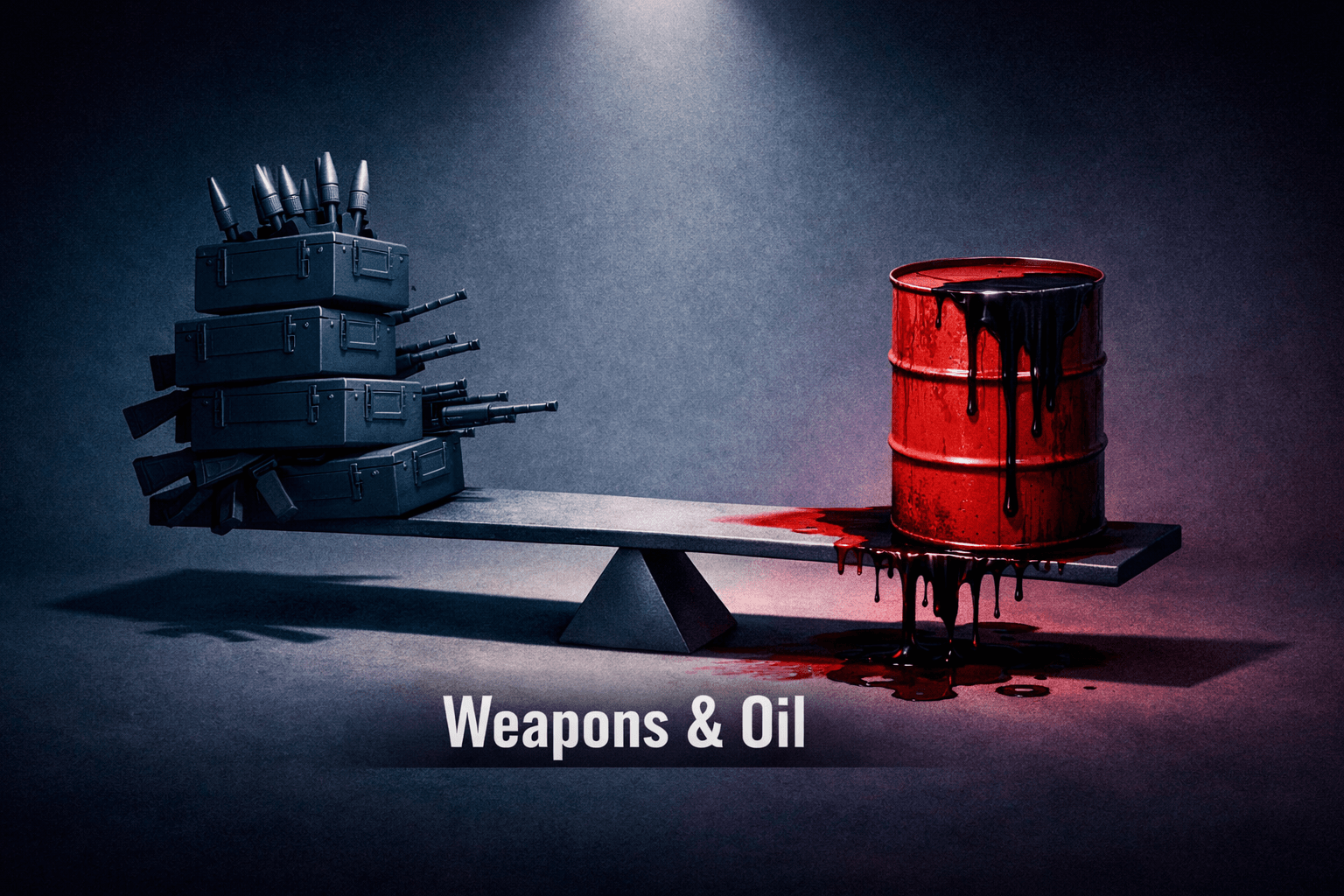
Energy is the structural long. The EIA, Goldman, and Barclays are all singing from the same hymnal — supply disruption risk is real, the risk premium in the barrel is justified, and even ceasefire headlines have not dislodged Europe's oil and gas index from being up nearly 30% in 2026. That is not momentum. That is the market pricing a permanent regime shift. Energy producers, oil services, and midstream infrastructure have something most of the market does not right now: direct, unhedged exposure to scarcity and pricing power. In this environment, that is the asset.
Defense is the durable secular theme. NATO confirmed all Allies met or exceeded the 2% GDP spending threshold in 2025, while European Allies and Canada increased defense budgets by 20% year-over-year. SIPRI reported global military spending hit a record $2.718 trillion in 2024 — the sharpest annual increase in decades. NATO members have committed to moving toward 5% of GDP for defense-related investment over time. That is not a trade. That is a multi-year capital allocation mandate already written into national budgets across 30+ countries. Missile systems, munitions, drones, sensors, battlefield software, and logistics are all downstream of that mandate.
Airlines are the trap. IATA projects fuel at 25.7% of airline operating expenses in 2026. Jet fuel prices more than doubled after the conflict erupted — far outpacing the move in crude. Delta and Southwest have already raised checked-bag fees in response. When ceasefire headlines hit and oil dropped, airline stocks jumped more than 7% in a single session. That tells you everything: airlines are not being repriced on secular demand thesis. They are being whipped around by an oil chart they do not control, managed by geopolitical actors they cannot predict. That is a tactical trade for the nimble, not a conviction position for the patient.
The Bottom Line
The broad market is pricing a world that does not exist. Energy and defense are pricing the world that does. A negotiating team that cannot read an economics textbook, invoking a treaty it has not read, prosecuting a war that may not be entirely its own idea, is not going to deliver the calm macro backdrop that expensive equity multiples require.
The fantasy rally is borrowed time. The real bull market is in scarcity, rearmament, and the cold acknowledgment that the adults left the room — and the adults who replaced them cannot find the room on a map.
Trade accordingly.