
 Alpha Breaking
Surging Treasury Yields Pose Problem for the Fed - Sep 25
Share this article
Spread the word on social media
The Big Picture
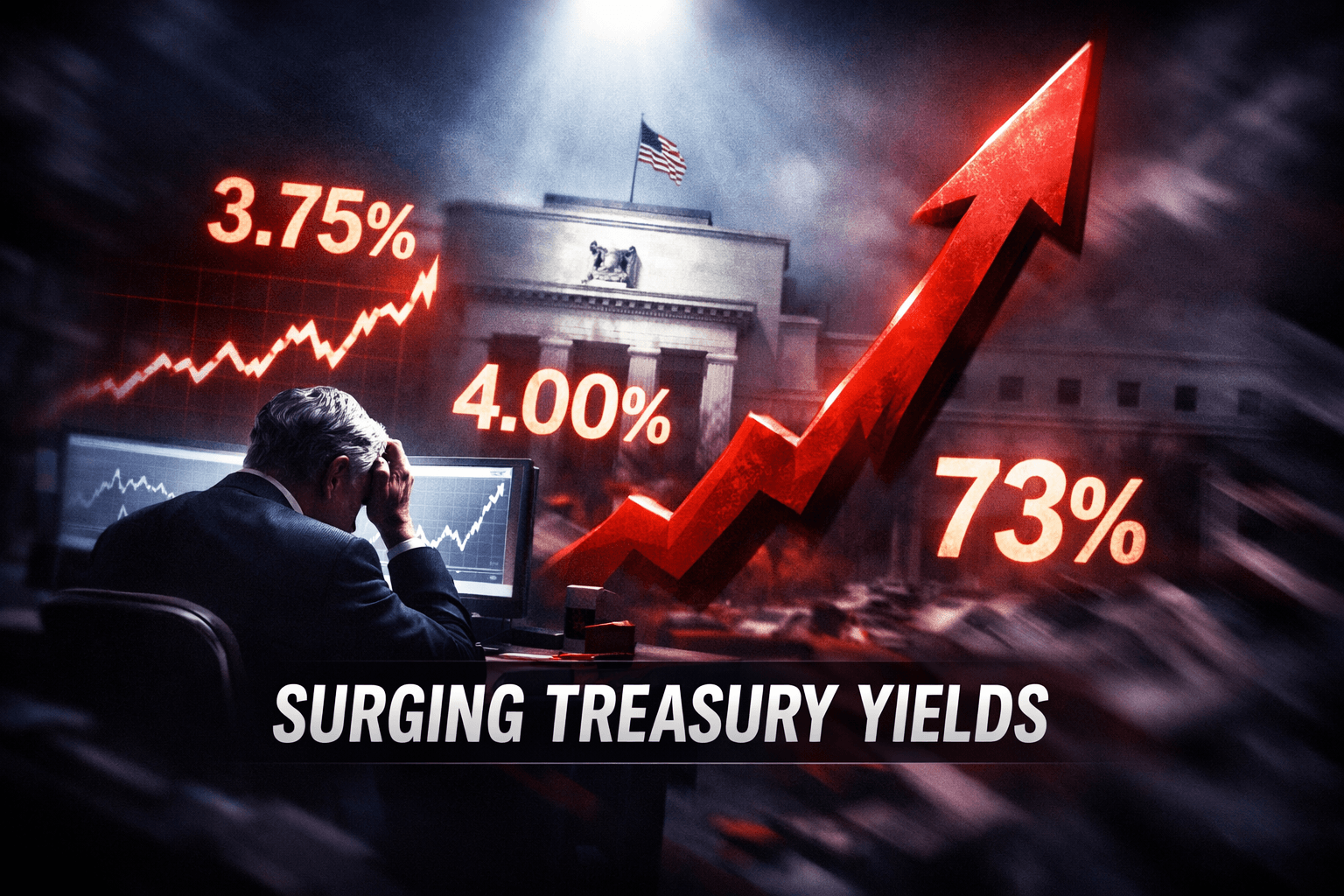
Surging Treasury yields pose a brand new problem for Kevin Warsh and the Fed, and that matters because higher yields force investors to reprice risk across equities and bonds. With key yield levels and market odds shifting, your portfolio's growth exposure and valuation multiples are under fresh pressure.
As of this report investors are reacting to yields near 3.75% and 4.00%, and market pricing that implies a roughly 73% chance of a firmer Fed stance, heightening volatility for interest-rate sensitive assets.
What's Happening
Markets are signaling that the Federal Reserve may need to take a firmer approach to inflation than markets had previously expected. That dynamic is showing up in Treasury yields and in probability markets.
- 2-year or short-term yield pressure around 3.75%, increasing near-term funding costs for households and companies.
- 10-year yield reaching about 4.00%, which raises long-term discount rates used to value stocks and real assets.
- Market-implied odds, roughly 73%, suggest investors expect a firmer Fed posture or additional policy persistence.
- The timing context is Sep 25, 2026, when these moves are influencing trading and positioning.
Those numbers change the calculus for valuation. Higher yields reduce the present value of future earnings, which disproportionately affects high-growth names. They also change the relative attractiveness of bonds versus dividend-paying or low-yield stocks.
Investors are parsing Fed commentary and economic data more closely because the path of yields can move quickly and reprice multiples across sectors.
Why It Matters For Your Portfolio
Rising Treasury yields directly affect discount rates, borrowing costs, and risk premia. That has three practical implications for investors.
- Valuation Pressure: Higher yields, exemplified by readings near 4.00%, lower the present value of distant cash flows, pressuring high-multiple growth stocks such as $NVDA more than value-oriented names.
- Income Competition: As Treasury yields climb toward 3.75%, fixed-income becomes relatively more attractive, which can pull flows away from equities and riskier assets, including some tech and growth names like $AAPL, depending on their income and buyback profiles.
- Portfolio Positioning: A market pricing signal near 73% for a firmer Fed means volatility could persist, so investors may need to reassess duration exposure and sensitivity to rate moves.
Analysts note that the interaction between Treasury yields and Fed communications will be a key determinant of sector leadership. That makes selectivity important, and it elevates the need for scenario-based valuation checks using multiple data points.
Risks To Consider
- Policy Surprise Risk, markets could be wrong about the Fed's next moves, creating sharp repricing in yields and equities if the Fed signals a different stance.
- Valuation Compression, sustained yields around 4.00% could materially compress multiples on long-duration profits, hitting growth stocks hardest and increasing equity drawdown risk.
- Liquidity And Volatility, fast-moving yields can tighten liquidity in some sectors, leading to wider bid-ask spreads and abrupt sector rotations that hurt active positions.
The bear-case scenario is a feedback loop where higher yields force accelerated selling in rate-sensitive assets, widening credit spreads and slowing economic activity, which in turn complicates the Fed's decision-making.
What To Watch Next
Focus on a short list of catalysts and metrics that will tell you whether the recent yield move is transitory or the start of a persistent regime shift.
- Fed communications and speeches from policymakers, which will reveal whether rhetoric shifts toward a firmer inflation fight.
- Key macro prints such as CPI and PCE inflation releases, and employment data, which will affect market-implied odds like the current ~73% reading.
- Treasury auction results and demand metrics, which can influence near-term yield volatility and liquidity.
- Sector metrics: monitor valuation multiples and earnings yield spreads versus the 10-year yield, especially for growth-heavy names such as $NVDA and more dividend-oriented names such as $AAPL.
Watching these items will help you convert the headlines into portfolio decisions rather than reacting to noise.
The Bottom Line
- Higher Treasury yields, with key references at 3.75% and 4.00%, make discount-rate sensitive stocks more vulnerable, especially high-growth names.
- A market-implied 73% chance of a firmer Fed suggests elevated odds of persistent rate pressure and continued volatility.
- Reassess duration exposure and valuation assumptions across your holdings, using multiple data points for any reweighting decision.
- Prioritize scenario planning and liquidity management, and avoid one-size-fits-all responses to rising yields.
- Use upcoming Fed signals and macro releases as decision triggers, not automatic buy or sell commands.
FAQ
Q: How do rising Treasury yields affect stock valuations?
A: Rising yields raise discount rates, which lower the present value of future earnings and tend to compress valuation multiples, particularly for long-duration growth stocks.
Q: Should I move to bonds if yields are near 3.75% to 4.00%?
A: That depends on your time horizon, income needs, and risk tolerance. The move toward higher yields increases bond appeal for income investors, but allocation shifts should be based on personal objectives rather than headlines.
Q: What does the 73% market signal mean for investors?
A: The roughly 73% figure indicates markets are pricing a high probability of a firmer Fed stance or persistent policy, which implies greater rate-driven volatility; use it to gauge conviction, not as a trade instruction.