
 Alpha Breaking
Spacex Is Heavily Reliant on Starlink - May 21
Share this article
Spread the word on social media
The Big Picture
SpaceX's IPO prospectus makes one thing obvious: the company's path to a Nasdaq listing and its financial story are tightly linked to Starlink's performance. For investors, that means the rewards from Starlink's growth could be large, but so could the exposure to a single business line.
SpaceX is a private company preparing for a potential public debut, so there is no public share price to report yet. The filing's figures will be central to how the market values the company once an offering price range is set.
What's Happening
The S-1-style disclosure accompanying SpaceX's push toward a Nasdaq listing emphasizes Starlink's outsized role in revenue and profitability. Key prospectus figures include:
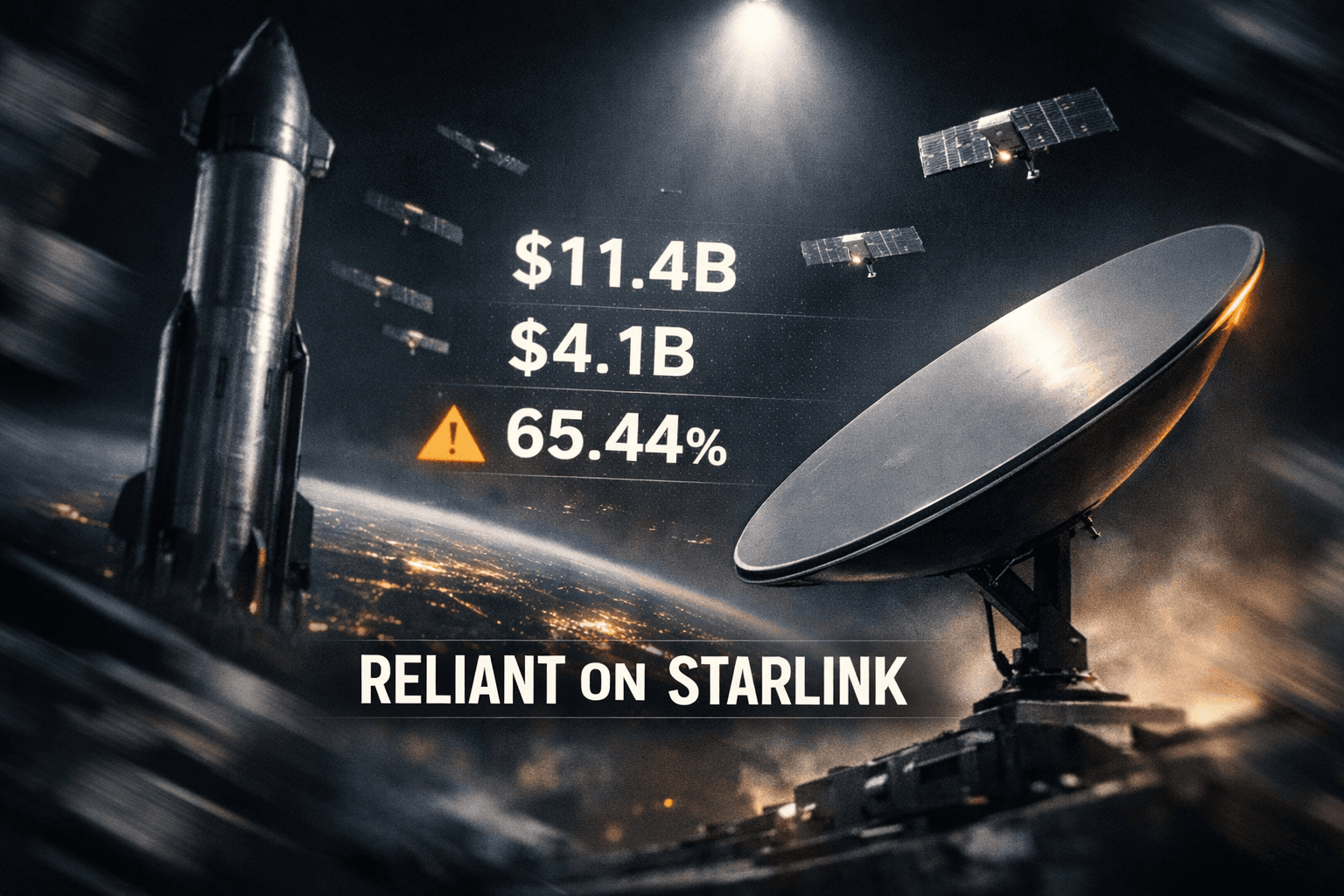
- 65.44% — a prospectus figure showing Starlink's prominent share within the disclosed metrics, highlighting concentration risk and growth dependency.
- 41.22% — another prospectus percentage that investors should watch as a performance indicator tied to Starlink or related margins.
- 0.02% — a prospectus figure included in the filing, underscoring granular items investors may need to unpack in the footnotes.
- $4.1 billion — the space business's revenue last year, a unit the company reports as unprofitable, which matters for near-term earnings expectations.
- $11.4 billion — a prospectus revenue figure tied to Starlink that frames the magnitude of the unit relative to the rest of the company.
Those numbers suggest Starlink is the main engine for both growth and profit on the prospectus. Investors should compare these figures to historical growth rates and public peers in satellite broadband and aerospace when sizing a position.
Why It Matters For Your Portfolio
The prospectus shifts the investment debate from "Is SpaceX a launch company?" to "Is SpaceX a Starlink company?" For portfolios, that distinction changes risk and valuation profiles.
Growth investors will care about Starlink's top-line momentum, the $11.4 billion figure, and whether customer additions sustain steep expansion. Value investors should note the unprofitable $4.1 billion space segment and the concentration implied by the 65.44% figure. Traders may focus on volatility tied to any IPO pricing and initial public-market reactions.
Risks To Consider
- Revenue Concentration: Prospectus figures indicate heavy reliance on Starlink, which raises single-product risk if demand or pricing weakens.
- Unprofitable Segments: The space business generated $4.1 billion in revenue last year but remained unprofitable, which could pressure aggregate margins and near-term cash flow.
- Execution And Regulatory Risk: Scaling satellite broadband to sustain $11.4 billion in revenue requires ongoing capital, regulatory approvals, and launch cadence; delays would hurt projections and valuation.
What To Watch Next
With the prospectus public, the next moves you should track are the items that will determine valuation and timing of a listing.
- IPO Timeline And Pricing: Watch for an S-1/A or pricing updates from the company or underwriters that set the eventual offering range.
- Quarterly Revenue And Profitability Trends: Monitor subsequent Starlink and space-segment results to see whether the $11.4 billion and $4.1 billion figures accelerate or decelerate.
- Margin And Cash-Flow Metrics: Track margin movement tied to the 41.22% and any small-percentage items like 0.02% that could signal structural cost or revenue drivers.
- Regulatory And Launch Updates: Any changes to spectrum, licensing, or launch cadence will directly affect Starlink's scaling prospects and time to break-even.
The Bottom Line
- The IPO prospectus makes clear Starlink is central to SpaceX's growth and profit story, with prospectus figures such as $11.4 billion and 65.44% highlighting that dependence.
- Investors need to weigh Starlink's revenue scale against the unprofitable $4.1 billion space business when modeling future cash flow and valuation.
- Watch upcoming filings, quarterly updates, and regulatory developments to assess durability of the Starlink thesis and execution risks.
- For portfolio construction, consider how concentrated exposure to Starlink fits your risk tolerance and whether the IPO valuation compensates for execution and regulatory uncertainty.
FAQ
Q: How much of SpaceX's revenue comes from Starlink?
A: The IPO prospectus shows figures that underscore Starlink's dominant role, with prospectus metrics including 65.44% and an $11.4 billion revenue figure tied to the unit. Investors should read the filing for the exact breakdown.
Q: Is SpaceX profitable today?
A: The prospectus reports the space business generated $4.1 billion in revenue last year but was unprofitable. Overall company profitability will depend heavily on Starlink's margins and future performance.
Q: What are the main risks before a Nasdaq listing?
A: Key risks include revenue concentration in Starlink, the unprofitable nature of the space segment, potential regulatory hurdles, and execution risks tied to scaling satellite broadband and launch operations.