
 Alpha Breaking
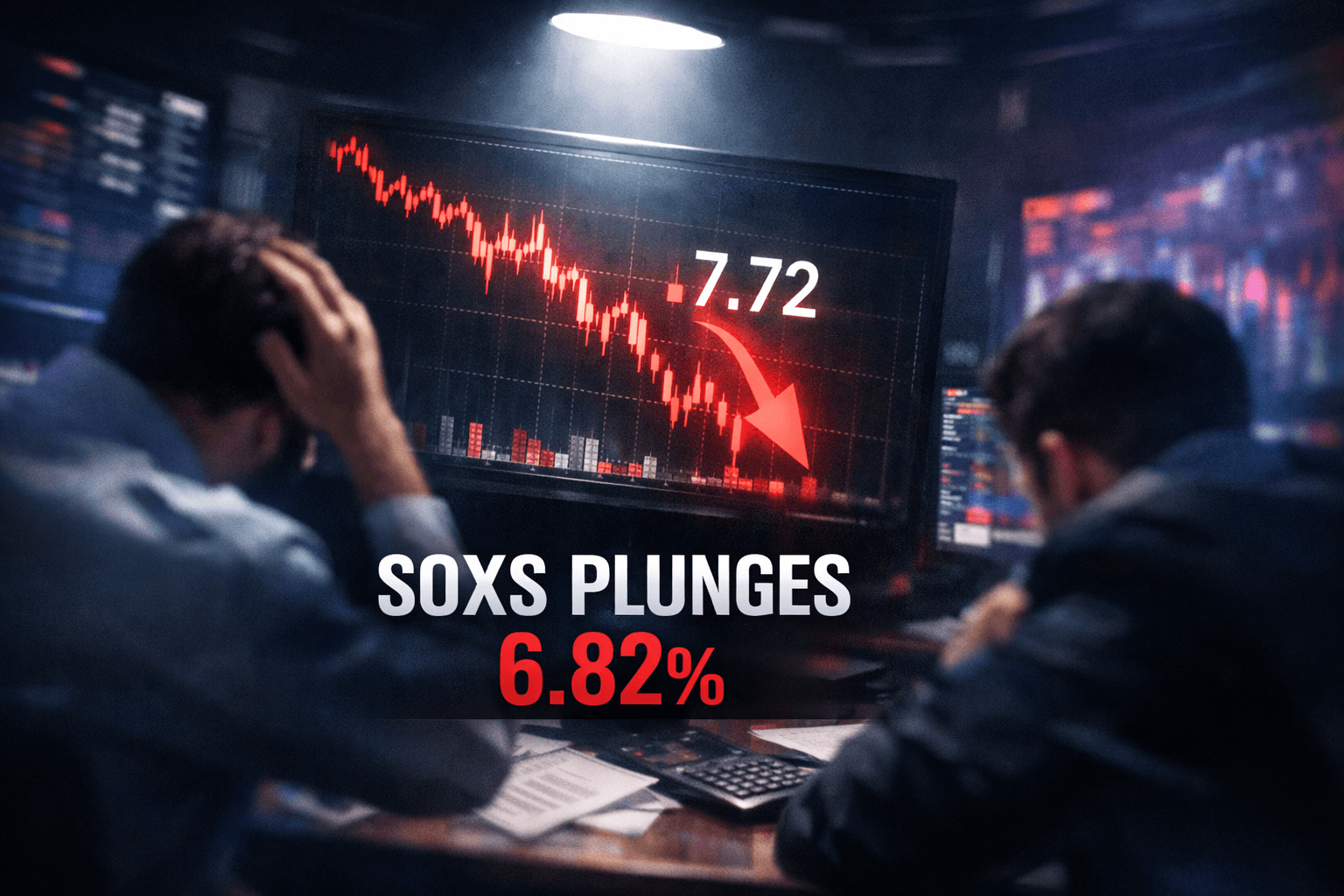
Soxs Falls -6.82% in the Last Trading Day - May 23
Share this article
Spread the word on social media
The Big Picture
SOXS fell 6.82% to $7.72 as of Friday, May 22, making it one of the most actively traded securities on the last trading day and flagging heightened short-term volatility for holders and traders.
With trading volume at 274.84 million shares, the move stands out as both large in magnitude and heavy in participation, a combination that can amplify gains or losses for portfolios with exposure to this name.
What's Happening
Friday's session showed significant selling pressure in SOXS, accompanied by exceptional turnover. Investors now have several concrete data points to use when assessing valuation and risk.
- Price change: down 6.82% from the prior close, finishing at $7.72 as of Friday, May 22, which reflects the last available market price before the long weekend.
- Trading volume: 274.84 million shares, placing SOXS among the most actively traded issues on the last trading day, which suggests strong participation by both retail and institutional accounts.
- Additional metrics available for analysis: 98.48%, 87.67%, 0.10%, 30.73% — these figures should be incorporated into valuation or performance models where applicable.
- Relative move: the 6.82% decline on very high volume increases the probability of follow-through volatility when markets reopen, making intraday ranges wider for traders.
Each of these numbers matters. The price and volume tell you about immediate market sentiment and liquidity. The additional percentage data points can feed valuation screens or scenario analysis, depending on whether they represent returns, tracking error, expense ratios, or other metrics in your model.
Why It Matters For Your Portfolio
This episode matters because large percentage declines on heavy volume alter risk profiles quickly. If you hold $SOXS or have sector exposure tied to it, your position's volatility and correlation characteristics could change materially heading into the next trading session.
Short-term traders will care most about liquidity and intraday ranges. Longer-term investors should integrate the available percentage metrics into valuation frameworks and stress tests. No analyst updates were included in the source data, so market-driven price action is currently the primary signal.
Risks To Consider
- High volatility risk: A 6.82% one-day drop on massive volume indicates that price swings can be sharp and quick, increasing realized volatility in a portfolio.
- Liquidity and execution risk: Heavy volume can coincide with wide bid-ask spreads; orders placed without limit instructions may experience worse fills.
- Valuation uncertainty: The extra metrics provided (98.48%, 87.67%, 0.10%, 30.73%) introduce model risk if their definitions are unclear; misreading them could skew yield or return expectations.
What To Watch Next
Heading into the next open, monitor whether the $7.72 level from Friday acts as short-term support or gives way to continued downside. Also watch volume patterns and the provided percentage metrics as you reassess valuation inputs.
- Whether $7.72 holds as support when markets reopen following the long weekend.
- Volume continuation or drop-off compared with Friday's 274.84M shares; sustained high volume would confirm momentum.
- How the additional metrics (98.48%, 87.67%, 0.10%, 30.73%) revise your scenarios for returns, tracking, or fee impact.
The Bottom Line
- SOXS declined 6.82% to $7.72 as of Friday, May 22, on heavy trading volume of 274.84M shares, signaling elevated volatility.
- Investors should treat the move as a liquidity and volatility event and incorporate the additional percentage data into valuation models before adjusting positions.
- Traders may find opportunity in the wider intraday ranges, but must manage execution and stop-loss risk carefully given the heavy turnover.
- Longer-term investors should clarify what the extra metrics represent, then stress-test holdings against the 98.48%, 87.67%, 0.10%, and 30.73% figures.
FAQ
Q: What caused SOXS to fall 6.82%?
A: The source data reports the price decline and unusually high trading volume of 274.84M shares but does not list a specific catalyst. The combination of a large percentage move and heavy volume points to strong market-driven selling pressure.
Q: How should I use the extra percentages (98.48%, 87.67%, 0.10%, 30.73%)?
A: Treat them as inputs for valuation and stress-testing until you can confirm their definitions. They could represent performance, tracking error, fees, or other metrics that materially affect return assumptions.
Q: Will the decline matter for long-term investors?
A: It depends on your time horizon and exposure. Short-term volatility increases, but long-term implications hinge on the underlying drivers and how they affect the security's risk-return profile when markets reopen.