
 Alpha Breaking
Poet Demos Starlight Gen 2 at OFC Conference LA
Share this article
Spread the word on social media
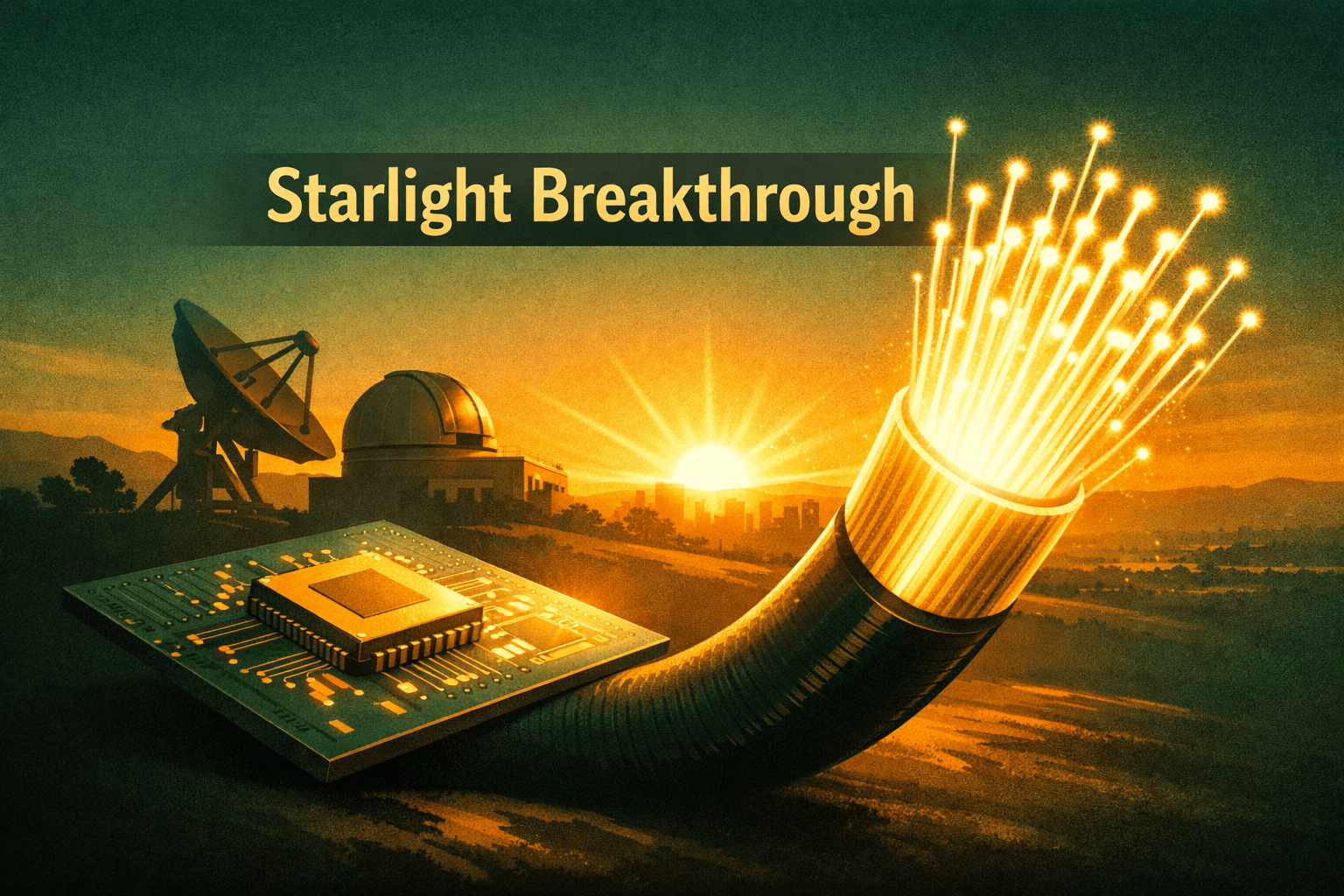
At OFC 2026 in Los Angeles, $POET Technologies unveiled its Starlight Gen 2 platform, marking a significant step forward in the evolution of optical infrastructure for artificial intelligence and hyperscale data centers. The demonstration highlighted a fundamental shift in how light is generated and distributed across optical networks, positioning POET at the forefront of next-generation photonics architecture.
Starlight Gen 2 is an external light source (ELS) module that integrates eight high-power lasers into a single compact system. Each laser operates at a distinct wavelength, enabling wavelength division multiplexing (WDM), a technique that allows multiple data streams to be transmitted simultaneously over a single optical fiber. By tightly integrating these wavelengths, POET effectively creates parallel lanes of data transmission, dramatically increasing bandwidth efficiency.
What differentiates Starlight Gen 2 from traditional optical systems is its disaggregated architecture. Historically, each optical transceiver required its own internal laser, leading to increased power consumption, heat generation, and cost. POET’s approach centralizes laser generation, allowing a single external module to supply light to multiple optical engines or transceivers. This shift not only improves efficiency but also simplifies system design and scalability.
The module delivers approximately 20 dBm of output power per channel, equivalent to around 100 milliwatts. This high-power output is critical for maintaining signal integrity over longer distances and supporting the demanding requirements of AI-driven data centers. As AI clusters continue to expand in size and complexity, the need for robust, high-performance optical interconnects becomes increasingly urgent.
Starlight Gen 2 builds on the foundation established by POET’s first-generation platform, which was designed to validate the underlying technology. The second generation, however, is engineered for high-volume manufacturing, signaling a transition from proof-of-concept to commercial readiness. This progression is a key milestone, indicating that the technology is not only viable but also scalable for widespread deployment.
The timing of this innovation is particularly important. The rapid growth of AI workloads is placing unprecedented strain on data center infrastructure, especially in terms of power consumption and connectivity. Traditional copper-based interconnects are reaching their physical and economic limits, making photonics an essential solution for future scalability.
By centralizing light generation and enabling efficient wavelength multiplexing, Starlight Gen 2 addresses several critical challenges simultaneously: reducing power consumption, lowering cost per optical link, and improving thermal management. These advantages make it a compelling solution for hyperscalers and enterprise data centers seeking to optimize performance while controlling operational costs.
In essence, POET’s Starlight Gen 2 is more than just a product—it represents a paradigm shift in optical network design. As the industry moves toward increasingly distributed and high-density AI architectures, innovations like this will play a crucial role in enabling the next wave of technological advancement.